

Wrestling Expands to Include Cadet, U23 and U15 World Championship Events
Wednesday, December 25, 2019 - 22:38 By Andrew Hipps

CORSIER-SUR-VEVEY, Switzerland (December 25) -- Over the past decade, United World Wrestling has continued to expand its world championship events, reinstating the world championships for cadet wrestlers and adding world championship events for U23 and U15 wrestlers.
The first Cadet World Championships took place in 1975. However, it did not become an annual event on the competition calendar until 1987. Starting in 1987, the Cadet World Championships were contested for 13 consecutive years before being removed from the competition calendar after 1999. After a dozen years, the event was reinstated in 2011 and has once again become an annual world championship event that attracts the world's top 17-and-under wrestlers.
In 2017, United World Wrestling announced the addition of the U23 World Championships to its official competition calendar. The inaugural event took place that same year in Bydgoszcz, Poland. The U23 World Championships event was created following the success of the U23 European Championships in 2016 where more than 400 wrestlers from 34 nations competed for the continental gold. The large turnout was attributed to a desire by many national federations to give their top prospects a chance to compete in a meaningful federation-based championship.
Wrestling success tends to favor the young, with the average age of 2016 Olympic champion being just 23.1 years old for freestyle wrestling, 24.6 years in women’s wrestling and 27.5 years old in Greco-Roman.
In 2019, United World Wrestling held the World School Combat Games, the first-ever world championship event for U15 wrestlers, in Budapest, Hungary. Ten nations competed in freestyle and Greco-Roman, while seven competed in women’s wrestling.
U-15 continental championship events were also held for Asia, Europe and the Americas.
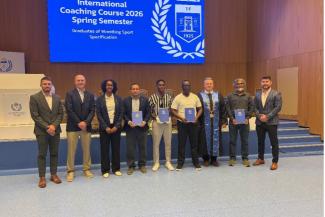
 From left to right: Gabor FARKAS (HUN), Zach ERRETT, Deqa NIAMKEY, Tamas STERBENZ (HUN), Peter BACSA and Gergely BABSZKY (HUN).
Share your thoughts.
Comments