

World Silver Medalist Morikawa Adds Punch to Credentials with 3rd National Title
Friday, December 17, 2021 - 17:13 By Ken Marantz

TOKYO, Japan (December 17) -- Against an opponent seeming to channel boxing great Mike Tyson, it was world silver medalist Miwa MORIKAWA who delivered the wrestling equivalent of a TKO.
Morikawa captured her third straight national title with a 10-0 technical fall victory over former world bronze medalist Ayana GEMPEI in the women's 65kg final on Friday at the Emperor's Cup All-Japan Championships at Tokyo's Komazawa Gym.
"I wanted to solidify my hold on 65kg by winning here and having that lead into next year, so I'm content with this win," said Morikawa, a senior at Nippon Sports Science University, which came away with five of the day's eight golds by either current or former students.
The Emperor's Cup is serving as the first of two domestic qualifiers for next year's World Championships in Belgrade, along with the Meiji Cup All-Japan Invitational Championships slated for the spring. It is also the qualifying meet for Japan's team to the Asian Games in September in Hangchou, China.
Ayata SUZUKI and Kaiki YAMAGUCHI, both members of the Japanese squad at this year's World Championships in Oslo, each won a second national title, but face a difficult path to Belgrade should the Tokyo Olympic medalists in their weight classes return to action as expected at the Meiji Cup. None of the medal-winners in Tokyo entered the Emperor's Cup.
Suzuki, this year's Asian bronze medalist who finished seventh in Oslo, won the gold medal at Greco 60kg -- the domain of Tokyo 2020 silver medalist and two-time world champion Kenichiro FUMITA -- while Yamaguchi triumphed at freestyle 65kg, where he can expect Olympic champion Takuto OTOGURO to be the one to beat at the Meiji Cup.
Among the five other champions crowned on Friday across the three styles, Arata SONODA maintained his complete domination of the heaviest weight in Greco-Roman by capturing his eighth straight title at 130kg.
 Miwa MORIKAWA (red) defeated Ayana GEMPEI in the 65kg final. (Tateo Yabuki / Japan Wrestling Federation)
For the 22-year-old Morikawa, her exploits at 65kg now are a stepping stone toward her goal of appearing in the 2024 Paris Olympics, for which she will move up to 68kg. She came to a whisker away from making the Tokyo Games at that weight but lost a nail-biting playoff to Rio 2016 gold medalist Sara DOSHO for Japan's spot.
After that, Morikawa dropped back down to 65kg, the weight in which she won the world junior title in 2019, only to be handed a dose of reality in her senior worlds debut when she was dealt an 8-6 loss in the final by Irina RINGACI (MDA), who became Moldova's first-ever female world champion.
The match hinged on a 4-point counter that gave Ringaci an 8-2 lead, a severe blow to the psyche of Morikawa who prides herself on her takedown ability. But it proved a valuable lesson that she won't forget soon.
"At the World Championships, you can't let down," Morikawa said. "I gave up a big 4-point move. My opponent really kept plugging away, and I couldn't hold her off. I was beaten both physically and technically. To become No. 1 in the world is no easy thing. I think there are still things I am lacking."
She looked to be on the right track against Gempei, who is only getting back to form after missing nearly two years due to a knee injury. A 2018 world bronze medalist and world U23 champion, the 25-year-old returned to action at last spring's Meiji Cup, where she placed third.
Morikawa took the initiative from the outset with a pair of stepouts, then after getting Gempei to the mat with a double-leg takedown, she tossed her fellow Abe Gakuin High School alum over for 4 points and an 8-0 lead. Another stepout and a snapdown-spin behind takedown ended the match at 2:51 for her third technical fall of the day without giving up a point.
"My opponent is an older alumni of the same high school and I had never beaten her up to now," Morikawa said. "She is really strong. But I was definitely determined to win. I planned to keep on attacking, and that resulted in my controlling the pace of the match."
Morikawa managed to successfully attack despite a somewhat unique strategy Gempei employed while in the standing position. Instead of tieing up like she used to, Gempei stayed at arm's length and bobbed and weaved, much like a prizefighter in the boxing ring.
"I changed my stance and my movement, without regard for how it looks," Gempei said. "To simply explain it, it's moving so that I can shoot without grabbing my opponent."
Gempei said it was her father who suggested the action, although he himself has no experience in martial arts beyond a passing interest.
"There are different factors, but it's moving like Mike Tyson, and based on principles," Gempei said. "It's an unusual way of moving, and it's still a work in progress. There are times it doesn't work, but I will work out the kinks so that it does work."
Morikawa said that while she noticed the bobbing, it did not dissuade her from going with what works best for her. "I just stuck with my wrestling and martialed the courage to shoot," she said.
She was just following the advice of the coach in her corner, four-time Olympic champion Kaori ICHO. "She said, 'More than what the opponent does, just stick with your wrestling and fight with a strong will,'" Morikawa said. "I heeded those words and gave everything I had."
In other women's finals, Sumire NIIKURA became the first-ever women's national champion from Kanagawa University when the freshman defeated 2019 champion Mei SHINDO 3-1 in the 72kg final.
Niikura, also a graduate of powerhouse Abe Gakuin High School, scored with a stepout in the second period just seconds after receiving a second activity point to clinch the victory in the weight class missing world champion Masako FURUICHI, who dropped down to 68kg for the tournament.
At 55kg, Nihon University's Umi IMAI captured her first national title, scoring a first-period takedown and holding on for a 2-1 win in the final over Ibuki TAMURA.
Imai has a long list of honors at 53kg to her name, including the world and Asian junior titles in 2018 and victories at the Klippan Lady Open and Ivan Yarygin Grand Prix, but was always stuck deep in a depth chart filled with stars like world champions Mayu MUKAIDA and Haruna OKUNO.
 Ayata SUZUKI won the gold at 55kg. (Tateo Yabuki / Japan Wrestling Federation)
In Greco finals, Suzuki scored two gut wrenches in the par terre position to opponent Kaito INABA's one, and that was the difference in a 5-3 victory at 60kg in a battle between an alumnus and current student at NSSU.
Although nearly a repeat of Suzuki's 3-1 win over Inaba in the final of the Meiji Cup last May, it still left Suzuki with a bad taste in his mouth after posting technical falls in his first two matches.
"It was a 'salty' match, the final," Suzuki said. "My first match and the semifinal went well, but a 5-3 score in the final is disappointing. I lost at the World Championships and intended to be more aggressive, but in the final against an opponent I train with, I held back and that was the result."
Suzuki hopes to settle some scores at the Asian Games. He may also go to the Asian Championships, scheduled for April at a place to be determined, but the Japan federation has not decided how or when that team will be decided.
"The Iran wrestler [Mehdi MOHSEN NEJAD (IRI)] who beat me, I've lost to him twice, I'd liketo get back at him," Suzuki said. "The Uzbekistan wrestler [Islomjon BAKHRAMOV (UZB)], I beat him at the Asian Championships, but I lost to him in the final of the international tournament in Poland. That's another one I have to avenge."
At 130kg, Sonoda stormed to his eighth straight gold with an 8-0 technical fall in 4:21 in the final over Sota OKUMURA, a student at his alma mater of Takushoku University.
Unfortunately, Sonoda has not been able to transfer his domestic dominance overseas. He has never won a match in six trips to the World Championships, and his best continental showing was a bronze medal at the 2016 Asian Games.
Looking to buck that trend and qualify for the Paris Olympics "when I will be at my peak," he said he has changed his training routine, including added a rowing machine.
 Katsuaki ENDO won the 67kg gold over Kyotaro SOGABE. (Tateo Yabuki / Japan Wrestling Federation)
At 67kg, Katsuaki ENDO avenged a loss from the Meiji Cup semifinals to Kyotaro SOGABE, scoring all of his points in the first period of a 6-1 victory to add to his lone national title previously won in 2018, the year he was the world U23 champion at 63kg.
In freestyle, NSSU's Yamaguchi defeated Waseda University's Ryoma ANRAKU in the 65kg final for the second straight year, scoring a stepout and an activity clock point in a tense 2-0 victory.
Yamaguchi, the 2019 world junior champion who finished 11th in Oslo, was also a bit dissatisfied with his performance.
"I'm happy I was able to win the title, but the way the final went was the same as last year, and I felt it ended without bringing out what I had done in training," Yamaguchi said. "The way I wrestled will ensure I lose in Asia, so I have to make more effort."
The 79kg final was also an NSSU-Waseda clash, with the former's Yudai TAKAHASHI notching a 6-1 win over Kosuke YAMAKURA for his first national title.
Last year's champion, Ryuki YOSHIDA, who finished fifth at the World Championships after beating Takahashi in a playoff to make the Japan team, has moved up to 86kg.
The tournament continues Saturday with action in freestyle 61kg, 74kg and 86kg, Greco 63kg and 97kg, and women's 57kg, 62kg and 68kg.
As coronavirus protocols, each weight class is limited to a maximum of 12 entries and are completed in one day, with no repechage and only one bronze-medal match. Spectators are banned from the arena, including family and non-essential team members.
 Kaiki YAMAGUCHI won over Ryoma ANRAKU 2-0 in the 65kg final. (Tateo Yabuki / Japan Wrestling Federation)
Day 2 Results
Freestyle
65kg (11 entries)
Final - Kaiki YAMAGUCHI df. Ryoma ANRAKU, 2-0
3rd Place - Yujiro UENO df. Kanta TOKURIKI by TF, 15-4, 4:23
Semifinal - Yamaguchi df. Tokuriki by TF, 11-1, 4:44
Semifinal - Anraku df. Ueno, 6-4
79kg (11 entries)
Final - Yudai TAKAHASHI df. Kosuke YAMAKURA, 6-1
3rd Place - Takahiro MURUYAMA df. Tetsuro MARUME, 8-3
Semifinal - Takahashi df. Marume, 8-1
Semifinal - Yamakura df. Muruyama, 2-1
Greco-Roman
60kg (10 entries)
Final - Ayata SUZUKI df. Kaito INABA, 5-3
3rd Place - Maito KAWANA df. Kosei TAKESHITA, 4-1
Semifinal - Suzuki df. Kawana by TF, 9-0, 2:36
Semifinal - Inaba df. Takeshita, 3-2
67kg (11 entries)
Final - Katsuaki ENDO df. Kyotaro SOGABE, 6-1
3rd Place - Shintaro YOSHINAGA df. Yuji UEGAKI, 7-1
Semifinal - Sogabe df. Uegaki, 5-3
Semifinal - Endo df. Yoshinaga by TF, 10-0, 1:57
130kg (12 entries)
Final - Arata SONODA df. Sota OKUMURA by TF, 8-0, 4:29
3rd Place - Ryuta KONO df. Satoshi KAIZUKA, 3-1
Semifinal - Sonoda df. Kono by Fall, 1:49 (6-0)
Semifinal - Okumura df. Kaizuka, 7-1
Women's Wrestling
55kg (6 entries)
Final - Umi IMAI df. Ibuki TAMURA, 2-1
3rd Place - Misaki YOSHIBA df. Eri SHIMADA, 6-5
Semifinal - Imai df. Yoshiba by TF, 10-0, 3:58
Semifinal - Tamura df. Shimada by Fall, 2:33 (4-2)
65kg (8 entries)
Final - Miwa MORIKAWA df. Ayana GEMPEI by TF, 11-0, 2:51
3rd Place - Miyu IMAI df. Kaede HIRAI by TF, 11-0, 3:29
Semifinal - Morikawa df. Hirai by TF, 10-0, 1:48
Semifinal - Gempei df. Imai, 3-1
72kg (7 entries)
Final - Sumire NIIKURA df. Mei SHINDO, 3-1
3rd Place - Kyoka MIZUSHIMA df. Kanon KOBAYASHI, 6-4
Semifinal - Shindo df. Mizushima by TF, 10-0, 1:29
Semifinal - Niikura df. Kobayashi, 10-2

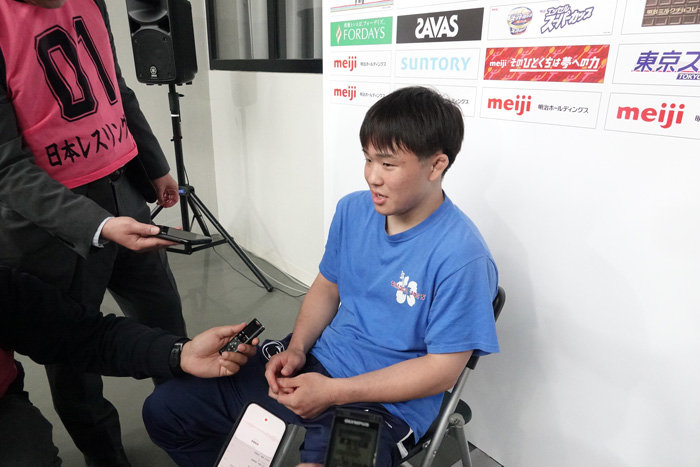 Masanosuke ONO (JPN) giving interview on the sidelines of the Meiji Cup. (Photo: wrestling-spirits.jp / Ikuo Higuchi)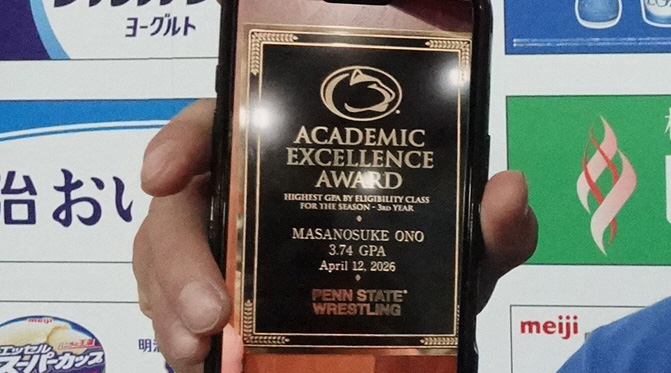
Share your thoughts.
Comments