ZAGREB, Croatia (September 17) -- After a slightly subdued start to its Women's Wrestling, Japan managed to show up at the World Championships.
Japan put three wrestlers in the final out of the four weight classes that were in action on Wednesday in Zagreb. Olympic champion Sakura MOTOKI (JPN) remained on course for her first world title at 62kg while Haruna MURAYAMA (JPN) and Ami ISHII (JPN) will look to add to their world titles at 53kg and 68kg.
Motoki was up against former world champion Orkhon PUREVDORJ (MGL) in the semifinals and she began with a four-pointer. Purevdorj got a reversal but that was all she managed in the match as Motoki kept coming up with different ways to score the takedowns. At 10-1, she scored another four-pointer to win 14-1 and enter her second world final.
For the elusive gold, she will face Ok Ju KIM (PRK) who pinned Amina TANDELOVA (UWW) in the other semifinal after building a 14-3 lead.
Murayama, a three-time world champion, will wrestle for her fourth world title after she won a close semifinal against Hyogyong CHOE (PRK). Both traded activity points but Murayama had a stepout which proved to the be difference as she won 2-1.
On Thursday, she will face Olympic silver medalist Lucia YEPEZ (ECU) in the final after the Ecuadorian defeated world bronze medalist ANTIM (IND), 5-3, majorly with four-pointer in the first period and protecting her lead.
Yepez hit a duck under to throw Antim for four and gave up a reversal to lead 4-1 in the break. The Indian tried to find the opening but she only got one in the final 10 seconds after giving up a takedown. Yepez was happy to give up that final takedown as it did not affect her win and only changed the score to 5-3.
Ecuador, a country which did not have a world finalist till Tuesday, now has two. Yepez is the second on consecutive day after Genesis REASCO (ECU) entered the 76kg final to create history.
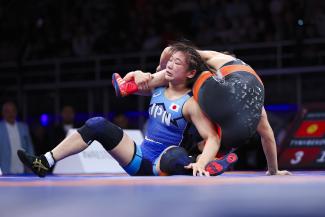
World 72kg champion Ishii, who dropped down to 68kg this year, took a step closer to her second world title after she bullied through two Olympic medalist in quarterfinals and semifinals.
Ishii dominated silver medalist from Paris Kennedy BLADES (USA), 12-2, and had a similar match against bronze medalist against Buse TOSUN (TUR) in the semifinals.
Ishii was straight to work in the semifinal with a four-pointer as Tosun landed on her back despite controlling Ishii's legs. Turkiye challenged that scoring but lost it, giving one more point to Ishii.
She scored three different takedowns to finish the match 11-0 inside the first period and enter her second world final.
Yuliana YANEVA (BUL) will look to stop Ishii from winning the gold medal after she upset world 65kg champion Jia LONG (CHN) in the semifinal. Yaneva fell behind 1-1 on criteria but scored a takedown with around one minute and 30 seconds on the clock to lead 3-1.
From there on, Long was on the backfoot and a win seemed further away as she was cautioned for a point for locking fingers. As she tried to trip Yaneva, the Bulgarian blocked her and got the winning takedown for a 6-1 win.
At 72kg, multiple age-group world medalist Nesrin BAS (TUR) managed to reach her first-ever senior world final after she won a thrilling semifinal against Zelu LI (CHN), 9-6.
Bas scored a four-pointer using a whizzer to lead 4-1 at the break. Li scored a takedown to begin the second period but Bas elevated her leg from the front to score two points and lead 6-3. Turkiye challenged the call and the scored for reversed to 8-4. Li tried to mount a comeback from there but she managed only two points while Bas scored a reversal to win 9-6.
For her first world title, she will face Alla BELINSKA (UKR) who used a whizzer to pin Nurzat NURTAEVA (KGZ) in the other semifinal.
RESULTS
53kg
GOLD: Lucia YEPEZ (ECU) vs. Haruna MURAYAMA (JPN)
SF 1: Haruna MURAYAMA (JPN) df. Hyogyong CHOE (PRK), 2-1
SF 2: Lucia YEPEZ (ECU) df. ANTIM (IND), 5-3
62kg
GOLD: Sakura MOTOKI (JPN) vs. Ok Ju KIM (PRK)
SF 1: Ok Ju KIM (PRK) df. Amina TANDELOVA (UWW), via fall
SF 2: Sakura MOTOKI (JPN) df. Orkhon PUREVDORJ (MGL), 14-1
68kg
GOLD: Ami ISHII (JPN) vs. Yuliana YANEVA (BUL)
SF 1: Yuliana YANEVA (BUL) df. Jia LONG (CHN), 6-1
SF 2: Ami ISHII (JPN) df. Buse TOSUN (TUR), 11-0
72kg
GOLD: Nesrin BAS (TUR) vs. Alla BELINSKA (UKR)
SF 1: Nesrin BAS (TUR) df. Zelu LI (CHN), 9-6
SF 2: Alla BELINSKA (UKR) df. Nurzat NURTAEVA (KGZ), via fall



Share your thoughts.
Comments