But on Sunday, Amouzad was staring at his first loss in two years and an uphill task of overcoming an 8-0 lead by Shamil MAMEDOV (BUL) in the 65kg final at the Ulaanbaatar Open.
Both Mamedov and Amouzad made their way to the 65kg final in the Mongolian capital and set up a top-tier clash, three years after they first clashed at the 2023 World Championships bronze-medal bout which the former won.
While Mamedov had began his 2026 season at the European Championships, Amouzad was wrestling for the first time this year.
Amouzad opened the bout aggressively as is the norm. But it was Mamedov who struck first.
Mamedov lifted the Iranian on his shoulders and then brought him down for four points. He did not let Amouzad settle on the mat for defense and rolled him twice using a gut-wrench to lead 8-0 before Amouzad defended the next turn, that would have ended the final.
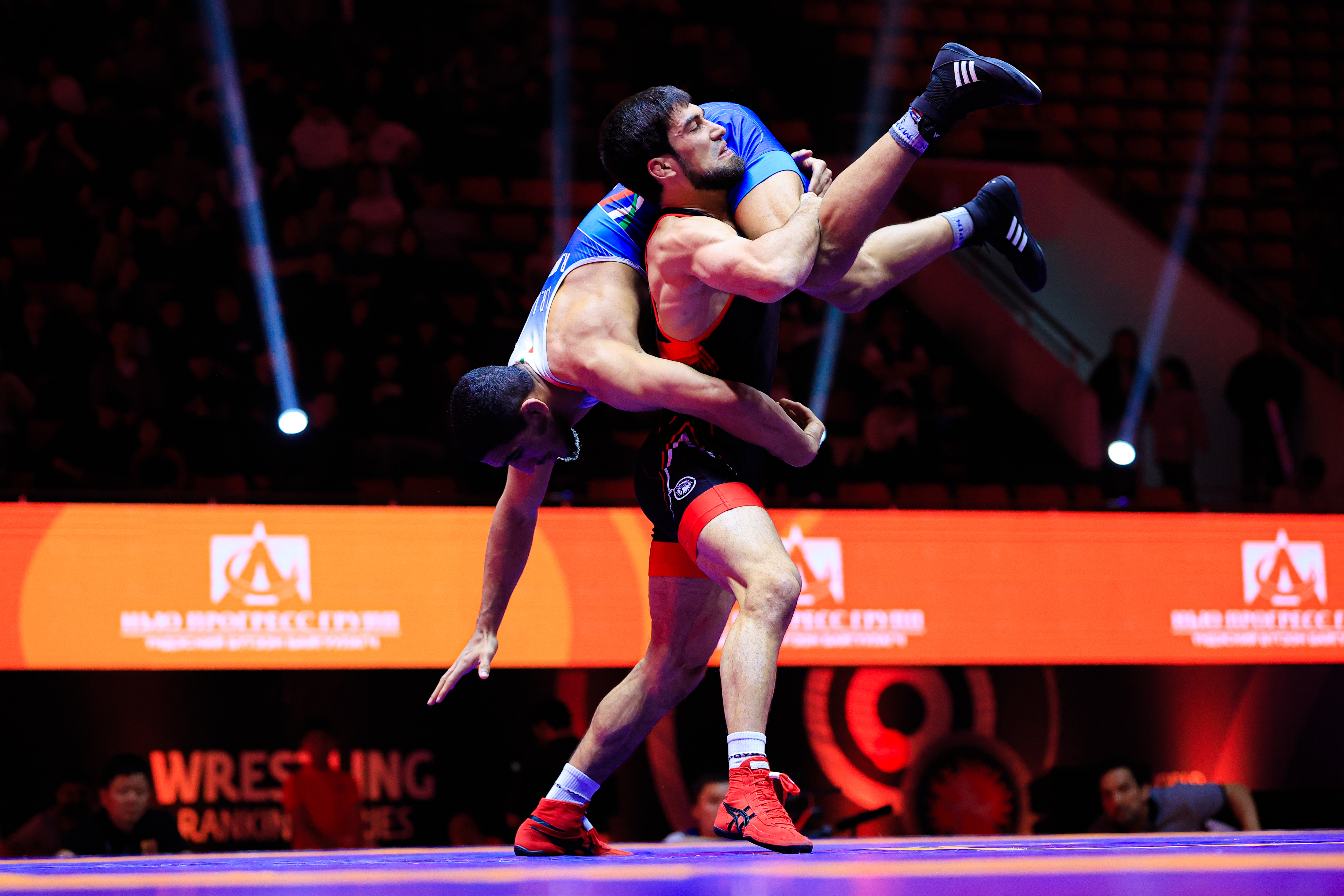 Shamil MAMEDOV (BUL) loads to throw Rahman AMOUZAD (IRI) at the start of their 65kg final. (Photo: United World Wrestling / Kostadin Andonov)
As the referee asked the wrestlers to return to neutral with 4:10 left, it was Iran's coach Pejman DOROSTKAR who signaled Amouzad to remain calm. Perhaps he knew that Amouzad can still win. May be even Amouzad believed.
Amouzad began his comeback with a stepout two seconds later. He snapped hard and pressured Mamedov who was slowly showing signs of weak conditioning. The 30-second break came just in time for Mamedov, who led 8-1.
But a monstrous second period awaited both wrestlers. Amouzad scored two stepouts in a minute to make it 8-3 but Mamedov scored a takedown just when it looked it he had nothing left. With a 10-3 lead, it seemed that Mamedov will be able to defend that with 1:22 left.
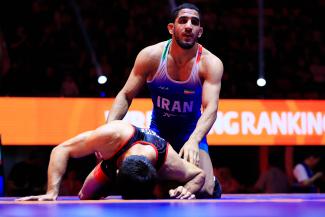
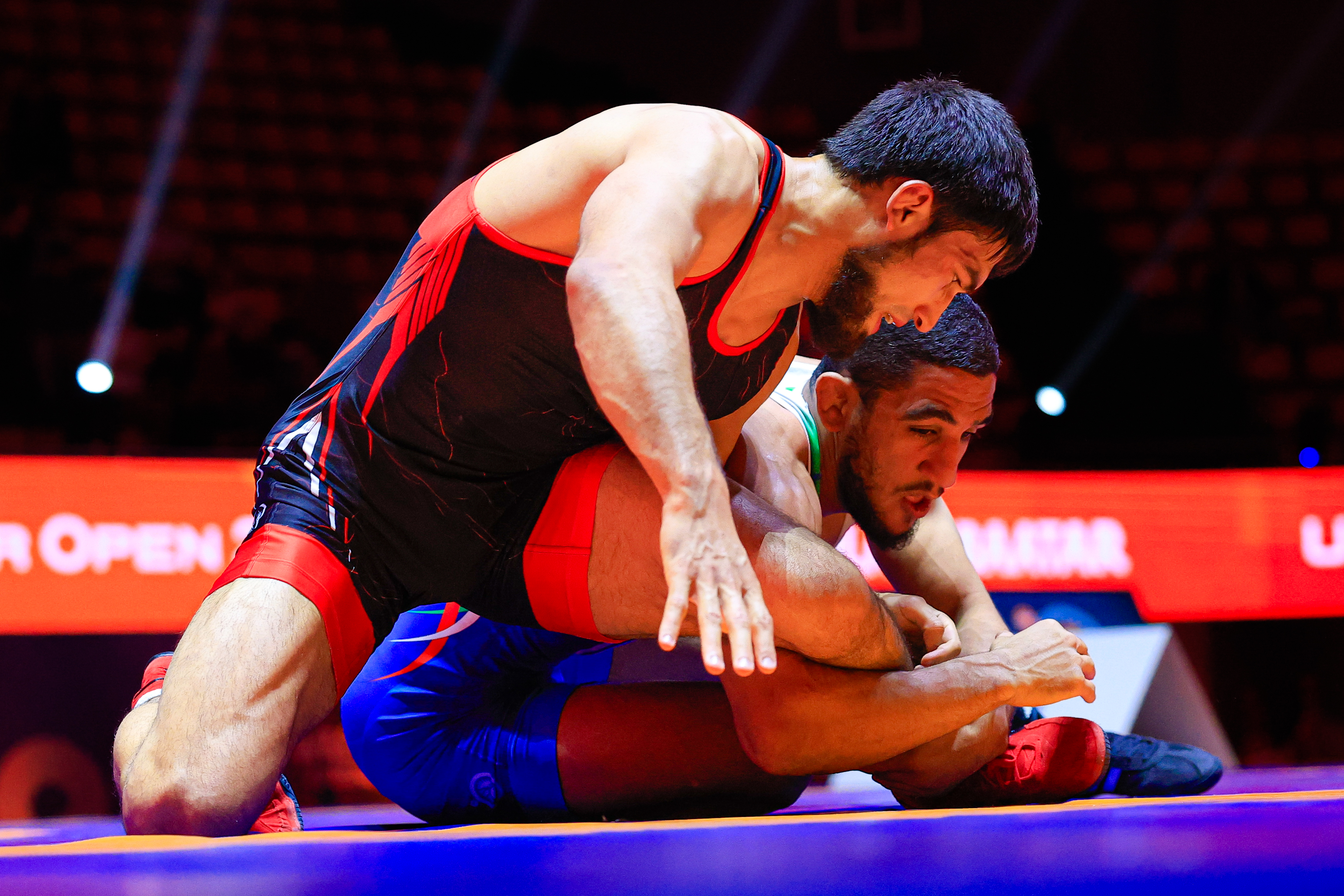 Rahman AMOUZAD (IRI) scored 14 unanswered points on Shamil MAMEDOV (BUL) in the 65kg final. (Photo: United World Wrestling / Kostadin Andonov)
Amouzad scored a takedown five seconds later: 10-5. Mamedov was still fighting and defending but the pressure from Amouzad was unstoppable as the Iranian scored another stepout: 10-6. He made it 10-7 with 50 seconds left with another stepout.
Then came the double-leg attack that changed the bout. Amouzad quickly swept on Mamedov's left leg and the Bulgarian, struggling with conditioning, was slow to defend it as Amouzad wrapped the other leg as well and jumped with Mamedov landing on the mat in danger for four points. Amouzad scored a two-point exposure and then a complete turn to lead 15-10. It all changed all of a sudden.
Mamedov kept helpless as he legs became heavier to move and Amouzad found new spring in his steps. The Iranian scored one more takedown before the final whistle to complete a remarkable comeback and win 17-10, having scored 14 unanswered points in 82 seconds.
Amouzad is not unbeaten in his last 17 bouts and has lost only two matches out of his last 30 internationally.
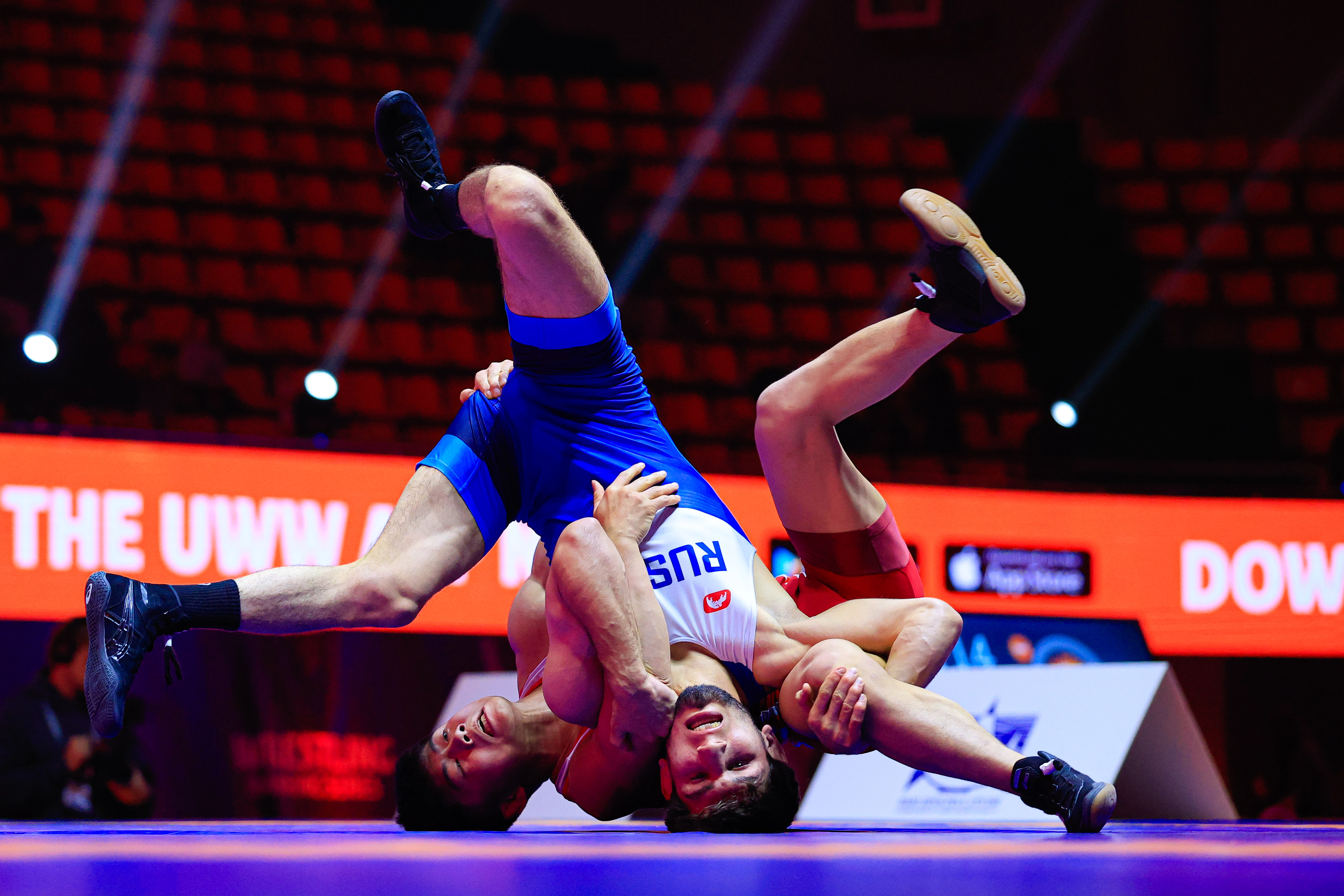 Musa MEKHTIKHANOV (RUS) hits a fireman's carry on Chong Song HAN (PRK) during the 57kg final. (Photo: United World Wrestling / Kostadin Andonov)
The other world champion in action on Sunday at the Ulaanbaatar Open, Chong Song HAN (PRK) failed to complete a comeback like Amouzad. Han suffered a heartbreaking 6-6 criteria loss to European silver medalist Musa MEKHTIKHANOV (RUS) in the 57kg final.
Mekhtikhanov hit a mesmerizing fireman's carry for four points while he was on the 30-second activity clock. Han responded with a two-point exposure using a front headlock in the same sequence to make it 4-2. As Han tried the headlock again, Mekhtikhanov blocked him and held his back on the mat for two points to extend his lead to 6-2 at the break.
Han closed the gap with a stepout and hit a leg-attack to score two points via exposure and make it 6-5. As the sequence continued, Han and Mekhtikhanov went neutral and then Han scored a go-behind which was surprisingly scored only one point which made it 6-6.
Mekhtikhanov, with his criteria lead due to the bigger move, defended his lead for the remaining 50 seconds to upset the world champion and claim the gold medal.
Russia won two more golds as the Khaniev brothers captured their first-ever gold medals at a United World Wrestling senior tournaments. Ismail at 79kg completed a 10-0 technical superiority over U20 world champion Mahdi YOUSEFI (IRI) in the final to win gold. This was his fourth victory via superiority in Ulaanbaatar.
His brother Takhir began slowly but he also won the 97kg final with technical superiority, 10-0, against Demchigdorj TUMURBAATAR (MGL).
India Wins 2 Golds
India won two golds both at the expense of Kazakhstan, a welcome result for the country. At 61kg, unheralded DEEPAK (IND) defeated Assyl AITAKYN (KAZ), 6-0, in the final to capture the first gold.
Asian bronze medalist DINESH (IND) then held off U20 world champion Yedige KASSIMBEK (KAZ), 2-0, with both points coming from Kassimbek's passivity.
Host Mongolia won gold through Tulga TUMUR OCHIR (MGL) at 70kg after his opponent in the final, Rustamzhan KAKHAROV (KGZ), injury defaulted. Tumur Ochir also avenged his Asian Championships final loss to ABHIMANYOU (IND), 9-0, earlier in the day.
RESULTS
57kg
GOLD: Musa MEKHTIKHANOV (RUS) df. Chongsong HAN (PRK), 6-6
BRONZE: SUMIT (IND) df. Abzal OKENOV (KAZ), 6-3
BRONZE: Meirambek KARTBAY (KAZ) df. Aiaal BELOLYUBSKII (TJK), 8-0
61kg
GOLD: DEEPAK (IND) df. Assyl AITAKYN (KAZ), 6-0
BRONZE: Adilet ALMUKHAMEDOV (KAZ) df. Bair BAIANDUEV (RUS), 4-0
BRONZE: Ahora KHATERI (IRI) df. Batnasan GANKHULEG (MGL), 7-0
65kg
GOLD: Rahman AMOUZAD (IRI) df. Shamil MAMEDOV (BUL), 17-10
BRONZE: Kwang Jin KIM (PRK) df. Adlan ASKAROV (KAZ), 7-6
BRONZE: Mohit KUMAR (IND) df. Ossimzhan DASTANBEK (KAZ), 17-6
70kg
GOLD: Tulga TUMUR OCHIR (MGL) df. Rustamzhan KAKHAROV (KGZ), via inj. def.
BRONZE: Magomed ELTEMIROV (RUS) df. ABHIMANYOU (IND), 10-0
BRONZE: Aden SAKYBAEV (KGZ) df. Usukhbayar BAATARKHUU (MGL), 4-3
79kg
GOLD: Ismail KHANIEV (RUS) df. Mahdi YOUSEFI (IRI), 10-0
BRONZE: Shamsat TAIR (KAZ) df. Nurdaulet KUANYSHBAY (KAZ), 5-4
BRONZE: Suldkhuu OLONBAYAR (MGL) df. Sandeep MANN (IND), 10-0
97kg
GOLD: Takhir KHANIEV (RUS) df. Demchigdorj TUMURBAATAR (MGL), 10-0
BRONZE: VICKY (IND) df. Gankhuyag GANBAATAR (MGL), 4-0
BRONZE: TUXIGE (CHN) df. Nurdaulet BEKENOV (KAZ), 11-0
125kg
GOLD: DINESH (IND) df. Yedige KASSIMBEK (KAZ), 2-0
BRONZE: Robert BARAN (POL) df. Timur KOTAEV (RUS), 13-2
BRONZE: Kamil KOSCIOLEK (POL) df. Jose DIAZ (VEN), 4-2


Share your thoughts.
Comments