ZAGREB, Croatia (September 13) -- It was supposed to be the anointing of Kamran GHASEMPOUR (IRI) as the successor to legendary compatriot Hassan YAZDANI at freestyle 86kg. Instead it turned out to be the introduction of Zahid VALENCIA (USA) as a new force on the scene.
In a battle between wrestlers who moved down this year from 92kg, Valencia put on a stunning display of disciplined wrestling to knock off Ghasempour 7-0 in the semifinals on Saturday, the opening day of the World Championships in Zagreb.
"I was prepared," Valencia said. "I felt comfortable knowing I did everything I could to prepare for this World Championships.
"If I wrestle like that, I'm the best in the world. No one can score like me. No one could shut out defense like me. I could score from anywhere. So I'm very confident in myself."
Iran, along with Japan, still put two wrestlers into Sunday's finals of the four weight classes in action, while it took a former Olympic champion to finally end the amazing run of an American high schooler who stole the show during the morning session.
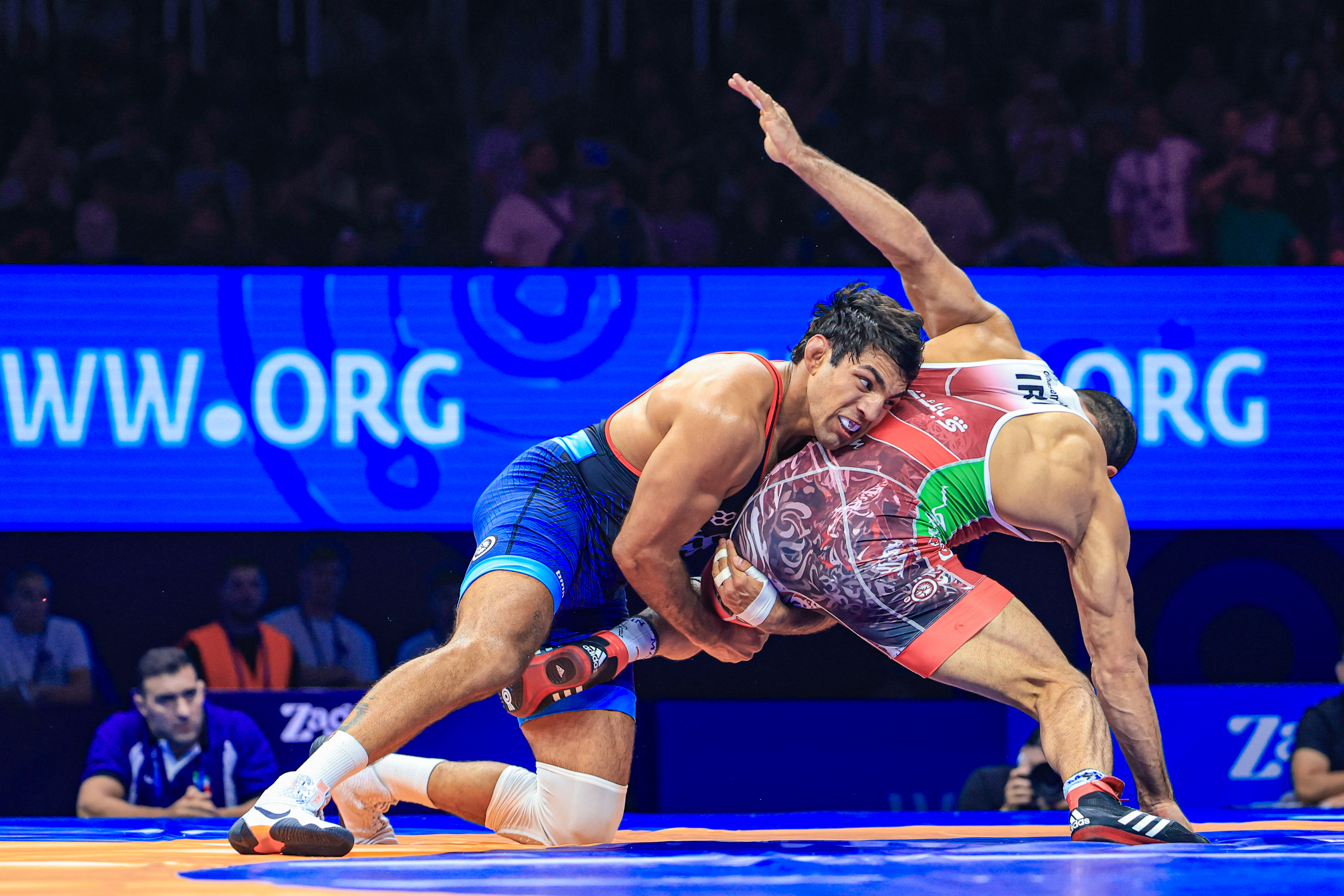 Zahid VALENCIA (USA) defeated Kamran GHASEMPOUR (IRI) 7-0 in the 86kg semifinals. (Photo: United World Wrestling / Amirreza Aliasgari)
Ghasempour had long been biding his time at 92kg, winning back-to-back world titles at that weight in 2021 and 2022 while Yazdani dominated 86kg in a fierce rivalry with David TAYLOR (USA). With Yazdani sidelined following his injury-hit loss in the Paris Olympic final, Ghasempour was ready to seize the chance to shine at the Olympic weight.
Not so fast, said Valencia, who had a world bronze at 92kg from 2023 to his credit. Both wrestlers prepped for Zagreb with victories at 86kg at the Ranking Series events this year, Khasempour in Tirana and Valencia in Zagreb.
Back in the same Arena Zagreb on Saturday, Valencia earned an activity point before chalking up two takedowns to take a 5-0 lead into the break. He added two stepouts in the second period while twice wiggling out of low singles by the Iranian to clinch the victory.
"I'm out there moving fake and snap, and there's just no time for my opponents to grab a hold of me taken in a shot," Valencia said. "And even when they do, it's one thing getting in, it's another thing finishing. I don't do anything fancy, just stop the shot and move on to the next thing."
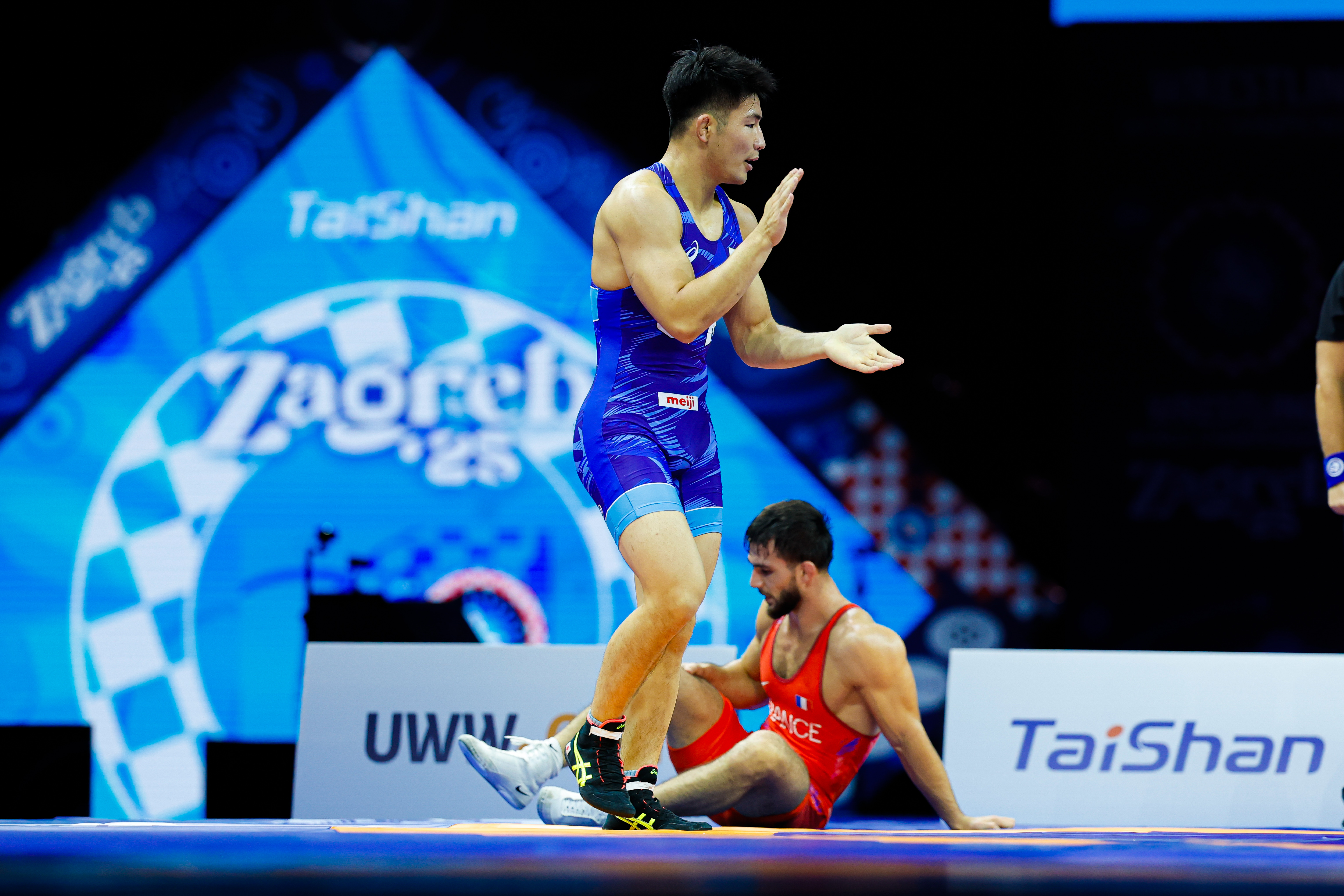 Hayato ISHIGURO (JPN) reached the 86kg final after beating Rakhim MAGAMADOV (FRA). (Photo: United World Wrestling / Kostadin Andonov)
In the final, Valencia will face Hayato ISHIGURO (JPN), who rallied to a 17-7 victory over Rakhim MAGAMADOV (FRA) in the other semifinal.
Ishiguro, an 2023 Asian bronze medalist, fell behind 7-1 early on when he got caught in a lace lock. After chipping away at the lead with a pair of takedowns, he wrapped up the ankles and, with Magamadov apparently injuring a knee as he tried to resist, reeled off six rolls to end the match and make his first global final since winning the world U20 title in 2018.
Valencia and Ishiguro have met before, with the Japanese scoring an 11-0 victory in the semifinals of the 2023 Zagreb Open. But, Valencia said, that was then and this is now.
"I'm like, I don't even remember wrestling him," he said. "I know probably I've heard it from you guys that I lost, so I'm just going out there and wrestle how I've been wrestling. I just, I don't think anyone could stop me."
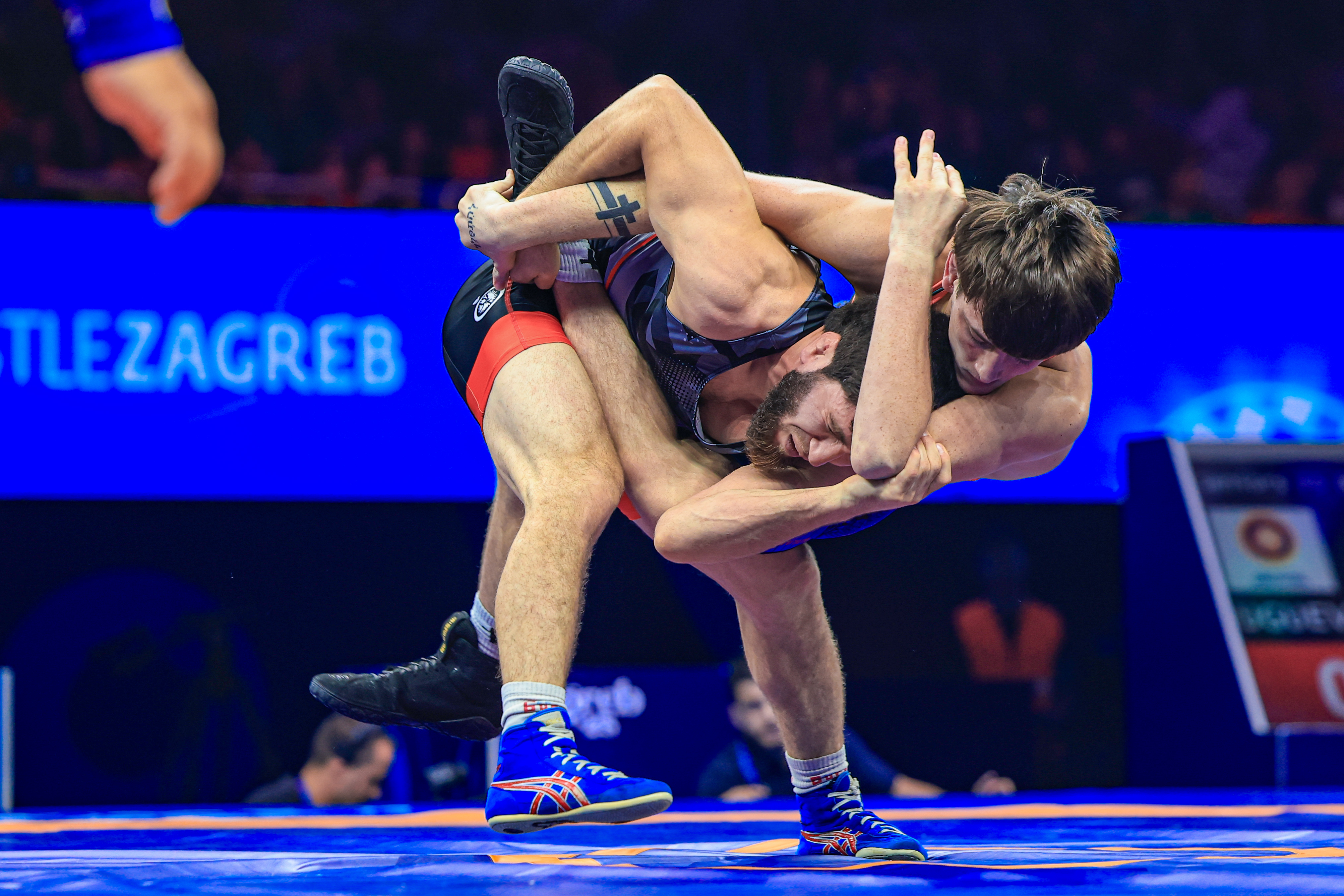 Zavur UGUEV (UWW) scores two points against Jaxen FORREST (USA) in the 61kg semifinals. (Photo: United World Wrestling / Amirreza Aliasgari)
At 61kg, it was experience over a very determined youth when Tokyo Olympic 57kg champion Zavur UGUEV (UWW) forged a 10-3 victory over teen phenom Jax FORREST (USA) to earn a shot at a third career world title.
The 30-year-old Uguev used his wits to defend against everything the long-limbed high schooler threw at him, particularly when he pulled away with an eight-point second period.
Uguev gained the kind of 2-point exposures that come with international experience, once putting Forrest onto his back when the American got too high as he tried to go up and over on a counter. Another time, he masterfully caught the 18-year-old in a cradle.
"Many people were betting on the American -- he’s young, promising," Uguev said. "As they say, we’re already battle-tested wolves, we can feel the mat, we wrestle with experience. But I wish him good luck, he’s just at the beginning of his journey."
Uguev, who won back-to-back world golds at 57kg in 2018 and 2019 but finished fifth at the last two World Championships, was relieved to be back in a world final.
"I’m very happy, I’ve been working toward this medal, toward this World Championships, for a long time," Uguev said. "Tomorrow I’ll do everything possible to take the gold medal at this championships."
In Sunday's final, Uguev will face Asian bronze medalist Ahmad JAVAN (IRI), who pulled a rabbit out of the hat by scoring a takedown with :03 left to stun Kum Hyok KIM (PRK) 3-2 in the second semifinal.
After giving up a stepout in the first period, Kim came back with a double-leg takedown to head into the break up 2-1. In the second period, Javan got Kim's leg up in the air, but was unable to finish the move and Kim continually fended off any further attempts.
But with the time ticking down, Javan snapped Kim down and spun behind for the winning takedown, setting off a roar of delight from the raucous Iranian supporters.
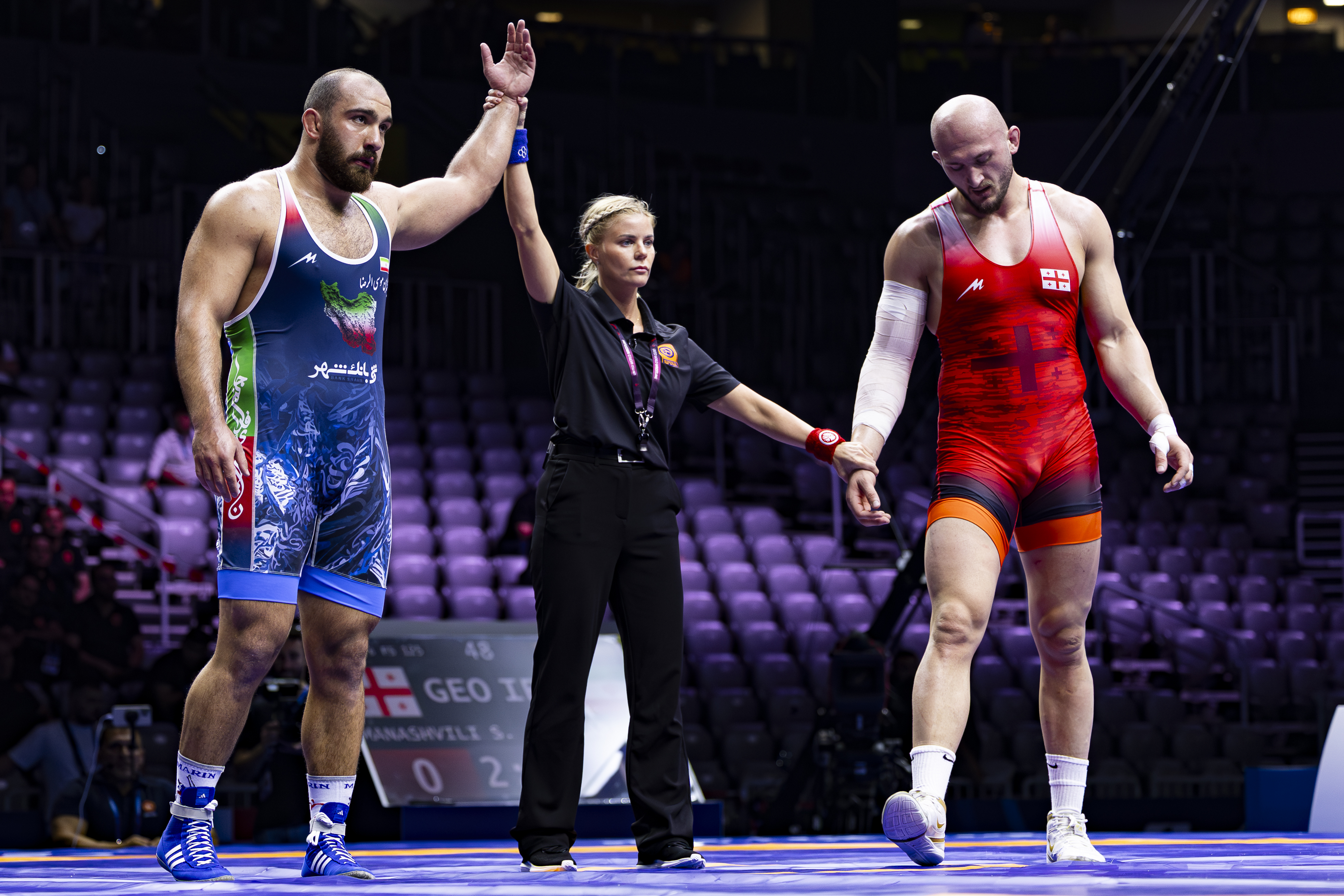 Amir Hossein ZARE (IRI) reached the final at 125kg. (Photo: United World Wrestling / Kostadin Andonov)
Iran earned a second spot in the finals when two-time Olympic medalist Amir Hossein ZARE (IRI) outclassed Shamil SHARIPOV (BRN) 7-3 at 125kg in the final bout of the evening, giving him a chance to add to his world titles from 2021 and 2023.
It was the third time Zare has beaten Sharipov in two years, most recently a 3-0 triumph in the quarterfinals at the Tirana Ranking Series tourney in February.
In the final, Zare will take on European champion Giorgi MESHVILDISHVILI (AZE), who scored an activity point in the first period and a stepout in the second to defeat Robert BARAN (POL) 2-0.
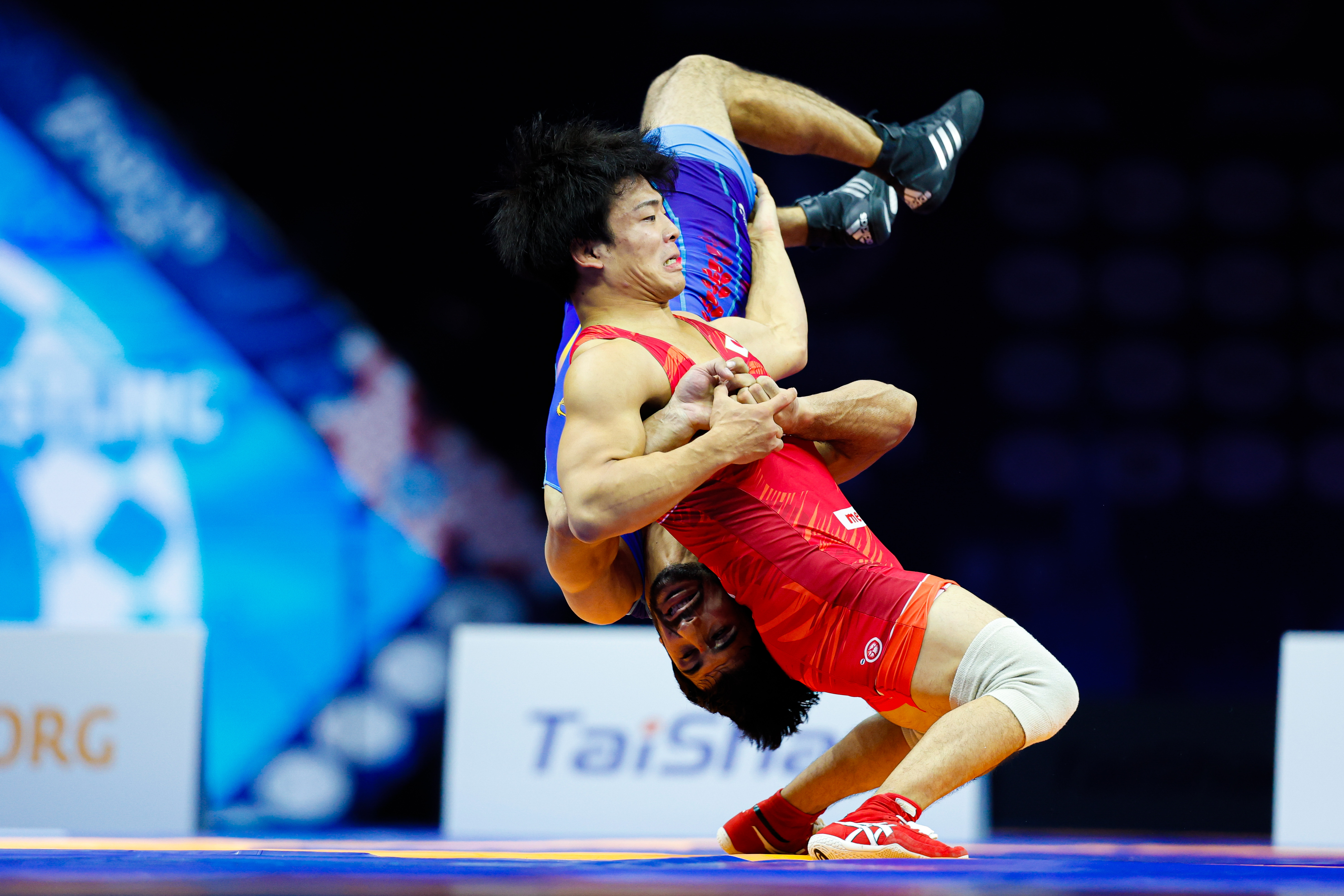 Returning silver medalist Yoshinosuke AOYAGI (JPN), red, reached the 70kg final for a second year in a row. (Photo: United World Wrestling / Kostadin Andonov)
At 70kg, a rematch of the final at last year's Non-Olympic World Championships was spoiled when Tulga TUMUR OCHIR (MGL) knocked off defending champion Nurkosha KAIPANOV (KAZ) 5-2, setting up an all-Asian final with silver medalist Yoshinosuke AOYAGI (JPN).
Tumur Ochir, a 2021 world bronze medalist at 65kg, took a 2-0 lead in the first period with an activity point and a stepout, only to fall behind on criteria when Kaipanov opened the second period with a takedown. But the Mongolian went on the attack and came away with a stepout and takedown to complete a well-earned victory.
Earlier, Aoyagi repeated his victory in the final of the Budapest Ranking Series tournament over Arman ANDREASYAN (ARM), right down to the final score of 8-0 thanks to a superfluous challenge at the end.
Aoyagi was leading 3-0 and well on the way to victory when Andreasyan tried to get behind and the Japanese locked his arms and dropped backwards for a 4-point throw. The Armenian side challenged, but to no avail.
Day 1 Results
Freestyle
61kg (26 entries)
SEMIFINAL - Zavur UGUEV (UWW) df. Jax FORREST (USA), 10-3
SEMIFINAL - Ahmad JAVAN (IRI) df. Kum Hyok KIM (PRK), 3-2
70kg (29 entries)
SEMIFINAL - Yoshinosuke AOYAGI (JPN) df. Arman ANDREASYAN (ARM), 8-0
SEMIFINAL - Tulga TUMUR OCHIR (MGL) df. Nurkosha KAIPANOV (KAZ), 5-2
86kg (29 entries)
SEMIFINAL - Zahid VALENCIA (USA) df. Kamran GHASEMPOUR (IRI), 7-0
SEMIFINAL - Hayato ISHIGURO (JPN) df. Rakhim MAGAMADOV (FRA) by TF, 17-7, 3:50
125kg (27 entries)
SEMIFINAL - Giorgi MESHVILDISHVILI (AZE) df Robert BARAN (POL), 2-0
SEMIFINAL - Amir Hossein ZARE (IRI) df. Shamil SHARIPOV (BRN), 7-3



Share your thoughts.
Comments