SAMOKOV, Bulgaria (August 23) -- When Yehor YAKUSHENKO (UKR) reached the final of the World U20 Championships in Samokov, he was aware that he will be facing a new challenge in Hadi SEYDI AVENDI (IRI), the other finalist.
In his career, Yakushenko had never wrestled an Iranian wrestler. With the pedigree of Iran in Greco-Roman especially in age-group competition, Yakushenko knew that Seydi will be a tough opponent.
With his U20 world title on line, Yakushenko planned his final against Seydi to perfection to beat the Iranian 5-2 and capture his second straight gold medal at the World U20 Championships. He became the first Ukrainian wrestler to win two gold medals in Greco-Roman at this age-group Worlds.
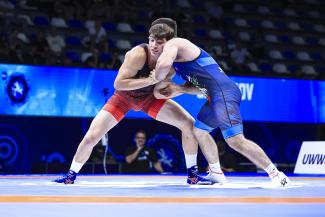
Yakushenko had the first par terre position and he lifted Seydi and then completed a correct throw for two points and lead 3-0. Seydi managed to close out the first period with a stepout and cut the lead to 3-1.
Seydi had his chance to score in the second period from par terre but Yakushenko was solid in his defense and did not give up any points. Seydi tried a few attacks in the final second but there was no score. Yakushenko got two more points for a go-behind in the final second to win 5-2.
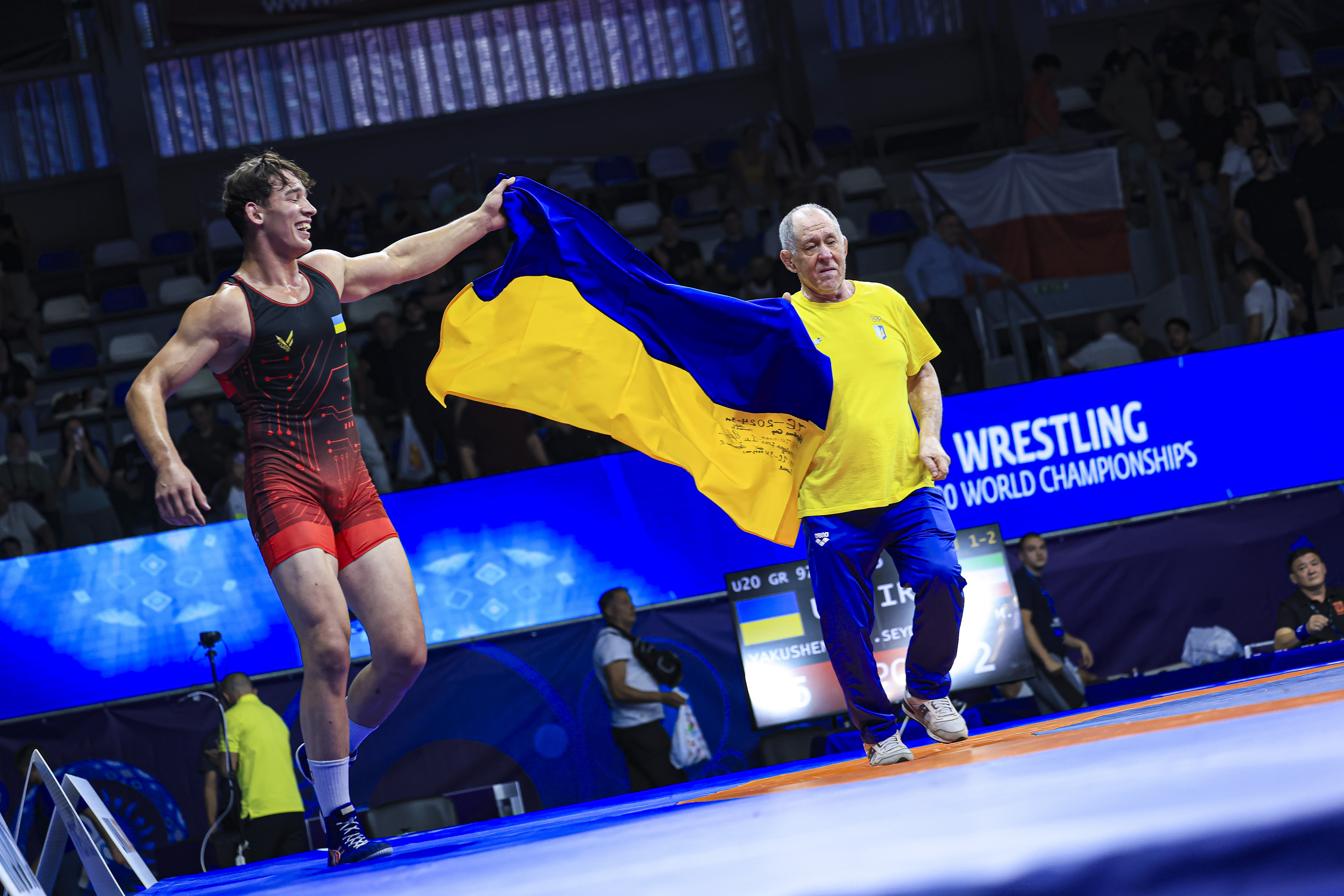 Yehor YAKUSHENKO (UKR) celebrates after becoming the world U20 champion for the second time. (Photo: United World Wrestling / Kadir Caliskan)
While Seydi was a new challenge, Yakushenko faced a familiar foe in Darius KIEFER (GER) in the semifinals on Friday. Kiefer, who had lost three previous bouts to Yakushenko got one back when he defeated the Ukrainian in the final of the U20 European Championships. Yakushenko wasn't keen to letting him get one more win.
"When I saw my bracket, I understood that in the semifinals I would face Kiefer who beat me at the European Championships," Yakushenko said. "I really wanted to beat him. I trained and prepared only for him, focused only on him. Before him, in earlier matches, I just wrestled for six minutes straight, just to warm up. The bracket overall was pretty easy."
Yakushenko still has one more year left in this age-group and he wants to win the third gold medal at the U20 World Championships next year. He also plans to debut in the senior category.
"I still have one more year left in this age-group and next year the third belt will be mine," he said. "Starting next year, I plan to compete at the seniors, qualify for the Senior European Championship, and to be a strong competitor."
However, to be on the Ukraine team, he will have beat a few senior wrestler and may find it slightly difficult than the U20s.
"At the senior level, we have good competition," he said. "But among juniors, not really. For example, before the U20 European Championships there was no one in my category. I had to call an old friend, Vladislav LUB, whom I had trained with. Thanks to him, I managed to push through, and because of him I improved a lot and beat Kiefer."
Among the medalist at 97kg was Ilia KOMAROV (UWW), younger brother of European 87kg champion Aleksandr KOMAROV (SRB). Ilia defeated Andrej RODIN (CRO), 8-0, in the bronze medalist.
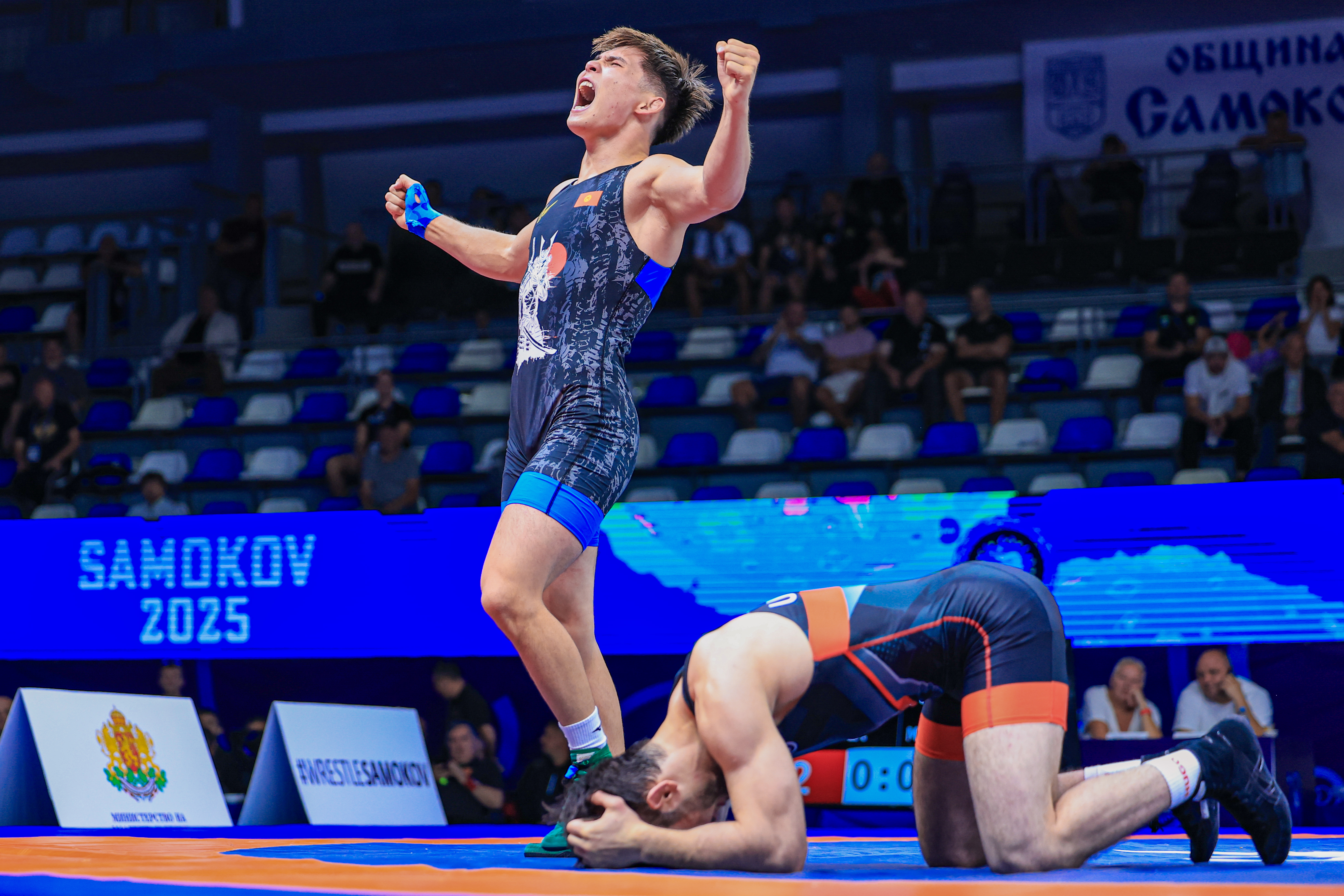 Zhantoro MIRZALIEV (KGZ) celebrates after beating Erzu ZAKRIEV (UWW) in the 67kg final. (Photo: United World Wrestling / Amirreza Aliasgari)
Another returning champion was not as fortunate and Erzu ZAKRIEV (UWW) dropped his 67kg final to 2023 World U20 silver medalist Zhantoro MIRZALIEV (KGZ), 4-2, and finish with a silver medal.
Zakriev was hurt from the two stepouts Mirzaliev scored on him when was in the dominant position but the Kyrgyz wrestler switched the position and pushed Zakriev out.
The first such incident came in the second minute when Zakriev tried to push Mirzaliev towards the zone the Kyrgyz wrestler spun an arm-throw and managed to force a stepout for a 1-0 lead. Zakriev got one for himself to take make it 1-1 but Mirzaliev had the criteria according to the new Greco rule that when the score is 1-1 in bout, the first scorer will have criteria.
But Zakriev quickly made it 2-1. That's when the second instance of Mirzaliev getting a stepout when Zakriev was aggressive occurred. Zakriev had Mirzaliev in the zone when the latter hit the arm-throw but Zakriev kept his balance. He stepped out and conceded a point to Mirzaliev who now led 2-2 on criteria at the break.
The second period also began in this manger when Zakriev almost made Mirzaliev stepout but the Kyrgyz survived and circled inside. He then pushed Zakriev out and get a 3-2 lead. There no more points scored in the bout but Zakriev challenged at the end asking for passivity from Mirzaliev which was denied and he lost another point to lose 4-2.
The result is in contrast to the 10-0 win Zakriev scored on Mirzaliev just a month ago in Turkiye.
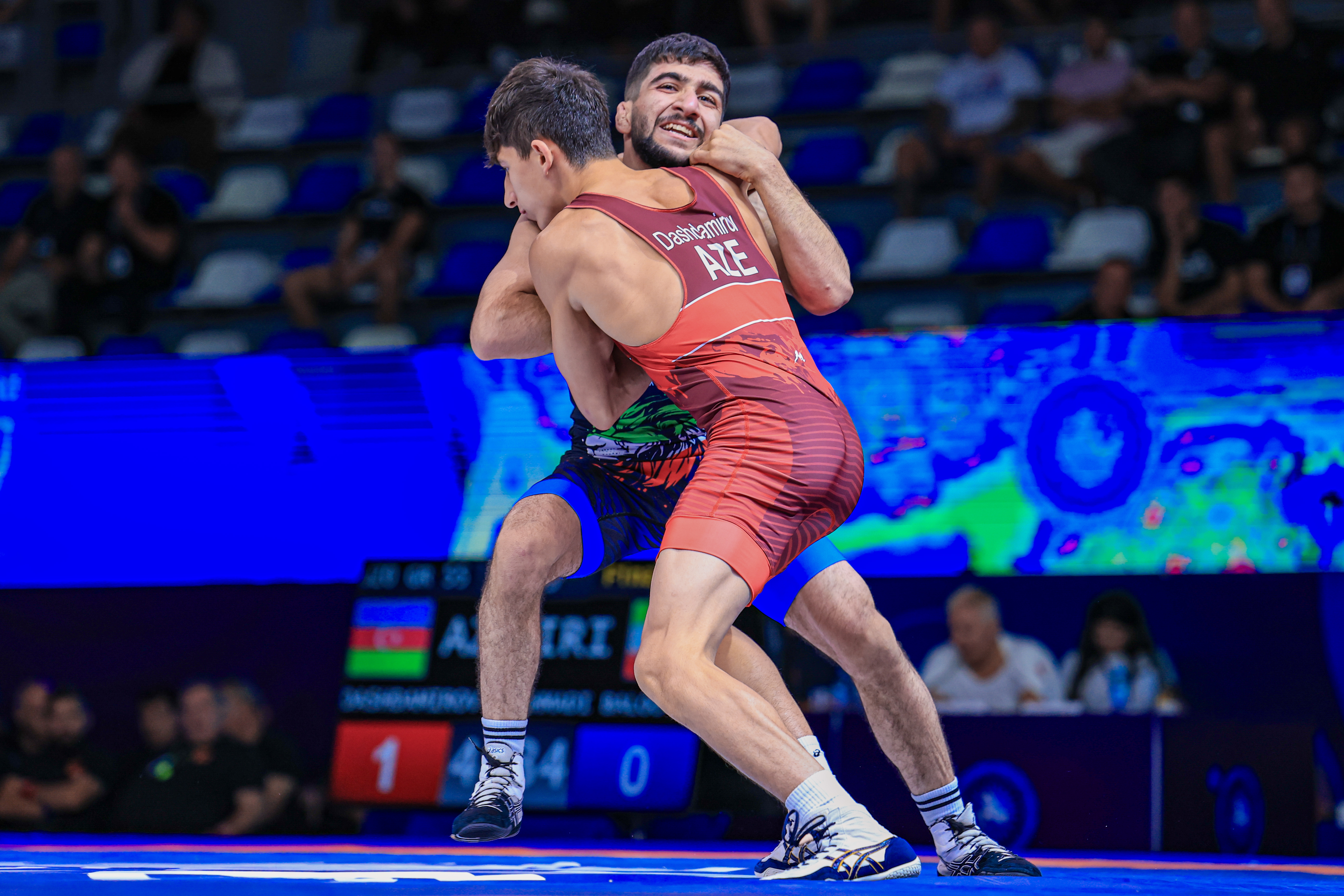 Payam AHMADI (IRI) scores a takedown against Turan DASHDAMIROV (AZE) in the 55kg final. (Photo: United World Wrestling / Amirreza Aliasgari)
Payam AHMADI (IRI) won the first gold medal for Iran at this World Championships when he defeated former world U17 champion Turan DASHDAMIROV (AZE), 5-3, in the 55kg.
In one of most thrilling finals, Ahmadi needed an acrobatic summersault to not give up points to Dashdamirov in the final minute and defend his lead for the win.
Dashdamirov got the par terre position first but Ahmadi escaped with ease and without any trouble. Soon, Ahmadi scored a takedown and turned the Azerbaijani wrestler using a high gut-wrench for a 4-1 lead.
The second period saw Ahmadi on the aggressive and he tried a bodylock but Dashdamirov blocked it with an overarm and flipped Ahmadi for two points. Ahmadi now led 4-3 and Dashdamirov needed two points for a win with 2:40 remaining.
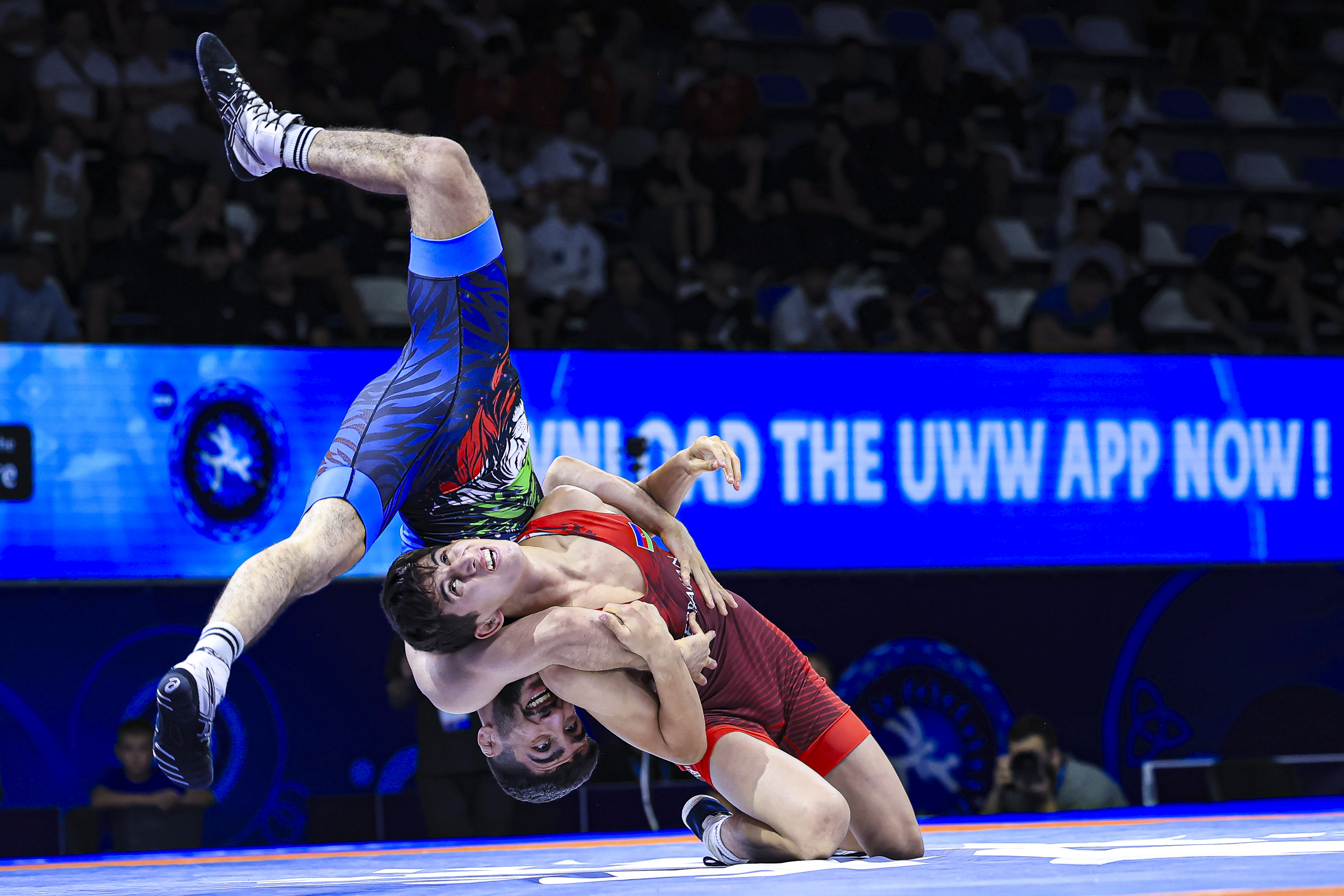 Turan DASHDAMIROV (AZE) hits a fireman carry for no points against Payam AHMADI (IRI) during the 55kg final. (Photo: United World Wrestling / Kadir Caliskan)
Dashdamirov failed to find an opening until the last 15 seconds when he did a fireman carry but Ahmadi landed on his feet. Dashdamirov was awarded two points but Iran challenged and the points were removed as there was no danger position. With 4-3 score, Ahmadi defended for the last 7 seconds remaining and won the gold medal.
After drawing a blank in Ponteverdra, Spain last year, Armenia crowned a world U20 champion in Greco-Roman Gaspar TERTERYAN (ARM) defeated Ahmad KODIROV (UZB), 1-1, in the 72kg final and win the gold medal.
RESULTS
55kg
GOLD: Payam AHMADI (IRI) df. Turan DASHDAMIROV (AZE), 5-3
BRONZE: Omur YNTYMAK UULU (KGZ) vs. Arsen ZHUMA (KAZ)
BRONZE: Anil MOR (IND) vs. Daisuke MORISHITA (JPN)
67kg
GOLD: Zhantoro MIRZALIEV (KGZ) df. Erzu ZAKRIEV (UWW), 4-2
BRONZE: Fayozbek ESHMIRZAEV (UZB) df. Gholamreza ABDOVALI (IRI), 5-1
BRONZE: Faraim MUSTAFAYEV (AZE) df. Takaku SUZUKI (JPN), 5-4
72kg
GOLD: Gaspar TERTERYAN (ARM) df. Ahmad KODIROV (UZB), 1-1
BRONZE: Oliver PADA (FIN) df. Arvid STRAAKEVED (SWE), 14-5
BRONZE: Yussuf ASHRAPOV (KAZ) df. Arionas KOLITSOPOULOS (GRE), 2-0
97kg
GOLD: Yehor YAKUSHENKO (UKR) df. Hadi SEYDI AVENDI (IRI), 5-2
BRONZE: Darius KIEFER (GER) df. Amirkhon BERDIKULOV (UZB), 8-0
BRONZE: Ilia KOMAROV (UWW) df. Andrej RODIN (CRO), 8-0
Semifinals
63kg
GOLD: Aleks MARGARYAN (ARM) vs. AYTJAN KHALMAKHANOV (UZB)
SF 1: Aleks MARGARYAN (ARM) df. Kristiyan MILENKOV (BUL), 9-0
SF 2: AYTJAN KHALMAKHANOV (UZB) df. Damir IBRASHOV (KAZ), 8-0
77kg
GOLD: Ahoura BOUVEIRI (IRI) vs. Anri PUTKARADZE (GEO)
SF 1: Ahoura BOUVEIRI (IRI) df. Zaur BESLEKOEV (UWW), 8-0
SF 2: Anri PUTKARADZE (GEO) df. Kiryl VALEUSKI (UWW), 5-4
87kg
GOLD: Luka KOCHALIDZE (GEO) vs. Abdurakhman ABDULKADYROV (UWW)
SF 1: Luka KOCHALIDZE (GEO) df. Elias LYYSKI (FIN), 6-0
SF 2: Abdurakhman ABDULKADYROV (UWW) df. Temirlan TURDAKYN (KAZ), 8-0
130kg
GOLD: Yusuf BAKIR (TUR) vs. Ali ILIASOV (UWW)
SF 1: Yusuf BAKIR (TUR) df. Ivan YANKOVSKYI (UKR), 8-0
SF 2: Ali ILIASOV (UWW) df. Abolfazl FATHITAZANGI (IRI), 5-4 .




Share your thoughts.
Comments