#JapanWrestling

Two-time Olympic champ formerly known as Kawai returns in triumph

By Ken Marantz

YAIZU, JAPAN (October 16) -- As Risako KINJO stood on the top of the medal podium, a warm smile came across her face. It was not for the victory in her return to the mat after 14 months, but for that other part of her life that had kept her to stay away so willingly.

She had caught sight of her mother in the stands across the gym, holding Kinjo's 5-month-old daughter in her arms and waving the infant's hand in her direction.

"There have been so many people supporting me, and that's what allowed me to take the mat today," she said.

To the rest of the wrestling world, she is still known by her maiden name KAWAI, under which she won a second straight Olympic title by capturing the women's 57kg gold at the Tokyo Games in August 2021.

Much had changed in her life since that triumph at Makuhari Messe arena, her name notwithstanding through the marriage to former wrestler Kiryu KINJO. But as the three-time world champion showed on Sunday, her desire and talent for the sport have not altered in the slightest.

Kinjo returned to competition by cruising to the 59kg senior title at the Japan Women's Open, winning three matches without surrendering a point in Yaizu, Shizuoka Prefecture, about 200 kilometers southwest of Tokyo.

"There's a feeling of relief, but also I wish I had a few more matches," said the 27-year-old Kinjo, who capped her golden run with a 9-0 victory in the final over national collegiate silver medalist Miyu NAKANISHI. "It felt like the three matches were over before I knew it."

Kinjo said she had butterflies in her stomach at the start, but actually welcomed that feeling as in reminded her of old times.

"I was really nervous before my first match," she said. "After that there wasn't much time between matches. But it's like there was something nostalgic about the nervousness. After it was over, looking back I thought, 'That was fun.'"

JPN
Risako KINJO gets 2 with a counter-lift in the 59kg final against Miyu NAKANISHI (photo by Japan Wrestling Federation)

Kinjo, who had a bye into the quarterfinals, opened with a victory by fall in 51 seconds over Mizuki NAKAHORI. Kinjo did not have to attack, as she spun behind off a Nakahori shot, executed a pair of gut wrenches, then used a leg lock and reverse half-nelson for the fall.

In her semifinal match against Himeka HASEGAWA, Kinjo maintained her defensive wall and scored two go-behind takedowns, then scored another with a snap down. From there, a pair of gut wrenches ended the match 10-0 at 1:23.

In the final against a defensive-minded Nakanishi, Kinjo took a 3-0 lead into the second period from an activity point and a back-door takedown off a single--off her first shot of the day. But in the second period, Kinjo effectively moved Nakanishi around to set up a low sweeping single, then a shrug-and-go-behind. She added a counter-lift for 2 to make it 9-0.

Kinjo's coach Ryo KANEHAMA was impressed with the performance, given the uncertainty going into the tournament.

"That she first of all could get so mentally prepared was really big," he said. "She also showed speed. What we were most fearful of was going the full six minutes, but she was able to keep moving like that. Looking at how she started in the morning, she looked in really good shape."

For Kinjo, the most unfamiliar moment came when her married name was used in the pre-match announcement for the first time.

"When I saw 'Kinjo' on the scoreboard, I was like, 'Oh, right,'" she said. "This is the first tournament that I entered as Kinjo, and I feel honored to have it on the certificate that I received."

The couple announced they had tied the knot on Aug. 27, 2021, and Kinjo gave birth to a baby girl in May this year. She said she started working out again at the end of June, and practiced on the mat the following month. As can be imagined, it was not easy.

"At first, I couldn't even do calistenics on the mat, or a high bridge," she said. "Parts of my body were really stiff. My legs couldn't react to where my eyes were looking. I thought, this is how much it changes after being away 10 months. It was like watching someone else."

Kinjo eventually got back to speed, realizing that the additional burden of raising a child meant changing her approach to training from quantity to quality.

"I have a child and she is the No. 1 priority," Kinjo said. "The amount of practice has been reduced. Before, my time was all mine; now more time is spent on the child. I don't know how much less I'm doing, but to me, it's of a better quality."

Living with her husband in Fukui Prefecture in western Japan, where he is coach at Tsuruga Kehi High School, presents a challenge for Kawai. She takes advantage of every opportunity for a practice spot--sometimes it's with the high schoolers, other times she might head to Tokyo or Aichi Prefecture to train with younger sister Yukako, the Tokyo Olympic gold medalist at 62kg.

Everywhere she goes, she is fortunate to have someone to help out with the baby. In Fukui, Tsuruga has a kids club and sometimes the mother of one of the team members will look after the child. In Tokyo, she knows she can always leave her with her mother, Hatsue, a national team member during her career who almost unfailingly attends all of her daughters' matches.

That support system has allowed Kinjo to join the ever-growing number of Japanese female athletes who are continuing careers after childbirth, which only a few decades ago would have been unheard of. Most noticeable was Ryoko TANI, who won a fourth Olympic medal in judo after giving birth.

JPN
Risako KINJO, center, smiles on the medal podium. (photo by Japan Wrestling Federation)

Kinjo became the latest high-profile wrestler to use the Japan Women's Open as the first stepping stone in a return to the sport. It is actually a second-tier tournament with age groups that for senior wrestlers, is a last-chance event to qualify for the All-Japan Championships in December. Kinjo's only previous appearance was in the junior high school division in 2008.

Previously, 2016 Olympic champion Eri TOSAKA appeared at the 2017 tournament as her first competition after undergoing foot surgery, and the legendary Kaori ICHO competed in 2018, having taken two years off after Rio 2016 in a bid for a fifth Olympic gold that would eventually be thwarted by Kinjo.

The question now is, what will Kinjo do from here? The All-Japan in December marks the start of the qualifying process for the 2024 Paris Olympics, which is squarely on Kinjo's radar. It is possible for her to enter at 59kg and later drop down to the Olympic weight of 57kg, or she can go down to the latter now. "It's a secret," she said mischievously.

Of course, whether she does it in December or later, Kinjo will almost surely eventually clash heads with rising star Tsugumi SAKURAI, who won the 57kg world title in Kinjo's absence.

Kinjo takes an esoteric stance when it comes to the emergence of the 21-year-old Sakurai, who also won the 55kg world title in 2021.

"I think it is a good thing for Japan that young wrestlers are being cultivated," Kinjo said. "I don't mean that it would be good for me to lose to them. But for the ones coming up after me, the future is bright. While I keep battling on, the young ones get stronger. They are all rivals, but I think that their getting stronger is a good situation."

JPN1
Yukako KAWAI talks to the media after withdrawing just before her opening match. (photo by Japan Wrestling Federation)

Younger sister defaults after injury during warm-up

Meanwhile, younger sister Yukako KAWAI was also entered in the tournament, but defaulted her opening match at 62kg after hurting her back while warming up.

"It's not such a serious injury, but we thought it was better to be cautious and not risk making it worse," Kawai said.

Unlike Risako, Kawai has already faced a domestic usurper to her throne, and lost it. In her first tournament after winning the Tokyo Olympic gold, she returned at the All-Japan Invitational Championships last June, but lost in the final to another rising star, Nonoka OZAKI.

Ozaki went on to win the senior world title in Belgrade last month, establishing herself as the one to beat in the race to Paris 2024.

"I've been working to fix the mistakes I make in the June match, and this Women's Open was supposed to be a test of how far I have come," Kawai said. "I think I'm rounding into shape."

Kawai said she finds motivation in Ozaki's world title run.

"I thought she would win the championship," she said. "By winning the title, I think it shows that our domestic matches are the highest level matches in the world. That's motivating me."

Another top wrestler who made the trip to Yaizu was world silver medalist Ami ISHII, who won the 68kg title by beating Kokona TAKADA by fall at the first-period buzzer.

"The reason I entered this tournament, to put it plainly, was to check my technique," she said. "Also, my pre-match preparation has not been good and I wanted to work on that."

In December, Ishii can expect to see a great deal of shifting into the Olympic weight class, with her most notable competition likely to be current 65kg world champion Miwa MORIKAWA.

"If I do what I need to do, the confidence will come," Ishii said. "We'll see how much I can progress in the next two months. If I do everything I need to, it will be like insurance, and winning won't be out of the question."


#WrestleZagreb

Komarov upends Mohamadi to make history, spoil Iran celebrations

By Ken Marantz

Note: An earlier version of this article mentioned Aleksandr KOMAROV (SRB) as the first male wrestler to have won the "Grand Slam". Amin MIRZAZADEH (IRI) was the first. The error is regretted.

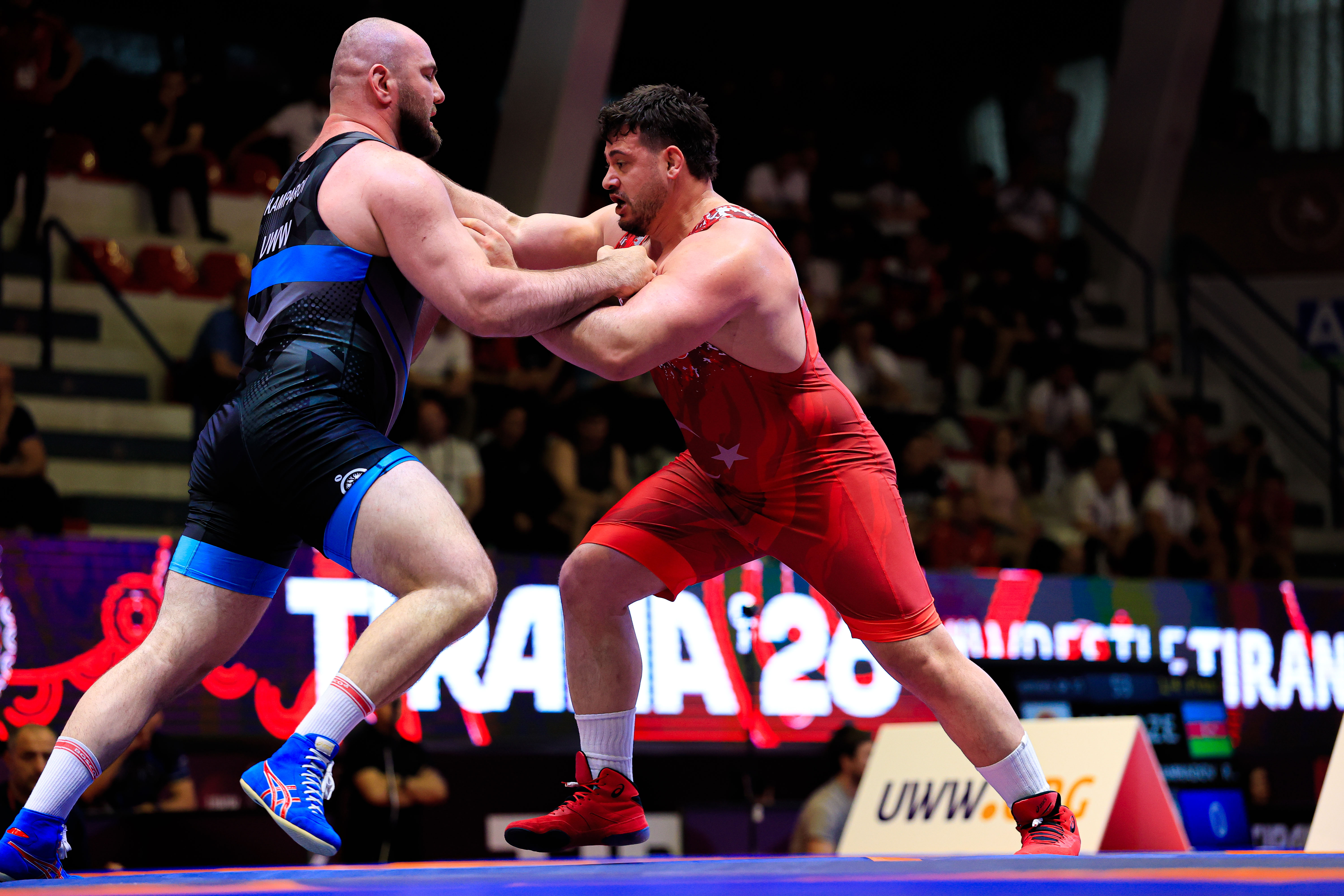
ZAGREB, Croatia (September 21) -- Olympic silver medalist Alireza MOHAMADI (IRI) was set to put the cherry on top of Iran's dominant performance in Zagreb, but Aleksandr KOMAROV (SRB) had a recipe for disaster.

Komarov pulled off a stunning 4-3 victory in the 87kg final that left Mohamadi inconsolable, while earning himself a unique place in wrestling history as the curtain came down on the World Championships on Sunday with the last three Greco titles decided.

"I’m very happy," Komarov said. "The final was really tough, and I believed I could succeed. In the end I managed it, and I’m very glad about that."

In other finals, teenager Aytjan KHALMAKHANOV (UZB) gave Uzbekistan just its second world Greco title -- more than two decades after the first -- with a victory at 63kg, while Saeid ESMAEILI (IRI) triumphed at 67kg to become the Iran's second Olympic champion in two nights to add the senior world gold.

Iran easily won the team title with 180 points, nearly twice as much as the runner-up, to complete the freestyle-Greco double for the first time. The Asian powerhouse finished with four golds and eight medals overall in Greco. Azerbaijan placed second with 89 points, followed by Uzbekistan with 72. Both nations had one champion.

With his triumph in Zagreb, the Russian-born Komarov became the second male wrestler to complete the "Grand Slam" of world titles -- winning all three age-group titles as well as the senior gold.

Komarov, who began competing for Serbia in 2024, previously won the first of two cadet (U17) titles in 2015, the world junior (U20) in 2017 and 2018, then added the world U23 in 2021.

He joins Amin MIRZAZADEH (IRI) as the lone men to achieve the Grand Slam. Mirzazadeh, who won a second career Greco 130kg title two days earlier in Zagreb, become the first when he won his first senior gold in 2023, adding to world titles at U17 in 2015, U20 in 2018 and U23 in 2021.

A handful of women, including Yui SUSAKI (JPN) and Amit ELOR (USA), have achieved the slam. Three other male greats came close, but fell just short by taking silvers on either the U17 or U20 levels -- Geno PETRIASHVILI (GEO) and Amir Hossein ZARE (IRI) in freestyle and Leri ABULADZE (GEO) in Greco.

"I’ve collected the whole set of medals," said Komarov, who has also completed the Grand Slam on a European level. "My coach, my journey -- everything I did was right. I have success, so I’m very happy. My goal and my dream are the Olympic Games. I think about it. It’s too early to talk about that now, but I hope everything works out."

Even with his past glory, not everything had worked out for Komarov in his run-up to Zagreb. In fact, it was less than spectacular.

Eighth at the Paris Olympics, this year the 26-year-old relinquished the European title he had won in 2024, having to settle for a bronze, and placed fifth at all three Ranking Series events he entered, in Zagreb, Tirana and Budapest.

In fact, it was in Tirana that he clashed with Mohamadi, who handed him a 5-1 defeat in the semifinals en route to the gold.

"It was a very hard road to get here -- it’s been a very difficult year and I lost all the ranking series. I lost at the Europeans," Komarov said. "Of course I had doubts in myself, but I believed I could do it and I succeeded. I’m always mentally ready -- I didn’t change anything, just worked a lot and tried to wrestle without mistakes and give my best."

But Komarov made all the right moves in Zagreb to beat Mohamadi, who reluctantly settled for his second world silver, adding to one at 82kg in 2023.

The difference came down to what each wrestler did from par terre. Mohamadi, who won the Tirana Ranking Series title, could only manage a stepout on a throw
attempt. Komarov, on the other hand, got the traditional roll, which put him up 3-2 in the second period.

The key moment of the match came in the final minute, when Mohamadi pressed forward in a tackle position and had Komarov backpedaling out of the ring.

But the stepout -- nor a potential fleeing point -- was not awarded when it was determined on a lost Iranian challenge that Mohamadi's hands had dropped below Komarov's waist, which made it 4-2.

Mohamadi needed a takedown to win, but could only manage a late stepout. At the final whistle, he dropped to the mat in total despair, and had be propped up as he
walked dejectedly from the main floor.

Meanwhile, Komarov's celebrations took a odd twist when it was discovered there was no Serbian flag for him to hoist for his victory lap. Instead, he circled the mat on the shoulders of his coaches.

"Nobody believed I would win," Komarov said with a smile. "Many Serbians came to support me, but nobody brought a flag."

While Komarov chose to relocate his life to Serbia and has a Serbian wife, his family remains in Russia. His younger brother, Ilya KOMAROV (UWW), won a bronze medal at the U20 World Championships in August.

At 63kg, Khalmakhanov's victory on the senior stage came just over a month after winning the gold at the World U20 Championships in Samokov, Bulgaria.

Khalmakhanov, who also won the senior Asian title in March, looked like a seasoned veteran in the final against Hanjae CHUNG (KOR), dominating in a 6-0
victory.

Khalmakhanov wasn't able to turn in par terre in the first period, but added a stepout to take a 2-0 lead at the break. In the second, he shrugged Chung down for a takedown, then added another stepout while attempting a throw.

The Korean side challenged the original takedown, but it was denied, giving Khalmakanov a 6-0 lead that he defended to the end. 

Perhaps the only person more ecstatic over Khalmakanov's victory was his coach, the indefatigable Rustam ASSAKALOV (UZB), who finally retired at age 40 after the Paris Olympics, having won two world medals but no golds.

Uzbekistan's only previous gold in Greco came in 2001, when Dilshod ARIPOV (UZB) won the 58kg title in Petras, Greece.

Chung was denied in his bid to give Korea its first world Greco gold since his senior teammate and longtime training partner at Kyungsung University, the now-retired Hansu RYU (KOR), won the second of his two world golds in Paris in 2017.

At 67kg, Esmaeili got a stepout to start the match, and that proved the difference in a 2-1 victory over reigning European champion and Paris Olympic bronze medalist Hasrat JAFAROV (AZE).

"With a smart plan, I beat him 2–1 and became the champion of this weight class," said Esmaeili, who won the gold in his senior world debut.

Each wrestler had a chance in par terre, but neither could turn the other, giving Esmaeili his closest victory of the tournament. He had cruised into the final with four consecutive wins by technical superiority.

"Anyone who makes it to the final is obviously a good wrestler, but I didn’t want to take unnecessary risks in the final," Esmaeili said. "We had a clear plan to win, and thank God it worked out -- we came out on top."

Esmaeili has been on quite a run in recent years. He has suffered just one loss since 2021, a 9-7 defeat at the hands of Luis ORTA (CUB) in the semifinals of the Budapest Ranking Series event in June 2024.

His accolades, in addition to the Paris gold, include back-to-back Asian titles in 2024 and 2025. Having already won golds at the world U17 and U20, he needs just the world U23 to complete a "Golden Grand Slam," which includes the Olympics.

His victory came a day after fellow Paris champion Mohammadhadi SARAVI (IRI) won the title at 97kg.

"This was my first time competing in the [senior] world championships," Esmaeili said. "Before this, I had competed in the Olympics, where thankfully I won gold, and here I was able to repeat that Olympic gold to prove myself once again."

Keshtkar tops Emelin for 63kg bronze

In the bronze-medal matches, Asian silver medalist Mohammad KESHTKAR (IRI) stormed out a big lead, then fought fatigue to hold off a late surge from former world champion Sergey EMELIN (UWW) to take his first world medal with a 6-4 victory at 63kg.

Keshtkar used an arm spin for an opening takedown, then added a stepout off a whizzer. Another stepout, combined with an unsuccessful challenge, put him up 5-0 at the break.

After Keshtkar padded his lead with another stepout, Emelin went on the offensive as the Iranian began to run out of gas. A stepout, takedown and fleeing penalty point cut the gap to two points, but the Tokyo Olympic bronze medalist couldn't apply the coup de grace and fell short of a third world medal.

European bronze medalist Vitalie ERIOMENCO (MDA), last year's world U23 champion, was able to complete his comeback to defeat Oleksandr HRUSHYN (UKR) 6-5 for the other 63kg bronze.

Hrushyn, a two-time European medalist, had two stepouts and led 3-0 in the second period when Eriomenco gained a stepout, then was put in par terre. He took full advantage, executing a trap arm roll, then going back the other way to go ahead 6-3.

Hruyshyn scored a takedown with :37 left to pull within one, but Eriomenco conceded nothing the rest of the way to secure the medal.

At 67kg, lanky Slavik GALSTYAN (ARM) fell into a five-point hole early against Razzak BEISHEKEEV (KGZ), but used his elongated limbs to maximum advantage in ground wrestling to rally to a big lead before securing a late fall.

Two-time Asian silver medalist Beishekeev uncorked a 4-point throw from par terre in the first period to lead 5-0, with Galstyan picking up a stepout before the break.

Galstyan started his comeback by shrugging Beishekeev to the mat for a takedown, then getting behind again to tie the score at 5-5, although he still trailed on criteria. But he wrapped his long arms around Beishekeev and scored two exposures to go ahead 9-5.

An arm spin gave him another takedown, then he stopped an attack for another 2. That would have ended the match, but Galstyan put an exhausted Beishekeev on his back for a fall with :18 left.

At 87kg, Asian U23 champion Asan ZHANYSHOV (KGZ) defeated David LOSONCZI (HUN) 4-2 to deny the former world champion a third career world medal.

Zhanyshov stopped a lateral drop attempt in the first period for a 2-point score, then added a passivity point to lead 3-0 at the break.

Losonczi, who took silver medals at three ranking series events this year, had a chance at par terre, but could not turn Zhanyshov. He did manage a stepout to cut the gap, but Zhanyshov shut him down the rest of the way, while a late caution point added to his tally.

Milad ALIRZAEV (UWW) stepped over on a gut wrench attempt by Islam YEVLOYEV (KAZ) and secured a fall to take home the other 87kg bronze.

Alirzaev took a 3-0 lead with an exposure from par terre in the first period. In the second, he was on the bottom when he deftly stuck Yevloyev for the fall in 4:08.

Day 8 Results

Greco-Roman

63kg (26 entries)
GOLD: Aytjan KHALMAKHANOV (UZB) df. Hanjae CHUNG (KOR), 6-0

BRONZE: Mohammad KESHTKAR (IRI) df. Sergey EMELIN (UWW), 6-4
BRONZE: Vitalie ERIOMENCO (MDA) df. Oleksandr HRUSHYN (UKR), 6-5

67kg (34 entries)
GOLD: Saeid ESMAEILI (IRI) df. Hasrat JAFAROV (AZE), 2-1

BRONZE: Daniial AGAEV (UWW) df. Sebastian NAD (SRB), 7-1
BRONZE: Slavik GALSTYAN (ARM) df. Razzak BEISHEKEEV (KGZ) by Fall, 5:42 (15-5)

87kg (30 entries)
GOLD: Aleksandr KOMAROV (SRB) df. Alireza MOHAMADI (IRI), 4-3

BRONZE: Asan ZHANYSHOV (KGZ) df. David LOSONCZI (HUN), 4-2
BRONZE: Milad ALIRZAEV (UWW) df. Islam YEVLOYEV (KAZ) by Fall, 4:08 (5-1)