

From Teens to 40-Somethings: The Youngest and Oldest Gold Medalists in Olympic History (Part I: Freestyle)
Wednesday, May 6, 2020 - 16:49 By Ikuo Higuchi

(This is the first of a three-part series that appeared on the Japan Wrestling Federation website. It was translated for UWW by Ken Marantz.)
With wrestling currently on hold along with the rest of world sports and looking for a distraction, I started to wonder about the Tokyo Olympics, which have been postponed for a year. Would that have any affect on the records for youngest- and oldest-ever Olympic champions in history each of the three styles?
What put that subject into my head was a story I had read on an American media website. In the report, it speculated that the Tokyo Games might produce the oldest gold medalist in Olympic wrestling history. But what struck me most was that the information cited didn't sound right to me. The ages seemed off.
So, with perhaps a bit too much time on my hands, I set out to confirm my suspicions and researched the ages of every Olympic wrestling gold medalist in history. The results were quite fascinating, and enabled me to come up with top 15 lists for both ends of the age spectrum in all three styles. Today I will start with freestyle.
First-Ever Teen Grabs a Gold
There have been 198 gold medals awarded in freestyle wrestling in Olympic history since wrestling first appeared at the 1904 St. Louis Olympics. The champions have been mostly in their 20s, with a fair number in their 30s. But there has been the rare teenager, and the even rarer 40-something to make it to the top step of the podium.
The youngest in history in freestyle has been Saban TRSTENA (YUG), who may have competed for a country that no longer exists but left his name in the record books when he won the 52kg gold at the 1984 Los Angeles Olympics at the tender age of 19 years 7 months 9 days.
Trstena had gone into the Los Angeles Games riding high from a victory in the final of that year's European Championships over reigning world champion Valentin JORDANOV (BUL), who has his own place in wrestling history (more on that later). Trstena's triumph in L.A. made him the first teenager in Olympic history in either style to win a gold.
En route to the gold, Trstena knocked off Yuji TAKADA (JPN), the 1976 gold medalist who was unable to defend his title at the 1980 Moscow Olympics because of the U.S.-led boycott. Takada, a four-time world champion, is now executive director of the Japan Wrestling Federation. Trstena's connection with Japan, however, was not finished--at the Seoul Olympics four years later, he would lose in the final to Mitsuru SATO (JPN).
One one other teenager has ever won an Olympic crown. Togrul ASGAROV (AZE) was a little more than one month shy of his 20th birthday when he captured the 60kg gold at the 2012 London Olympics. While young, he was not unknown going into London, having won the world junior gold the previous year and the European senior title five months before the Olympics. In the third round in London, he eked out a 2-0 (1-0, 2-2) win over 2008 silver medalist Kenichi YUMOTO (JPN).
Four years later, Asgarov was denied a second straight gold at the 2016 Rio Games when he lost in the 65kg final to Soslan RAMONOV (RUS). After falling out of the spotlight following that defeat, local media has reported he will aim to qualify for Tokyo at 74kg.
Looking at the other end of the timeline, it had been reported that Jordanov became the oldest freestyle champion in Olympic history when he won the 52kg gold at the 1996 Atlanta Olympics at a spry 36 years 6 months 7 days. But this was a mistake. On the day Arsen MEKOKISHVILI (URS) won the over-87kg gold at the 1952 Helsinki Olympics, the Soviet wrestler was 40 years 3 months 11 days. In fact, Jordanov is third on the all-time list.
It is worth noting that the rules have changed regarding weigh-ins, which could affect the performance of older wrestlers. Having just a single weigh-in, on the first day of competition, might be to a veteran's advantage, as they might have more trouble with weight control.
At Olympics that had weigh-ins over a span of two or more days, Sergei BELOGLAZOV (URS) takes the honor as oldest-ever champion by winning the 57kg gold at the 1988 Seoul Olympics 14 days after his 32nd birthday. Limiting it further to Games which had multiple weigh-ins on the mornings of competition days, Mirian ZALKALAMANIDZE (URS) was the oldest, having been 29 years 7 months 8 days at the time of his victory at 52kg at the 1956 Melbourne Olympics.
As world wrestling has recently returned to the latter system, it will make a gold-medal performance by a 30-something wrestler even more noteworthy. One candidate might be Yowlys BONNE RODRIGUEZ (CUB), who won the 2018 world title in Budapest at 61kg at the age of 34 years 11 months 9 days, although it is not certain he will be on the team to Tokyo.
Looking at the Top 15 lists, one wrestler makes both. Bouvaisa SAITIEV (RUS) occupies the No. 13 spot among youngest-ever with his 1996 Atlanta gold, and ranks 11th among the oldest in history after striking gold again 12 years later in Beijing.
TOP 15 YOUNGEST OLYMPIC CHAMPIONS (FREESTYLE)
Name Age Olympics Wt. Date of birth (Yr/Mo/Day)
1. Saban TRSTENA (YUG) 19 years 7 months 9 days 1984 Los Angeles 52kg 1965/01/01
2. Togrul ASGAROV (AZE) 19 years 10 months 25 days 2012 London 60kg 1992/09/17
3. Abdulrashid SADULAEV (RUS) 20 years 3 months 11 days 2016 Rio de Janeiro 86kg 1996/05/09
4. Sanasar OGANESYAN (URS) 20 years 5 months 24 days 1980 Moscow 90kg 1960/02/05
5. Mavlet BATIROV (RUS) 20 years 8 months 16 days 2004 Athens 55kg 1983/12/12
6. Magomedgasan ABUSHEV (URS) 20 years 8 months 19 days 1980 Moscow 62kg 1959/11/10
7. Kyle SNYDER (USA) 20 years 9 months 1 day 2016 Rio de Janeiro 97kg 1995/11/20
8. Henry CEJUDO (USA) 20 years 11 months 17 days 2008 Beijing 55kg 1987/09/02
9. Il KIM (PRK) 21 years 0 months 11 days 1992 Barcelona 48kg 1971/07/25
10. Bakhtiar AKMEDOV (RUS) 21 years 0 months 16 days 2008 Beijing 120kg 1987/08/05
11. George DE RELWYSKOW (GBR) 21 years 1 month 6 days 1908 London 66.6kg 1887/06/18
12. Mitsuo IKEDA (JPN) 21 years 1 month 17 days 1956 Melbourne 73kg 1935/10/14
13. Bouvaisa SAITIEV (RUS) 21 years 0 months 11 days 1996 Atlanta 74kg 1975/03/11
14. Hassan YAZDANI (IRI) 21 years 7 months 24 days 2016 Rio de Janeiro 74kg 1994/12/26
15. Khadshimourad GATSALOV (RUS) 21 years 7 months 24 days 2004 Athens 96kg 1982/12/11
TOP 15 OLDEST OLYMPIC CHAMPIONS (FREESTYLE)
Name Age Olympics Wt. Date of birth (Yr/Mo/Day)
1. Arsen MEKOKISHVILI (URS) 40 years 3 months 11 days 1952 Helsinki +87kg 1912/04/12
2. Gyula BOBIS (HUN) 38 years 9 months 24 days 1948 London +87kg 1909/10/07
3. Valentin JORDANOV (BUL) 36 years 6 months 7 days 1996 Atlanta 52kg 1960/01/26
4. Kaarlo MAEKINEN (FIN) 36 years 2 months 18 days 1928 Amsterdam 56kg 1892/05/14
5. *Yasar DOGU (TUR) 35 years 6 months 30 days 1948 London 73kg 1913/01/01
6. Hermann GEHRI (SUI) 34 years 11 months 18 days 1924 Paris 72kg 1889/07/26
7. Alexander MEDVED (URS) 34 years 11 months 15 days 1972 Munich +100kg 1937/09/16
8. Mahmut ATALAY (TUR) 34 years 6 months 20 days 1968 Mexico City 78kg 1934/03/30
9. Kustaa PIHLAJAMAEKI (FIN) 34 years 3 months 28 days 1936 Berlin 61kg 1902/04/07
10. Johan RICHTHOFF (SWE) 34 years 3 months 3 days 1932 Los Angeles +87kg 1898/04/30
11. Bouvaisa SAITIEV (RUS) 33 years 5 months 9 days 2008 Beijing 74kg 1975/03/11
12. Artur TAIMAZOV (UZB) 33 years 0 months 22 days 2012 London 120kg 1979/07/20
13. Kaarlo Johan ANTTILA (FIN) 32 years 11 months 28 days 1920 Antwerp 67.5kg 1887/08/30
14. Emile POILVE (FRA) 32 years 10 months 16 days 1936 Berlin 79kg 1903/09/19
15. Olle ANDERBERG (SWE) 32 years 10 months 10 days 1952 Helsinki 67kg 1919/09/13
*--There are discrepancies in the birthdate of Yasar Dogu. The date used here is conjecture from various sources.
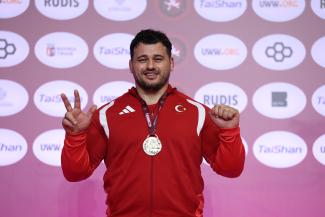
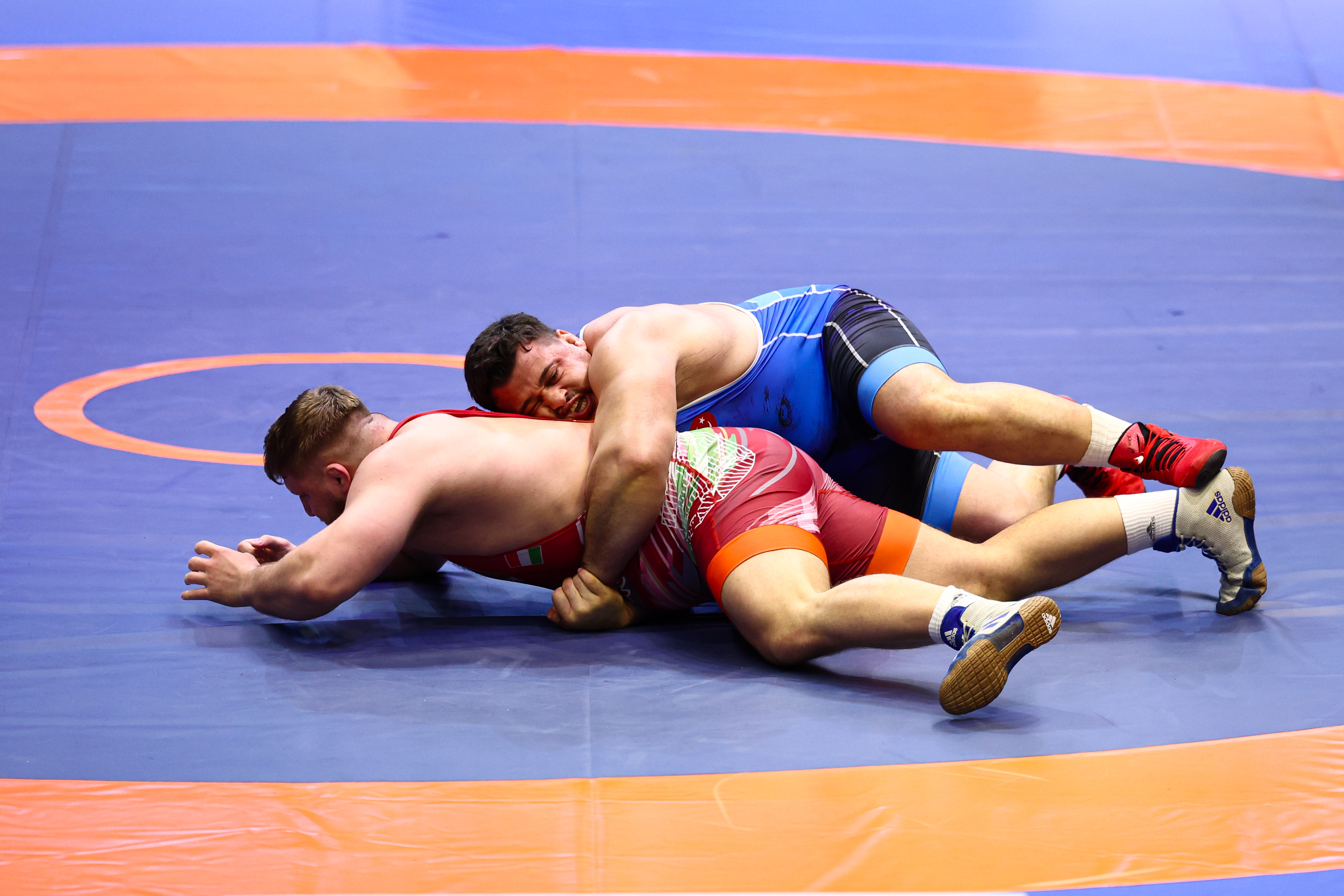 Riza KAYAALP (TUR) turns Darius VITEK (HUN) in the 130kg final. (Photo: United World Wrestling / Kadir Caliskan)
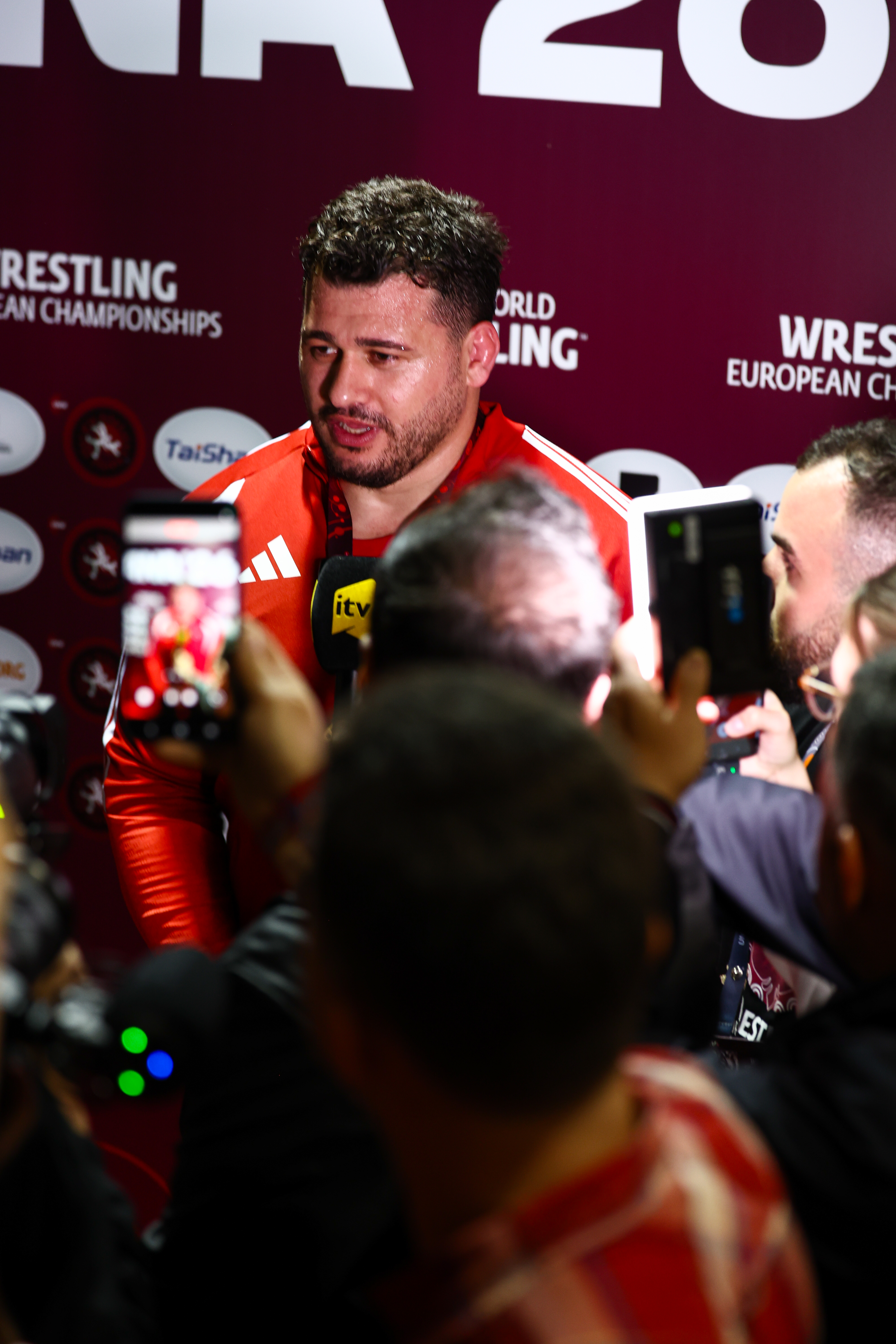 Riza KAYAALP (TUR) speaks to the media after winning the gold medal at the European Championships. (United World Wrestling / Jake Kirkman)
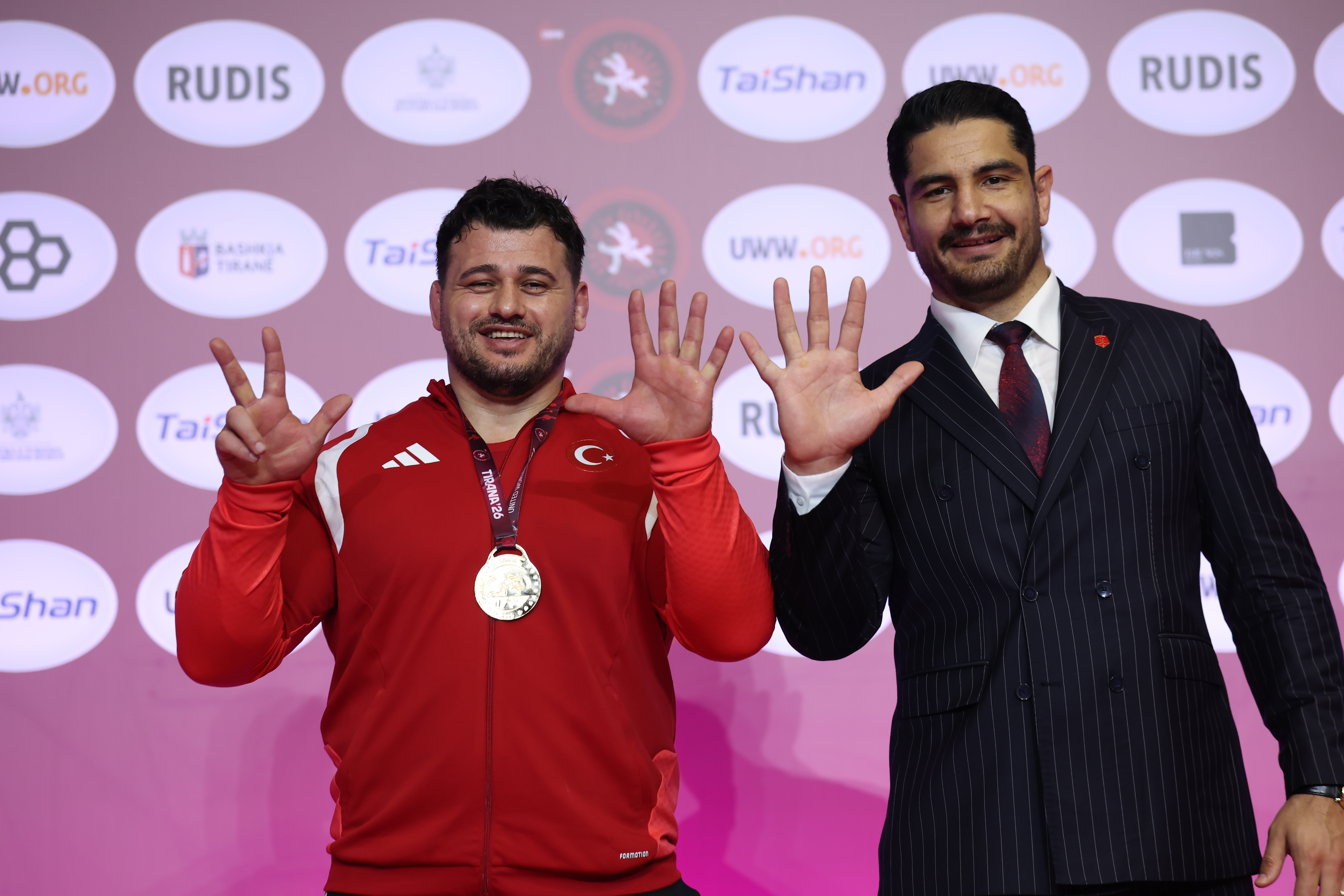 Riza KAYAALP (TUR) with Taha AKGUL (TUR) at the medal ceremony in Tirana. (Photo: United World Wrestling / Kadir Caliskan)
Share your thoughts.
Comments