

Takahashi Tops Rio Silver Medalist Higuchi in Playoff for Olympic 57kg Ticket
Saturday, June 12, 2021 - 16:47 By Ken Marantz

TOKYO---The message from his wife on the handkerchief tucked away in his singlet impelled Yuki TAKAHASHI to be confident and assured him "it was going to be a good day." How right she was.
Takahashi came up with the win he had waited for his entire life--the one that earned him an Olympic ticket--by defeating 2016 Rio Olympics silver medalist Rei HIGUCHI 4-2 in a wrestle-off Saturday for Japan's freestyle 57kg spot at the Tokyo Games.
Takahashi, the 2017 world champion, filled the Olympic spot he himself had secured at the final world qualifying tournament just over a month ago after scoring a 2-point counter exposure with a minute to go to defeat Higuchi in the special match held at Tokyo's Ajinomoto National Training Center.
"He's the Rio silver medalist and I know he's a strong wrestler," the 27-year-old Takahashi said. "To me, I was the one who got the Olympic berth [for Japan] and making it mine was another step in the process. I didn't want to waste the chance."
Under strict coronavirus protocols with Tokyo still in a third state of emergency, only about 20 people were present at the match in the NTC wrestling room, not unlike the final gladiator fight scene between Kirk Douglas and Tony Curtis in Spartacus. The match was livestreamed on Facebook, with a online press conference on Zoom held afterwards.
The match had originally been scheduled to be held on the final day of the Meiji Cup All-Japan Invitational Championships in late May, but was pushed back as Takahashi had gone through a two-week quarantine upon returning from the final world qualifier in Sofia, Bulgaria.
"I'm more relieved than anything," Takahashi said. "After I got back from the world qualifying tournament, the date [of the playoff] wasn't decided and it made me anxious and things remained tense. I had to maintain my weight that I had just done [in Sofia].
"Anyway, there's only 1 1/2 months until the Olympics. I'll take a little rest, then change gears and do what I have to so I have no regrets."
In the match, Takahashi gained the only point of an action-less first period with an activity point, then added another in the second period for a 2-0 lead.
"In the first period, I was hoping to get a takedown, but I got an activity point with my aggressiveness," Takahashi said. "I was able to control the flow like I wanted."
As Takahashi was being awarded his second point, Higuchi got in on a single leg in the first true shot of the match, which he finished off with 1:43 to go to move ahead 2-2 on criteria.
"The first time he got my leg, and I could get a sense of his strength," Takahashi said. "That was at around two minutes [to go], but I didn't think I would lose. He went for a tackle and I thought, 'If I can turn him, I'll turn him, if I can't, I'll get points from standing.' I never thought I was in any danger."

Yuki TAKAHASHI (JPN) exposes Rei HIGUCHI for two points during Saturday's 57kg special wrestle-off. (Photo: Japan Wrestling Federation)
Higuchi remained the aggressor and again secured a single leg near the edge. But Takahashi was able to flatten out his opponent and, reaching over and grabbing a leg, levered him over for a 2-point exposure to go up 4-2 with 1:03 left. That's how it ended.
"Wrestling is six minutes and you never know what is going to happen, you can't let up from start to finish," said the 25-year-old Higuchi, who dropped to the mat in despair after the match. "I don't know what left me a step behind. I was able to do my attacking style of wrestling."
Following the match, Takahashi immediately called his wife, Sayaka, who was watching with Takahashi's parents and brother at their home in Yamanashi, a city 100 kilometers west of Tokyo where he is currently coach of his alma mater, Yamanashi Gakuin University.
"She was half-crying, half-ecstatic," said Takahashi, who credits her and his family for their moral support during the tough times when he thought his Olympic dream had been over.
"Seeing them happy makes me happy. Without them, I wouldn't be here. I wanted to thank them...although it's not over yet. There is the wall of getting to the Olympics, the wall of getting a medal and the wall of winning the gold medal. I am over the first wall."
Takahashi later showed the media a handkerchief that Sayaka had made for him bearing a drawing of him with the Olympic rings, and messages from her and the rest of his family such as "Do as you always do!" and "Go, go, go Yuki! Grab the future!"
"With the writing on it, I thought I might not be able to use it because it isn't white," Takahashi joked.
The victory came nearly two years after Takahashi, also a world bronze medalist in 2018, came up short in his first attempt at clinching an Olympic spot, which he could have done by winning a medal at the 2019 World Championships in Nur-Sultan.
Instead, a 10th-place finish left the door open for others to enter the picture, which is what Higuchi did. After an unsuccessful attempt to wrest the 65kg spot from 2018 world champion Takuto OTOGURO---although he did win a world U-23 gold at that weight--- Higuchi went through the grueling process of dropping back down to 57kg, a struggle that cost him dearly at one point.
Higuchi took a huge step forward when he defeated Takahashi at the All-Japan Championships in December 2019, which earned him the right to enter the Asian Olympic qualifying tournament.
Then the global pandemic hit, and the saga took an unexpected twist. The one-year delay in the Tokyo Olympics and the qualifiers only made it harder for Higuchi, who had not wrestled at 57kg since the Rio Games and was constantly fighting a battle with the scale.
"That has always been the biggest issue for me," Higuchi said. "I'm a bit bigger than those in the world of 57kg. I did a lot of research into weight loss and hired a trainer, and talked with other wrestlers and friends. I would never have been able to do it on my own."
At the Asian qualifier in Almaty in April, disaster struck. Higuchi stunned Japan and the wrestling world when he failed to make weight as a prohibitive favorite at 57kg. It might not have been a slam dunk, but with just nine entries, the odds were certainly in his favor.
The Japan federation opted to dispatch Takahashi, the 2020 All-Japan champion, in Higuchi's place to the world qualifier. He lived up to the expectations, emerging from the field of 23 as one of the two finalists to clinch the berth for Japan and set up the playoff with Higuchi.
Before the Rio Olympics, the two went through almost the same scenario. Takahashi suffered a shocking third-round loss of the 2015 All-Japan to an unheralded wrestler, and Higuchi went on to take the title. He then won the Asian Olympic qualifier to earn the ticket to Rio, where he took the silver.
"That was a disappointment, but I was able to put it behind me," said Takahashi, who added he wants to lead by example as a coach. "If you don't give up, it will produce results. That is what I want to show."
As for Higuchi, he remains unsure what the future holds.
"The Tokyo Olympics are over for me," Higuchi said. "With all of the weight loss, I've been through a dark time. I will take some time to refresh myself mentally, get my thoughts in order and decide what to do."
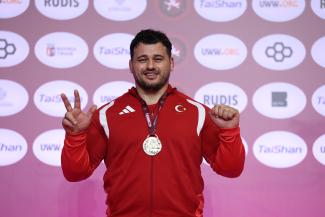
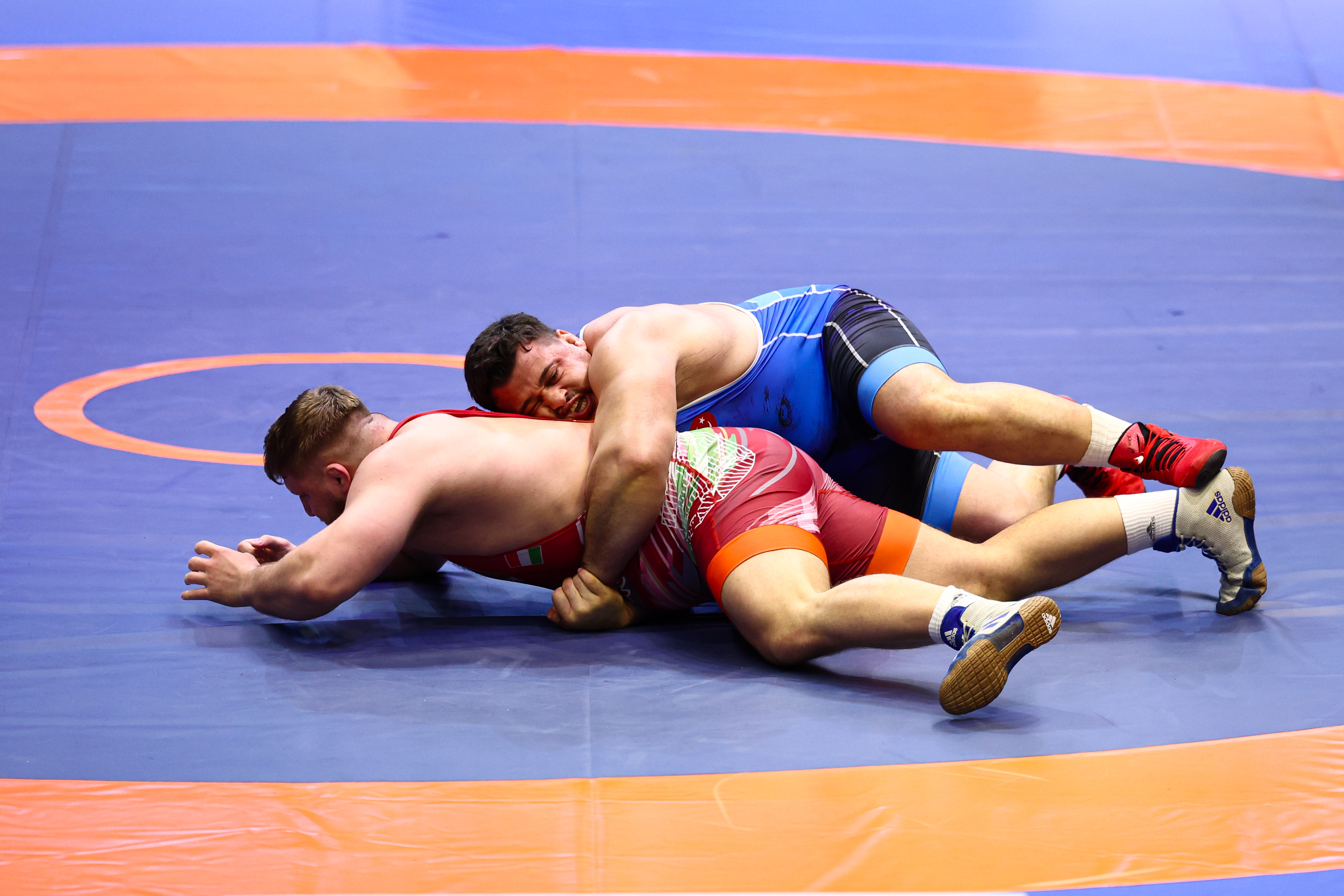 Riza KAYAALP (TUR) turns Darius VITEK (HUN) in the 130kg final. (Photo: United World Wrestling / Kadir Caliskan)
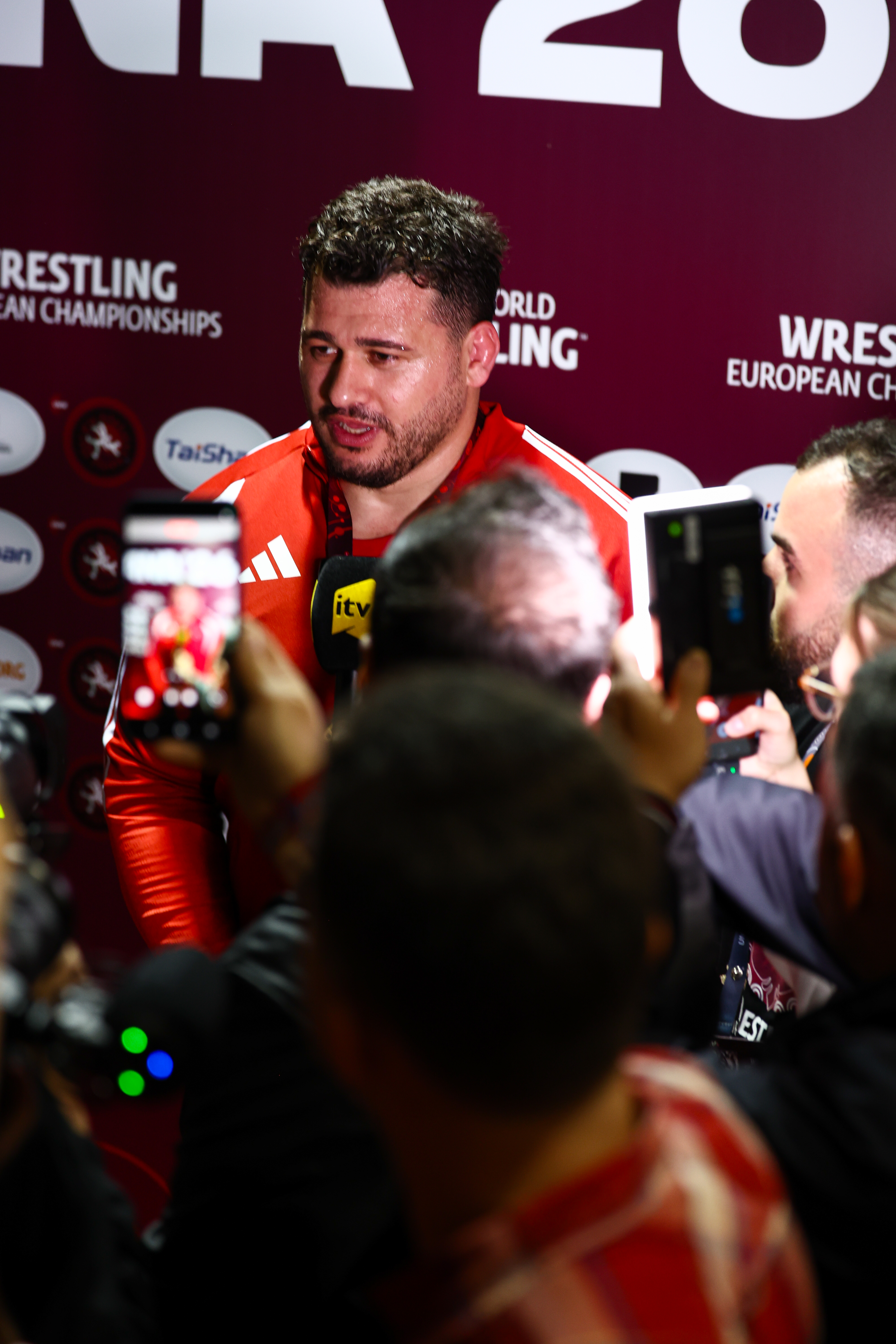 Riza KAYAALP (TUR) speaks to the media after winning the gold medal at the European Championships. (United World Wrestling / Jake Kirkman)
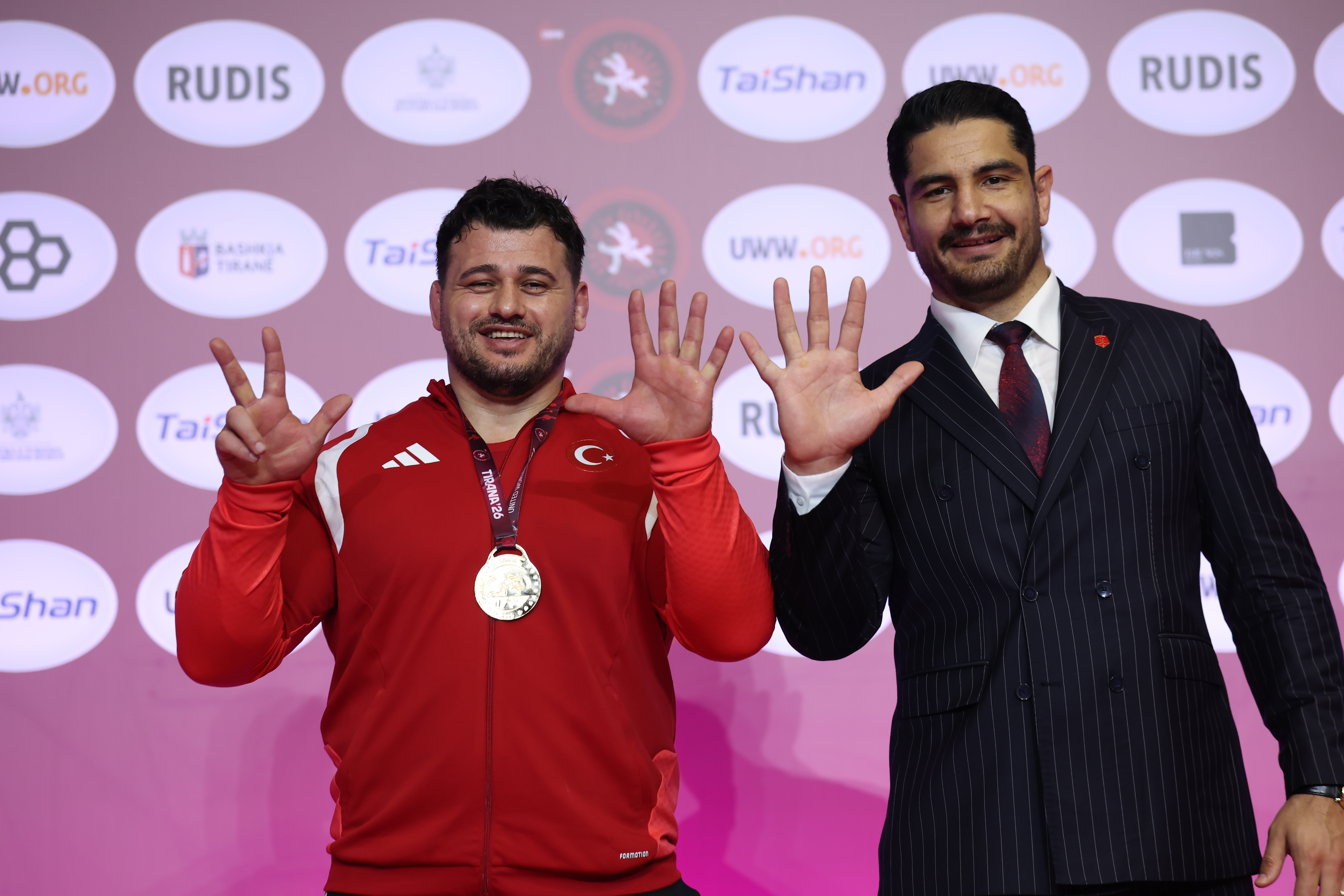 Riza KAYAALP (TUR) with Taha AKGUL (TUR) at the medal ceremony in Tirana. (Photo: United World Wrestling / Kadir Caliskan)
Share your thoughts.
Comments