

Top Stories of the Decade

Sushil Kumar Wins World Championship, Awakens Wrestling Powerhouse in India

By Vinay Siwach

CORSIER-SUR-VEVEY, Switzerland (December 24) -- India had never won a gold medal at a global wrestling event. The drought was such no one seemed to put money on any wrestler to even a medal, forget the top one. Indians weren't supposed to dominate world events in any sport.

That was about to change. On September 12, 2010, Sushil KUMAR (IND) broke all barriers to become India's first-ever gold medal winner at the World Championships in Moscow, Russia. In the 66kg weight category, Kumar would put up a commanding performance and beat Alan GOGAEV (RUS) 3-1 in the final in front of a hostile home crowd.

On the back of his bronze medal at the Beijing Olympics in 2008, Kumar arrived in Moscow as a dark-house, like he had in all global competitions. No one gave him a chance in India. But as the day progressed, the 36-year-old raised hopes.

He beat Anastasios AKRITIDIS (GRE), 6-2, in the opening round followed by Martin DAUM (GER), 4-1. Buyanjavyn BATZORIG (MGL) failed to challenge in quarter-final and lost 9-1 before Kumar eked out a close 4-3 win against Jabrayil HASANOV (AZE) in the semifinal.

"2010 was the best year," Kumar said. "Wherever I went, I won gold. Commonwealth Games, Asian Championships, World Championships. I beat a Russian wrestler in Russia."

These things were unheard of in India. Kumar's victory was hailed because no one had heard that an Indian wrestler can go to Russia and defeat their wrestler to win a gold medal. 

And if the world thought Kumar's bronze in Beijing was a fluke, he changed that and gave a new life to Indian wrestling which was struggling with doping scandals, nepotism and inter-federation politics. His medal put wrestling on India's sports map and perhaps the top one too.


Kids thronged to akhadas in villages in Haryana, Delhi and Uttar Pradesh. Not only boys, but parents were ready to break social stigmas and send their girls to akhadas, a place where girls are seldom seen. New wrestling pockets emerged and broke the dominance of traditional powerhouses like Haryana and Maharashtra.

The result was seen three years later when India won three medals at 2013 World Championships and this year in Nur-Sultan, it won five, the best-ever performance.

Kumar added a silver medal at London Olympics to become India's first-ever individual to win multiple medals at the Games. But it was before that India needed a sporting hero. It got one on that September evening in Moscow.
#development

Road to Dakar 2026 Continues with Successful Central Africa Programme in Brazzaville

By United World Wrestling Press

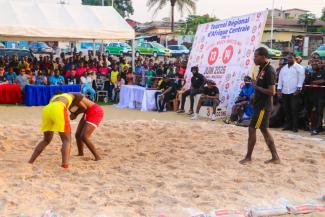
BRAZZAVILLE, Republic of Congo (June 21) -- The second stop of the United World Wrestling (UWW) Africa Regional Educational Development Programme, Road to Dakar 2026, concluded successfully in Brazzaville after a week combining athlete preparation, education, technical development and competition in Olympic and Beach Wrestling.

Held from June 8 to 14 in the Republic of Congo, the Central Africa phase brought together National Olympic Committees and National Federations from across the region under a unified objective: strengthening wrestling ecosystems and creating more accessible pathways toward the Youth Olympic Games Dakar 2026.

As the second of four regional tournaments scheduled within the continental Road to Dakar programme, the event represented another important milestone on the road to the first Olympic event to be hosted on African soil.

Africa REDT

The UWW Africa Regional Educational Development Programme was designed as a comprehensive and sustainable model that extends beyond competition. The initiative combines athlete development camps, coach and referee education, and practical competition opportunities.

By decentralising activities across regions and consolidating training and competition into one structure, the programme aims to reduce financial barriers for national federations and increase opportunities for athletes and technical officials.

Throughout the week, athletes participated in intensive daily training sessions, as coaches attended the UWW Technical Course - Level 2, focused on improving technical knowledge, athlete development methodologies and long-term performance planning.

Africa REDT

Simultaneously, referees took part in dedicated education sessions covering Beach Wrestling and introductory officiating pathways, preparing them for selection to undertake the International Category III referee examination in the future.

The programme concluded with the Regional Tournament, followed by the Beach Wrestling Regional Tournament, giving participants the opportunity to apply lessons learned during the educational phase directly into competition conditions.

The programme specifically prioritised youth development, with participating athletes largely drawn from the U17 age group and encouraging the involvement of emerging coaches across Central Africa. Support mechanisms jointly delivered by UWW and Olympic Solidarity helped facilitate participation through travel, accommodation, training access and tournament organisation.

Africa REDT

More than just a standalone event, Brazzaville demonstrated the long-term vision behind Road to Dakar 2026 by building stronger national structures, expanding participation and creating sustainable development opportunities well before the final qualification stages for the Youth Olympic Games.