

Development

Saudi Wrestling Federation Hosts Introduction to Refereeing Course for New Female Referees

By United World Wrestling Press

Following the vision of the Saudi Wrestling Federation, headed by Mr. Mashaal Aljomaih, a five-day introduction to refereeing course for females was conducted January 31- February 04, at the Green Halls in Riyadh under the auspice of the General Manager of the Leadership Development Institute Abdullah Bin Faisal Hammad.

The introduction to refereeing course was the first course ever for new female referees in KSA. Sixteen female participants from all over the kingdom attended the five-day course in Riyadh. And it was a great opportunity to introduce them to refereeing wrestling and its basic rules.

The course was financially covered by the Saudi Wrestling Federation and the Leadership Development Institute. Saudi Federation covered the domestic flight tickets and the full accommodation for all the female participants, while the Leadership Development Institute covered all the other expenses.

The UWW Educator Sherif HALAWA from Egypt assisted by the Cat I International Referee Mohsen Yamani, Chief of Saudi referees conducted the course. The Course was also an opportunity to teach the female participants how to use the electronic Arena system during the wrestling competitions. The Cat III international referee Saud Alsuhaibi assisted Mr. HALAWA in teaching the female participants how to use the Arena system.


The Saudi Wrestling Federation hosted an introduction to refereeing course for female referees. The course lasted five days and was held in Riyadh. 

During the course, three specialized lecturers from Kind Saud University did also some sessions in 3 different topics (Sports Psychology, Sports injuries, and Sports management). The Leadership Development Institute covers all the lecturers’ expenses.

All the female participants did not practice wrestling before. Therefore, during the course there was some theoretical sessions about the wrestling rules basis, some practical sessions on the mat (however they did not have the referees’ uniform), and some practical sessions on Arena system to manage a competition. For 5 days, the female participants watched many videos about wrestling rules and some matches to let them feel the sport of wrestling.

The Saudi Wrestling Federation made a decision to assign the new female referees to the coming national competitions to work as referees, especially to manage the Arena system and to work as judge. They must gain the experience through continuous participation at competitions, and step-by-step, they'll take the whistle and work as referees on the mat soon.
#WomensWrestling

'Women who fight are strong and beautiful': How wrestlers have broken barriers, one takedown at a time

By United World Wrestling Press

CORSIER-SUR-VEVEY, Switzerland (March 8) -- They come from the gleaming futuristic city that is Tokyo to an ancient Moldovan hamlet; the American suburbs to the rustic Indian villages. They belong to diverse backgrounds, different cultures and have undertaken contrasting journeys from obscurity to the top.

It doesn’t matter if you are Nonoka OZAKI (JPN), Anastasia NICHITA (MDA), Amit ELOR (USA) or ANTIM (IND). One thing binds them all.

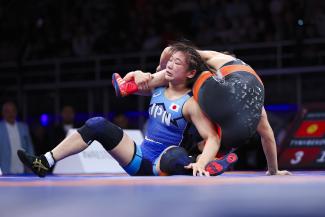
At every step, they were told: “Wrestling isn't for girls.” Taunted and heckled for cutting their hair short and playing a ‘man’s sport’, they shattered stereotypes and broke barriers one takedown at a time. Today, they are role models for wrestlers not just in their respective countries but beyond borders.

“Every time I was told that wrestling isn’t for girls, I thought, "I'll prove them wrong. Gender has nothing to do with strength,” two-time world champion Ozaki says.

Elor adds: “Every time I felt doubted or like I didn’t belong, it only made me work harder to prove them wrong. I love showing that women are just as tough, skilled, and capable as anyone else on the mat.”

For some, discrimination started at home. Antim -- Hindi for ‘last’ -- got her name because her family hoped she would be the last girl child. Antim grew up to land an ever-lasting punch to patriarchy with her exploits on the mat, which have contributed to the changing mindset towards women in her village in Northern India.

Thousands of miles away, Nichita faced similar struggles. Growing up in Tataresti, Moldova, Nichita was told by her family not to wrestle, as it wasn’t ‘meant for girls’. “But I loved this sport so much that I didn’t pay attention to what others were saying. When you do something with your heart, something you truly love, it doesn’t matter what others think,” she says.

Sarah HILDEBRANDT (USA)Sarah HILDEBRANDT (USA) is the Olympic champion at 50kg. (Photo: United World Wrestling / Kadir Caliskan)

Empowerment and self-belief

Sarah HILDEBRANDT (USA) insists wrestling ‘empowered’ her ‘confidence and self-belief because its lessons and processes’ gave her the opportunity to ‘combine things like strength and grace, logic and intuition, deliberateness and flow…and endless other dualities’.

Hildebrandt won the gold medal in the 50 kg weight class at last year’s Paris Olympics. It was a classic redemption for her, having missed out on the gold medal in a cruel manner at the Tokyo Olympics. And on her way to the top of the podium in Paris, Hildebrandt showcased her wide-ranging skills, which she says also help her in everyday life.

"Through that, I’ve gotten to learn just who I am and challenge myself not only to grow through wrestling but also to express who I’ve uncovered. To feel confidence because what I uncover is authentically ME," Hildebrandt says. "It’s given me identity- not through accolade or achievement but through my process and the values I sharpen as I work toward those achievements. I can apply these lessons and skills to all areas of my life. It’s invaluable."

Zaineb SGHAIER (TUN)Zaineb SGHAIER (TUN) is a two-time Olympian from Tunisia. (Photo: United World Wrestling /Amirreza Aliasgari)

Teenage prodigy Zaineb SGHAIER (TUN) agrees that wrestling is a great source of 'confidence and patience', which help them in daily life. "It might not be easy to be a woman wrestler in a male-dominated society but with love for the wrestling and passion rooted in our hearts, no one can stop us," the two-time Olympian says.

Hildebrandt is conscious that the sport will test them in ‘countless ways’. “Being a woman in this sport is an additional test at times. But a woman wrestler is not deterred by those tests. They recognize the power the lessons in wrestling hold,” the American wrestler says. “The vulnerability required to step on the mat is exactly why it is the greatest sport in the world and a woman wrestler is a woman who craves that so they can discover just who they are.”

Anastasia NICHITA (MDA)Paris Olympic silver medalist at 57kg Anastasia NICHITA (MDA). (Photo: United World Wrestling / Kadir Caliskan)

Indeed, the challenges for a wrestler extend beyond the mat. For Nichita, the constant injuries pegged her back but she braved them to finish second on the podium in the French capital last year.

"The biggest obstacle I had to overcome was injuries. Throughout my career, I’ve had to push through many injuries—knees, shoulders, back, ribs—but it was all worth it for the sake of my dream and my love for wrestling,” Nichita says.

Eventually, love for the sport is what keeps them going.

For Ozaki, wrestling is a way to best express herself. “Women who fight are strong and beautiful,” she says. “You can see this by watching women’s wrestling.”

Elor dreams that ‘women’s wrestling continues to grow worldwide, with more opportunities, more support, and more respect.’

As the new Olympic cycle gains momentum, the wrestlers are resetting their targets and evolving their training plans. Nichita, for one, hopes to covert her Paris silver into gold at the 2028 Los Angeles Olympics gold medal. ”I know it will be very difficult,” she says. “But after everything I’ve been through, nothing scares me anymore.

But amidst her personal goals, she hasn’t lost the sight of the bigger picture: “I will continue to prove that wrestling is not just for boys."