BISHKEK, Kyrgyzstan (April 9) -- To hear Yui SUSAKI (JPN) speak of it, she is a new version of the wrestler who had stormed to every major title on offer before her unexpected and devastating downfall at the 2024 Paris Olympics.
Having made serious changes to both her lifestyle and wrestling style in the ensuing years, she made a golden return in her first international competition since Paris.
Susaki made sure there would be no lapses or surprises when she defeated Son Hyang KIM (PRK) 6-0 in the women’s 50kg final at the Asian Championships on Thursday in Bishkek, Kyrgyzstan.
“I’m genuinely happy, and I’m so glad to be back here and to have won,” Susaki said. “After Paris was over, I experienced various setbacks and I made various changes over the two years. The results of my new lifestyle in the two years since Paris and the daily practice I put in all came out in the four matches at these Asian Championships.”
In the four other women’s finals on the fourth day of competition, the host country had mixed results, as Olympic silver medalist Meerim ZHUMANAZAROVA (KGZ) won the gold in a stacked 68kg division, while Davaanasan ENKH AMAR (MGL) stunned defending champion Aiperi MEDET KYZY (KGZ) at 76kg.
The powerful Japanese squad had three other finalists besides Susaki, but only got a title from teenager Sowaka UCHIDA (JPN) at 55kg, while Mengyu XIE (CHN) triumphed at 59kg for her first Asian gold.
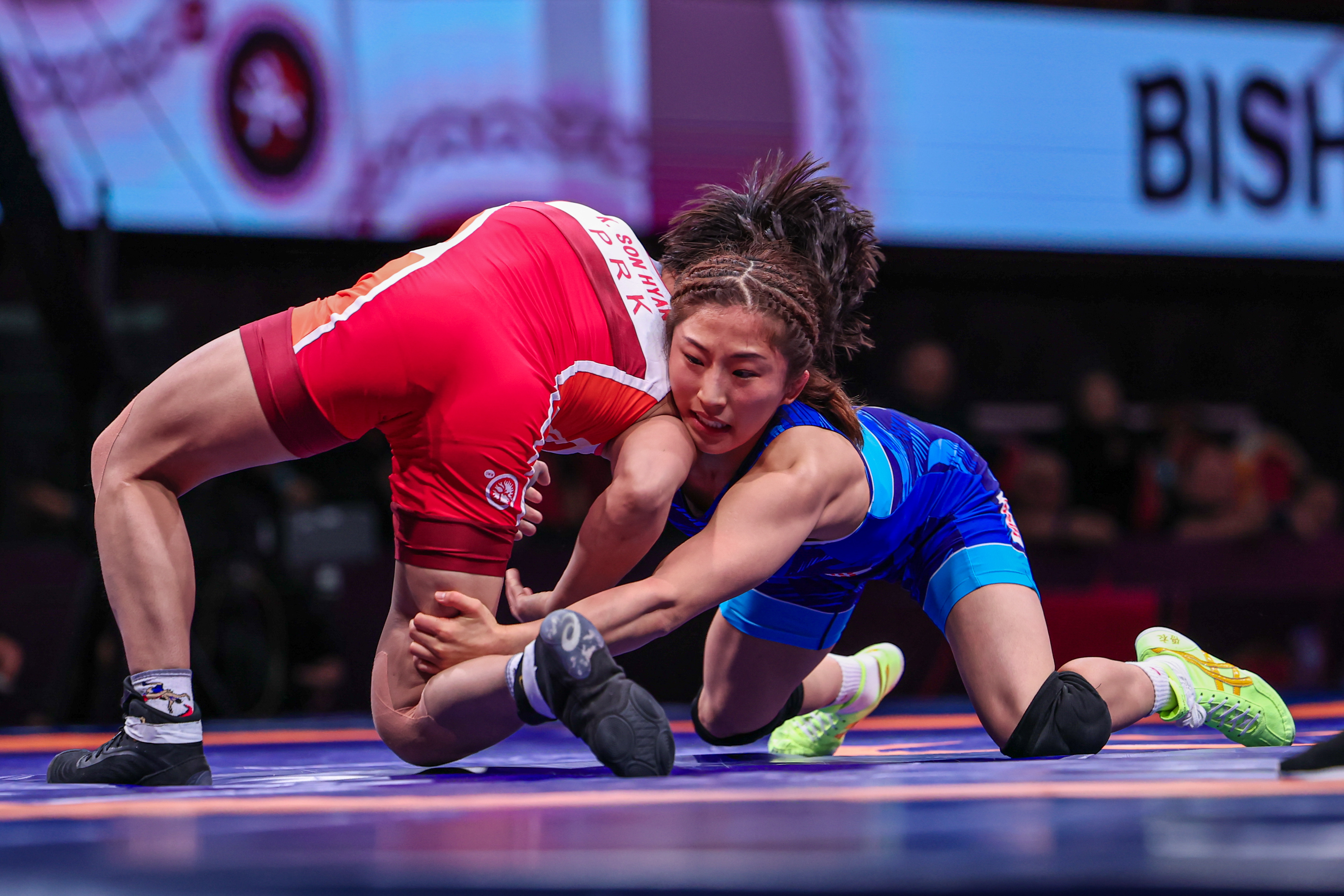 Yui SUSAKI (JPN) hits a leg-attack on Son Hyang KIM (PRK) during the 50kg final at the Asian Championships. (Photo: Untied World Wrestling / Kadir Caliskan)
Susaki had established herself as one of the new faces of the sport in the wake of the retirements of legends Saori YOSHIDA (JPN) and Kaori ICHO (JPN) with her triumph at the 2021 Tokyo Olympics.
That victory had made her the founding member of the “Golden Grand Slam” club for those who had won an Olympic gold as well as titles on all four levels of World Championships – senior, U23, U20 and U17.
But leading up to the defense of her Olympic title in Paris, she had shown chinks in the armor, first with some near-misses at the 2024 Asian Championships, which she still won but in less-than-convincing fashion.
It then all came crashing down at the Champs de Mars Arena, where she was dealt a stunning last-second loss by Vinesh PHOGAT (IND), marking her first-ever loss to a non-Japanese wrestler. Susaki ended up taking home a bronze, but that was small consolation.
After taking some time off, Susaki decided that some changes were in order, from altering her diet to make cutting weight easier to revising her match strategy.
“Along with Vinesh in Paris, I also learned much from my first-round match against the DPR Korean [Yong Ok HWANG] at the Asian Championships before Paris,” Susaki said, referring to an unusually difficult victory. “After that, I lost at the National Games [to Moe KIYOOKA], making it really a difficult two years.
“But thanks to those experiences, I have grown considerably. I definitely want to win the gold at the Los Angeles Olympics, and taking it one step at a time, I will take each title along the way.”
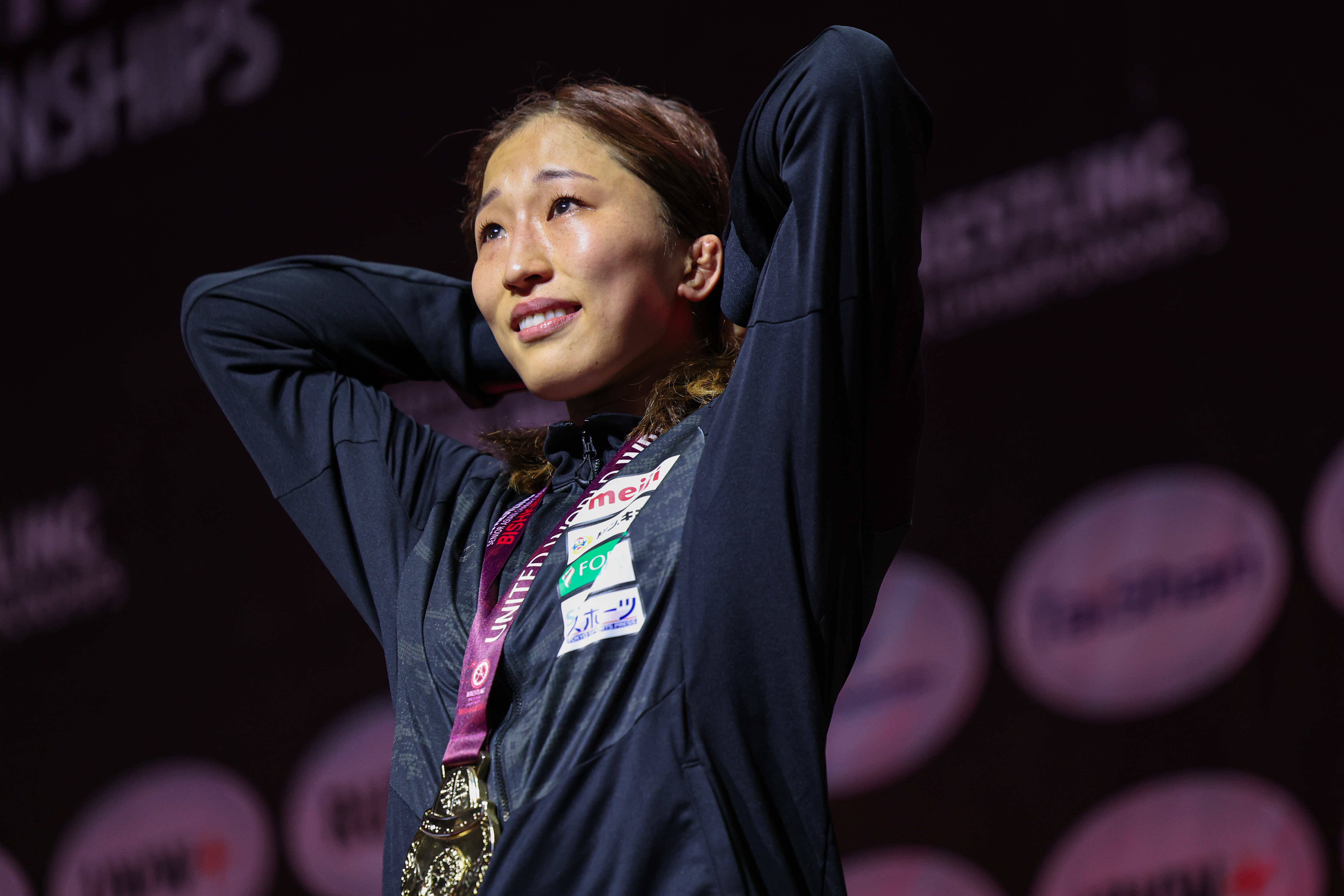 An emotional Yui SUSAKI (JPN) at the medal ceremony. (Photo: United World Wrestling / Kadir Caliskan)
The final at the Zhastyk Arena on Thursday, which brought her to tears on the medal podium, was a reunion of sorts. Susaki and Kim had faced each twice way back in 2017, first in the final at the Asian Championships and again in the semifinals of the World Championships. Susaki won both encounters.
Given her Paris experience, Susaki knew she could not underestimate Kim, and set up her moves deliberately and without anxiousness. She broke through with a go-behind takedown in the first period, then added a stepout for a 3-0 lead.
In the second period, Susaki got in deep on a tackle, but could only manage a stepout, then padded the lead with a snapdown takedown to make it 6-0. Down the stretch, she kept calm and on alert as Kim tied up, looking for an opportunity for a last-ditch throw that never came.
“It’s been nine years since I faced Kim Son Hyang, so it’s been quite awhile,” Susaki said. “She has achieved good results. I think I myself have changed and grown a lot over these past nine years.”
Susaki seemed unconcerned about a potential future encounter with the current world 50kg champion, Myong Gyong WON (PRK).
“The country and the opponent does not matter,” she said. “My objective is to assure I win by giving 100 percent.”
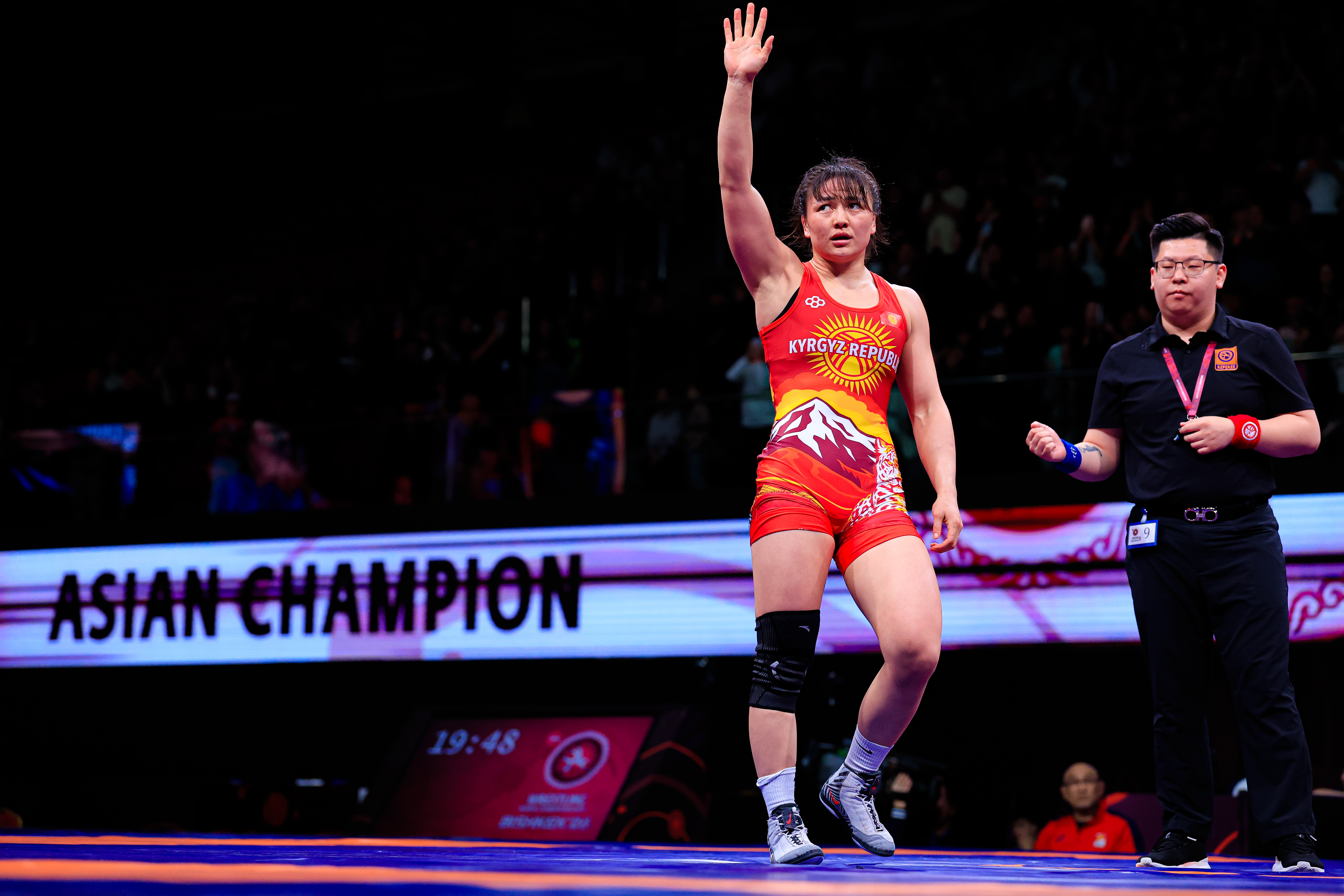 Meerim ZHUMANAZAROVA (KGZ) won her second Asian title. (Photo: United World Wrestling / Kostadin Andonov)
At 68kg, Zhumanazarova spun behind for a first-period takedown and held on for a 2-1 victory over Miwa MORIKAWA (JPN), last year’s world and Asian champion at 65kg who has moved up to the Olympic weight.
The victory gave Zhumanazarova her second Asian gold, after previously winning in 2021, and fifth medal overall.
“This is my second gold medal at the Asian Championships, but it means just as much to me as the first one,” Zhumanazarova said. “I’m just as happy, because I’ve worked very hard for it and this is the result.”
Like Susaki and Kim, Zhumanazarova and Morikawa have a history that goes back some time. The two had met in the quarterfinals of the 2016 World Cadet (U17) Championships, where Morikawa won 4-0 en route to the silver medal. Zhumanazarova took a bronze.
Since then, they have both achieved varying levels of success. Zhumanazarova has two Olympic medals, including a bronze from Tokyo, and a world title from 2021. Morikawa has medals from five consecutive World Championships from 2021 to 2025, including two golds, and two Asian titles.
Morikawa needed to beat reigning world champion Ami ISHII (JPN) at the Japan national championships just to make the team to Bishkek.
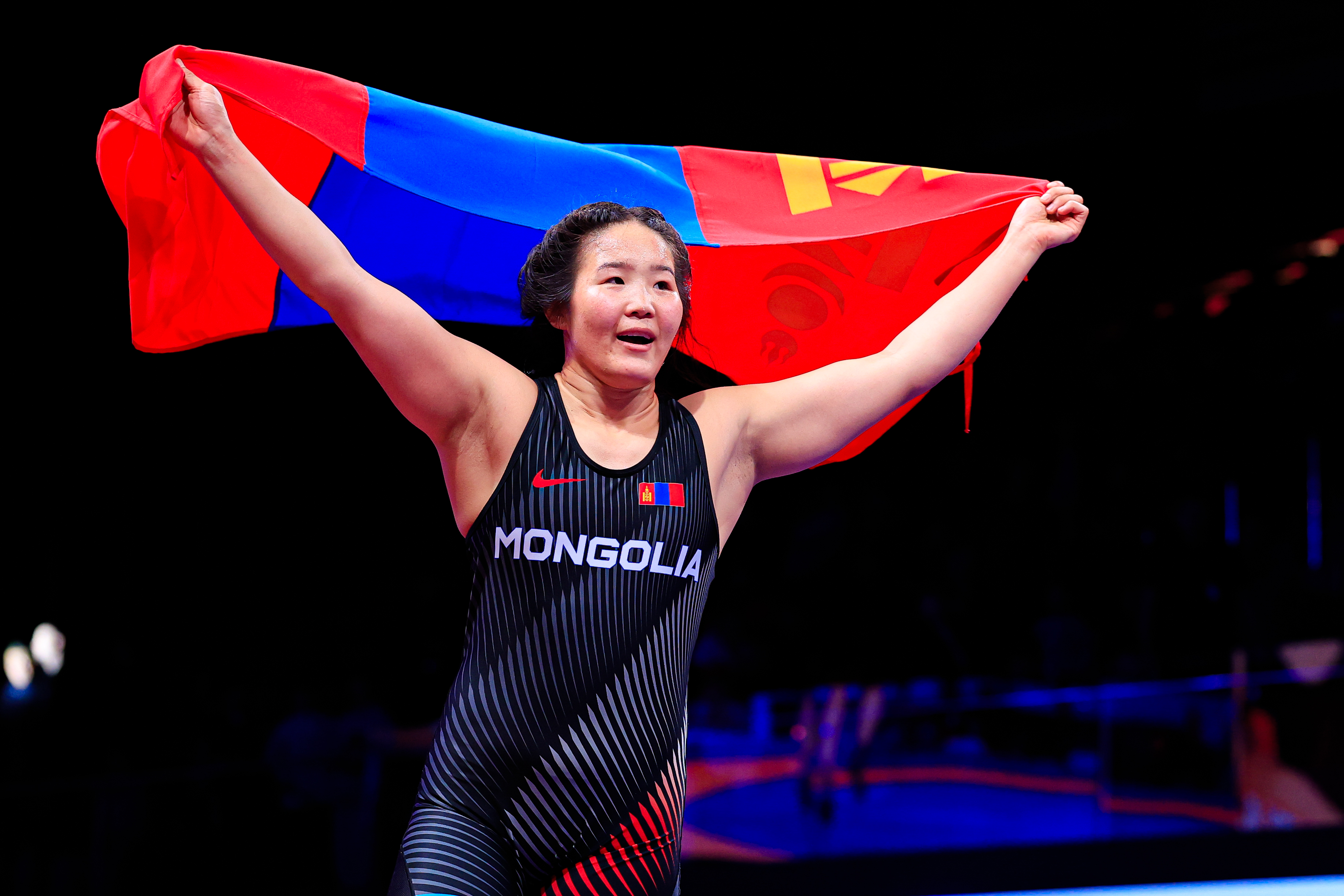 Davaansan ENKH AMAR (MGL) defeated home favorite Aiperi MEDET KYZY (KGZ) in the 76kg final. (Photo: United World Wrestling / Kostadin Andonov)
While the home crowd was still buzzing over Zhumanazarova’s win, compatriot Medet Kyzy was dealt a come-from-behind 4-2 loss by Enkh Amar in the 76kg final.
With no real attacks and lots of mutual pushing, Medet Kyzy had taken a 2-0 lead on an activity point in the first period and a face-shoving penalty in the second. After Enkh Amar received an activity point, the match finally started to heat up in the final minute.
Enkh Amar used a headlock to get Medet Kyzy off balance and slipped behind her with the two on their feet, then proceeded to march her over the edge for a stepout with :13 left. Medet Kyzy’s lack of a resistance led to a 1-point fleeing penalty to put the Mongolian ahead 3-2.
“I was very calm, and my coach also said to me to stay very calm, and that's why I made the correct decision at the last moment,” said Enkh Amar, the 2023 world silver medalist at 72kg.
As the clock ticked down, Medet Kyzy powered Enkh Amar to the edge and slammed her to the mat, sending the crowd into a frenzy. But the move failed to beat the clock, and an unsuccessful challenge made the final score 4-2.
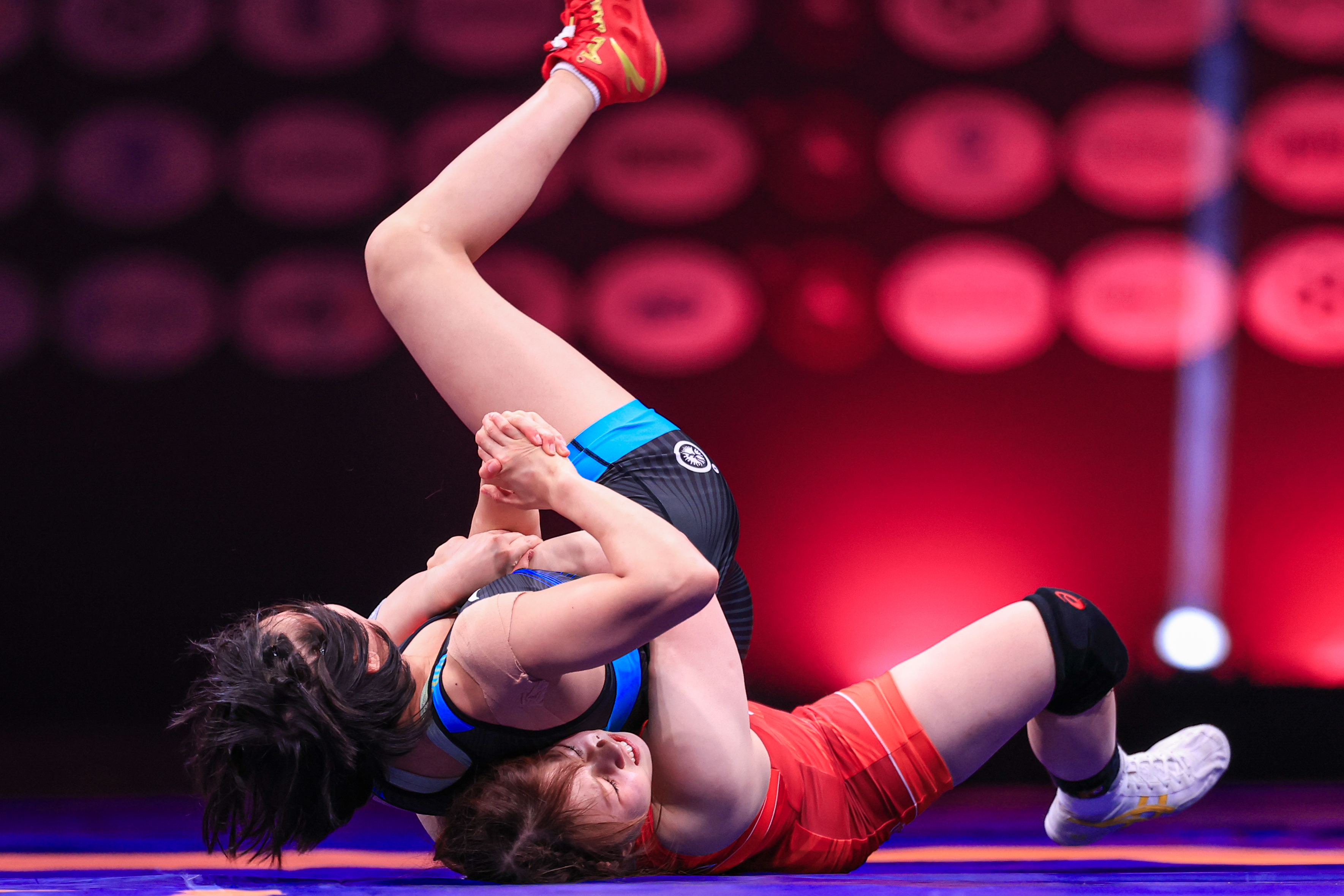 Sowaka UCHIDA (JPN), red, turns Yuxuan LI (CHN) during the 55kg final. (Photo: United World Wrestling / Kadir Caliskan)
In the 55kg final, Japan’s Uchida spotted Yuxuan LI (CHN) a six-point lead, only to storm back for a 10-6 victory that relegated the Chinese to a silver medal for the second straight year.
Li gained a takedown off a counter and proceeded with two gut wrenches. But on an attempt at a third, Uchida stepped over for a 2-point exposure.
Uchida’s next attack hit the mark for a single-leg takedown, to which she added two rolls of her own for an 8-6 lead. Uchida then sewed up the victory with a takedown for the lone points of the second period.
“Right away, I gave up a go-behind takedown and she rolled me, so I was really panicking,” Uchida said. “It made me uneasy that I couldn’t finish off my single-leg tackle, which is my specialty, and I gave up points off of it.
“But I have a variety of moves, and I know the hardships I went through to get here. I believed in myself and remembered to keep attacking to the end.”
Uchida said that when she noticed her opponent appeared to be running out of gas, she applied more pressure.
“I realized that my opponent was getting winded and even though it was tough for me, too, mentally I was feeling a bit at ease,” she said. “Even though I came back, it was still only a two-point difference. I made sure not to let up through the end.”
For the 19-year-old Uchida, a recent world U17 and U20 champion who had to settle for a bronze medal at last year’s World Championships in her first major senior-level tournament, the win in Bishkek had special meaning.
“I definitely wanted to win my first [major] senior tournament, but I lost convincingly at the World Championships in September,” Uchida said. “It was really tough to take, so I was really determined to win here.
“This is my last international tournament as a teenager, so I really wanted to finish with a win. Even if it was messy, I just wanted to be able to smile at the end.”
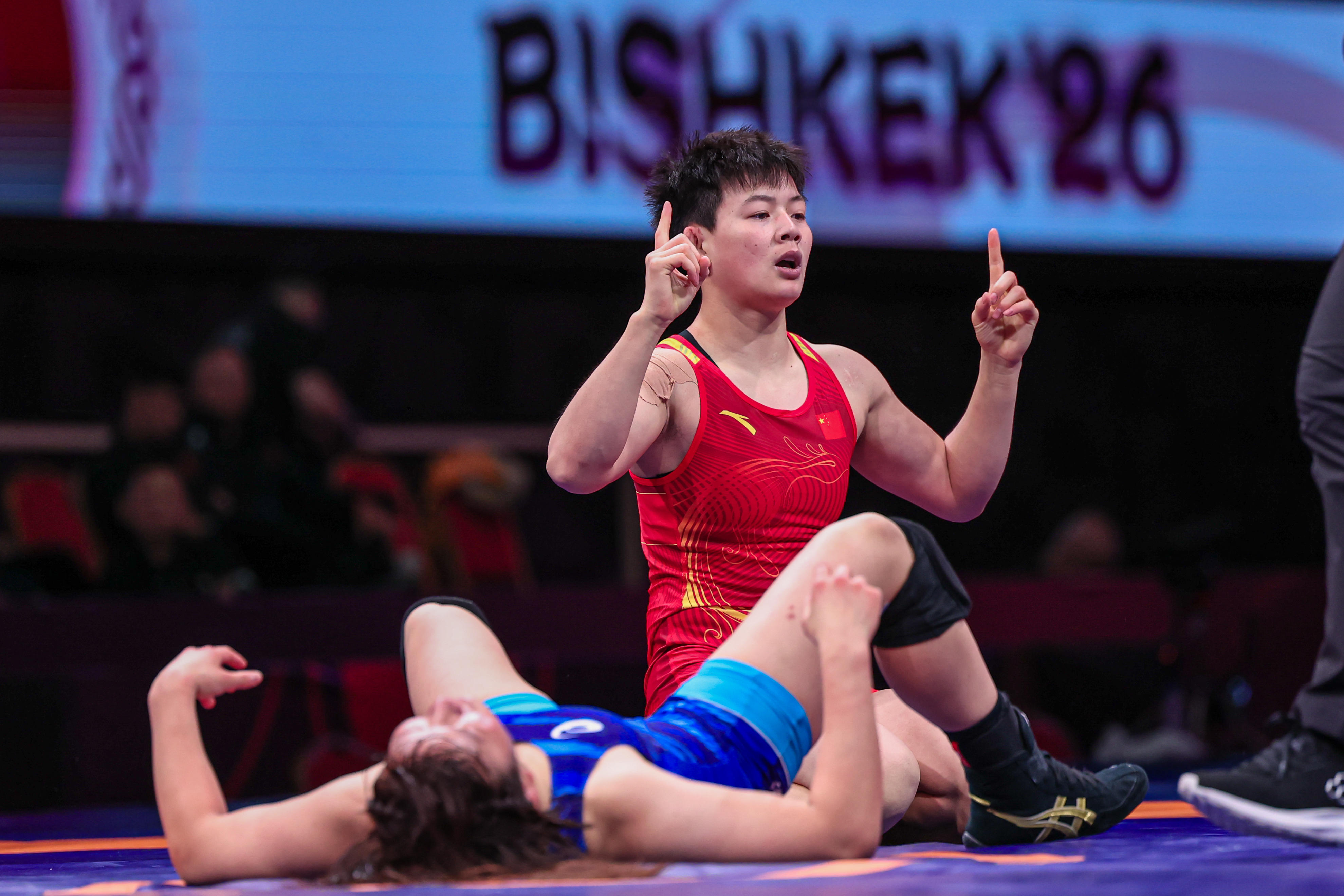 Mengyu XIE (CHN) won the 59kg gold medal with an 8-6 victory over Sena NAGAMOTO (JPN). (Photo: United World Wrestling / Kadir Caliskan)
At 59kg, China’s Xie won her first Asian gold by surviving a fierce battle with Sena NAGAMOTO (JPN), hanging on for an 8-6 victory after holding a five-point lead in the second period.
“I know the opponent, the Japanese wrestler is very strong and tough,” Xie said. “I knew it would be a difficult final, but I didn't put too much burden on my shoulders. I just followed my mood and tactics and what the coach told me to do.”
Xie, a bronze medalist last year, struck first with a duck under for a takedown, but Nagamoto used a low single for a takedown in the final seconds of the first period to make it 2-2.
Xie broke the match open with a stepout and two takedowns to lead 7-2, but Nagamoto was not prepared to give up the fight. The 2023 world U23 silver medalist gained a 2-point exposure from a reverse headlock, which Xie slipped out of for a reversal.
Nagamoto picked up a late takedown, but Xie held on for the win.“I needed to be more careful to do all the actions because the opponent will try her best to attack,” Xie said. “But I cannot only think about defense, but also find a chance to do counterattack or attack.”
Xie, who also has a world 55kg bronze won in 2022, reveled in triumphing in her first trip to a major final.
“I never had this experience before,” she said. “It’s the first time in the final and I won gold the first time. So it’s like a dream.”
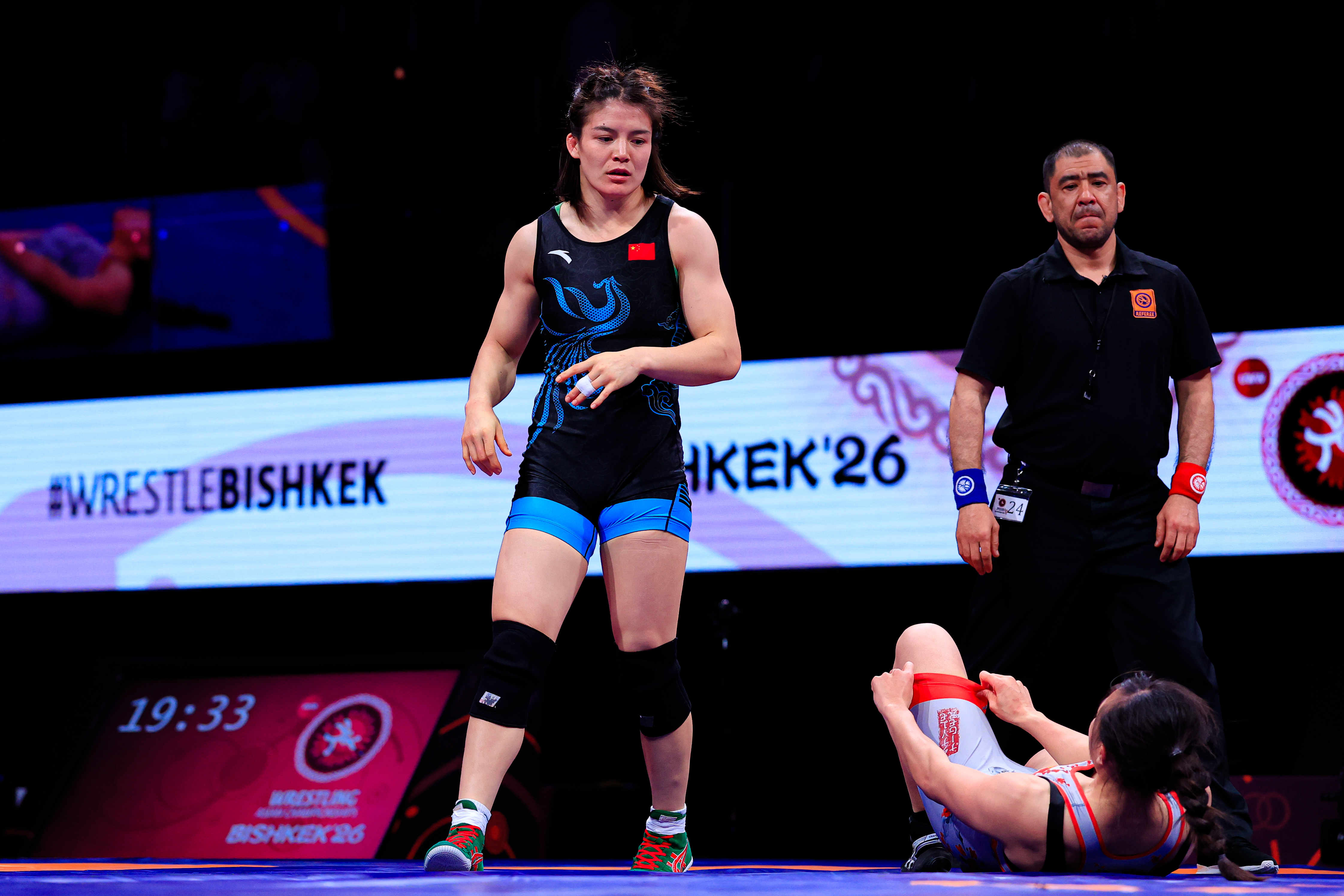 Returning champion at 68kg, Zelu LI (CHN) had to settle for a bronze medal in Bishkek. (Photo: United World Wrestling / Kostadin Andonov)
All 5 Chinese make medal podium
Zelu LI (CHN), dethroned as the 68kg champion by Zhumanazarova in the semifinals, was among a trio of Chinese who won bronze-medal matches to ensure that all five of the country’s wrestlers made it to the podium on Thursday.
Li, a 2025 world bronze medalist at 72kg, had little trouble rolling to a 10-0 victory in 1:25 against an overmatched Thi Linh DANG (VIE) to take home a 68kg bronze.
Li twice combined a takedown with two rolls – using an intriguing technique in which she locked Dang’s heel against the back of her leg in lieu of the more common lace lock.
In the other 68kg match, Delgermaa ENKHSAIKHAN (MGL) picked up her second straight bronze and fifth Asian medal overall by ending what had been a close match with Yelena SHALYGINA (KAZ) with a fall 47 seconds into the second period.
With the score tied 1-1, Enkhsaikhan powered the 37-year-old Shalygina straight to her back and secured the fall, denying the veteran another major medal in a vast collection that includes a bronze at the 2008 Beijing Olympics.
At 50kg, Aktenge KEUNIMJAEVA (UZB) denied Sri Lanka its first-ever Asian medal, scoring an activity point and a takedown off a barrel roll in the first period to edge Nipuni HEWA PEDIGE (SRI) 3-0. Hewa Pedige became the fourth wrestler overall and second woman from the island nation to make it to a bronze-medal match, and the fourth to come away empty-handed.
Olympic bronze medalist Ziqi FENG (CHN) earned her third career Asian medal by taking the other 50kg bronze with a quick 10-0 win over Maral TANGIRBERGENOVA (KAZ), scoring a takedown and four rolls in 1:16.
At 76kg, Wenji LI (CHN) secured China’s third bronze of the night, scoring a takedown and three stepouts in a 5-0 victory over Hui Tsz CHANG (TPE).
Gulmaral YERKEBAYEVA (KAZ) became a five-time Asian bronze medalist – dating back to 2015 – when she defeated Eunju HWANG (KOR) 5-1 for the other 76kg bronze.
The 30-year-old Yerkebayeva scored a takedown in the first period and added another in the last 10 seconds of the match to clinch the victory.
The wildest match of the day came at 59kg, in which Ulmeken ESENBAEVA (UZB) squandered a nine-point lead to fall behind by three points, only to throw down Sezim ZHUMANAZAROVA (KGZ) and secure a fall with 23 seconds left.
Esenbaeva had a 4-point takedown as she raced to a 9-0 lead in the first period. But Zhumanazarova came to life, scoring a takedown and then piling up points in a scramble that included a 2-point penalty against Esebaeva for grabbing the head. When the dust was cleared on challenge, Zhumanazarova had a 12-9 lead at the break.
In the second period, Esenbaeva cut the gap with a backwards trip for a takedown. With time running out, she secured a headlock and took Zhumanazorova to her back for a 13-12 lead that became irrelevant when the fall was confirmed.
The other 59kg match has its share of drama as well, as NEHA (IND) rallied from a 4-1 deficit with second-period surge that gave her a 10-4 victory over two-time Asian medalist Bolortuya KHURELKHUU (MGL).
Neha won her first Asian medal after moving up to 59kg, having finished second at the Zagreb Ranking Series at 57kg, the weight class in which she won a world U17 gold and U23 bronze in 2024.
That was India’s second bronze of the night, after Hansika LAMBA (IND) scored all of her points in the second period of a 6-1 victory over 2024 bronze medalist Aruuke KADYRBEK KYZY (KGZ) at 55kg.
Ariunzaya ODONCHIMEG (MGL) received the other 55kg bronze when Jeongbin OH (KOR) defaulted due to injury.

Day 4 Results
Women’s Wrestling
50kg (11 entries)
GOLD: Yui SUSAKI (JPN) df. Son Hyang KIM (PRK), 6-0
BRONZE: Aktenge KEUNIMJAEVA (UZB) df. Nipuni HEWA PEDIGE (SRI), 3-0
BRONZE: Ziqi FENG (CHN) df. Maral TANGIRBERGENOVA (KAZ) by TS, 10-0, 1:16
53kg (11 entries)
SF 1: Jin ZHANG (CHN) df. Moe KIYOOKA (JPN) by Fall, 2:33 (2-2)
SF2: MEENAKSHI (IND) df. Seoyoung PARK (KOR), 4-2
55kg (8 entries)
GOLD: Sowaka UCHIDA (JPN) df. Yuxuan LI (CHN), 10-6
BRONZE: Ariunzaya ODONCHIMEG (MGL) df. Jeongbin OH (KOR) by Inj. Def.
BRONZE: Hansika LAMBA (IND) df. Aruuke KADYRBEK KYZY (KGZ), 6-1
57kg (11 entries)
SF 1: Kexin HONG (CHN) df. Youngjin KWON (KOR) by TS, 10-0, :30
SF2: Khulan BATKHUYAG (MGL) df. Sara NATAMI (JPN) by Fall, 3:20 (8-1)
59kg (8 entries)
GOLD: Mengyu XIE (CHN) df. Sena NAGAMOTO (JPN), 8-6
BRONZE: NEHA (IND) df. Bolortuya KHURELKHUU (MGL), 10-4
BRONZE: Ulmeken ESENBAEVA (UZB) df. Sezim ZHUMANAZAROVA (KGZ) by Fall, 5:37 (13-12)
62kg (11 entries)
SF 1: Nonoka OZAKI (JPN) df. Nigina SABIROVA (UZB) by Fall, 1:55 (8-0)
SF2: Hyon Gyong MUN (PRK) df. Tynys DUBEK (KAZ) by TS, 11-0, 3:20
65kg (9 entries)
SF 1: LILI (CHN) df. Firuza ESENBAEVA (UZB) by Fall, 2:09 (4-0)
SF2: Nana IKEHATA (JPN) df. Hanbit LEE (KOR), 4-0
68kg (10 entries)
GOLD: Meerim ZHUMANAZAROVA (KGZ) df. Miwa MORIKAWA (JPN), 2-1
BRONZE: Zelu LI (CHN) df. Thi Linh DANG (VIE) by TS, 10-0, 1:25
BRONZE: Delgermaa ENKHSAIKHAN (MGL) df. Yelena SHALYGINA (KAZ) by Fall, 3:47 (3-1)
72kg (8 entries)
SF 1: Jia LONG (CHN) df. Nurzat NURTAEVA (KGZ) by TS, 11-1, 4:31
SF2: Mahiro YOSHITAKE (JPN) df. HARSHITA (IND) by Fall, 5:59 (7-2)
76kg (9 entries)
GOLD: Davaanasan ENKH AMAR (MGL) df. Aiperi MEDET KYZY (KGZ) 4-2
BRONZE: Wenji LI (CHN) df. Hui Tsz CHANG (TPE), 5-0
BRONZE: Gulmaral YERKEBAYEVA (KAZ) df. Eunju HWANG (KOR), 5-1



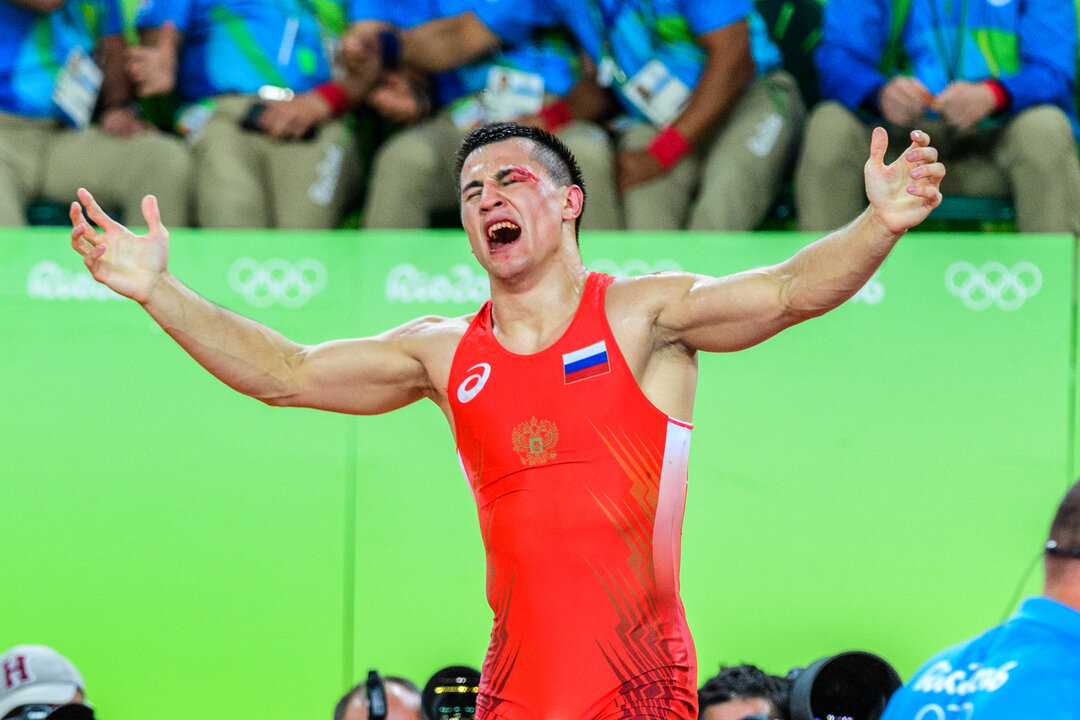 Roman VLASOV (RUS) celebrates after winning his second Olympic title. (Photo: Tony Rotundo)
 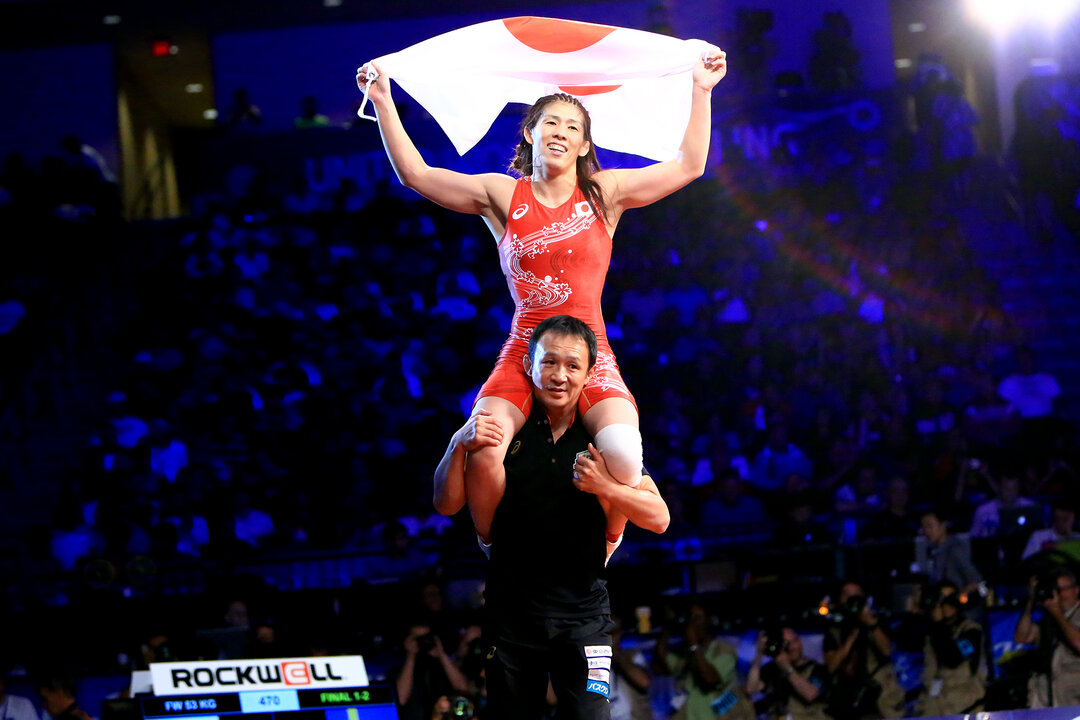 Saori YOSHIDA (JPN) celebrates after winning the 2015 world title in Las Vegas, Nevada. (Photo: Gabor Martin)
Share your thoughts.
Comments