

Top Stories of the Decade

Russian Men, Japanese Women Dominate the Decade

By Ken Marantz

CORSIER-SUR-VEVEY, Switzerland (December __ ) -- At this year's World Championships in Nur-Sultan, both Kyrgyzstan and the Democratic People's Republic of Korea came away with their first-ever world gold medals in women's wrestling. France earned its first medal of any kind in freestyle with a bronze. And the tiny enclave of San Marino, while not winning a medal, qualified a wrestler for the Olympics for the first time.

While the family of champion-producing and medal-winning nations continues to expand, there are still a select number of countries that remain dominant. In looking at the decade from 2010 to 2019, Russia in both freestyle and Greco-Roman and Japan's women wrestlers soared high above all others.

The numbers speak for themselves, and show just how much of a gap there was during the 10-year span.

In freestyle during that period, Russia captured a total of 25 gold medals at the worlds, more than double the 12 of the nearest competitor, the United States. By comparison, Georgia was next highest with six golds, while Iran and Azerbaijan had five each.

The Russians also had the most silvers (9) and bronzes (18) for an overall total of 52. Iran was next highest with 29 (6 gold-9 silver-14 bronze), followed by the United States with 26 (12-3-11), Georgia with 21 (6-3-12) and Azerbaijan with 20 (5-7-8).

As medal tallies and team standings go hand-in-hand, it is no surprise that Russia took home six of the eight team titles up for grabs. Only runner-up finishes to Iran in 2013 and the United States in 2017--the latter by a one-point difference--denied Russia a perfect record.

The Olympics, with the reduced number of weight classes, narrowed the gap, but Russia still was either at or among the top of the heap, depending on how one crunches the numbers. Russia compiled three golds and seven medals overall at London 2012 and Rio 2016; Azerbaijan had more medals overall with eight, but one less gold with two. The United States tied Russia with three golds, to which it added two bronzes. Both Iran and Georgia had one gold and six medals overall.

Still only 23, Abdulrashid SADULAEV (RUS) made a large contribution to the Russian tally. Winning the gold at 97kg in Nur-Sultan gave the "Russian Tank" his fourth world title dating back to 2014, adding to his gold from Rio 2016 and a world silver from 2018.

Sadulaev hails from the wrestling hot spot of Dagestan, the mountainous republic in southwestern Russia on the Caspian Sea that has produced an inordinate amount of global champions, and supplies the national team with an unending line of top talent. At Rio 2016, there were six medalists in wrestling from that area alone.

"Wrestling is in our blood," Sadulaev said in an interview with the Olympic Channel. "That's why the Dagestanis are the best in the world."

The team standings at the World Championships determine the field for the ensuing World Cup, but while that team tournament can produce exciting matches, it doesn't always accurately reflect the strength of the nations, as rosters are often filled with second-string talent. As such, Russia won the freestyle World Cup just three times, while Iran had a run of six straight titles from 2012 to 2017. The United States won its lone title as host in 2018.
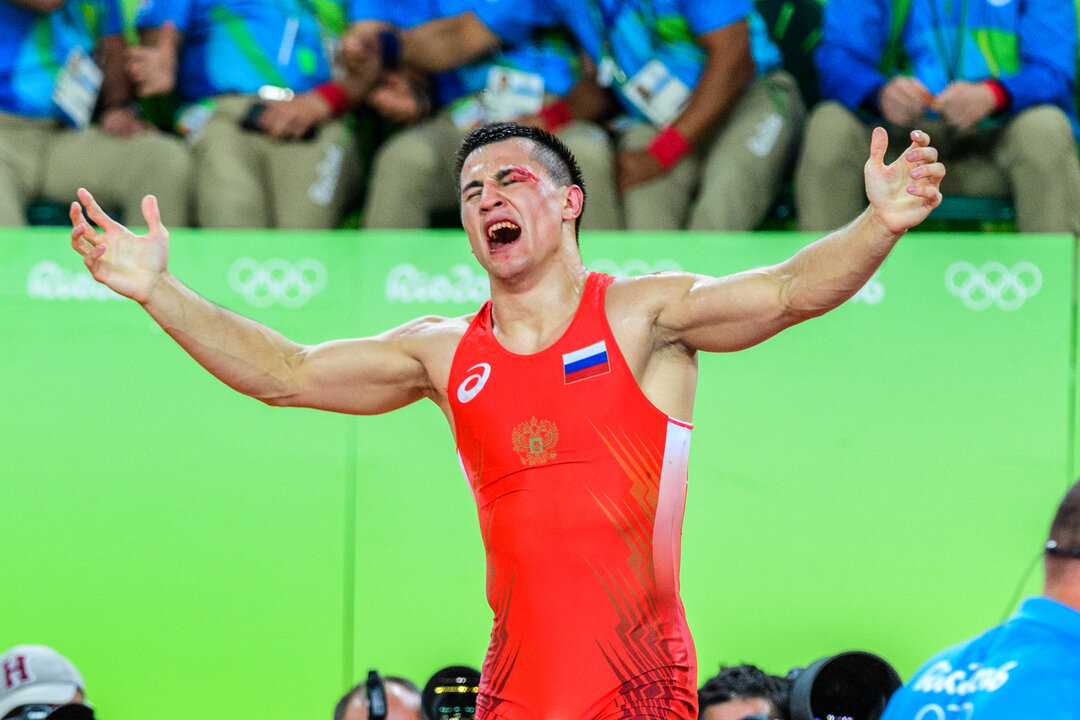
Roman VLASOV (RUS) celebrates after winning his second Olympic title. (Photo: Tony Rotundo) 

In Greco, Russia was only slightly less dominant, heading the pack that saw the spoils more widespread. Over the decade, Russia claimed 14 world golds and 37 medals overall (9 silvers, 14 bronzes), well ahead of the closest competitor, Turkey, which accumulated eight golds and 26 medals in total. Roman VLASOV (RUS)  won two world and two Olympic golds at 74-75kg during the span, while Musa EVLOEV (RUS) chipped in with two golds at 97kg.

Russia took the team title every year except 2014, when it was edged by Iran, which piled up six golds and 19 medals overall in the decade. Armenia also put on a strong showing with 16 overall medals (5-4-7), while Azerbaijan and Hungary had identical results in claiming 17 medals each (4-4-9).

In the two Olympics, Russia captured four golds and eight medals overall, which Cuba and Iran had three golds apiece. For what it's worth, Russia won the World Cup twice, the same number as Azerbaijan, while Iran took home the trophy four times, including three in a row from 2010 to 2012.
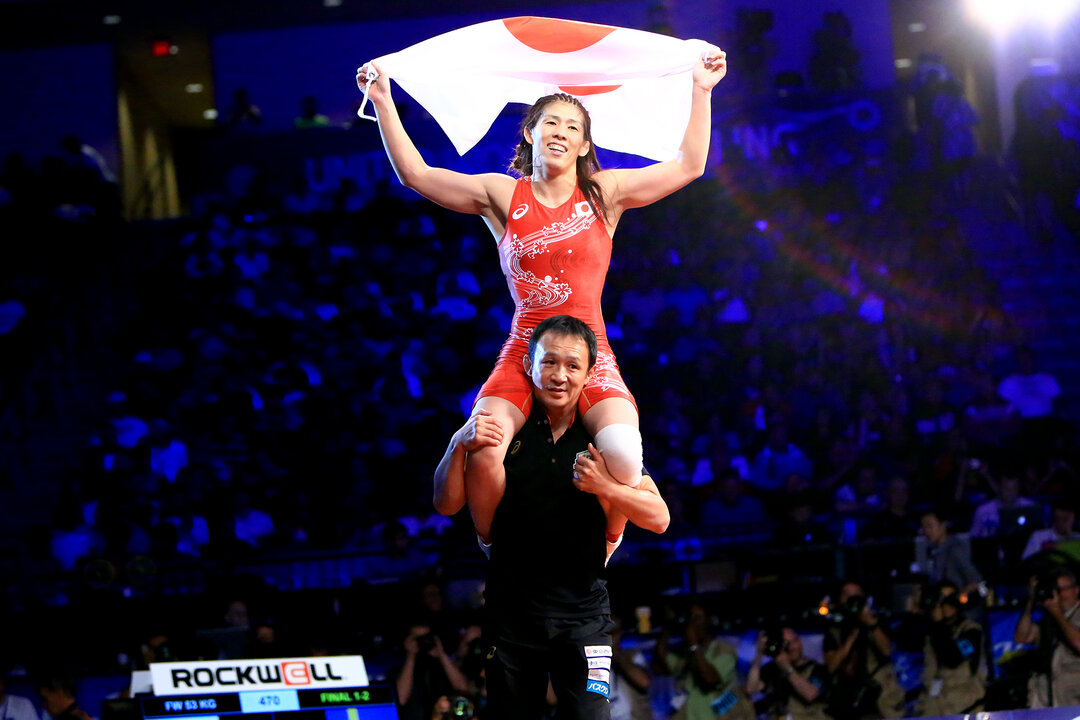
Saori YOSHIDA (JPN) celebrates after winning the 2015 world title in Las Vegas, Nevada. (Photo: Gabor Martin)

When it comes to women's wrestling, Japan got the jump on the rest of the world by putting resources into the sport during its infancy in the late 1980s, and everyone has been trying to catch up since. Adding it to the Olympic program at Athens 2004 provided incentive to the other nations to get in gear, but also served to motivate the Japanese even more.

From 2010 to 2019, Japan captured a whopping 26 gold medals at the World Championships, over 2 1/2 times that of its nearest rival, the United States, which had 10. It also represents more than one-third of the golds available (74). The golds were won by 20 different wrestlers, including Saori YOSHIDA (JPN), who won the last of her 13 world titles in 2015, the same year that Kaori ICHO (JPN) added her 10th and last world gold.

Japan also pocketed nine silvers (the most) and 12 bronzes for a total haul of 48 medals. The U.S. had the next biggest with 28 (10-6-12), while China and Ukraine each earned six golds, and Mongolia, Canada and Russia had four apiece. It was also a Bronze Age for the Chinese, who had 18 third-place finishes.

At the Olympics, the Japanese were in another stratosphere. Of the 10 gold medals awarded (four in London, six in Rio), seven were taken back to the Land of the Rising Sun, including two by Icho. Japan also had one silver medalist--the result of Yoshida's stunning loss to Helen MAROULIS (USA) at 53kg in Rio.

After finishing behind China in three of the first four World Cups of the decade, Japan started fielding stronger teams and last month won its fifth straight title. Three of the five wins came as host, including the most recent in Narita in November.

Like Dagestan for the Russians, there is a hotbed of wrestling in Japan that seems to churn out an inexhaustible flow of women wrestlers ready to challenge the upper echelon and make their own marks. It is not so much a place as an institution, Shigakkan University in central Japan and its affiliated high school.

Yoshida, Icho, Kawai and fellow Rio 2016 champion Sara DOSHO (JPN) are among the countless medal-winning wrestlers produced by Shigakkan, which was formerly known as Chukyo Women's University. One recent notable exception is two-time world champion Yui SUSAKI (JPN), who opted for Tokyo's Waseda University

While success in the age-group divisions does not always translate on the senior level, the numbers put up by the Japanese juggernaut over the decade have been nothing short of mind-numbing: 45 golds in the world juniors, 48 in the cadets, and 18 in the U-23, which has only been held since 2017.

Haruna OKUNO (JPN), as one of Japan's seven gold medalists at this year's world U-23, also became the lone wrestler to complete a "grand slam" of cadet, junior, U-23 and senior titles.

#wrestlebishkek

Iran Caps Asian Championships with Three Golds, Team Title

By Ken Marantz

BISHKEK, Kyrgyzstan (April 12) -- World champion Amir Hossein ZARE (IRI) capped a trifecta of victories for Iran in the last three finals of the Asian Championships, regaining the Freestyle 125kg gold after a one-year absence.

Zare followed Kamran GHASEMPOUR (IRI) and Mobin AZIMI (IRI) onto the top of the medal podium by defeating Shamil SHARIPOV (BRN) 4-0 – his fifth win in five meetings in a two-year span over the Russian-born foe – as the competition wrapped up with the last five Freestyle weight classes.

“Representing Iran despite the hard situation in my country made this gold medal even more meaningful,” Zare said.

World bronze medalist Ghasempour started the Iranian gold rush with a victory by fall in the 86kg final for his third Asian title and first since 2021, and Azimi followed suit by cruising to the 92kg gold to become a first-time champion.

The match of the day came at 61kg, in which Kwang Myong KIM (PRK) came out on top of a 23-point free-for-all over Olympic bronze medalist AMAN (IND), while world 70kg champion Yoshinosuke AOYAGI (JPN) made a successful move up to 74kg by making his fourth Asian medal golden for the first time.

Iran, which also took home two bronzes on the final day at Zhastyk Arena and had five champions overall, finished with 178 points to capture the team title for the third straight year and seventh time in eight years. India, with three golds and three silvers, finished second with 162, while Japan placed third with 127 behind two golds.

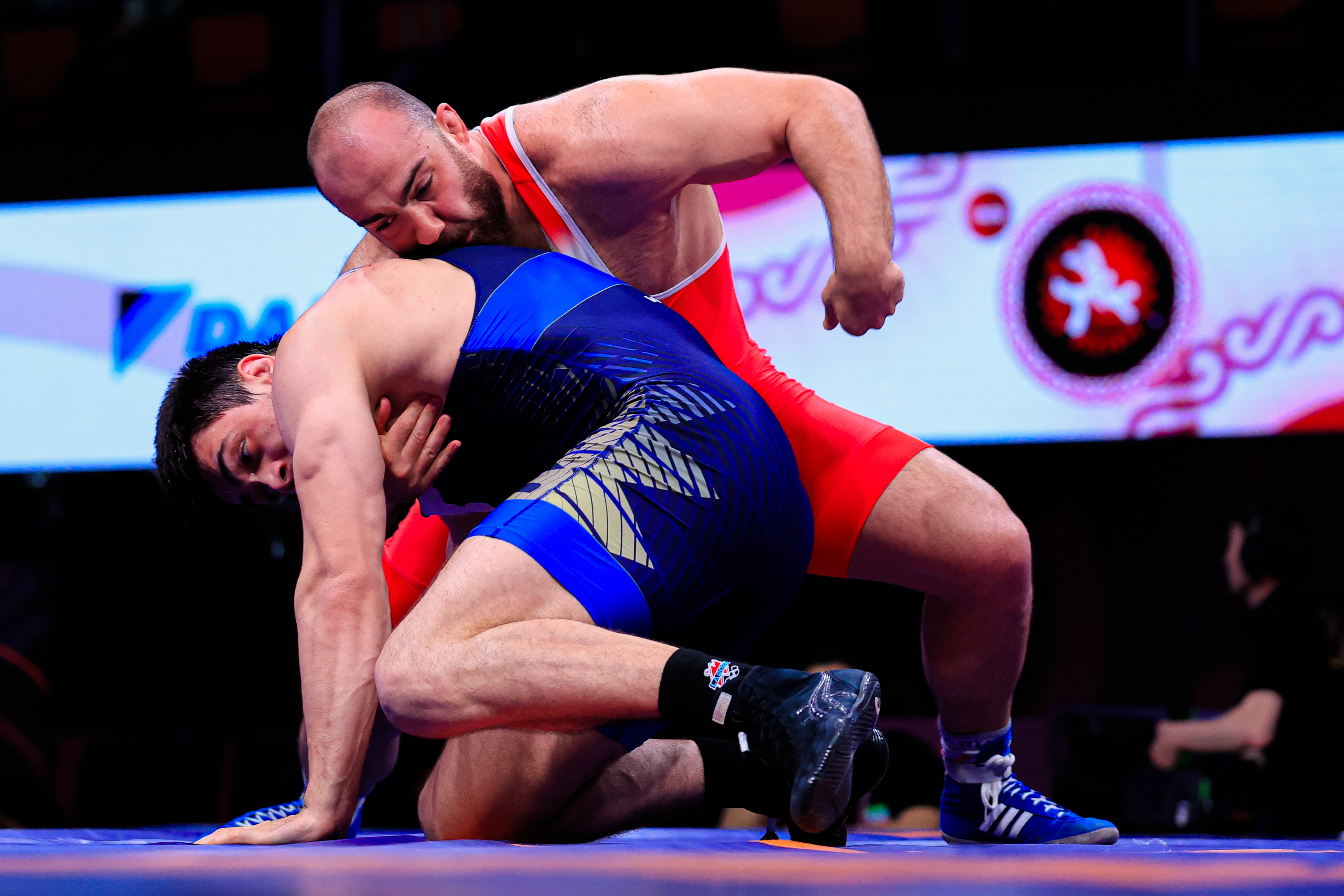
Amir Hossein ZARE (IRI)Amir Hossein ZARE (IRI) scores a takedown on Shamil SHARIPOV (BRN) during the 125kg final. (Photo: United World Wrestling / Kostadin Andonov)
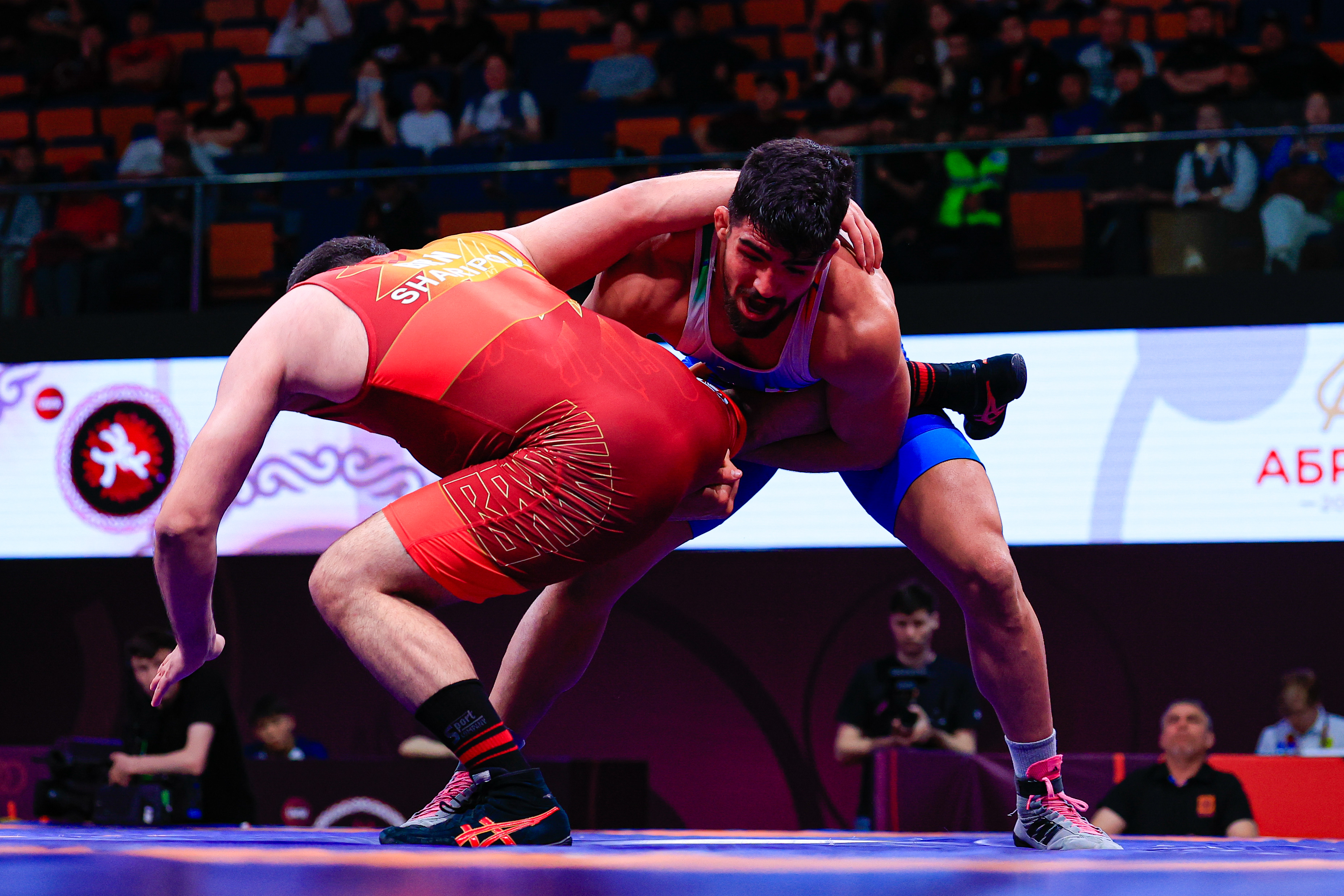
Zare, who missed last year’s tournament in lieu of eventual champion Amirreza MASOUMI (IRI) when Iran dispatched a young team to Amman, defeated Sharipov in a final devoid of high drama, which the Iranian said was due to his still recovering from a recent cold.

After receiving an activity point in the first period, Zare sandwiched a pair of stepouts around a second activity point for a 4-0 victory that never saw him in danger.

“Fighting through a severe cold infection, I lost seven kilograms three weeks before this competition,” Zare said. “I struggled to even finish an hour of training three days before this competition.

“Yet, with the help of my coaches, the prayers of the people, and God's grace, I’ve become a three-time Asian champion,” he added, counting his 2023 Asian Games gold into the total.

While Zare has seen limited action on the continental level, he has certainly made his mark on the global stage. In addition to a 2021 Tokyo Olympic bronze to go with his Paris silver, he has world golds from 2021, 2023 and 2025, as well as a 2022 bronze.

Zare, who was competing for the first time in 2026, has only three losses dating back to 2019 – to Geno PETRIASHVILI (GEO) in the semifinals at the Tokyo Olympics, to Taha AKGUL (TUR) in the semifinals at the 2022 World Championships, and to Petriashvili again in the Paris Olympic final.

Ghasempour, competing for the first time this year, was leading Mukul DAHIYA (IND) 3-0 in the 86kg final when he stuck the Indian for a 4-pointer that he turned into a fall at 2:43.

Ghasempour had just received an activity point when he scored with a single-leg takedown. In the next action, Dahiya shot for a takedown, but Ghasempour got the underhooks in and suddenly pancaked the Indian over to his back.

“This is my first international stage of 2026, and I’m so thankful I could start it all with a gold medal,” Ghasempour said. “I hope to keep this streak going through the next competition.”

Ghasempour won his first Asian gold at 86kg in 2019, then moved up to 92kg and won the Asian title in 2021 and back-to-back world golds in 2021 and 2022. He was absent from the global scene until reappearing at last year’s World Championships, where he took a bronze.

“My aim is to keep this path strong through the 2026 World Championships and finish the year on top, setting the stage for the 2028 Olympics,” he said.

Mobin AZIMI (IRI)Mobin AZIMI (IRI) blanked Magomed SHARIPOV (BRN), 11-0, in the 92kg final. (Photo: United World Wrestling / Kostadin Andonov)
World U23 champion Azimi, who moved down to 92kg after taking a bronze at 97kg last year, finished up an 11-0 victory over Magomed SHARIPOV (BRN) with just under a minute to go – and 10 seconds after scoring his first takedown of the match.

Azimi built up a 7-0 lead with a flurry of stepouts – five in all – before combining a takedown and gut wrench to conclude the match at 5:01.

Sharipov, a world U23 bronze medalist, added the Asian silver to his bronzes from 2023 and 2024.

For those who like their championship matches freewheeling, the 61kg final could hardly have been more entertaining.

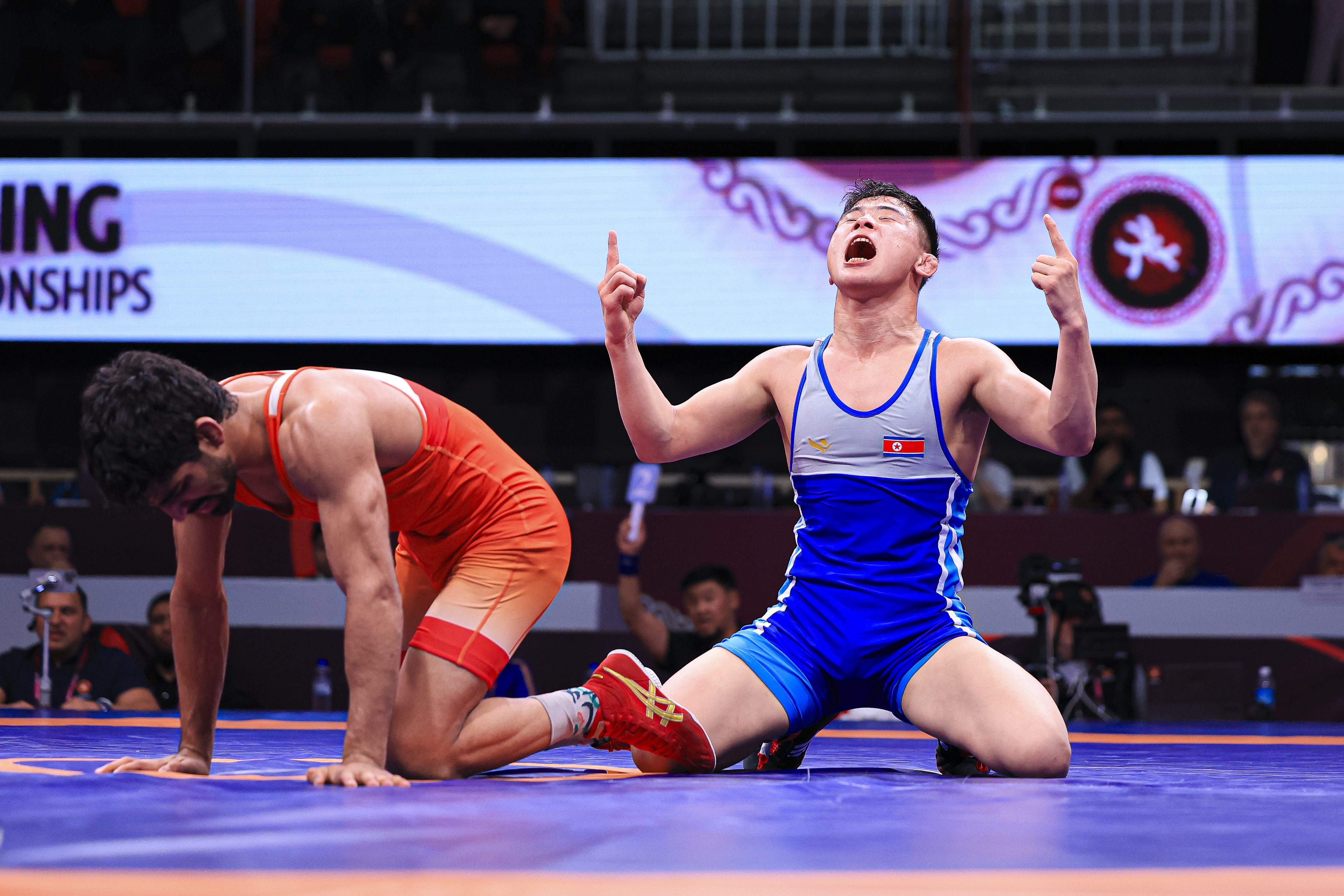
Kwang Myong KIM (PRK)Kwang Myong KIM (PRK) celebrates after defeating AMAN (IND), 13-10, in an electric 61kg final. (Photo: United World Wrestling / Amirreza Aliasgari)
India’s Aman, a Paris bronze medalist and 2023 Asian champion at 57kg, was the main instigator of the action, shooting for takedowns at will that Kim, a 2025 Asian U23 bronze medalist, did his best to counter – successfully, enough times.

Kim jumped out to a 4-0 lead with a counter arm throw and a roll with his head between Aman’s thighs, before Aman connected on a single for a takedown. Kim gained a stepout fighting off another attempt, then got 2 more with a whizzer counter, only for Aman to get a late double-leg takedown that left Kim up 7-4 at the break.

Aman charged back and went ahead 9-7 in the second period with a stepout and two takedowns. Kim used his lethal whizzer again for the stepout, then got behind countering a shot to move ahead 10-9 with 1:10 left.

With Aman wildly pressing for the winning takedown, Kim appeared to clinch the win with a stepout with :05 left. But the scoring wasn’t finished, as Kim was hit with a 1-point fleeing penalty in the final seconds to make it 11-10.

A last-second shot by Aman fell short and Kim spun behind just before the buzzer to account for the final margin of victory.

“I'm very happy that I won today, but I'm not going to think about this gold medal, instead I will move forward preparing for the World Championships,” said Kim, who won the lone gold for the DPR Korea in Bishkek.

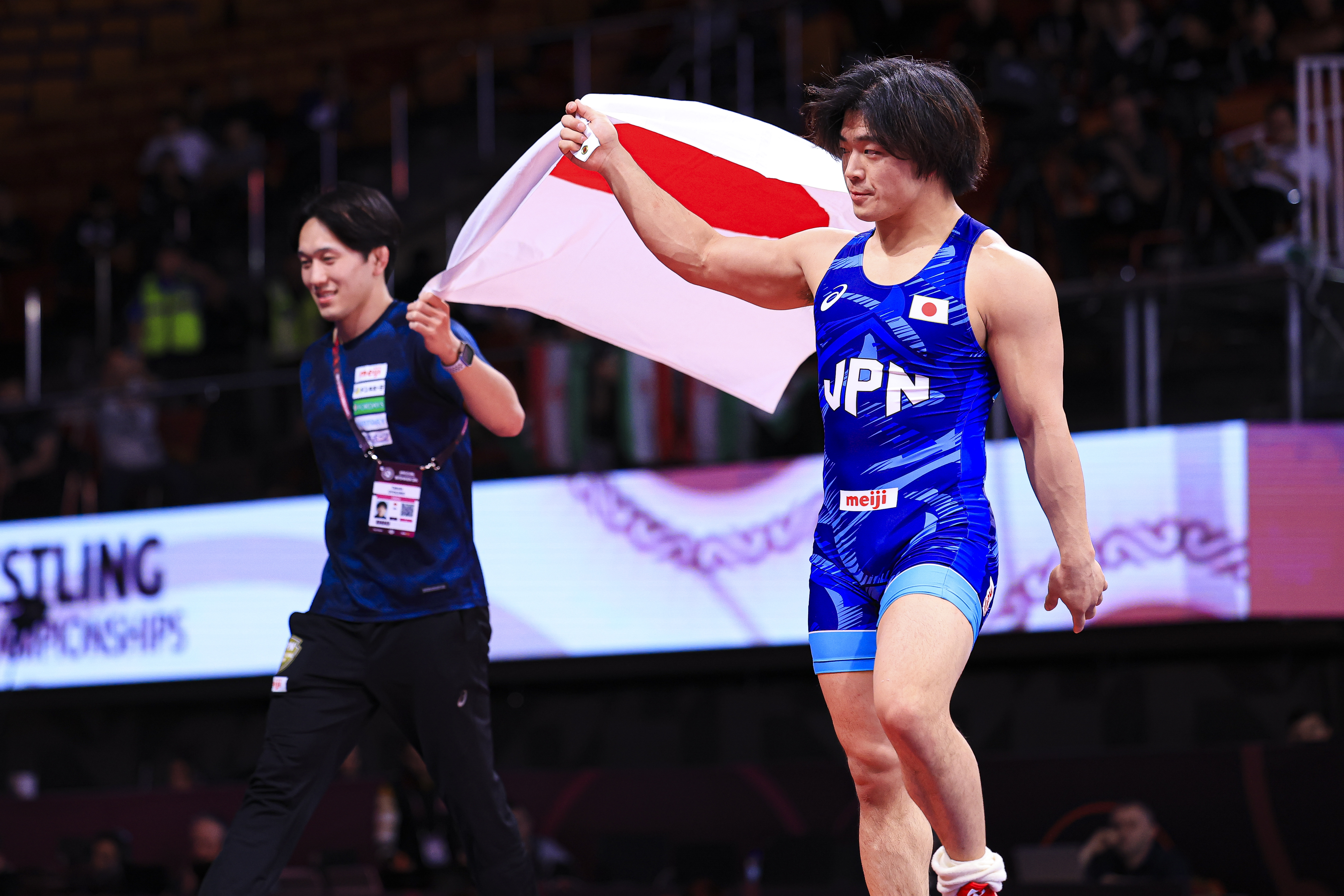
Yoshinosuke AOYAGI (JPN)Yoshinosuke AOYAGI (JPN) celebrates after winning the 74kg gold with fellow Yamanashi Gakuin University alumnus, former Olympic champion, and now Freestyle coach of Japan Takuto OTOGURO (JPN), left. (Photo: United World Wrestling / Amirreza Aliasgari)
Japan’s Aoyagi, whose matches often have their fair share of fireworks, captured his first Asian gold with a staid 2-0 victory over two-time bronze medalist Magomedrasul ASLUEV (BRN) in the 74kg final.

The gold ended a run of bronze, silver, bronze over the past three years at 70kg. “I was continually unable to win the title at 70kg, which was really disappointing, so to move up to 74kg and win the gold medal for the first time, and also my first gold medal [at this weight] overseas, I’m really happy,” Aoyagi said.

Aoyagi scored a takedown with a low single in the first period, then left no openings for an opponent who seemed reticent to go on the offensive.

“With victory within reach, I think my movement became a little stiff,” Aoyagi said of the lack of spark in the match. “I consider myself to be a wrestler who is particularly good at defense.”

Just getting to Bishkek was an accomplishment in itself for Aoyagi. As a sign of the depth in Japan, Aoyagi had to defeat reigning world 74kg champion Kota TAKAHASHI (JPN) at last December’s All-Japan Championships, winning a close 4-4 decision in the final.

To make the team to this year’s World Championships and Asian Games, Aoyagi will likely have to go through Takahashi again at next month’s Meiji Cup All-Japan Invitational Championships.

“Of course, [the win in December] gave me confidence,” Aoyagi said. “But I think he is still stronger than me. I still have a month to prepare. I want to beat him again.”

Since making the move up to the Olympic weight, Aoyagi placed third at the 2025 World U23 Championships and second at Zagreb Ranking Series event earlier this year. He said he is still making the physical adjustment.

“I still feel the difference [of opponents] being taller, having longer legs and longer reach,” Aoyagi said. “But there is nothing I can do to increase those in me. I can just add bulk to my body size and little by little be able to respond.”

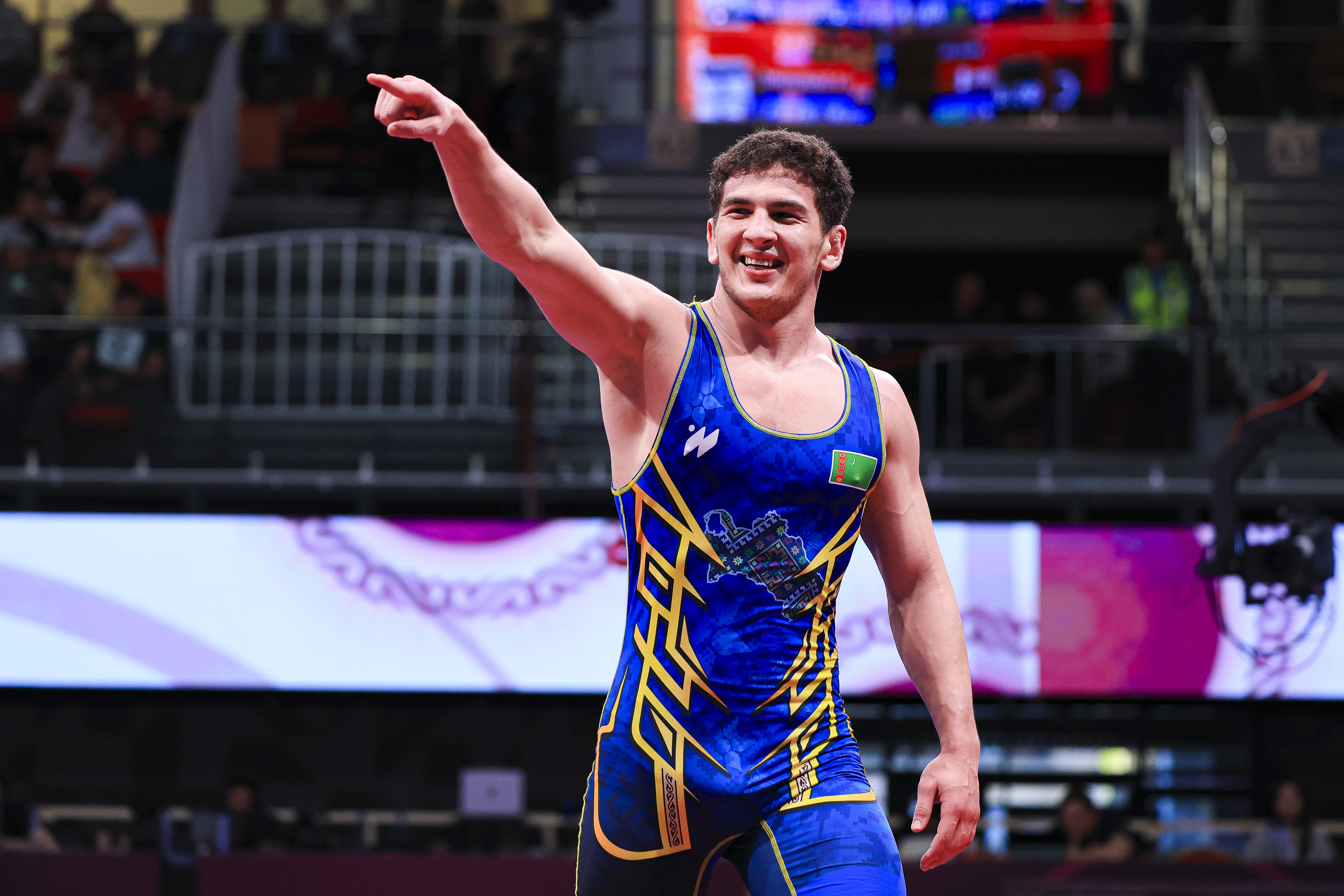
Alp Arslan BEGENJOV (TKM)Alp Arslan BEGENJOV (TKM) became Turkmenistan's first-ever Asian medalist in Freestyle. (Photo: United World Wrestling / Amirreza Aliasgari)

Begenjov claims first-ever Freestyle medal for Turkmenistan

Alp Arslan BEGENJOV (TKM) became Turkmenistan’s first-ever Asian medalist in Freestyle, taking home an 86kg bronze with a stunning victory by fall over Yudai TAKAHASHI (JPN).

Begenjov, the 2024 world U20 champion and 2025 Asian U23 silver medalist at 79kg, had scored his second 4-point move when Takahashi reversed to cut Begenjov’s lead to 8-5. But Begenjov stuffed an attempted roll and secured the fall at 5:09.

Begenjov had started the match with a back trip for 4, before the brawny Takahashi, a 2022 bronze medalist at 79kg and the older brother of Kota, came back with takedowns to end the first period and start the second.

Trailing 4-4 on criteria, Takahashi got in on a tackle, only to be pancaked to his back. The Japanese then reversed, only to be stopped midway through and then held down for the fall.

It was also Turkmenistan’s first medal overall since 2018, and just the ninth in the nation’s history.

Khidir SAIPUDINOV (BRN), a world 79kg bronze medalist, claimed the other 86kg bronze and his third straight with a 2-1 win over returning silver medalist Bolat SAKAYEV (KAZ), with all of the points scored on the activity clock.

At 92kg, veteran Azamat DAULETBEKOV (KAZ) added to his vast collection of Asian medals, scoring all of his points in the first period to defeat Takashi ISHIGURO (JPN) 6-0 and make the podium for the fifth straight year.

Dauletbekov, who also has a pair of world bronzes to his credit, now has seven Asian medals, including three straight golds from 2022 to 2024 at 86kg. Ishiguro was denied a second straight bronze and what would have been his third overall.

Asian U20 bronze medalist Iakov CHAPLIN (KGZ) claimed the lone medal of the final night for the host country, outlasting Hade AYIDUSI (CHN) 6-4 for the other 92kg bronze.

While Ayidusi was piling up single points, Chaplin went ahead in the second period with a takedown and roll for a 4-3 lead with 1:20 left. Ayidusi picked up his third stepout to tie the score, but still trailed on criteria, and a desperation shot allowed Chaplin to get behind in the last second.

At 57kg, world medalists Ahmad JAVAN (IRI) and Gulomjon ABDULLAEV (UZB) both assured they would not be leaving Bishkek empty-handed by grabbing the bronzes with one-sided victories.

Javan, the world silver medalist, secured his second straight Asian bronze by overwhelming Changsu KIM (KOR) 12-0, scoring a takedown and three back-and-forth rolls, then finishing the match with a 4-point takedown at 1:30.

Abdullaev, who won bronze medals at the 2024 Paris Olympics and last year’s World Championships at 57kg, was taken into the second period, but came up with a similar 11-0 victory over Azatberdi ASHYRGULYYEV (TKM).

He followed an initial takedown by using a grapevine for an exposure, then grabbed another exposure off a counter. In the second period, he ended it at 3:40 with a takedown-gut wrench combination.

At 74kg, former Asian champion and two-time world medalist Amirmohammad YAZDANI (IRI) added another bronze to the Iranian tally, notching three takedowns in a 9-3 victory over last year’s silver medalist, Orozobek TOKTOMAMBETOV (KGZ).

Mustafo AKHMEDOV (TJK), a four-time Asian U23 medalist, earned his first senior medal by taking the other 74kg bronze with an entertaining 7-6 win over Begijon KULDASHEV (UZB).

The match saw six lead changes, with Akhmedov scoring a takedown with :27 left for the decisive points.

The 125kg bronze-medal matches also saw an engaging encounter, in which world and Asian U20 champion Yedige KASSIMBEK (KAZ) reversed BUHEEERDUN (CHN) twice in the first period before holding on for an 8-7 win.

Buheeerdun, a two-time bronze medalist, started the proceedings with a takedown, but Kassimbek reversed, then scored a takedown and gut wrench to lead 5-2. Buheeerdun replied with a takedown-roll combination of his own, but again Kassimbek reversed, then added a roll to make it 8-6. Kassimbek limited the Chinese to a stepout in the second period to secure the win.

DINESH (IND) won his second straight bronze at 125kg, storming to a 12-1 win over Arslanbek TURDUBEKOV (KGZ) that he completed as time ran out.

Photo

Day 7 Results

Freestyle

61kg (11 entries)
GOLD: Kwang Myong KIM (PRK) df. AMAN (IND) 13-10

BRONZE: Ahmad JAVAN (IRI) df. Changsu KIM (KOR) by TS, 12-0, 1:30
BRONZE: Gulomjon ABDULLAEV (UZB) df. Azatberdi ASHYRGULYYEV (TKM) by TF, 11-0, 3:40

74kg (14 entries)
GOLD: Yoshinosuke AOYAGI (JPN) df. Magomedrasul ASLUEV (BRN), 2-0

BRONZE: Mustafo AKHMEDOV (TJK) df. Begijon KULDASHEV (UZB), 7-6
BRONZE: Amirmohammad YAZDANI (IRI) df. Orozobek TOKTOMAMBETOV (KGZ), 9-3

86kg (15 entries)
GOLD: Kamran GHASEMPOUR (IRI) df. Mukul DAHIYA (IND) by Fall, 2:43 (7-0)

BRONZE: Alp Arslan BEGENJOV (TKM) df. Yudai TAKAHASHI (JPN) by Fall, 5:09 (10-5)
BRONZE: Khidir SAIPUDINOV (BRN) df. Bolat SAKAYEV (KAZ), 2-1

92kg (12 entries)
GOLD: Mobin AZIMI (IRI) def. Magomed SHARIPOV (BRN) by TS, 11-0, 5:01

BRONZE: Iakov CHAPLIN (KGZ) df. Hade AYIDUSI (CHN), 6-4
BRONZE: Azamat DAULETBEKOV (KAZ) df. Takashi ISHIGURO (JPN), 6-0

125kg (11 entries)
GOLD: Amir Hossein ZARE (IRI) df. Shamil SHARIPOV (BRN), 4-0

BRONZE: Yedige KASSIMBEK (KAZ) df. BUHEEERDUN (CHN), 8-7
BRONZE: DINESH (IND) df. Arslanbek TURDUBEKOV (KGZ) by TS, 12-1, 6:00