#Rome2018

Russia Reels in Eleventh Junior Euro Gold Medal

By Eric Olanowski

ROME, Italy (August 4) - After running through the Greco-Roman and women’s wrestling competition, Russia’s dominance trickled over to freestyle as they were able to capture two additional gold medals on the sixth day of competition at the Junior European Championships. 

Thus far, eleven Russian wrestlers have enjoyed hearing their national anthem begin played while standing atop of the podium, and will have three more opportunities to hear it being played on the final day of wrestling in Rome, Italy. 

The duo of Aznaur TAVAEV (RUS) and Chermen VALIEV (RUS) each seized gold medals, helping Russia command the team lead heading into the seventh day of competition. 

In the 65kg finals, Aznaur Tavaev walloped 2014 cadet world bronze medalist, Nicolai GRAHMEZ (MDA), picking up the 15-4 technical superiority victory to pocket his first continental championship. 

Tavaev trailed early after surrendering a takedown and an exposure but was able to erase the four-point deficit, taking the 4-4 lead on criteria into the second period by picking up a takedown and exposure of his own. 

The Russian exploded in the second period, scoring four-points off a defensive chest-wrap, followed by a failed Moldova challenge to take the imposing 9-4 advantage into the final minute of the match. 

After another defensive scoring sequence, Tavaev closed the match out with a snap-down spin-behind to a trapped-arm gut-wrench, ultimately winning 15-4. 
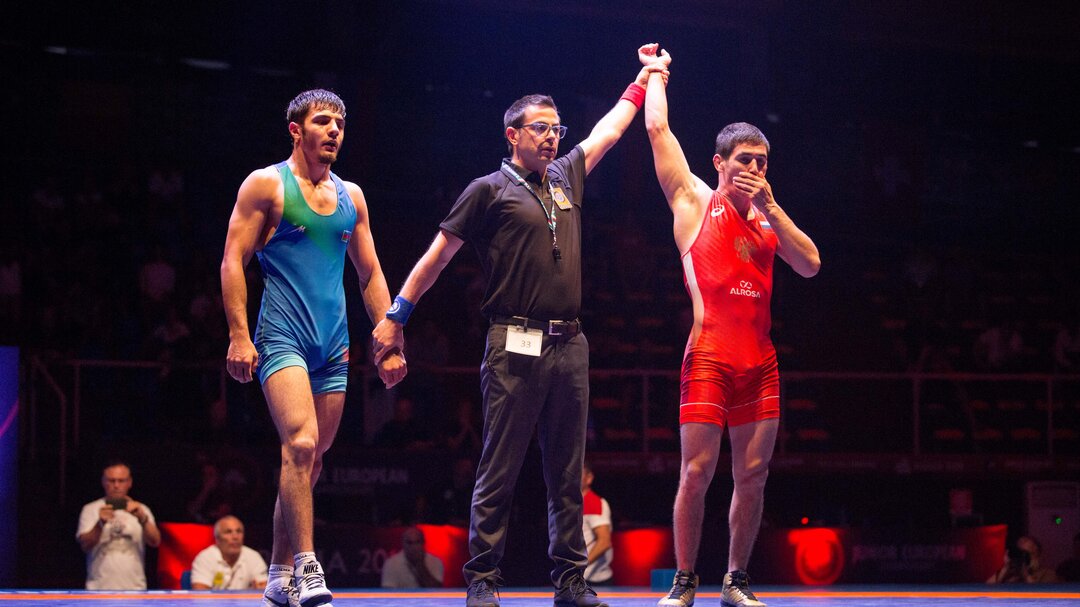
Chermen VALIEV (RUS) give Russia their eleventh Junior European gold medal. (Photo Max Rose-Fyne) 

Chermen Valiev used a pair of second-period takedowns to narrowly escape Khadzhimurad GADZHIYEV (AZE), 5-3 in the 70kg gold-medal bout. 

In the opening period, Valiev, the 2014 Cadet World team representative picked up a step-out point before conceding a takedown and a step-out to fall behind 3-1. 

Valiev rebounded in the final period and snatched the two-point lead with a pair of takedowns. The 2017 Ivan Yarygin runner-up narrowly held on to present Russia their second gold medal of the day and eleventh overall. 

Three other Russians will have the opportunity to compete for gold tomorrow, as the competition wraps up with the final freestyle medal match session starting at 6:00 PM (local time). 
RESULTS 

#development

South Africa Advances National Wrestling System with DNSS Phase 2

By United World Wrestling Press

PRETORIA, South Africa (April 8) -- South Africa has reached a decisive milestone in its long-term wrestling development strategy with the successful implementation of Phase 2 of the Development of National Sport System (DNSS) programme, delivered in collaboration with United World Wrestling (UWW) and supported by Olympic Solidarity.

Following the diagnostic and mapping phase conducted earlier, Phase 2 marks a clear transition from analysis to structured implementation, laying the foundation for a sustainable and internationally aligned wrestling system.

Led by UWW Development Officer Vincent AKA, in close cooperation with the South African Wrestling Federation (SAWF), the National Head Coach, Markus DEKKER and Provincial Coordinators, the programme was deployed across multiple provinces through a structured 10-day intervention from March 2 to 13. 

Activities were conducted in key locations including:

· LPWA (Ion Bachu)
· CGWA (Ruiter)
· NGWA (Menlo Park Hall)
· Frank Joubert Tournament (Menlo Park Hall)

This nationwide approach ensured direct engagement with provincial structures, strengthening alignment between national leadership and local associations while promoting inclusive development across the country.

From Talent Identification to System Building

Unlike traditional training camps, DNSS Phase 2 focused on identifying talent and building long-term development systems. Wrestlers and coaches from all age categories -- U13, U15, U17, U20, and Senior -- were actively involved, ensuring a complete pathway approach.

Provincial visits and stakeholder meetings played a key role in assessing facilities and operational structures, strengthening coordination between SAWF and provinces, and identifying emerging wrestlers.

Building Athlete Pipeline

A training camp for different provinces brought together wrestler to consolidate talent identified during Phase 1 and introduce standardized training methodologies.

The training camp included technical sessions, physical conditioning, match simulations and wrestling. The initiative contributed to the creation of an updated national prospect and the foundation of a structured athlete monitoring system.

South Africa

Beach Wrestling Gains Momentum

As part of the DNSS activities, a Beach Wrestling training session in Roodepoort highlighted the programme’s expanding impact.

During the visit, Aka led a specialized session, sharing advanced technical insights adapted to beach wrestling. It included stance and balance adjustments, grip and control techniques, and movement adaptation on sand.

The training programme comes at a crucial time, as South African athletes prepare for African Beach Wrestling Championships in Alexandria, Egypt and other international tournaments.