ULAANBAATAR, Mongolia (June 7) -- Freestyle day at Ulaanbaatar Open with seven weight class. World champions Rahman AMOUZAD (IRI) and Chongsong HAN (PRK) are in action at 65kg and 57kg respectively.
WATCH LIVE | LIVE MATCH ORDER
14:20: 65kg semifinal - Rahman AMOUZAD (IRI) has unreal pace and Adlan ASKAROV (KAZ) has no answers for it. The world champion enters the 65kg final after a win over the Kazakhstan wrestler. Amouzad led 3-0 and then scored a stepout before Askarov also got a stepout to make it 4-1. Amouzad managed another before scoring a takedown to lead 7-1 at the break. He starts the second period with a takedown as well and then needs a stepout and go-behind to finish the bout 12-1.
14:07: 61kg semifinal - In a match that saw the lead switch hands on several occasions, Assyl AITAKYN (KAZ) scores a late takedown to beat Batnasan GANKHULEG (MGL), 3-2, and reach the 61kg final
14:07: 125kg semifinal - DINESH (IND) breaks Timur KOTAEV (RUS) in the 125kg semifinal and scored easy go-behind takedowns for a 11-0 victory in 3:13
14:00: 125kg semifinal - Yedige KASSIMBEK (KAZ) with a late takedown to beat Jose DIAZ (VEN) 2-2 on criteria. Diaz had two activity points but Kassimbek's takedown takes the upper hand in the score
13:58: 61kg semifinal - DEEPAK (IND) in the 61kg final after a 7-1 victory over Adilet ALMUKHAMEDOV (KAZ). Deepak with relentless pressure to score his takedowns while Almukhamedov could never break through
13:51: 97kg semifinal - Demchigdorj TUMURBAATAR (MGL) hangs on for a 2-1 win over TUXIGE (CHN) at 97kg. He will face Takhir KHANIEV (RUS) for the gold medal
13:48: 65kg semifinal - Shamil MAMEDOV (BUL) took his time but comes alive in the second period, finishing his semifinal 12-1 against Ossimzhan DASTANBEK (KAZ) at 65kg. He led 4-1 at the break but scores eight points in the second period to win 45 seconds after the break
13:47: 97kg semifinal - Takhir KHANIEV (RUS) scores a takedown and four turns using the gut-wrench to finish off his semifinal in 53 seconds against VICKY (IND) and advance to the final.
13:44: 79kg semifinal - Mahdi YOUSEFI (IRI) with a 13-2 victory over Shamsat TAIR (KAZ). Tair scored the first takedown but Yousefi with a takdown and turn to lead. Tair gives up a stepout and fleeing caution as Yousefi leads 7-2. A takedown later, he makes it 9-2 before finishing the bout with a techncial superiority win.
13:43: 70kg semifinal - Tulga TUMUR OCHIR (MGL) holds on to a 2-0 win over Magomed ELTEMIROV ((RUS) after the Russian was called passive two times in the bout. Both passivity calls gave Tumur Ochir gave one point each.
13:40: 57kg semifinal - Musa MEKHTIKHANOV (RUS) uses the leg lace to build a 6-0 lead before finishing his 57kg semifinal with a 12-1 victory over Abzal OKENOV (KAZ) with the lace in the second sequence.
13:33: 57kg semifinal - World champion Chongsong HAN (PRK) advances to the final at 57kg after a 4-1 win over Meirambek KARTBAY (KAZ). A stepout and activity point gave Han two points but he lost a challenge. He added a takedown in the second period to lead 4-1, the winning score.
13:31: 70kg semifinal - Rustamzhan KAKHAROV (KGZ) dominates his 70kg semifinal against Usukhbayar BAATARKHUU (MGL) and posts a 10-0 win. Kakharov never looked in trouble against the Mongolian
13:30: 79kg semifinal - Barring a four-pointer from Suldkhuu OLONBAYAR (MGL) which extended the bout, Ismail KHANIEV (RUS) dominated his semifinal to complete a 14-4 victory and advance to the final.
Semifinals on all three mats with three different weight classes
13:15: Last match of the qualification rounds and Assyl AITAKYN (KAZ) hangs on for a 3-2 win over Ahora KHATERI (IRI) at 61kg. He score two activity points and a stepout while Khateri scored a takedown
12:30: World Champion Rahman AMOUZAD (IRI) keeps it simple in his first bout of the tournament with a 5-0 controlled win over Kwang Jin KIM (PRK). Kim had not idea how to break those underhooks. Amouzad into the 65kg semifinals.
12:15: Cross WASILEWSKI (USA) with two takedowns at the end against Tulga TUMUR OCHIR (MGL) to make it 5-4 but he cannot score a point needed for the win and Tumur Ochir advance to the semifinals at 70kg with the narrow win
12:05: Shamil MAMEDOV (BUL) looks in great form at 65kg as he now beats Christopher COMPOSTO (USA), 10-0. He scores a takedown and gut-wrench to go 4-0 up. He then gets an easy go-behind for a 6-0 lead. Composto tries a fake but Mamedov counters with a takedown and exposure to win.
11:50: The Khaniev brothers -- Ismail and Takhir -- begin with contrasting victories at 79kg and 97kg respectively. Takhir goes first at 97kg and scores a 2-0 win over Gankhuyag GANBAATAR (MGL) with no action points. However, Ismail is scores multiple different takedowns to complete an 11-0 win over Khangaibayar GANBOLD (MGL) at 79kg
11:30: Magomed ELTEMIROV (RUS) starts off with a 10-0 victory over Zandanbat BATSAIKHAN (MGL) at 70kg. He scores an easy takedown and then turns the Mongolia using gut-wrench and lace to complete the victory.
11:15: Tulga TUMUR OCHIR (MGL) lost the Asian Championships final to ABHIMANYOU (IND) at 70kg. But he avenges that loss with a 9-0 victory over the Indian on Sunday. Tumur Ochir with total control of the bout while Abhimanyou looked tired.
11:05: Shamil MAMEDOV (BUL) steps on the mat at 65kg against MOHIT (IND). He lifts and slams Mohit for a four-pointer before finishing the bout 10-0. Mamedov is on the way to clash with world champion Rahman AMOUZAD (IRI) if both do not suffer an upset
10:55: European silver medalist Musa MEKHTIKHANOV (RUS) scores six points and then holds on to his 6-2 lead throughout to beat Merey BAZARBAYEV (KAZ) at 57kg.
10:45: World champion Chongsong HAN (PRK) needed his strong leg lace to survive a scare in the opening round at 57kg against Aiaal BELOLYUBSKII (TJK). Han and Belolyubskii exchanged a few scrambles but the former led 10-8 when he unleashed the leg lace to complete an 18-8 win at 57kg.
10:30: The fourth day of the Ulaanbaatar Open will feature 57kg, 61kg, 65kg, 70kg, 79kg, 97kg, and 125kg.


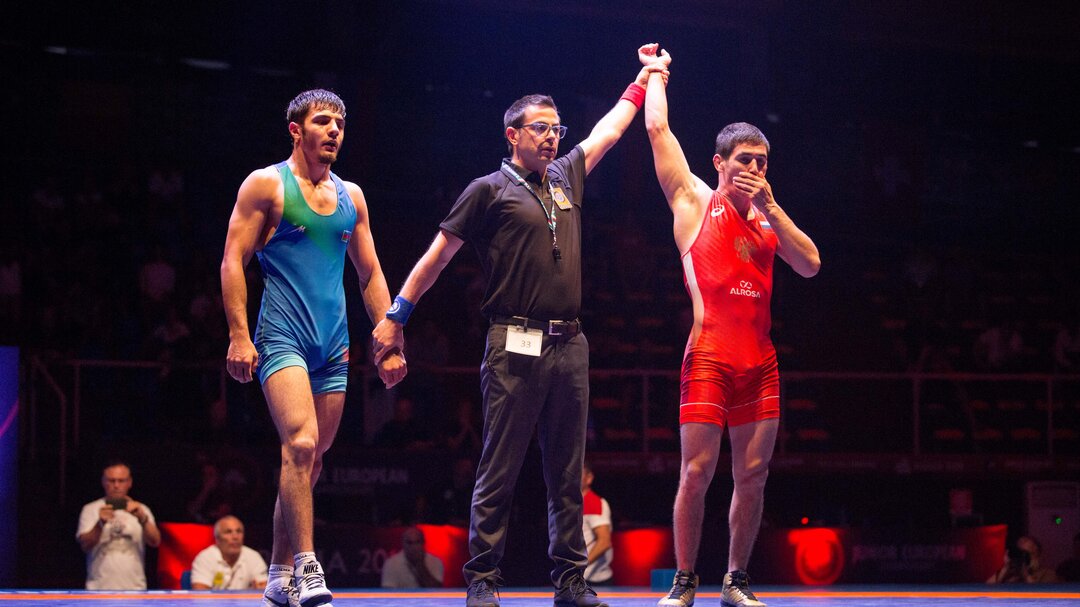 vs. Khadzhimurad GADZHIYEV (AZE) --5.jpg) Chermen VALIEV (RUS) give Russia their eleventh Junior European gold medal. (Photo Max Rose-Fyne)
Chermen VALIEV (RUS) give Russia their eleventh Junior European gold medal. (Photo Max Rose-Fyne) 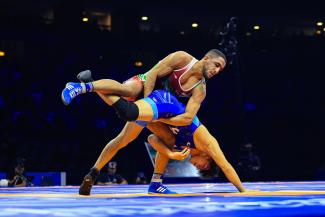
Share your thoughts.
Comments