

Rising Sun: Chinese Star Aims for Olympic Glory in Land of Top Rivals
Friday, October 18, 2019 - 17:10 By Ken Marantz

Once SUN Yanan (CHN) made the bold decision at 15 to leave home for the unknown to pursue a wrestling career, she knew there was no turning back.
"At the beginning, I told myself I needed to be independant, because I already left home," she recalls. "I cannot go back. If I go back, it would be shameful."
Sun has never looked back and, despite her late start in the sport, has forged a solid career that includes a world gold medal, an Olympic bronze and numerous other laurels. After a setback at the recent World Championships, the 27-year-old has her sights set firmly on the Tokyo 2020 Olympics.
"Step by step, I felt I really enjoyed wrestling and it already became part of my life," Sun says of her development in the sport. "And I wanted to realize my dream to be more confident and become a perfect lady because of wrestling. I really grew up."
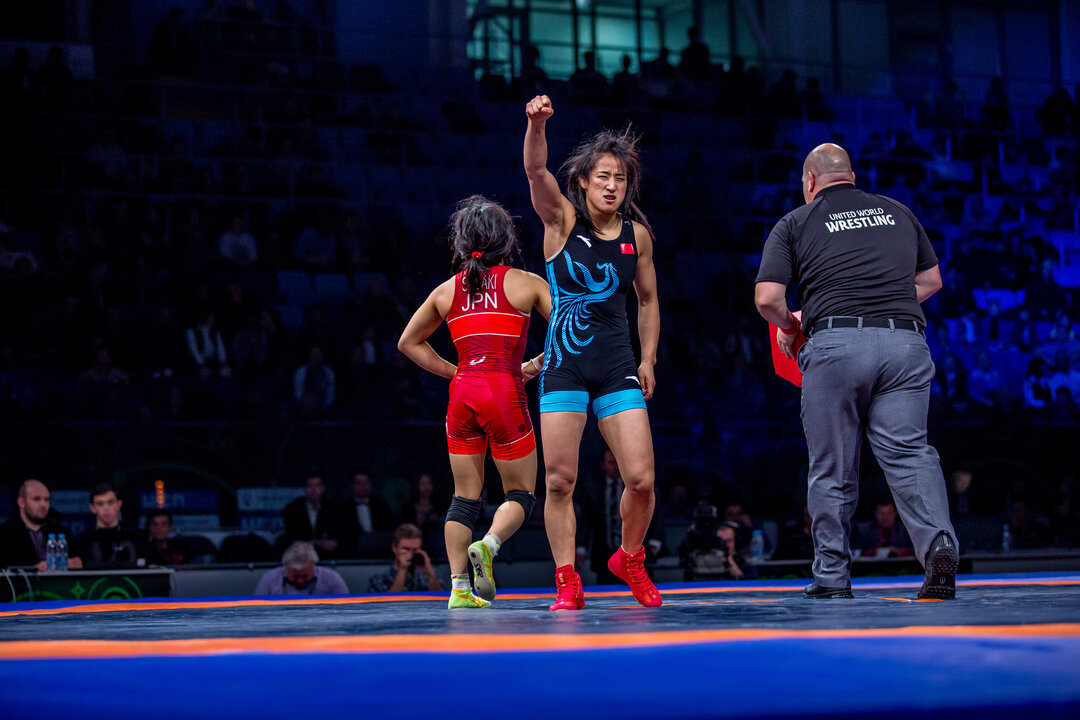 Yanan SUN celebrates during a match with Japan's Yui SUSAKI. (Photo: Max Rose-Fyne)
The 27-year-old Sun speaks easily and openly through an interpreter during an interview at last week's Tokyo 2020 test event, a women's tournament in the six Olympic weights. While Sun attended with the Chinese team but did not take part, the trip gave her a first glimpse of the Olympic venue, located in the Makuhari Messe convention center in neighboring Chiba city.
"I'm very excited when I imagine that next year maybe I will compete here at the Olympics," she says. "I hope I can be much stronger and show my best next year."
Sun secured a spot for China at 50kg by placing fifth at the World Championships in the Kazakh capital of Nur-Sultan last month. Although she finished out of the medals, she showed she could still be a factor in the weight class.
Throughout her career, Sun has inevitably found herself in high-level clashes with opponents from powerful Japan, and the draw in Nur-Sultan put her into a quarterfinal against Yuki IRIE (JPN). Irie, who knocked off two-time world champion Yui SUSAKI (JPN) to make the Japanese team, had beaten Sun in their last two meetings over the past two years.
But on this September day in Central Asia, Sun got the best of her nemesis with the kind of confidence and audacity that develops by leaving home as a teenager to strike out on one's own.
Sun built up a 9-1 lead with two bold moves before holding on for a nail-biting 13-12 win.
The first big move was a backdrop off a front headlock, a 4-point move more likely to be seen in Greco-Roman matches. She had used the move before in a 15-7 win over Vinesh PHOGAT (IND) in India's Pro Wrestling League in January 2018.
"In China, the women also practice that move," Sun says. "[The one against Vinesh] was better than this one."
She topped that soon after, getting behind Irie in the standing position and popping a slick back suplex for 5 points. That proved crucial as she saw an 11-3 lead with 1:30 left whittled down before coming away with the win.
After falling 6-4 to eventual champion Mariya STADNIK (AZE) in the semifinals, Sun lost the bronze-medal match to Ekaterina POLESHCHUK (RUS), although she can take some solace in the way she fought back from a 9-3 deficit with :19 left, scoring 6 points but losing on big-point criteria (the difference was 4-point headlock throw with :40 left).
That experience reaffirmed her policy of not concentrating solely on the Japanese, who will have to earn their own Olympic spot at 50kg at the Asian qualifier in March.
"I haven't only focused on Japan," Sun said. "Because my dream is to become the Olympic champion, so no matter if [the opponent] is Japanese or from other countries, I need to win, I need to improve myself."
As a rambunctious daughter of an electric welder growing up in Fengsheng village in Lioaning Province, located near the border with the Democratic People's Republic of Korea, Sun stood out for her prowess in sports, particularly for her speed as a runner. It caught the eyes of local sports officials.
"When I was young, I was really good at sports," Sun says. "Sprinting, all kinds of sports. One of the wrestling coaches went to my school and found me and invited me to train, and I found that it was very interesting."
One month after completing her studies at the time, Sun left home for the sports school. While she developed a passion for the sport, "at the time, I missed my home very much," she says, adding she returned home for visits just three times in two years. It's during those trips home she can indulge in her favorite dishes from the region, her mom's chicken mushroom stew and pickled cabbage with boiled pork.
Sun, who has a brother nine years her junior who also wrestled but has since stopped, says her family was concerned about her leaving at first, but always supported her efforts.
"At the beginning, my parents thought it would be very hard work," she says. "Later, they could feel that I am very happy when I am involved and I can fight for my team and country, and they supported me."
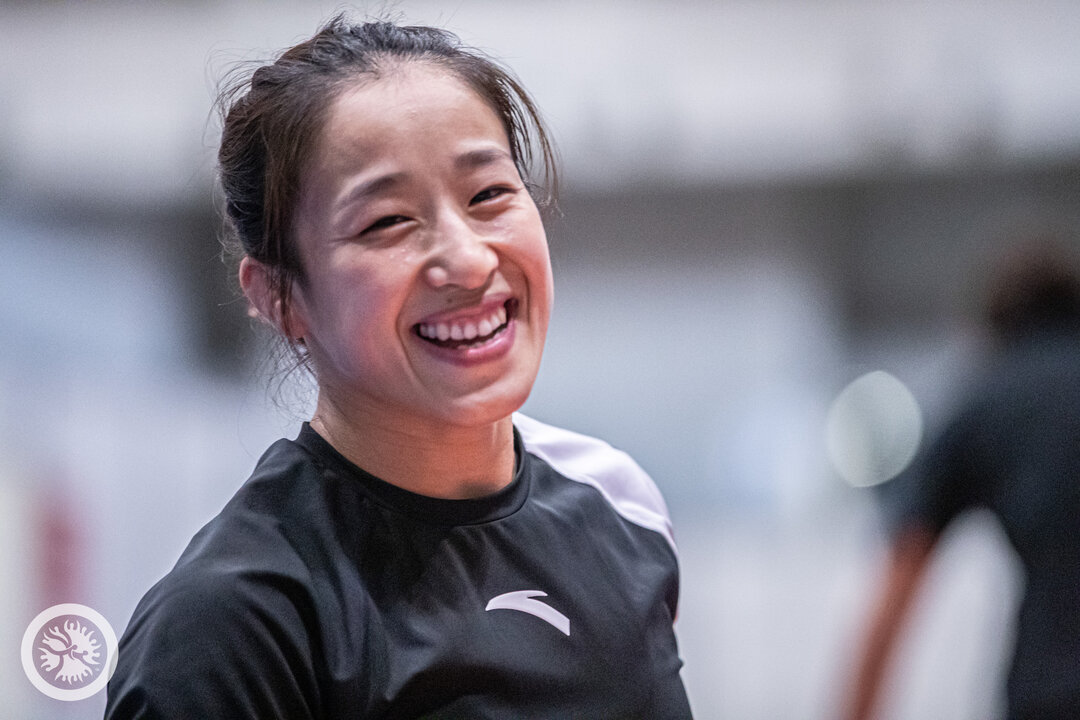 SUN Yanan smiles during a training session during the Toyko Test Event. (Photo: Sachiko Hotaka)
Three years after starting the sport, Sun was invited to train with the national team in Beijing for the first time. Like any youngster from a rural upbringing, she was awed by the big city and star-struck by the heroes with whom she trained.
"I felt that Beijing was a gorgeous city, the center of China, and I was very excited," Sun recalls. "I met so many world champions on the national team, and I so admired them.
"We trained with Wang Jiao, who was an Olympic champion [in 2008 at 72kg], and all I could do was just stare at her all the time," she says with a laugh. "Actually, Wang Jiao is also from Liaoning, the same team [as me], but I met her in Beijing."
Soon after arriving in the capital, she got her first taste of international competition at the 2010 Asian Junior Championships, although she did not have to leave the country. The tournament was held in the eastern China city of Huangshan, known for its World Heritage Site mountain peaks.
"At the time, it was my first time to see so many foreign faces," Sun says. "Some were fat, some were short, some were tall. It was very interesting to compete with so many foreigners."
Scaling her first wrestling mountain, Sun successfully reached the summit, and not surprisingly the final step to the top involved a Japanese. Sun faced Arisa TANAKA (JPN) in the 51kg final and came away with a hard-fought 2-0 (6-2, 9-6) win under the old scoring system.
"The final was with a Japanese wrestler, and I felt at the time the competition was very fierce," she says. "It was a very tough match for me."
Just over one month later, Sun made her first international trip, heading to Budapest for the junior World Championships. Once again, the title came down to her and a Japanese, and Sun walked off with the gold with a 2-1 (2-1, 3-3, 3-2) win over Haruka HIRANO (JPN).
In 2011, she achieved the Asian senior-junior double in tournaments held three weeks apart. Her first senior continental title came at 48kg in Tashkent in May, and the next month in Jakarta, she repeated as 51kg junior gold medalist. In both finals, she defeated Davaanchimeg ERKHEMBAYAR (MGL).
In September that year, she made her first appearance at the senior World Championships, but finished eighth at 51kg in Istanbul after losing to eventual champion Zamira RAKHMANOVA (RUS) in the third round and Jessica MACDONALD (CAN) in the repechage.
After finishing second to MacDonald at the World Championships the following year in Strathcona County, Canada, Sun reached the top of the podium on her third try at 51kg in Budapest in 2013. After gaining revenge by beating MacDonald in the semifinals, she defeated Sumiya ERDENECHIMEG (MGL) for the elusive gold.
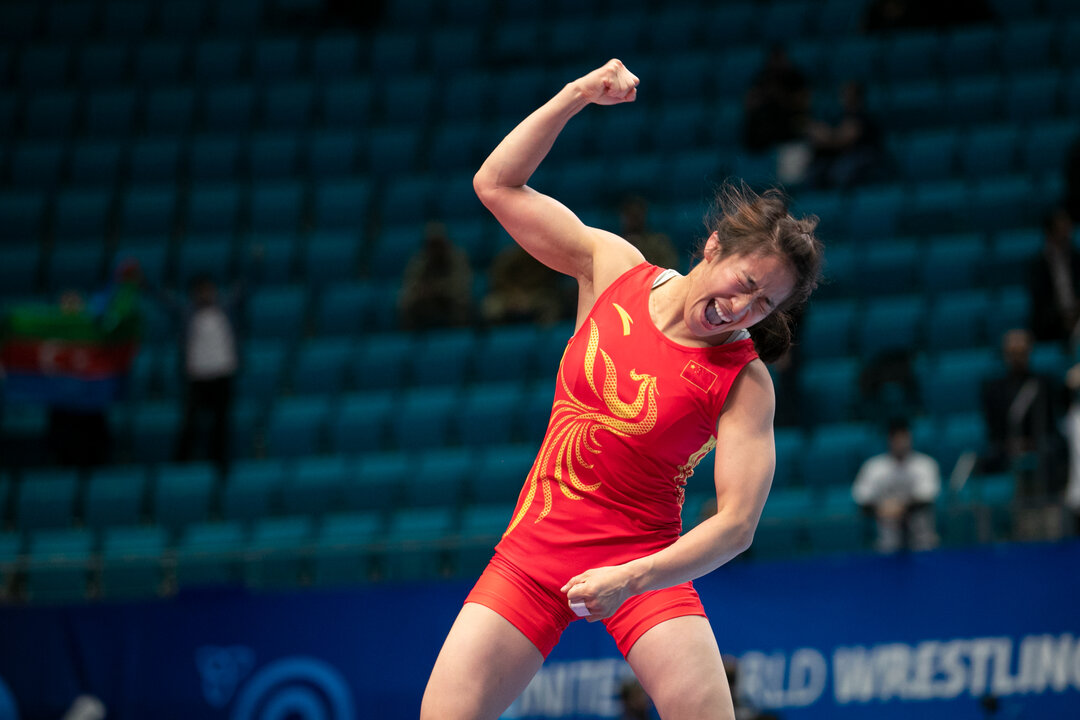 SUN Yanan gets emotional after defeating Yuki IRIE (JPN) at the 2019 World Championships. (Photo: Kadir Caliskan)
It took awhile for the magnitude of the accomplishment to sink in.
"At that time I didn't really pay that serious attention to the World Championships because I was still very young, even though I already attended many international competitions and in 2012, I got second [at the worlds]," Sun says. "It was my third time to attend the World Championships in 2013 and I was still feel very relaxed and did not know what it really meant, not like now."
From 2014, Sun dropped down to the Olympic weight of 48kg, which put her on a direct collision course with Japan's new lightweight star Eri TOSAKA (JPN). Tosaka, a year younger than Sun, was the 48kg champion at the 2011 Asian juniors, the year the Chinese won the 51kg title.
Their first encounter was a close one, with Tosaka winning 6-4 at the 2014 Women's World Cup. Six months later, the setting was the 48kg final at the Asian Games in Incheon, Korea, and the Japanese came away with a 5-1 win and the gold.
Sun would finally get the better of her rival at the 2016 Asian Championships in Bangkok, handing the three-time world champion her first defeat in almost 3 1/2 years with a dramatic victory in the semifinals.
Trailing 2-1, Sun turned Tosaka over with a crotch lift counter with :12 left, but in a final rolling flurry, Tosaka was awarded 2 points for an apparent 4-3 win. The Chinese side challenged the call, and it was amended to give each 2 points, reversing the outcome and making Sun a 5-4 winner.
Sun then went on to capture her second senior continental title with a 12-2 technical fall over Irina BORISSOVA (KAZ) in the final.
For Tosaka, the loss relieved some of the pressure she had put on herself, which would bear fruit when the two would meet with much more at stake six months later.
"Part of me feels relieved," Tosaka was quoted as saying on the Japan federation website at the time. "Up to now, I felt somehow I would always find a way to win. In the back of my mind, I would think, I'm still going to win. I didn't want to lose [today], but to win the gold medal at the Olympics, I think it was probably best to lose once."
That prove prescient, as Tosaka went on to win the gold medal at the Rio 2016 Olympics, taking out Sun in the semifinals 8-3 when she scored a takedown, then ripped off three straight ankle-lace rolls. Sun made sure she didn't leave Brazil empty-handed, as she defeated Zhuldyz ESHIMOVA (KAZ) by 10-0 technical fall for a bronze medal.
Following the Rio Games, Tosaka took time off and underwent foot surgery, but the 48kg hole (later to become 50kg) in the Japanese lineup was quickly filled by a new kid on the block, the teenaged Susaki. She marked her emergence by beating Sun 9-4 in the quarterfinals of the 2017 Asian Championships in New Dehli before going on to win the gold. Sun finished fifth.
Sun suffered another setback the following year at the Asian Games in Jakarta, where Vinesh, who suffered a dislocated knee during their quarterfinal match at Rio 2016, made amends by defeating the Chinese 8-2 in the qualification round. Vinesh went on to win the title by beating Irie in the final.
Sun got back on track by winning a bronze medal at the 2018 World Championships in Budapest, where she lost in the quarterfinals to Stadnik, whose subsequent loss in the final to Susaki gave the Japanese a second straight world title. At this year's Asian Championships, Sun took the silver after losing 6-4 in the final to Irie.
When Sun takes the mat at Makuhari Messe in pursuit of her dream of winning a gold medal at Tokyo 2020, there will be no shortage of rivals more than ready to burst her bubble.
Whoever earns the place for Japan---Susaki, Irie, Tosaka or anyone else---will have extra motivation in gunning for gold in front of the home crowd. And Stadnik, coming off her golden performance in Nur-Sultan, will surely be aiming to make up for her silver at Rio 2016 as her career winds down.
Sun, of course, is still young enough to be considered a candidate for the Paris 2024 Olympics, but she does not foresee sticking around for that one. Asked if she has considered retirement, she replied, "After this Tokyo Games and the year after, there is a National Games held once every four years. After that, maybe," then adds, "What I think most is how to realize my dream first. Then maybe travel around the world."
While an Olympic gold would certainly lead to more fame and fortune than she currently has accumulated like the medals in her trophy case, Sun says it would not have a personal effect on her.
"It will change nothing for me," she says. "I will still be myself. After this is realized, I will find my next dream and try to realize it."
And if it means leaving home, so be it. She will keep looking ahead.
Share your thoughts.
Comments