ZAGREB, Croatia (September 16) -- The fourth day of the Women's Wrestling will see all Women's Wrestling action. Weight classes on the mat are 50kg, 57kg, 65kg and 76kg.
WATCH LIVE | LIVE MATCH ORDER | DAY 3 RESULTS
The 2026 World Championships will be held in Bahrain from September 5 to 13.
13:44: Welker got to Medet Kyzy's legs and then converts it to a takedown. Welker scores a stepout to start the second period and extender her lead to 3-0. Medet Kyzy gets the takedown to make it 3-2 with a minute remaining. The Asian champion tries to find a way to get the one point and tries a pushout. Welker blocks it but Medet Kyzy slips her arm out and scores a takedown. She continues the action with a turn and leads 6-3 with 10 seconds remaining. An easy go-behind and she wins 8-3 to enter the semifinals.
13:41: Genesis REASCO (ECU) goes right to the lace lock in a first-period attack and before Enrica RINALDI (ITA) knows what hit her, she's behind 6-0. Reasco then gets behind and levers her over for an exposure to make it 10-0. A bit of a delay for a challenge, but nothing changes and officially Reasco wins 11-0 to advance to the 76kg semifinals.
13:37: European champion Anastasiya ALPYEYEVA (UKR) uses the leg lace to great effect and wins her 76kg semifinal against Davaanasan ENKH AMAR (MGL), 10-0.
13:36: Milaimy MARIN (CUB) bulls her way into the 76kg semifinals with a one-sided 10-0 win over Nodoka YAMAMOTO (JPN). Marin gets behind for the takedown, then reels off four gut wrenches to end the match in 57 seconds.
50kg semifinals
SF 1: Remina YOSHIMOTO (JPN) vs. Myonggyong WON (PRK)
SF 2: Munkhnar BYAMBASUREN (MGL) vs. Yu ZHANG (CHN)
13:32: Yu ZHANG (CHN) scores a takedown in the first period, then adds two more and a thigh-lock roll to secure a semifinal spot at 50kg with an 8-0 win over Emanuela LIUZZI (ITA).
13:31: Munkhnar BYAMBASUREN (MGL) gets a stepout while on the activity clock in the second period to put her up 2-0, then makes that score hold up to defeat Nohalis LOYO JIMENEZ (VEN) and advance at 50kg.
13:28: Remina YOSHIMOTO (JPN) gets a takedown and lace turn on Oksana LIVACH (UKR) to open the scoring in their 50kg quarterfinal. After the 4-0 lead, she adds two different takedowns to lead 8-0 at the break. Livach with a big throw out of nowhere but Yoshimoto survives the attempted pin and scores a reversal. An exposure to make it 11-4 which was the winning score for her.
13:25: Asian bronze medalist Myonggyong WON (PRK) catches Madison PARKS (CAN) in a lace and finishes her quarterfinal 12-0. Parks just could not stop Won's powerful turns.
57kg semifinals
SF 1: Helen MAROULIS (USA) vs. Olga KHOROSHAVTSEVA (UWW)
SF 2: Il Sim SON (PRK) vs. Kexin HONG (CHN)
13:19: Tamara DOLLAK (HUN) found a way to takedown Olga KHOROSHAVTSEVA (UWW) in the final 20 seconds of their 57kg semifinal. Down 6-1, she scored two points from that takedown and then turned Khoroshavtseva for two more points to make it 6-5. She needed one more turn for a win but the 10 seconds ran off and Khoroshavtseva booked her spot in the semifinal with a 6-5 win.
13:15: Il Sim SON (PRK) is looking sharp at 57kg, as she finishes off a 12-0 victory over Iryna KURACHKINA (UWW) with a 4-point fireman's carry throw in the second period to book her place in the semifinals later today.
13:13: Kexin HONG (CHN) learns her lesson after giving up a counter-lift 2-pointer to Evelina HULTHEN (SWE) in their 57kg quarterfinal. Hong is more deliberate as she drives to three takedowns, going into the lace lock after the final one and reeling off three rolls to win 13:2 in 2:49.
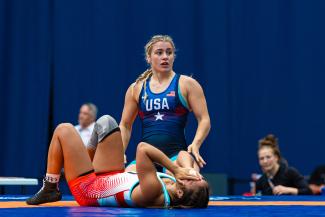
13:12: Helen MAROULIS (USA) pins Himeka TOKUHARA (JPN) in the 57kg quarterfinals! She trips Tokuhara and holds her for a fall and enter the semifinals at 57kg.
65kg semifinals
SF 1: Miwa MORIKAWA (JPN) vs Irina RINGACI (MDA)
SF 2: Enkhjin TUVSHINJARGAL (MGL) vs. Alina KASABIEVA (UWW)
13:05: Irina RINGACI (MDA) with a suplex for four against Kadriye KOCAK AKSOY (TUR) in the 65kg quarterfinals. She then adds a two-pointer to make it 6-0. Aksoy seems to have hurt herself during that throw. A stepout for Ringaci but it is challenged by Turkiye and it is awarded four points to Aksoy to cut it to 6-4. A takedown and turn for Ringaci in the second period as she extends to 10-4. Aksoy tries to comeback but Ringaci with a lace and she wins 16-6.
13:01: Grace BULLEN (NOR) sees her bid for an elusive first world title when she falls behind 8-3 in the second period off a scramble with Alina KASABIEVA (UWW), then in a desperation attack, gets slammed to her back for a fall with :08 left in their 65kg quarterfinal.
13:00: Miwa MORIKAWA (JPN) gets a stepout to get on board after Iryna KOLIADENKO (UKR) scored the opening takedown in their 65kg quarterfinal. In the second period, Morikawa with a leg attack and comes out on top with a takedown and leads 3-2. She manages to turn Koliadenko to make it 5-2 with 50 seconds left. She scores a stepout and hangs on to her 6-2 lead to win and enter the semifinals.
12:59: After the two trade two points in a first-period scramble, Enkhjin TUVSHINJARGAL (MGL) catches Vaishnavi PATIL (IND) with a counter directly to her back and secures a fall to advance to the 65kg semfinals.
Quarterfinals
12:48: Asian bronze medalist Nodoka YAMAMOTO (JPN), holding the fort at 76kg for Japan as Olympic champion Yuka KAGAMI (JPN) remains on hiatus, survives a dangerous situation to edge QIANDEGENCHAGAN (CHN) 6-5. With the Chinese leading 1-0 but on the activity clock in the second period, Yamamoto drives forward for a 4-point takedown that is upheld on challenge. The activity point gives her a 6-1 lead. But Qiandegenchagan catches her in a headlock and Yamamoto spends some anxious time fighting off her back. Qiandegenchagan then gains a stepout and a late takedown, but can't turn the Japanese in the final seconds.
12:35: Genesis REASCO (ECU) scores two takedowns in the first period to lead 4-0 at the break against PRIYA (IND) at 76kg. Priya gets on back in the second period but that is all in the bout and Reasco wins 4-2 and advance to the 76kg quarterfinals.
12:28: Former world U20 champion Yu ZHANG (CHN) worked on two takedowns and a roll before launching a big attack on Evin DEMIRHAN (TUR) at 50kg. She gives up two exposure points but manages six points from the exchange to win 12-2 and reach the 50kg quarterfinals.
12:18: Asian bronze medalist Myonggyong WON (PRK) storms into the 50kg quarterfinals with a 10-0 victory over Svetlana ANKICHEVA (KAZ). After a stepout, Won gains a takedown with Ankicheva on the clock and whips off two lace-lock rolls. Another takedown and that's all she wrote.
12:10: Paris Olympic bronze medalist Milaimy MARIN (CUB) makes short work of Anastasiya ZIMIANKOVA (UWW), getting a takedown and gut wrench, then coming back and doing it again, with an added roll to finish off a 10-0 victory in their 76kg match in just over a minute.
12:07: Anastasiya ALPYEYEVA (UKR) shrugs off giving up an early takedown by coming back to take Ozoda ZARIPBOEVA (UZB) down directly to her back and securing a fall at 76kg.
12:04: World U20 silver medalist Audrey JIMENEZ (USA) finds the going tough in her senior world debut at 50kg, as Emanuela LIUZZI (ITA) grabs a stepout for the lone point of the first period. But Jimenez gets in gear and opens the second period with a takedown, only to get flagged for fleeing, giving Liuzzi a point and the top position of par terre -- from which she hits a gut wrench. In the final seconds, Liuzzi scores a 2-point counter exposure as Jimenez gets behind, but time runs out, giving the Italian a 6-3 win.
11:55: She had a slow start in the first bout but Himeka TOKUHARA (JPN) wins via technical superiority against Zhala ALIYEVA (AZE) at 57kg. Tokuhara with a big four-pointer in that bout.
11:50: A wild one on Mat C as European bronze medalist Solomiia VYNNYK (UKR) and Paris Olympic bronze medalist Kexin HONG (CHN) trade 4-point moves in a non-stop thriller at 57kg that sees Hong go from a 4-0 deficit to a 7-6 lead at the break. Hong gets two more takedowns off a single in which she fights off Vynnyk's counter attempts, and adds an exposure after the second one to go up 13-7. Another takedown and an exposure gives her a 17-6 with 18 seconds to spare.
11:45: Paris Olympic bronze medalist and two-time reigning European champion Grace BULLEN (NOR) absolutely devastates 2023 world 59kg champion Qi ZHANG (CHN) in their opener at 65kg, scoring two takedowns in the first period, then starting the second with a 4-point throw. A double-leg takedown gives her an 11-0 victory.
11:40: Helen MAROULIS (USA) with her trademark arm-bar to get the fall against Emine CAKMAK (TUR) at 57kg. Maroulis is looking to add to her world medal collections.
11:35: Olympic silver medalist at 62kg Iryna KOLIADENKO (UKR) has no trouble in seeing off Alexis GOMEZ (MEX), 10-0, in 46 seconds at 65kg.
11:31: 2024 world U23 silver medalist Alina KASABIEVA (UWW) scores 4 with a reverse throw against two-time world medalist Macey KILTY (USA) at 65kg. The two then trade takedowns to put Kasabieva up 6-2 at the break. But Kilty goes on the attack and scores two takedowns, but Kasabieva has the big-point criteria, and she holds on for a 6-6 win.
11:21: A historic moment for wrestling, as Aylah MAYALI (PLE) becomes the first Palestinian woman to take the mat at a World Championships. Unfortunately, the (un)luck of the draw at 65kg put her against three-time world medalist Irina RINGACI (MDA), who is looking to regain the world title she won in 2021. Ringaci proved too much for the Canadian-born Mayali, using a back-trip twice and a throw to score three 4-point moves and win 12-0 in 1:03. Mayali, who won a silver medal at the 2021 Pan Am Championships, first appeared for Palestine at this year's Asian Championships, where she placed eighth.
11:20: World champion Miwa MORIKAWA (JPN) just started off with a 10-0 technical superiority win over Miki ROWBOTTOM (CAN) at 65kg. She is looking for her second world title. Morikawa finished with a bronze medal last year at 65kg
11:12: Tokyo Olympic silver medalist and four-time world medalist Iryna KURACHKINA (UWW) breaks open a close match with a takedown and gut wrench in the second period, then goes on to post a 10-2 victory over Magdalena GLODEK (POL) at 57kg.
11:05: Myonggyong WON (PRK) built an 8-2 lead and tried defending it against Elizaveta SMIRNOVA (UWW) at 50kg. But Smirnova kept coming back against Won. However, it was Won who managed to score another takedown and win 10-8.
10:55: Himeka TOKUHARA (JPN), a former world U23 champion, handles her match against Samantha STEWART (CAN) with great strategy. She works slowly before getting two takedowns in the second period to win 5-0 at 57kg.
10:30: Welcome to day four of the World Championships with all women's wrestling action. The weight classes in action are 50kg, 57kg, 65kg and 76kg.



Share your thoughts.
Comments