TIRANA, Albania (April 25) -- The last five weight classes of European Championships will be in action on Saturday. Zavur UGUEV (UWW), Zelimkhan ABAKAROV (ALB), Tajmuraz SALKAZANOV (SV), Ibragim KADIEV (UWW), Georgios KOUGIOUMSTIDIS (GRE) are among the stars that hit the mat in 61kg, 74kg, 86kg, 92kg and 125kg.
WATCH LIVE | LIVE MATCH ORDER | UKRAINE RECORD HAUL

14:00: Osman GOCEN (TUR) cannot get his leg out of Ibragim KADIEV (UWW) hold in what was one of the most entertaining matches of the morning session. Kadiev led for most of the match but Gocen kept coming back and made it 4-4 with exposure points but a reversal gives Kadiev a 5-4. He then turns Gocen to extend it to 7-4. However, Gocen with a takedown with 24 seconds left to make it one-point difference. But as he shoots for an attack, Kadiev hangs on to Gocen's leg and doesn't let it go, winning the semifinal 7-6.
13:45: Arsenii DZHIOEV (AZE) places himself in the 86kg semifinals with a big 10-0 victory over Eugeniu MIHALCEAN (MDA). Dzhioev will face Ivars SAMUSONOK (LAT) for a place in the gold medal bout
13:35: Taimuraz SALKAZANOV (SVK) has an unbreakable defense in the world. He frustrates Timur BIZHOEV (UWW) in the 74kg semifinals and beats him 2-1. Salkazanov is chasing his fifth European title
13:25: Vladimeri GAMKRELIDZE ((GEO) into the semifinals at 86kg with a 5-1 victory over Joshua MORODION (GER). Gamkrelidze looks in solid form but will face a tough challenge in the semifinals in one of Ibragim KADIEV (UWW) and Osman GOCEN (TUR).
(UWW) Nikita DMITRIJEVS MAYEUSKI (7)(AZE) Turan BAYRAMOV (9)
13:16: World silver medalist Miriani MAISURADZE (GEO) has no answer to Ali TCOKAEV (AZE) wrestling as the Azerbaijan wrestler blanks Maisuradze 5-0 to advance to the 92kg semifinals
13:15: Zelimkhan ABAKAROV (ALB), the returning medalist at 61kg, is back into the semifinals. He sends the home crowd into a frenzy after he defeated Niklas STECHELE (GER), 6-2.
13:10: Defending champion Zavur UGUEV (UWW) hits a massive counter using a double underhook on Dzmitry SHAMELA (UWW) and then works on a 11-2 victory to enter the semifinal against Arsen HARUTYUNYAN (ARM). It will be a rematch of the final from last year which Uguev won.
13:05: Giorgi MESHVILDISHVILI (AZE) with a takedown in the final five seconds to beat Khachatur KHACHATRYAN (ARM) at 125kg. The defending champion was down 3-3 on criteria and then gave up a takedown to fall behind 5-3. Khachatryna tries to defend is but in no position to do it as Meshvildishvili hits a double leg outside takedown for the criteria win.
12:50: Hakan BUYUKCINGIL (TUR) with late takedown in a back-and-forth match to beat Shamil MUSAEV (UWW), 6-5 at 125kg. Every time Musaev seemed to chip away, Buyukcingil came back with a takedown.
12:45: Arsen HARUTYUNYAN (ARM) gives up one point against Kamil KERYMOV (UKR) but has no trouble in beating the Ukrainian 11-1 and advance to the semifinals at 61kg
12:40: World champion at 79kg Georgios KOUGIOMISTDIS (GRE) falls in the first round against Osman GOCEN (TUR), 5-3. He began well with takedown and stepout but Gocen comes back with two takedowns to take a 4-3 lead. Kougiomistdis commits a offensive foul. Greece challenge the call and but lost it to win a point to Gocen.
12:30: Vladimeri GAMKRELIDZE (GEO) sets up a match against Ibragim KADIEV (UWW) after a 8-1 victory over Rakhim MAGAMADOV (FRA) at 86kg. Just controlling the bout through and through for the win.
12:20: Timur BIZHOEV (UWW), trying to the coveted 74kg gold, begins with a 11-0 shutout victory over Ibragim VELIEV (BEL) and advance.
12:15: World bronze medalist Arsenii DZHIOEV (AZE) is like a workhorse and slowly pile ups the points over Denys BYKOV (UKR), winning his 86kg opening bout 10-0.
12:05: Turan BAYRAMOV (AZE) survives a scre against Farhad NOURIKHORJESTAN (UWW) at 74kg. Bayramov fell behind 2-1 but scored a stepout to take a 2-2 criteria lead before defending it for the win.
11:30: Home-favorite Zelimkhan ABAKAROV (ALB) moves forward at 61kg after a 12-2 technical superiority win over Simone PIRODDU (ITA). He blocked an arm throw from Prioddu to score his opening points before using a 2-on-1 for snap takedown and turn to lead 6-0. Piroddu scored two exposure points from a scramble but Abakarov quickly escaped and turned him three times for the win.
11:25: Returning silver medalist Arsen HARUTYUNYAN (ARM) works on his murderous leg-lace and beats Vladimir EGOROV (MKD), 11-0.
11:15: Kamil KERYMOV (UKR) does a perfect fireman's carry against Emrah ORMANOGLU (TUR) to score four points. He then continues to turn Kerymov and comes out with an 8-2 lead from the scramble. Ormanoglu scores two more points but Kerymov wins 8-4
11:10: Big match on Mat C as Shamil MUSAEV (UWW) takes on returning silver medalist Soloman MANASHVILI (GEO) at 125kg. Musaev with a trip to open the scoring for two points before giving up a reversal. He scored a go-behind to go ahead 4-1. Manashvili cut the lead to 4-3 after exposure with a minute left in the bout. But a struggling Manashvili gives up two more go-behinds and drops his first bout 8-3
10:30: Welcome to day six of the European Championships in Tirana. After the repechage rounds, the qualifications will being in 61kg, 74kg, 86kg, 92kg and 125kg.



 df. Aline FOCKEN (GER) by 3-0 A.jpg) Sara DOSHO (JPN) df. Aline FOCKEN (GER) by 3-0 to win the gold medal at the 2017 World Championship. Photo by Martin Gabor.
Sara DOSHO (JPN) df. Aline FOCKEN (GER) by 3-0 to win the gold medal at the 2017 World Championship. Photo by Martin Gabor.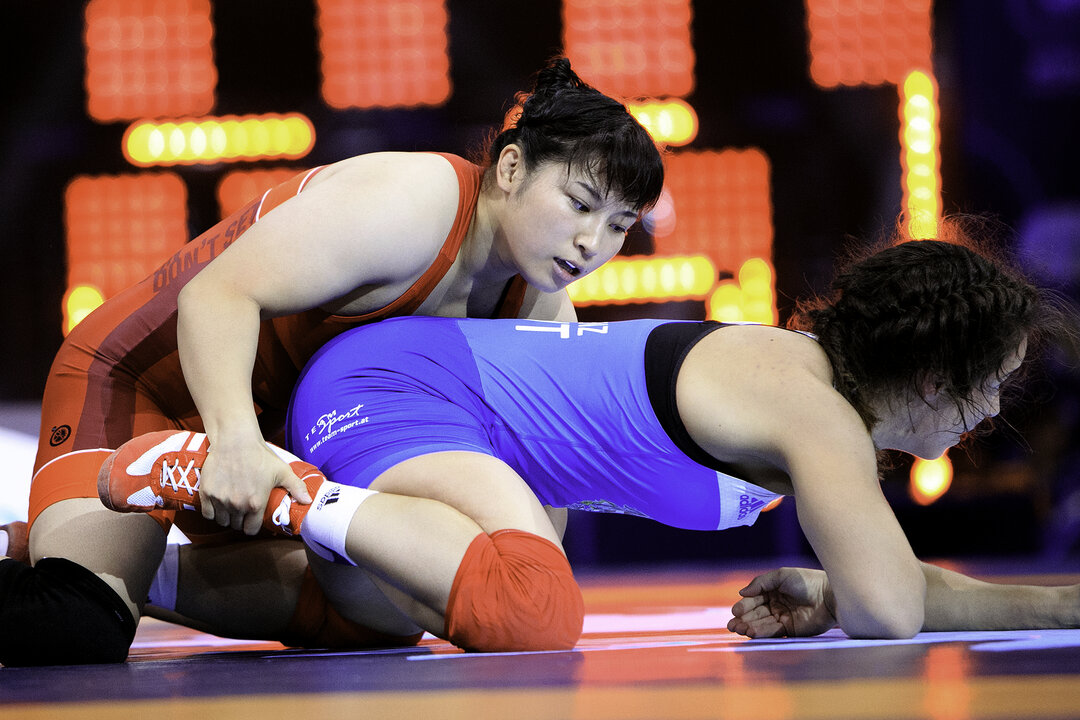 df. Martina KUENZ (AUT) by 6-0 (1).jpg)

Share your thoughts.
Comments