TOKYO (May 22) -- Having followed nearly identical paths up to and after their triumphs at the Paris Olympics, Rei HIGUCHI suddenly diverged from Kenichiro FUMITA on an issue that no one had seen coming.
Higuchi captured the Freestyle 61kg title at the Meiji Cup All-Japan Championships in Friday in Tokyo, only to then make the stunning announcement that he would take a pass on a playoff for Japan's team to this year's World Championships.
Fumita earned a chance at a third world title and first since 2019 when he claimed the Greco-Roman 63kg gold, then handily defeated Asian bronze medalist Kaisei TANABE 9-1 in a playoff.
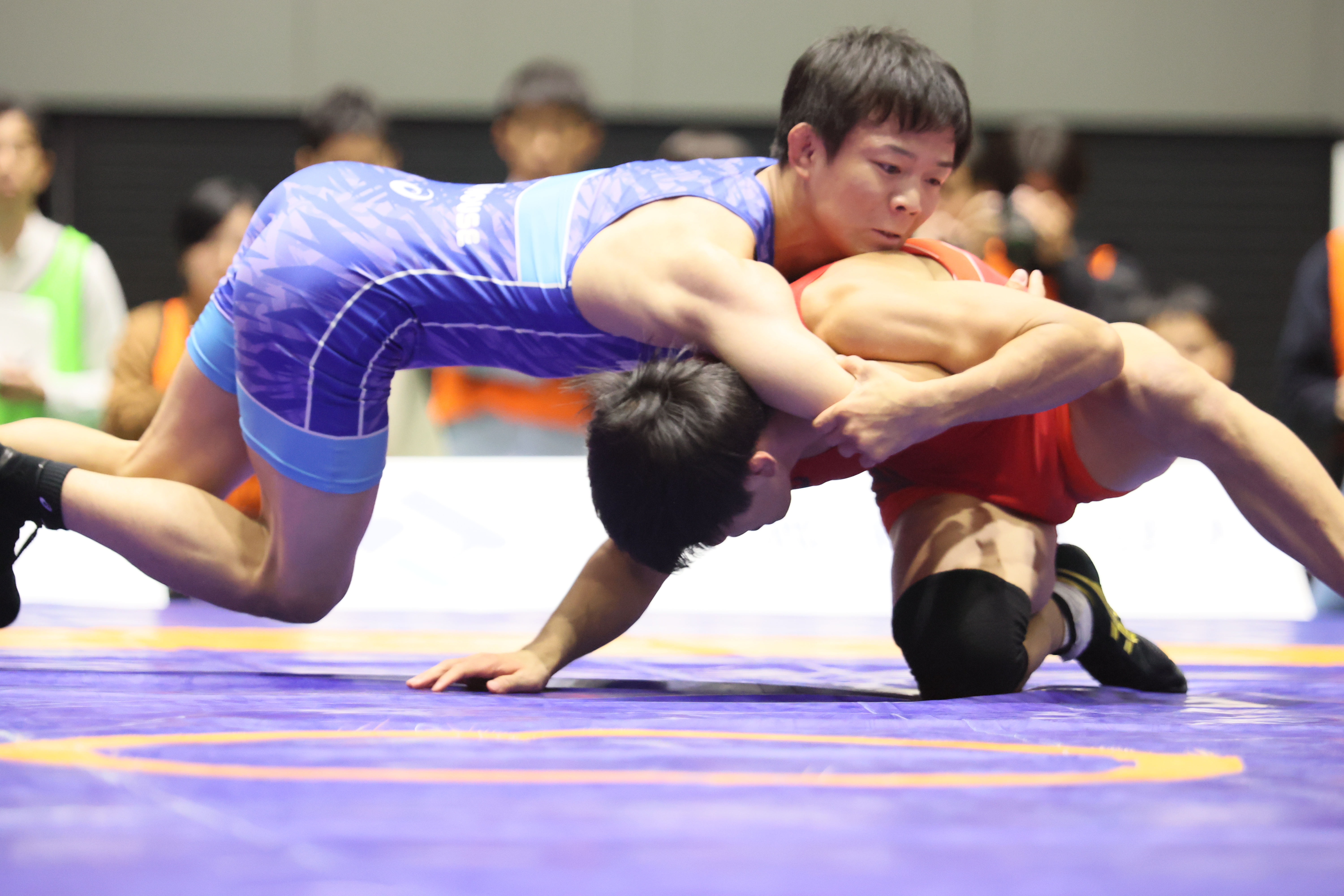 Rei HIGUCHI (JPN) defeated Toshihiro HASEGAWA (JPN), 3-0, in the 61kg final for Meiji Cup. (Photo: wrestling-spirits.jp / Takeo Yabuki)
Higuchi, the Paris gold medalist at 57kg, cited a single-minded desire to become a repeat Olympic champion as being behind his lack of interest in trying to add a world title to the one he claimed in 2022.
"In December, the qualifying process at 57kg starts for [the 2028] Los Angeles [Olympics]," Higuchi said. "There is the World Championships, but all I am thinking of is a second straight title in Los Angeles.
"Strategically speaking, I have six months from now to get my body ready and drop to 57kg, and I want to give that priority. That's how I came to this decision."
Fumita, a former teammate of Higuchi's at Nippon Sports Science University who now shares the same corporate sponsor, was neither critical nor surprised by the move.
"He has his own way of thinking," said Fumita, the Paris gold medalist at Greco 60kg. "To tell the truth, before the Meiji Cup, he continually said how he was not aiming for the World Championships. I thought, that's just like him."
"I'm the type who gets into the position where I earn the ticket first, then consider what I want to do. For him to be able to just make such a decision on the spot, I think is actually pretty cool."
The Meiji Cup is serving as the second of two qualifiers for the Asian Games (in the Olympic weights) and World Championships, both of which will be held in the fall. A wrestler who wins the first qualifier -- the Emperor's Cup All-Japan Championships held in December -- and the Meiji Cup earns the national team place outright; a playoff is held when the winners are different.
Higuchi set up the playoff, that he eventually spurned, by defeating Emperor's Cup champion Toshihiro HASEGAWA 3-0 in the 61kg final, scoring a spin-behind takedown and stepout in the first period.
"It was fun being back in competition for the first time in awhile, and I was excited and nervous," Higuchi said. "I didn't really feel much pressure.
"As the Olympic champion, I think there were some people expecting an upset. But win or lose, it's not going to change that I am the Olympic gold medalist. In that way, I paid no mind and could enjoy my wrestling."
Powering the 30-year-old Higuchi's quest for gold at Los Angeles is a desire to etch his place among -- or at the top -- of the greats in Japanese wrestling history. He wants to join the legendary Yojiro UETAKE, who won the Freestyle 57kg gold at the 1964 Tokyo and 1968 Mexico City Olympics, as the only Japanese males to win consecutive Olympic titles.
"In Japanese wrestling history, there has been only one [male] who has won back-to-back Olympic titles," Higuchi said. "My goal is to become the strongest wrestler in Japan history. There are many greats who came before me, and I want to top their records by ending with a second gold in Los Angeles."
With Higuchi stepping aside, Hasegawa automatically gained a chance to improve on the bronze medal he won at the 2021 World Championships.
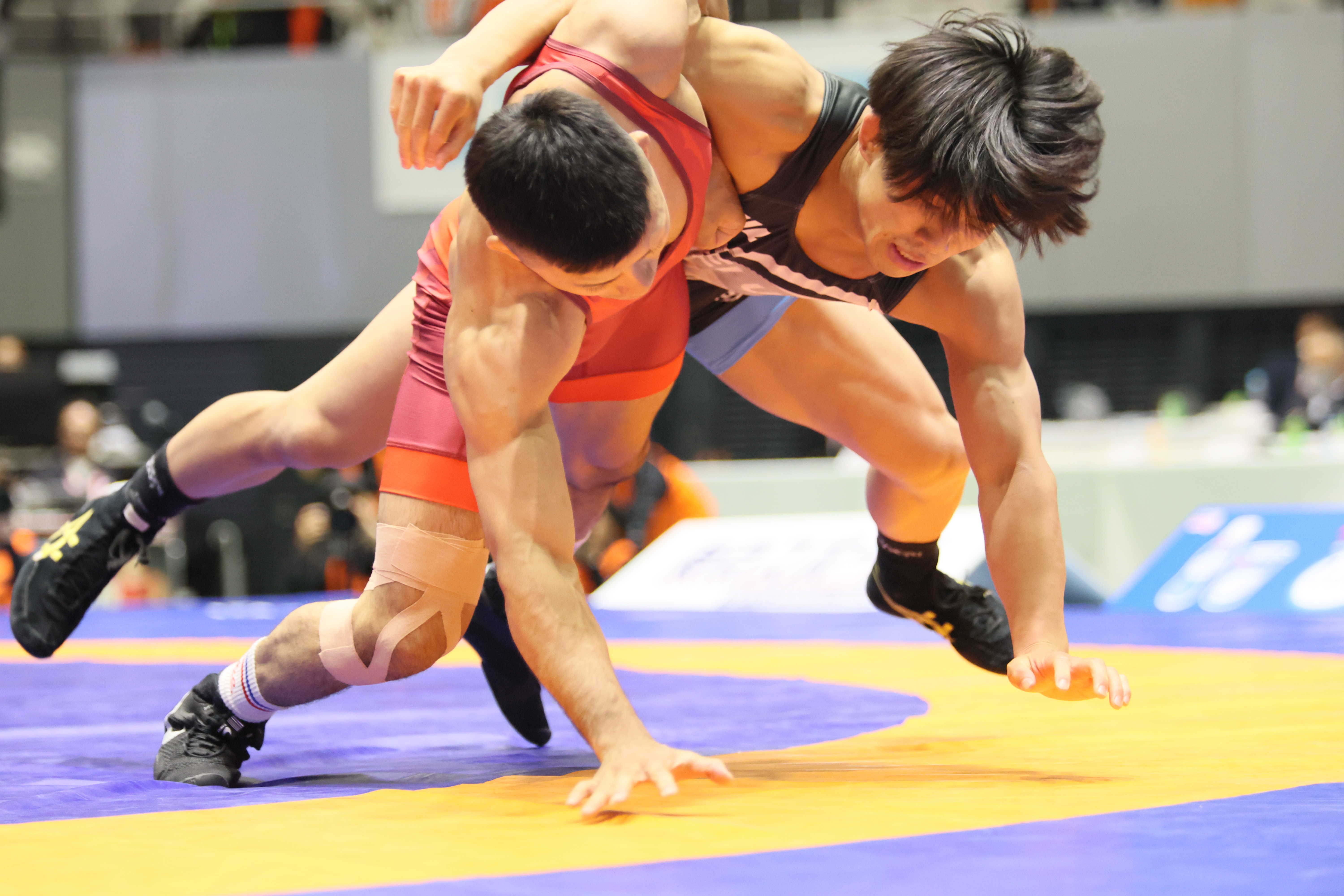 Kenichiro FUMITA (JPN) battles it out during his 63kg final against Manato NAKAMURA (JPN). (Photo: wrestling-spirits.jp / Takeo Yabuki)
Unlike Higuchi, Fumita had planned to return to action at the Emperor's Cup, but was forced to withdraw due to injury. His dominant run to his fifth career Meiji Cup gold and first since 2022 made victory all the sweeter.
"Being in the position of winning again makes me realize how great it is. Winning really is great," Fumita said. "I really kept my focus. From the time Paris was over to now, I thought quite a lot about my wrestling and how I wanted to approach it, and in the final and the playoff, I was able to bring out what I had imagined."
In the 63kg final, Fumita used a high chest wrap from par terre to score three exposures and finished off Manato NAKAMURA 9-0 in just over two minutes.
That put him into the playoff, held a few hours later following the medal ceremony. Tanabe, who nearly completed a rare Freestyle-Greco double at the Emperor's Cup, had defaulted his first-round match, ensuring he would be fresh for the playoff.
As impressive as Tanabe has been in his "side" job in Greco, he proved no match for the powerful and wily Fumita, who also has a Olympic silver and two other world medals to his credit.
From par terre, Fumita relied on the high chest wrap again, rolling Tanabe twice to take a 5-0 lead into the second period. Tanabe had his chance at par terre, only for Fumita to step over on a roll attempt for 2, then gain control and end the match with a gut wrench in 3:15.
"After taking a little rest, I was able to turn the switch back on," Fumita said. "Getting the ticket [to the World Championships] was my No. 1 objective, and first off, I was able to clear that. But I intend to eventually go back down to 60kg."
Tanabe, who is also part of the training group of past and current NSSU students, will attempt to win the Freestyle 65kg title over the next two days.
"Normally, he practices Freestyle, but sometimes joins in Greco," Fumita said. "He has entered competitions in Greco and even won a medal in Asia, so he definitely has the ability. As such, I had to dig deep and fight and stay aware of not giving him any openings.
"He's preparing to compete in Freestyle at 65kg tomorrow and the day after and I will switch over to his side and give him my total support."
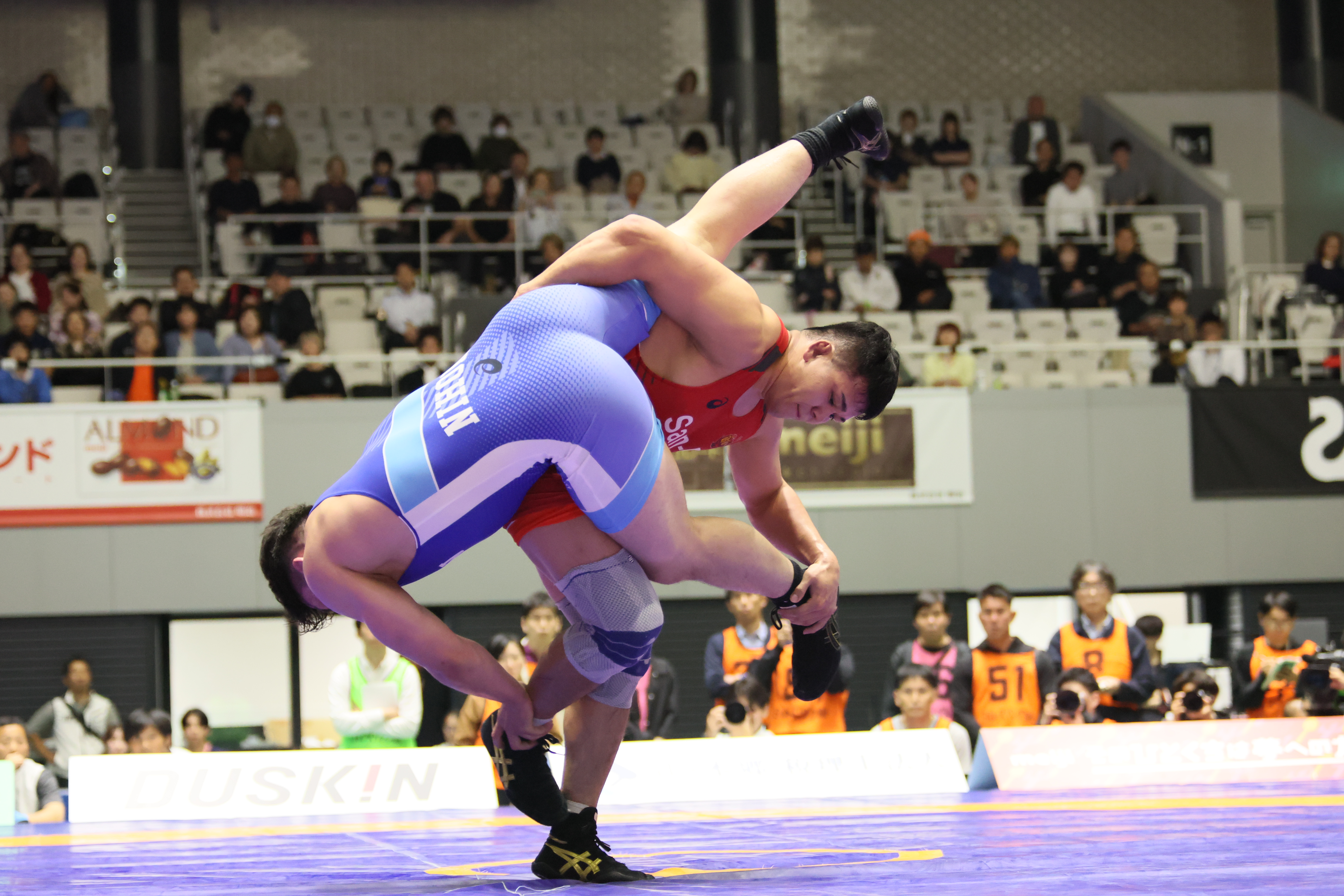 Arash YOSHIDA (JPN) scores upon Noah LEIBOWITZ (JPN) during 97kg final. (Photo: wrestling-spirits.com / Takeo Yabuki)
Yoshida Secures Return Trip to Worlds
In other action, world bronze medalist Arash YOSHIDA, coming off a second consecutive gold-medal run at the Asian Championships, won a second straight title at Freestyle 97kg with a 11-0 victory over up-and-coming teenager Noah LEIBOWITZ.
The result was a repeat of the final at the Emperor's Cup, thus clinching Yoshida's spot on the national team to the Worlds.
"Along with aiming to win, my objective was to use what I worked on in practice," Yoshida said. "But looking at it that way, there were more things I didn't use, so I need to practice so that they come out in matches.
"My opponent has a strong attack, and that makes it easy to wear yourself out. So my plan to was to let him shoot, stop it and get behind, and that's just how it went."
At Freestyle 70kg, Yuma TOMIYAMA received a victory by default over Taishi NARIKUNI, who suffered a severe facial injury earlier in the day in a Greco match.
Narikuni, who completed the Freestyle-Greco double at the Emperor's Cup that eluded Tanabe, was hospitalized and will undergo surgery on a broken eye socket, according to family members.
In Women's Wrestling, two Asian silver medalists earned their first trips to the senior Worlds, one outright and the other through the playoff route.
At 65kg, Nana IKEHATA, the 2024 world U20 champion, followed up her triumph at the Emperor's Cup with a 9-2 victory over Hiyori MOTOKI.
Mahiro YOSHITAKE avenged a loss in the semifinals to eventual 72kg champion Shirin TAKEMOTO, winning their playoff 5-1. Earlier, Takemoto defeated Chisato YOSHIDA 11-0 in the final.
One of the day's bronze-medal matches took sibling rivalry to the extreme, as Daizo TANIZAKI got the better of younger brother Konosuke at Greco 82kg. Daizo used a front headlock for a 4-point throw, then kept hold to add two rolls to win 8-0 in 1:14.
Day 2 Results
Freestyle
61kg
GOLD: Rei HIGUCHI df. Toshihiro HASEGAWA, 3-0
BRONZE: Rikito SASAKI df. Kosei KANEKO, 8-2
BRONZE: Akito MUKAIDA df. Meiryu AKAMINE, 4-1
70kg
GOLD: Yuma TOMIYAMA df. Taishi NARIKUNI by Inj. Def.
BRONZE: Taichi YAMAGUCHI df. Kaito MORITA, 9-5
BRONZE: Shina YASUMI df. Taishin HONNA, 2-1
92kg
GOLD: Sorato KANAZAWA df. Ryogo ASANO, 6-5
BRONZE: Takeru TAKESHIGE df. Yuya YOSHIDA, 12-4
BRONZE: Takato UCHIDA df. Ryuki NOSE, 9-0
97kg
GOLD: Arash YOSHIDA df. Noah LEIBOWITZ by TS, 11-0, 5:33
BRONZE: Satoshi MIURA df. Daiki ITO by TS, 14-1, 5:48
BRONZE: Toyoki HAMADA df. Yuto UEKI by Fall, 3:41 (4-1)
Greco-Roman
55kg
GOLD: Kagetora OKAMOTO df. Keidai ITO, 6-5
BRONZE: Mizuki ARAKI df. Hiro SAKAMOTO by Inj. Def.
BRONZE: Sanshiro TAKAHASHI df. Taketo NINOMIYA, 6-4
63kg
GOLD: Kenichiro FUMITA df. Manato NAKAMURA by TS, 9-0, 2:03
BRONZE: Kensho NATAMI df. Rikito SASAKI, 7-3
BRONZE: Shoya ITO df. Ryota Koshiba, 2-1
World team playoff: Fumita df. Kaisei TANABE by TS, 9-1, 3:15
82kg
GOLD: Tatsuya FUJII df. Tesshin HIGUCHI by TS, 10-1, 4:15
BRONZE: Yahiro MOTOHASHI df. Isshin ONITSUKA, 4-2
BRONZE: Daizo TANIZAKI df. Konosuke TANIZAKI by TS, 8-0, 1:16
130kg
GOLD: Sota OKUMURA df. Yuta NARA, 1-1
BRONZE: Koei YAMADA df. Tsubasa HARUKAZE by Fall, :19 (2-0)
BRONZE: Kosei MIYAKE df. Shion OBATA by Fall, 2:00 (2-1)
World team playoff: Nara df. Okumura, 2-1
Women’s Wrestling
55kg
GOLD: Nagisa HARADA df. Konami ONO, 7-7
BRONZE: Yuna SAWATANI df. Narumi NAKAMURA, 3-0
BRONZE: Ruka NATAMI df. Haru UCHINO, 6-5
59kg
GOLD: Natsuki YAMAGUCHI df. Nagisa ITO, 3-2
BRONZE: Himeka HASEGAWA, no match
BRONZE: Miuna KIMURA df. Risa MOTOHARA, 4-1
65kg
GOLD: Nana IKEHATA df. Hiyori MOTOKI, 9-2
BRONZE: Misuzu ENOMOTO df. Kotone HIRATA by TS, 10-0, 4:34
BRONZE: Momoko KITADE df. Haruka KOBARU, 1-1
72kg
GOLD: Shirin TAKEMOTO df. Chisato YOSHIDA by TS, 11-0, 5:26
BRONZE: Mahiro YOSHITAKE df. Makia KIMURA by Fall, 1:34 (6-0)
BRONZE: Kaede MATSUYAMA df. Ai SAKAI, 4-0
World team playoff: Yoshitake df. Takemoto, 5-1



Share your thoughts.
Comments