

Pedigreed Pakistani aims to revive illustrious family legacy via Japan
Sunday, March 20, 2022 - 13:04 By Ken Marantz

TOKYO, Japan (March 21) -- The quest started from a bond formed over a half-century ago in a pro wrestling match and meant leaving the comfort of home and traveling 6,000 kilometers to a country where he did not speak the language, to train in a sport he had never done.
But when Haroon ABID (PAK) accepted the challenge to move to Japan as a teenager to become a wrestler, he was not acting in self-interest. It became a mission to revive a family legacy in the sport that dates back centuries.
"The reason that I came to Japan was to regain the name of my family members because we had a long history," Abid said in a recent interview in the wrestling room at collegiate powerhouse Nippon Sports Science University, where he is finishing up his senior year and has found remarkable success despite his late start in wrestling.
"But it is old, people have forgotten it. So I want to be the key that people still remember us."
In his four years at NSSU (referred to locally as "Nittaidai") from 2018-2021, Abid finished second or third every year at either of the two national collegiate championships at freestyle 97kg or 125kg. He even dabbled in Greco-Roman, finishing as runner-up at 97kg in 2019.
"In terms of natural ability, he has what it takes," said NSSU head coach Shingo MATSUMOTO, who won nine straight national Greco titles from 1999 to 2007. "If he didn't, he wouldn't have achieved what he did. He was in a Japanese training environment and that led to his progress in high school and college."
As laudable as his achievements are, for the 22-year-old Lahore native, the ultimate way to restore the family to prominence is to get to the Olympics, and ideally, win a medal. Pakistan has not had a wrestling entry at the Olympics since 1996, and its lone medal was won in 1960.
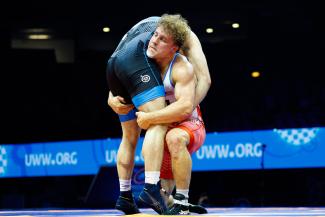
 Haroon ABID (PAK) gets in on a tackle against Aiaal LAZAREV (KGZ) in the repechage round of the Asian Olympic Qualifiers at 125kg. (Photo: UWW)
Abid had a shot at making last year's Tokyo Olympics, but circumstances linked to the pandemic left him less than prepared, plus he agreed to yield the Pakistan spot at 97kg for the Asian qualifier to veteran teammate Muhammad IMAM (PAK) and competed at 125kg instead. He dropped back down to 97kg for the tougher World Olympic Qualifier but lost his first match.
"I was not properly trained for those," Abid said. "Because of corona [COVID-19] and all, the training was closed at Nittaidai. We were not allowed to go out of our dorms, so were stuck in the rooms. So I didn't have much time.
"The Olympics is not a little dream, a lot of people have that dream in their mind. It's not that easy, you don't train for a few months and go and participate. I was not well prepared, but I tried my best in the time I had."
Time spent going to Pakistan ahead of the qualifiers also put him behind in his classes at NSSU, and he will not be graduating with his class later this month. But his path to qualifying for Paris 2024 is clear, as he recently signed a deal with the Japan pro-wrestling circuit Noah that will allow him to continue to train full-time at NSSU, which has a spacious campus with top-notch facilities in suburban Yokohama, 40 minutes by train and bus southwest of Tokyo.
"I think it's good at the start because right now, they gave me permission to do wrestling," Abid said. "I don't have to go there and train. I just have to come here [to NSSU]. It's more of a sponsorship. And they gave me the chance, if you want to do pro wrestling in the future, you can do it. It's my choice. That's really nice of them."
 Haroon ABID (PAK) poses with Narihiro TAKEDA, director of CyberFight, the parent company of Pro Wrestling Noah, to announce his signing a post-graduation contract with Noah. (Photo: ©Noah)
Chance of a lifetime
Nothing could have prepared Abid for the chance of a lifetime that came his way when he was 14.
A diligent student at the prestigious Bloomfield Hall School in Lahore, he was looking toward a career in business and perhaps following his father into money exchange and real estate.
Instead, his career path veered toward that of his revered ancestors.
Abid had grown up hearing the tales of his great-grandfather Imam BAKSH, a great champion and brother of Gulam BAKSH, who earned the title "The Great Gama." Both were unbeaten superstars in the early 20th century who defeated all-comers both at home and abroad in matches fought on the sand. They moved from India to Pakistan after the partition in 1947.
"It's called pro wrestling, but it was actual wrestling," Abid said. "It was not decided who was going to win and lose. The strong one is going to win. So they were training so hard for that."
Imam Baksh had five sons who kept up the family tradition in wrestling in the next generation. One would have a match that would change the course of a future grandson of one of his brothers.
In the 1970s, pro wrestling was flourishing in Japan and the biggest star was Antonio INOKI, a giant with a jutting jaw who would later become world famous for a special match in the ring against boxing legend Mohammad ALI.
In 1976, Inoki fought and won a special-rules match with Abid's great-uncle Akram PAHALWAN, whose glory days were already well behind him. Watching that match was a teenaged Zubair JHARA -- Abid's uncle -- who vowed to avenge the loss. Three years later, he did just that in a match in Pakistan.
 Haroon ABID (PAK), right, with Japan's pro-wrestling great Antonio INOKI, sitting, and Abid's father.
Fast forward four decades and Inoki, who had served several terms in the Japanese Diet while continuing his pro wrestling career, was visiting Pakistan to promote a sports friendship festival.
While there, he decided to look up his old friend and rival Jhara. When he learned that this iconic wrestling family had not had anybody in the sport for nearly three decades, Inoki made a generous offer -- he would cover the expenses for a family member to come to Japan for school and to become a wrestler.
But who would it be?
Abid was athletic, but had only limited exposure to sports, mainly in team sports like cricket, basketball and soccer. He had never taken part in any kind of combat sport.
"I knew that my family belonged to a wrestling background, but it was all finished, so I was not doing that much sports at that time," Abid said. "I was just studying and all that stuff.
"I was interested in wrestling because I had a wrestling background, but around me, none of our family members were doing it. I used to watch WWE and used to watch Olympic wrestling, too. But I was not doing anything."
And yet he became the Chosen One.
"He asked somebody to meet some member of the family, and I don't know for what reason he picked me," Abid said. "I can't tell, why me? Because I was not doing sports at that time. No gym, no sports, nothing. I was just a normal teenager. I'm so thankful that he chose me, but I don't know the reason behind that."
Abid was not rushed into the decision and was flown over to Japan to see what it was like. He had been planning to study abroad anyway, so being away from home was not an issue. His father, who had wrestled but never at a high level, favored his going, but with a caveat.
"He said, 'If you go into it, you have to go all in it. It's not like you can go halfway then you leave. It's not like that,'" Abid said. "So I was thinking about it and I saw that my family was happy, so I thought I should give it a try because of that. I have a passion, too, that I wanted to do that."
 Haroon ABID (PAK) has the upper hand in the 120kg match of the team final of the national high school invitational championships in March 2017, helping Nittadai Kashiwa win the title. (Photo: Japan Wrestling Federation)
New life in Japan
Although he came over to Japan to start a wrestling career. Abid actually spent his first year learning judo instead.
Inoki had a connection with Nippon Sports Science University, so it was arranged that he would go to one of its affiliated high schools, Nittaidai Ebara in Tokyo. The only problem was that it did not have a wrestling team. So he learned judo as he endured culture shocks that included his first experience of living in a dormitory.
"The place where I was staying in my school when I came, it had like eight people to a room," he said. "And we used the same bathroom... I had to wait for the last member to take a shower. I was like, what did I get myself into? But it was nice, it was a good experience. It's good to have new friends."
He also took to the new sport, enough so that when another Nittaidai-affiliated high school in Kashiwa, Chiba Prefecture, northeast of Tokyo, started a wrestling team, the Ebara coach tried to get him to stay.
"Judo was also a really good experience. My coach at that time, Kokubo-sensei, told me that you can stay with us. We will give you all of the expenses. At the time, Inoki-san was supporting me. He said I can leave him and we will support you if you want to do judo. And he used to tell me that judo was more famous in Japan.
"But I came here for wrestling, so I had to shift."
Abid recalled that his first impression of Japan was that it was nothing like he had imagined. Coming from an upper-middle-class family in Pakistan, he did not expect just how compact a sprawling city like Tokyo can be.
"Japan is such a well-known place, so I thought there would be big homes. But when I came, they sleep on the floor, they were so humble. I was like, damn, it was the opposite of what I thought Japan would be.
"Now I am used to it, but it was completely different than I had thought. There were big buildings, but I thought there would be robots and all. [And] everyone uses the train in Japan, so you can't judge who is rich or poor. That's the nice part of Japan."
For his second year of high school, Abid made the move to Kashiwa, which had newer facilities and the dorm only had four to a room. The sport-oriented school also had more foreign students, which made it easier for him to adjust.
"It was a good school," he said. "It was clean; Ebara was clean, too, but Kashiwa was like new beds and all that stuff, so it was a good place to study. The competition was very good, too. "
Abid said it took him six or seven months to achieve a passable level of Japanese, which became a necessity in one aspect.
"For me, I'm a Muslim, so I can't eat pork and I have to tell people, I can't eat this, I can't eat that, so I had to learn really fast. That was the reason I learned Japanese really fast."
He also made rapid progress in wrestling. In just his second year in the sport, he finished third at 120kg at both the national invitational high school championships and the Inter-High tournament, both of which had over 45 entries in his weight class. For good measure, he took the silver medal at Greco 120kg in the high school division at the National Games.
Abid chalks his success up to more than good genes. "I had a really good partner," he said. "He was from Mongolia, and he was also 125. So I got used to training with heavy guys. That was a really plus point for me. And that guy was strong, too, he was also an Inter-high champion. So I had the confidence that I was training with this guy and taking points, too. That's why I could [do well]."
In all three tournaments, he was defeated by Yuri NAKAZATO (JPN), who would become his teammate at NSSU and last December placed second at the senior All-Japan Championships at Greco 97kg. Abid is not eligible to take part in the All-Japan.
 Haroon ABID (PAK) is aiming to get to Paris 2024 and become the first wrestler from Pakistan to make the Olympics since 1996. (Photo: Japan Wrestling Federation)
Overcoming nerves
With eyes on Paris 2024, Abid is still looking for his first victory over a non-Japanese opponent outside of Japan.
Aside from facing foreign opponents from other schools in Japan, Abid was poised to face global competition for the first time at the Asian Junior Championships in 2018 in New Delhi.
But he was unable to get a visa to enter his ancestral homeland, and his international debut was pushed back to the same tournament the next year in Chonburi, Thailand.
In Chonburi, he lost his opening match in the quarterfinals at freestyle 97kg to Zyyamuhammet SAPAROV (TKM), then the bronze-medal match to Arslanbek TURDUBEKOV (KGZ).
In 2021, he was dealt a succession of first-round losses: to Lkhagvagerel MUNKHTUR (MGL) in the qualification round at 125kg in the Asian Olympic qualifier (followed by a repechage loss to Aiaal LAZAREV (KGZ)); to Minwon SEO (KOR) at 97kg at the Asian Championships; and to Timofei XENIDIS (GRE) at 97kg the World Olympic qualifier.
"He has continually been improving," NSSU coach Matsumoto said. "During the pandemic, he could not leave Pakistan for an extended period during Tokyo Olympic qualifying. If he has an environment in which he can continually train and prepare, he will become stronger and look ahead to the next competition."
No doubt the pandemic had an effect by curtailing his preparation. But there is another reason for his lack of success, as well as his failure to win a major collegiate title at NSSU. Granted, he made plenty of podiums, but, save for a victory at the spring newcomers tournament in his freshman year, he never ascended to the highest step.
For Abid, who said his next tournament will likely be the Asian Games in China in September, every match is as much a battle against nerves as an opponent.
"In matches, I'm not as good as in practice," he said. "I don't know why, I can't say I'm still at the start, it's been seven years I've been wrestling. But I need more competitions so I can gain more confidence."
Looking back at his first international outing in Thailand, he said, "I was prepared well, but the pressure was immense. It was not me on the mat. I couldn't move properly like I could in the training because it was my first international match.
"My family was looking at me, and there were all different people around me. I wasn't scared, but I was a bit under pressure. I would have gotten a medal in that [tournament], but after that match, I thought I really need to work hard."
 Haroon ABID (PAK) has had success at Greco-Roman in Japan. Here he battles Yamanashi Gakuin University's Bakhdaulet ALMENTAY (KAZ) in the 97kg final of national collegiate championships in October 2019. (Photo: Japan Wrestling Federation)
Abid points to two matches that he said helped boost his confidence. Ironically, both were in Greco, which he decided to do because it gives him a chance to enter more tournaments. It was how he held his own against expectations that makes the encounters --- one was even a defeat -- so significant.
Back in 2019, Abid made the final of the national collegiate Greco championships with a semifinal victory over Takashi ISHIGURO (JPN), who last year won the senior national and was an Asian bronze medalist title at freestyle 97kg.
"Everyone was telling me he's strong and I beat him," Abid said. "And it was a good point-difference [6-0], so that match really gave me a boost.
In the final, he would fall to Bakhdaulet ALMENTAY (KAZ), who went undefeated in his career at rival Yamanashi Gakuin University. Almentay would also defeat Abid in one freestyle final.
"I didn't beat him, but it was a good match between us, you couldn't tell who would win," he said. "Even though it was in Greco, when I came back from the match, I had gained that confidence of being among the best in Japan, and I could be that good."
It's an attitude that would make his ancestors proud. Now he has to back it up with deeds on the mat, and he's determined to fulfill his quest. Getting to Paris 2024 would make him the first Pakistani wrestler at an Olympics since Mohammad BHALA competed at the 1996 Atlanta Games at freestyle 90kg.
The Southeast Asian nation's lone Olympic wrestling medal came in Rome in 1960 with Mohamed BASHIR's bronze at freestyle 73kg, and it has not had a world medalist since winning two bronzes in 1959.
"I'm definitely going to be the Olympics at Paris 2024," Abid declared. "I have that confidence right now. For sure, I'm going to be in that match. For sure."
Share your thoughts.
Comments