

Pataridze, Kawai Highlight End-of-the-Year Age-Group Awards
Thursday, December 13, 2018 - 12:30 By Eric Olanowski
CORSIER-SUR-VEVEY, Switzerland (December 13) -- United World Wrestling has awarded a pair of cadet, junior and U23 wrestlers the 2018 Age-Group Wrestlers of the Year.
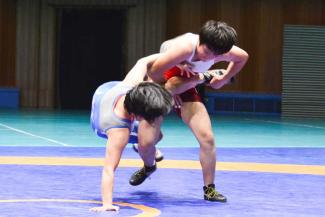
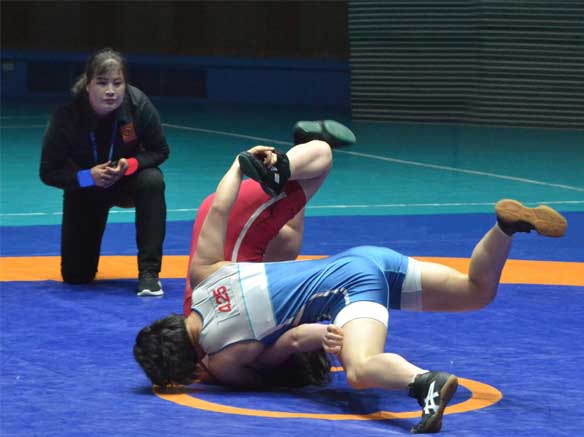
The U23 age-group wrestlers of the year went to the duo of Zviadi PATARIDZE (GEO) and Yukako KAWAI (JPN).
Pataridze won his sixth overall Greco-Roman age-group world title, scooping up the 2018 U23 world title at 130kg in Bucharest, Romania. The Georgian big-man has two cadet golds, a trio of junior titles, and a U23 world championship.
Kawai, the sister of the three-time world and Olympic champion, Risako KAWAI (JPN), won the 62kg gold medal at the U23 World Championships after falling in the finals of the Senior World Championships. Kawai’s gold and silver medal performances at the World Championships are improvements from a season ago when she took eighth-place at the Senior World Championships and ninth-place at the Junior World Championships.
The Russian twosome of Aleksander KOMAROV (RUS) and Khanum VELIEVA (RUS) earned the junior age-group wrestlers of the year after obtaining gold medals in Trnava, Slovakia at the 2018 Junior World Championships.
Komarov, one of the most dominant Greco-Roman age-group wrestlers in the world, remained undefeated in his international career and won his second junior world title. Komarov’s resume is now chalked up with a pair of cadet and junior world titles, totaling four overall age-group world titles.
Komarov’s Russian partner, Khanum Velieva, who is still eligible to compete at the junior level, also won her fourth overall age-group world title. In the 68kg finals, Velieva picked up her fourth shutout victory of the World Championships and knocked off reigning cadet world champion, Macey KILTY (USA), 6-0.
The cadet age-group wrestlers of the year are Alihasan AMIRLI (AZE) and Yuka KAGAMI (JPN). Amirli and Kagami each departed Zagreb, Croatia with their second straight cadet world titles.
Azerbaijan's Amirli rebounded from a bronze medal finish at the European Championships to win back-to-back cadet world titles. He wrapped up his 48kg gold medal performance at the World Championships with a 6-1 finals victory over the United States’ Richard FIGUEROA (USA).
For the second year in a row, Japan’s Yuka KAGAMI (JPN) blanked her opponents on her way to a world title. Over two years, Kagami outscored her eight world championship opponents 83-0. In 2017, she outscored her Athens opponents 41-0, and shutout her Zagreb counterparts 42-0.
The next award that will be released by United World Wrestling will be the 2018 History Makers. The History Makers for 2018 will be coming out this Sunday.
Share your thoughts.
Comments