

Paris 2024: Tazhudinov strikes gold; Japan finish with eight
Sunday, August 11, 2024 - 17:21 By Ken Marantz

PARIS (August 11) -- A little less than a year ago in Belgrade, Akhmed TAZHUDINOV (BRN) announced himself to the world by knocking off two of the sport's biggest giants -- both literally and figuratively. On Sunday, he accomplished the one feat that makes a name live on forever.
Tazhudinov added the Olympic gold to the one he won at last year's World Championships, scoring an opportunistic fall over Givi MATCHARASHVILI (GEO) in the freestyle 97kg final on the last day of competition at the Paris Olympics.
"This is the Olympic Games, all of the fights are difficult. I just did it," said the Russian-born Tazhudinov, who became Bahrain's first-ever Olympic champion in a sport outside of athletics. "I trained hard. My family, brothers and [training] partners helped me become what I am today."
Japan capped a spectacular showing in Paris by grabbing the two other gold medals at stake, with world champion Yuka KAGAMI (JPN) prevailing at women's 76kg to become the country's first-ever champion in the heaviest weight class, and unheralded Kotaro KIYOOKA (JPN) taking the freestyle 65kg title to join a childhood wrestling club teammate as Olympic champion in Paris.

The 21-year-old Tazhudinov turned the wrestling world upside down in Belgrade last September when he swept aside in succession both Kyle SNYDER (USA) and Abdulrashid SADULAEV (AIN), who between them had won every world or Olympic 97kg title dating back to 2015, en route to the gold.
Few had been aware of Tazhudinov up to that point, although he did give a hint of things to come by winning the Asian Championships earlier that year. The native of the wrestling hotbed of Dagestan had changed his nationality to Bahrain in the autumn of 2022.
A month after his triumph in Belgrade, Tazhudinov added the Asian Games gold, then prepped for Paris this year by winning the Antalya international tournament and successfully defending his Asian title in Bishkek.
On Sunday, Tazhudinov shone brightest on the biggest stage of all, beating Snyder in the semifinals before securing the gold before another packed crowd at the Champs de Mars Arena.
In the final, two-time reigning European champion Matcharashvili threw caution to the wind at the start and attempted a bold arm throw. It would be a fateful decision, as Tazhudinov stopped the move and Matcharashvili left on his back. That provided the opening for him to pounce on top, securing the fall at 1:52 for his seventh straight major tournament title.
"It was a counterattack, and I caught him on this move," said Tazhudinov, who has not lost since falling 6-4 to Vladislav BAITCAEV (HUN) in the quarterfinals of the Alexandria Ranking Series tournament in February 2023.
Kagami doesn't put up the big numbers like Tazhudinov, but she steadily wears down opponents and gains enough openings to score with her deceptive speed.
 Yuka KAGAMI (JPN) after winning the 76kg final against Kennedy BLADES (USA) in Paris. (Photo: United World Wrestling / Amirreza Aliasgari)
In the women's 76kg final against Kennedy BLADES (USA), Kagami trailed 1-1 on criteria when she connected with a double-leg tackle, driving the American out of bounds for a takedown that was originally scored a stepout to lead 3-1.
After that Kagami never let the taller Blades, who defeated six-time world champion Adeline GRAY (USA) at the U.S. Olympic trials to get to Paris, get even a whiff of her legs as she secured the historic victory for Japan.
“She was definitely strong, and her positioning was great," said the 20-year-old Blades, last year's world U23 silver medalist. "I knew going into the match that Japan is very disciplined on positioning, so I think that’s what made it a little tough. I’m just going to go back to the drawing board and start working on my stuff again.
“She was ready for what I was going to do, and I was ready for what she was going to do. It was definitely a scramble. It was a fun match. Of course, I do want to be on top, always. But honestly, at the end of the day, it was a battlefield."
Blades had advanced to the final by knocking off world silver medalist Aiperi MEDET KYZY (KGZ) 8-6 in the semifinals Saturday.
That Japan is the dominant power in women's wrestling is beyond dispute -- the country won four of the six golds in Paris, with two bronzes -- but until Sunday, it had always come up short in the heaviest weight at the Olympics.
The last time a Japanese heavyweight even medaled was in Beijing 2008, when Kyoko HAMAGUCHI (JPN) won a second straight bronze at 72kg. Kagami was determined to rectify the situation.
"It is something that I have always been aiming for," Kagami said. "It's really a thrill to be able to accomplish something that no one else has. What I did today resulted from what I have done up to now and the choices that I have made."
After the victory, Kagami lifted up and twirled around coach Shogo MAEDA, who is not only a national team coach but was her coach at Toyo University, which she chose to attend instead of one of the established powerhouses.
Kagami is a product of the JOC Academy that also produced Tokyo Olympic champion Yui SUSAKI (JPN) and Nonoka OZAKI (JPN), who both won bronzes in Paris. Her effervescence and outgoing nature make her a favorite on the national team.
"To see everyone with tears of joy for me makes me the happiest," said Kagami, a two-time Asian champion and world bronze medalist in 2022.
"I had always aimed to be standing here. I thought to enjoy each and every match, each and every second. I was smiling, and I was nervous. But I spent this Olympics even enjoying the nervousness."
 Kotaro KIYOOKA (JPN) laces Amouzad KHALILI (IRI) during the 65kg final at the Paris Olympics. (Photo: United World Wrestling / Amirreza Aliasgari)
At 65kg, Kiyooka was never considered a favorite in a stacked weight class, although he did earn some street cred by defeating Tokyo Olympic champion Takuto OTOGURO (JPN) en route to qualifying for Paris.
“There was a certain degree of pressure to perform as well as my rival, but I was able to defeat the champion of the Tokyo Games," said Kiyooka, who finished ninth at the 2023 World U23 Championships. "I felt like there was an element of fate there having defeated a prior gold medalist."
His lightning-quick reflexes and solid techniques propelled him to the pinnacle of the sport, capped by a 10-3 victory over reigning Asian champion and 2022 world 61kg gold medalist Rahman AMOUZAD (IRI).
Amouzad got on the scoreboard first with a driving stepout while on the activity clock. Kiyooka responded with a single-leg takedown, then executed a lace-lock variant in which he puts his head between the legs while securing the thighs or ankles, a move often used by Japanese wrestlers.
Kiyooka reeled off a series of rolls, but a fourth that would have ended the match came after time expired, leaving him with a still-formidable 10-1 lead.
Kotaro KIYOOKA 🇯🇵 won the 65kg 🥇 at #Paris2024
— United World Wrestling (@wrestling) August 11, 2024
Here’s how he defeated Tokyo Olympic champion Takuto OTOGURO 🇯🇵 in the playoff #wrestling
pic.twitter.com/XBhHJevL1N
"That is my pet move, and if I can get into position, I'm confident I can get the turns," the 23-year-old Kiyooka said. "I had intended to end it right there, but time ran out.
"When I looked up it was 10-1. I was aiming to attack from the beginning in the second period to win by technical superiority, but he is not so easy of an opponent, so I couldn't finish it off."
It was Amouzad who would score the lone points of the second period, a 2-point exposure off a counter, but he never found a way through Kiyooka's defenses to close the gap any further.
“In this 65kg weight class, any athlete could have won gold," Kiyooka said. "It’s a very difficult and challenging weight class, and winning gold in this weight class is particularly important for me. That’s why I felt like the hero of my own novel."
 Kotaro KIYOOKA (JPN) celebrates with his childhood friend and fellow Olympic champion Tsugumi SAKURAI (JPN). (Photo: United World Wrestling / Kadir Caliskan)
Kiyooka started wrestling at age 3 at a kids wrestling club in Kochi City on the central island of Shikoku. It was there he first met the 2-year-old daughter of the club's coach. Her name is Tsugumi SAKURAI (JPN), and she won the women's 57kg gold the previous day.
"I had to find a way to win," Kiyooka said. "Before the tournament, we knew that she would wrestle before me, so I told her to put pressure on me by winning. I converted that into motivation.
"We've had a great relationship leading up to this point and both of us won gold medals. We made each other stronger and had dreams of the Olympics together, and we could both win by encouraging each other. It's really incredible that we won titles at the same Olympics."
Asked about standing at the top of the medal podium, Kiyooka replied, "It's the most beautiful view in the world."
Japan finished its best-ever tournament with a total of eight golds, one silver and two bronzes from the 13 weight classes in which the country had qualified. With Kiyooka's victory, Nippon Sports Science University students and alumni combined for five golds, more than double any other country.
 Amirali AZARPIRA (IRI) denied Kyle SNYDER (USA) in the 97kg bronze-medal bout. (Photo: United World Wrestling / Amirreza Aliasgari)
Snyder denied bronze; Albania wins 2nd
Snyder, who came to Paris looking to regain the Olympic title after taking silver in Tokyo, will leave empty-handed after being dealt a 4-1 defeat by 2022 world U23 champion Amirali AZARPIRA (IRI).
Azarpira scored a takedown in the first period and two stepouts in the second, then fended off everything Snyder threw his way to earn a bronze medal and repeat his 6-3 victory over Snyder in the final at the Zagreb Open in January.
The other 97kg bronze went to Russian-born world silver medalist Magomedkhan MAGOMEDOV (AZE), who scored two takedowns in each period of a 10-0 victory over Murazi MCHEDLIDZE (UKR).
Prior to the Paris Olympics, Albania had never won an Olympic medal in any sport. European champion Islam DUDAEV (ALB) gave the tiny European nation a second in wrestling in two nights.
The Russian-born Dudaev had just been tagged for a 4-point throw when he scored a reversal with :04 left, giving him a thrilling 13-12 victory over reigning world champion Iszmail MUSZUKAJEV (HUN) in a freestyle 65kg bronze-medal match.
“The match was very difficult," Dudaev said. "It was not the first bout I had with Muszukajev. We have already met several times, so I knew him quite well, and I knew what I was supposed to do to win against him.”
Dudaev started off the clash with a bang, getting 4 with a marvelous inner crotch throw and 2 more with an exposure. Musukaev cut the lead to 8-4 off a scramble, and a takedown whittled it further to 8-6 at the break.
Dudaev spread the gap again to six points with a takedown and roll, but Musukaev struck back again with a takedown, then used a front headlock to throw Dudaev to the mat for 4 to go ahead 12-12 on criteria.
But Dudaev squirmed out of the hold and got behind in time to secure a dramatic win and join compatriot Cherman VALIEV (ALB), also a native Russian, as a bronze medalist.
 Sebastian RIVERA (PUR) scores the winning takedown against Tulga TUMUR OCHIR (MGL). (Photo: United World Wrestling / Amirreza Aliasgari)
There was also drama in the preceding 65kg bronze-medal match, as Sebastian RIVERA (PUR) scored a takedown in the final seconds to upend Tulga TUMUR OCHIR (MGL) 10-9, giving Puerto Rico just its second-ever Olympic wrestling medal.
"It was tough," Rivera said. "Everybody in the weight class was really tough. To get a medal, that’s what I expected and what I came here to do, so I’m happy I could fulfill my dreams."
Rivera prevailed in a back-and-forth match when Tumur Ochir, trying to clinch the victory, went for a headlock throw, but the Puerto Rican slipped out and got behind with eight seconds left.
Tumur Ochir appeared to have remained on all fours to avoid the takedown -- but a challenge revealed his knee hit down, giving Rivera the winning points.
Rivera had spotted Tumur Ochir a 4-0 lead in the first period, then went ahead himself 8-4 with a takedown and three exposures from an arm trap. Tumur Ochir took back the advantage 9-8 on a 4-point leg sweep and a lost challenge.
Rivera, who was born in the U.S. state of New Jersey and competed collegiately at Northwestern and Rutgers universities, joins Jaime ESPINAL (PUR), a silver medalist at freestyle 84kg at London 2012 as the only wrestling medalist in their nation's history.
At women's 76kg, world silver medalist Medet Kyzy was relegated to her second straight fifth-place Olympic finish when she was dealt a 6-0 defeat by Milaimy MARIN (CUB) in their bronze-medal match.
Marin fired out of the blocks with a big 4-point double-leg takedown, then went behind for a takedown in the second to deny the Asian champion.
In a rare Olympic medal match between South Americans, Tatiana RENTERIA (COL) gave Colombia its second-ever Olympic wrestling medal, defeating Genesis REASCO (ECU) 2-1 for the other women's 76kg bronze in a bout decided solely on activity points.
Day 7 Results
Freestyle
65kg
GOLD: Kotaro KIYOOKA (JPN) df. Rahman AMOUZAD (IRI), 10-3
BRONZE: Sebastian RIVERA (PUR) df. Tulga TUMUR OCHIR (MGL) 10-9
BRONZE: Islam DUDAEV (ALB) df. Ismail MUSZUKAJEV (HUN), 13-12
97kg
GOLD: Akhmed TAZHUDINOV (BRN) df. Givi MATCHARASHVILI (GEO) by Fall, 1:52 (2-0)
BRONZE: Magomedkhan MAGOMEDOV (AZE) df. Murazi MCHEDLIDZE (UKR) by TF, 10-0, 4:29
BRONZE: Amirali AZARPIRA (IRI) df. Kyle SNYDER (USA), 4-1
Women's Wrestling
76kg
GOLD: Yuka KAGAMI (JPN) df. Kennedy BLADES (USA), 3-1
BRONZE: Milaimy MARIN (CUB) df. Aiperi MEDET KYZY (KGZ), 6-0
BRONZE: Tatiana RENTERIA (COL) df. Genesis REASCO (ECU), 2-1
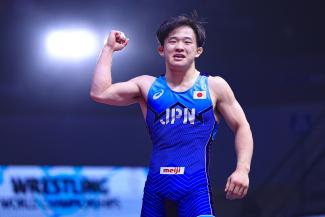

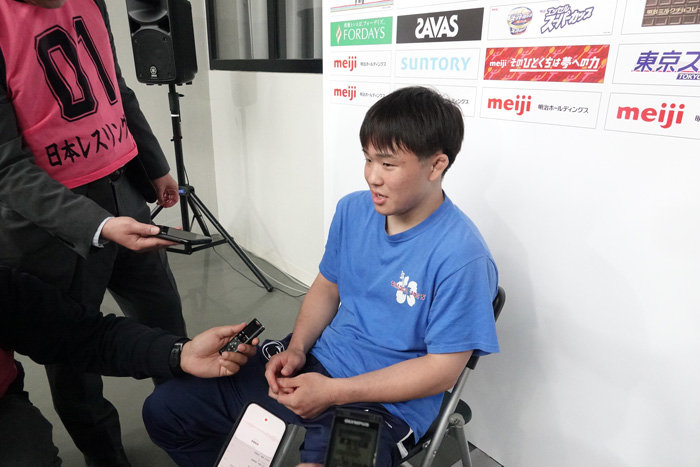 Masanosuke ONO (JPN) giving interview on the sidelines of the Meiji Cup. (Photo: wrestling-spirits.jp / Ikuo Higuchi)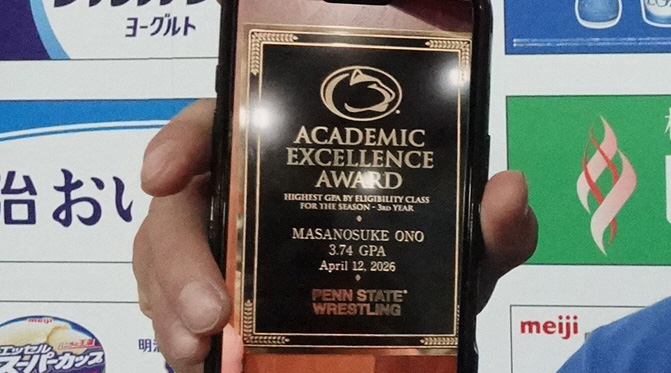
Share your thoughts.
Comments