

Ozaki gets best of Kawai in 62kg showdown; Susaki, Shidochi prevail
Sunday, June 19, 2022 - 19:16 By Ken Marantz

TOKYO, Japan (June 19) -- Five of Japan's seven Olympic medalists took the mat on Sunday for the first time since the Tokyo Games, with the goal of securing a place on the team to this year's World Championships. One will not be going to Belgrade.
World bronze medalist Nonoka OZAKI knocked off Tokyo Olympic champion Yukako KAWAI in the women's 62kg final at the Meiji Cup All-Japan Invitational Championships, scraping out a tense 3-1 victory in the first-ever meeting between the two.
While Kawai went down to defeat, fellow Olympic gold medalists Yui SUSAKI and Mayu SHIDOCHI (formerly MUKAIDA) earned chances to add to their world gold collections by capturing the tournament titles and then winning subsequent playoffs for the world team spots at 50kg and 55kg, respectively.
Susaki's victories came at the expense of reigning world champion Remina YOSHIMOTO, whom she beat 4-2 in the final and then 8-0 in the playoff.
The four-day tournament at Tokyo's Komazawa Gym was the second of Japan's two qualifiers for this year's World Championships in September in Belgrade, in conjunction with last December's Emperor's Cup All-Japan Championships. Winners of both tournaments receive automatic tickets to Serbia; when the winners were different, a playoff was held for the spot.
As none of the Olympic medalists competed at the Emperor's Cup, their path to the World Championships had to pass through a playoff, except in cases in which the Emperor's Cup winner did not enter the Meiji Cup due to injury.
 Nonoka OZAKI (blue) battles Yukako KAWAI in the women's 62kg final. (Photo: Takeo Yabuki / Japan Wrestling Federation)
The 19-year-old Ozaki had won the Emperor's Cup, and avoided a playoff by beating Kawai in a match that featured a lot of tension but few attacks, and came down to a challenged call in the final seconds.
Kawai received an activity point in the first period, but Ozaki went ahead when she received two in the second. Kawai, trying to budge Ozaki with a front arm-and-head lock combo, launched a sudden forward surge in the last five seconds that forced Ozaki backwards in a way that may have exposed her back. But the referee awarded no points, and a challenge by the Kawai side was lost to make the final score 3-1.
"I wanted to score technical points," Ozaki said. "I thought before the match, 'What do I have to do to win?' Even if I didn't score with a tackle, I had to show I was making the effort to attack. When it became one caution each, I thought I would definitely win in the end."
Ozaki was coming off a confidence-building gold-medal run at the Asian Championships in April in Mongolia, where she defeated world champion and longtime Kawai nemesis Aisuluu TYNYBEKOVA (KGZ) in the final. That avenged a first-round loss to Tynybekova at last year's World Championships in Oslo.
But for Ozaki and the rest of the Japanese contingent, this year's World Championships is just a way station en route to the next Emperor's Cup in December. That will serve as the starting point for qualifying for the 2023 World Championships, which in turn is the start of qualifying for the 2024 Paris Olympics -- the next ultimate goal.
"Looking ahead, the Emperor's Cup and Meiji Cup will be linked to Olympic qualifying, so I can't be content with this," said Ozaki, a rarity in Japan in that she is pursuing the sport while attending academically-oriented Keio University. "Other wrestlers will be coming up with strategies against me, and there will be some who change to the Olympic weight.
"I believe that I own the 62kg weight class. Aisuluu and other strong competitors will be at the World Championships, so I want to win the title. Then I want to defend my Emperor's Cup and Meiji Cup titles at 62kg and get to the Olympics."
Kawai, whose older sister Risako won the 57kg Olympic gold but will not be returning to action until December after giving birth in May, took her loss in stride as she looks at the big picture.
"The qualifying for the next Olympics in Paris starts in December," she said. "I hadn't been in a national tournament since June 2019, so regardless of whether I won or lost, I wanted to experience a domestic tournament. I entered for the purpose of preparing myself and was not obsessed with winning."
Kawai said she suffered from an emotional letdown following the hoopla that comes with winning an Olympic gold in an Olympic-obsessed country.
"I'd be lying if I said it wasn't hard to take," Kawai said. "But I achieved my dream at the Tokyo Olympics and after that, I started training again, but I really couldn't get into it."
She said she was encouraged by previous Olympic champions who are part of the Shigakkan University family of current students and alumni.
"Along with my sister, [Eri] TOSAKA, [Saori] YOSHIDA and others told me, 'You will get a lot of attention as an Olympic champion, and there are people who would want that and never get it.' That changed my mood and about February or March, I started coming around again."
 Yui SUSUKI scores a takedown against Remina YOSHIMOTO in the world team playoff at women's 50kg. (Photo: Takeo Yabuki / Japan Wrestling Federation)
Susaki went through a life change when, upon graduating from Waseda University, a company in her native Chiba Prefecture put her on the payroll in April to allow her to train full time. But her wrestling looked hardly different despite a 10-month break since the Olympics.
"It's really been a long time to get on the mat since the Tokyo Olympics and at this tournament, I was able to find many points that I need to work on, which to me is a good start in making progress as I head toward the Paris Olympics," Susaki said. "I want to make use of that and definitely become the world champion and get the ball rolling for qualifying for Paris that starts in December."
After looking like her old self and opening the tournament with a pair of technical falls, Susaki scored a pair of first-period takedowns against Yoshimoto in the final and, despite giving up a takedown herself in the second period, looked solid in winning a fifth career Meiji Cup title and first since 2019.
"I need to make sure not to allow such openings, and become a wrestler who doesn't show such space," she said of giving up the takedown. "I can't just stay with the status quo, I need to always work to improve looking ahead to the Paris Olympics."
She made the right adjustments in the playoff, as she kept Yoshimoto off the scoreboard while scoring one takedown in the first period and three in the second for her fourth win in four career meetings between the two.
 Mayu SHIDOCHI scores a stepout against Umi IMAI in the world team playoff at women's 55kg. (Photo: Takeo Yabuki / Japan Wrestling Federation)
Shidochi, who married her coach after her Olympic triumph at 53kg and now uses her married name, cruised to the 55kg title with three straight 10-0 technical falls, the last over teenager Moe KIYOOKA at 3:36 of the final.
That put her into the playoff with Emperor's Cup champion Umi IMAI, who was coming off a victory at the Asian Championships but lost to Kiyooka in the quarterfinals. Shidochi proved too much to handle and, despite settling twice for stepouts when she had Imai's leg in the air, she rolled to a 4-0 victory.
"It was my first tournament since the Tokyo Olympics, and while I was nervous, I was moving my legs from the first match like I wanted to and was able to make the final," Shidochi said. "In the playoff, I tightened up a bit, but I was able to pull off the victory."
The big question was why Shidochi moved up to 55kg, with speculation that she was ducking teenaged world champion Akari FUJINAMI, who has emerged as the dominant force in the weight class over the past year. But the reason was more simple.
"Before the Tokyo Olympics, I also competed at a non-Olympic weight," said Shidochi, who won the 2018 world title at 55kg. "Then I changed to 53kg for the main event. Heading to the Paris Olympics, I'm following the same process and wrestling now at 55kg. Next time in December, my plan is to enter at 53kg."
Asked about Fujinami, Shidochi replied, "She has long limbs and is a very strong wrestler. Looking at the Paris Olympics, I will have many rivals, but Fujinami is really good and one I will have to beat. First, my goal is to win the world championship, then prepare for the Paris Olympic qualifying that starts in December."
 Kenichiro FUMITA celebrates his win over Ayata SUZUKI in the world team playoff at Greco 60kg. (Photo: Takeo Yabuki / Japan Wrestling Federation)
Fumita, Yabiku make the cut
Not to be outdone, Japan's two Olympic medalists in Greco-Roman, Kenichi FUMITA and Shohei YABIKU, both made the cut for the team to Belgrade.
Fumita, the Olympic silver medalist at 60kg, will get a shot at a third world title after twice defeating Asian bronze medalist Ayata SUZUKI, who has emerged as his latest rival from the stable of current and past Nippon Sport Science University wrestlers that they both belong to.
The 26-year-old fired the first salvo by beating Emperor's Cup champion Suzuki 6-3 in the Meiji Cup final, then scored a decisive second-period takedown to take the playoff 4-2.
"Honestly speaking, I moved a lot better than I thought I would," Fumita said. "After the Olympics, I took a full three months off and had nothing to do with wrestling.
"At first my weight was up and my strength was down. I went back into training in November, and I wasn't sure I would be ready by June, but I did what I'm capable of and came out with the victory."
After both advanced with a pair of technical falls, Fumita fell behind in the final when he got a little complacent in executing a throw from par terre. As he bridged backward, Suzuki, sitting on Fumita's chest, reached forward and clamped down on his stomach, causing Fumita to fall onto his back.
Now down 2-1, Fumita quickly scrambled off his back and hit a reverse throw for 4 and a 5-2 lead. He added a stepout in the second period, after which he was put in the bottom of par terre but wouldn't budge as Suzuki desperately tried to lift him.
In the playoff, Suzuki scored a takedown when he fought off a headlock throw attempt to go ahead 2-1. A stepout by Fumita still left him trailing on criteria, but with about a minute to go, he got a body lock and twisted Suzuki down for the winning takedown.
"I was losing in the last minute, but I was confident I could turn it around," Fumita said.
Up until recently, Fumita had to battle fellow NSSU alum and Rio Olympic silver medalist Shinobu OTA for national team places. Ota has since retired, with Suzuki stepping up to keep Fumita on his toes. Fumita said the two practice at the same time, but "we don't wrestle together so much anymore, now that we're rivals."
Fumita said that he spent his post-Olympic hiatus taking a road trip with a friend to western Japan. He also said his weight rose to unmentionable heights.
"When it got to 74.5 kilos, I was too afraid to look at the scale anymore," he said with a smile.
 Shohei YABIKU attempts to throw Minta MAEDA in the Greco 77kg final. (Photo: Takeo Yabuki / Japan Wrestling Federation)
Yabiku, whose bronze-medal performance at 77kg in Tokyo made him Japan's heaviest-ever Olympic medalist in Greco, only needed to win the Meiji Cup title, as Emperor's Cup champion Kodai SAKURABA skipped the tournament due to injury.
He got what he came for, but it didn't come easy.
"In the first match I got head-butted in the face, then I gave up four points in the second round, and in the final, I couldn't dictate the pace," Yabiku said.
In the final, Yabiku forged out a 6-3 victory over Minto MAEDA that had a bizarre exchange that took the referees an extraordinary amount of time to sort out.
In the second period with Maeda leading 1-1 on criteria, Yabiku secured a front arm-headlock, but as he bridged back, Maeda secured a body lock and Yabiku was sent momentarily to his back before bridging out and getting on top. He then back-suplessed Maeda out of the ring.
The judges gave Maeda 2 for the initial block, Yabiku 1 for a reversal and then 4 for the throw.
Yabiku had undergone surgery in December on a herniated disc, finally fixing a problem that had been bothering him from even before the Olympics. But it set back his preparations, and he's still trying to regain his sharpness.
"Coming back from surgery, I'm at about 80%," he said. "I still don't have the feeling for actual competition. There's a big difference between practice and being at 100% in matches, so I still have a way to go to work it out."
Somewhat overshadowed on the last day of the competition was the final freestyle weight class, in which world 61kg bronze medalist Toshihiro HASEGAWA earned a trip back to the World Championships, this time at 57kg by defeating Toshiya ABE 2-0 in the final.
Hasegawa, who moved down to 57kg after taking the bronze in Oslo and won the title at the Emperor's Cup, scored with a single-leg takedown in the first period and made that hold up to add to the Meiji Cup title he won last year at 61kg while denying Abe a second straight one at 57kg.
"This time, I didn't wrestle aggressively, but I will be able to attack more against foreign opponents," Hasegawa said. "I will work on raising my level so I can win both at home and abroad."
Day 4 Results
Freestyle
57kg (12 entries)
Final - Toshihiro HASEGAWA df. Toshiya ABE, 2-0
3rd Place - Yudai FUJITA df. Rikuto ARAI, 4-0
Greco-Roman
60kg (11 entries)
Final - Kenichiro FUMITA df Ayata SUZUKI, 6-3
3rd Place - Kaito INABA df. Maito KAWANA by Fall, 4:33 (6-2)
World team playoff - Kenichiro FUMITA df. Ayata SUZUKI, 4-2
77kg (10 entries)
Final - Shohei YABIKU df. Minto MAEDA, 6-3
3rd Place - Nao KUSAKA df. Shinsuke MIZUGUCHI, 11-8
Women's Wrestling
50kg (10 entries)
Final - Yui SUSAKI df. Remina YOSHIMOTO, 4-2
3rd Place - Miyu NAKAMURA df. Hanano SAKURAI, 11-10
World team playoff - Yui SUSAKI df. Remina YOSHIMOTO, 8-0
55kg (11 entries)
Final - Mayu SHIDOCHI df. Moe KIYOOKA by TF, 10-0, 3:36
3rd Place - Mako ONO df. Ibuki TAMURA, 8-0
World team playoff - Mayu SHIDOCHI df. Umi IMAI, 4-0
62kg (6 entries)
Final - Nonoka OZAKI df. Yukako KAWAI, 3-1
3rd Place - Yuzuka INAGAKI df. Yui SAKANO, 4-2

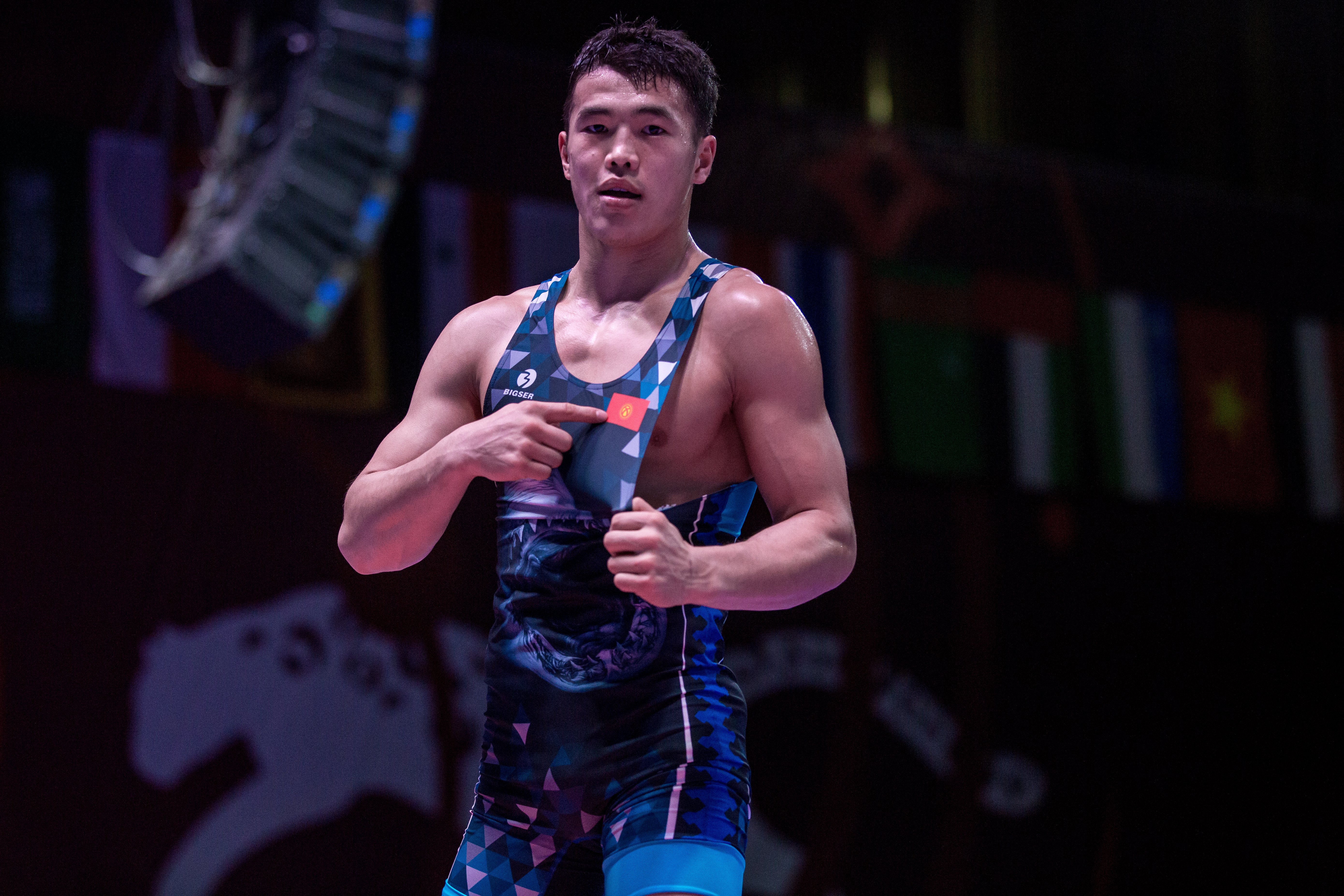 Akzhol MAKHMUDOV (KGZ) after winning his first Asian title in Bishkek in 2018. (Photo: United World Wrestling / Max Rose-Fyne)
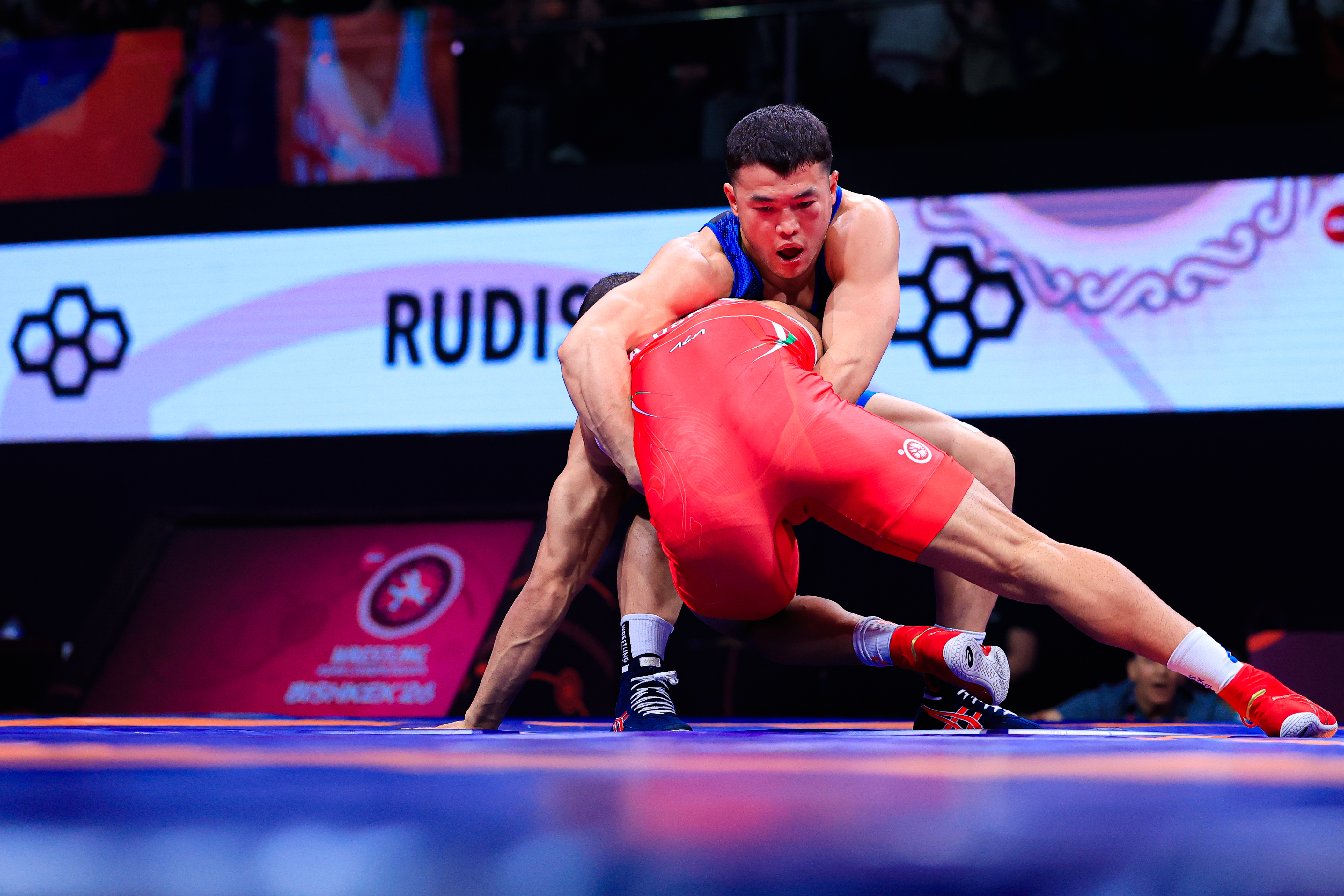 Akzhol MAKHMUDOV (KGZ) sets up a throw against Ali OSKOU (IRI) during the 77kg final at the Asian Championships. (Photo: United World Wrestling / Kostadin Andonov)
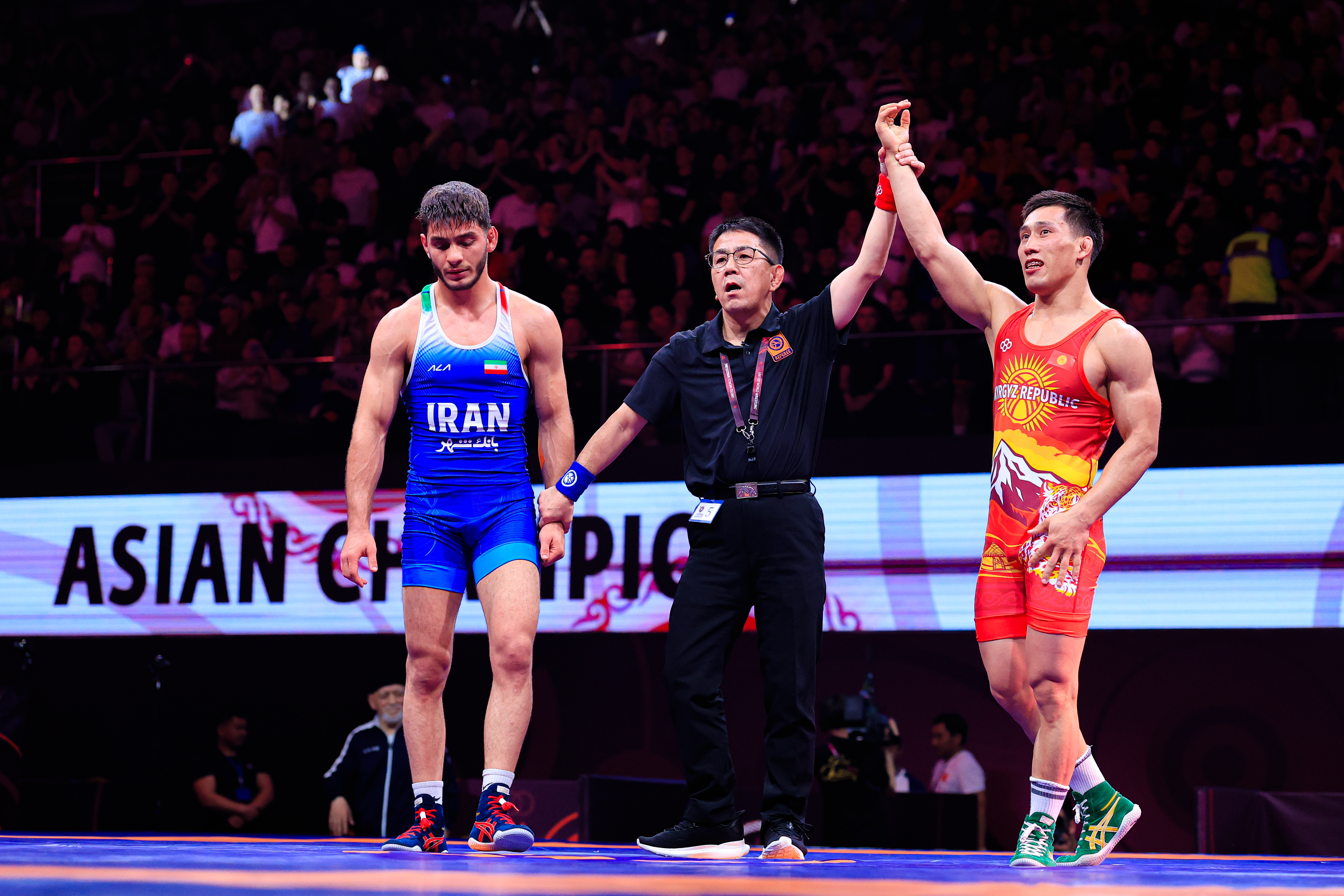 Aftandil TAALAIBEK UULU (KGZ) scored a 7-2 victory over Erfan JARKANI (IRI) in the 63kg final. (Photo: United World Wrestling / Kostadin Andonov)
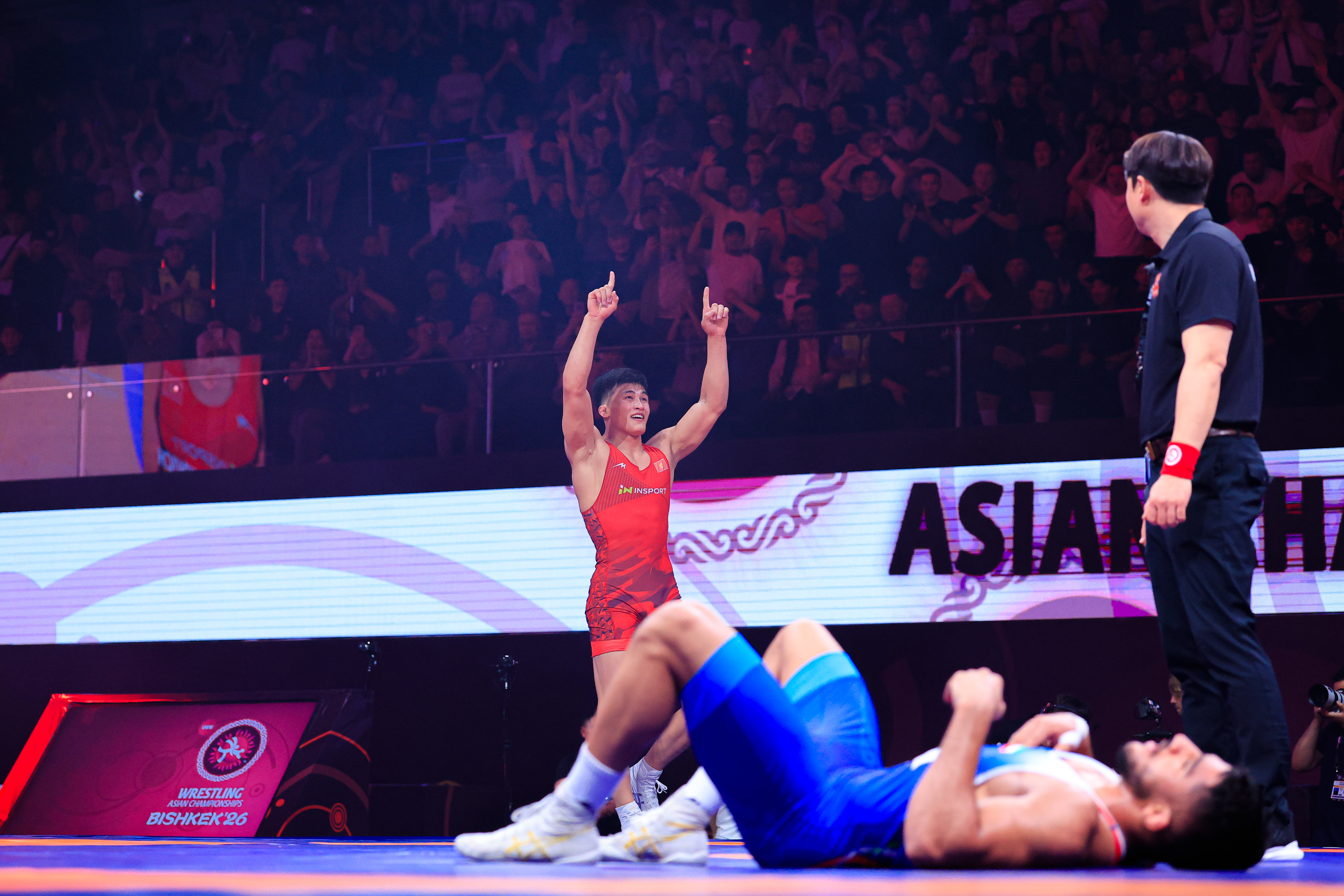 Asan ZHANYSHOV (KGZ) celebrates after beating world champion Gholamreza FAROKHI (IRI) in the 87kg final. (Photo: United World Wrestling / Kostadin Andonov)
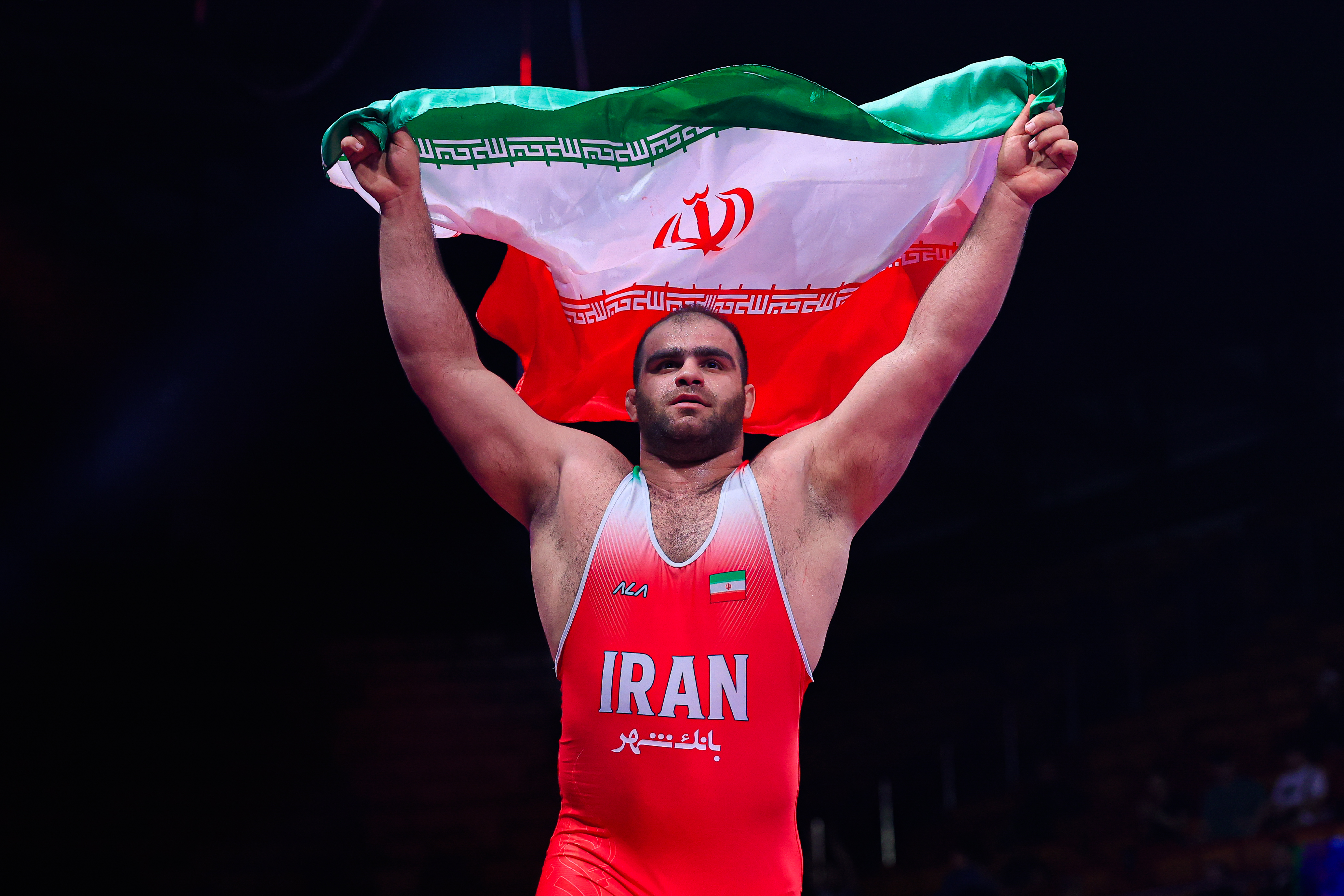 Amin MIRZAZADEH (IRI) captured his fourth Asian title at 130kg. (Photo: United World Wrestling / Kostadin Andonov)
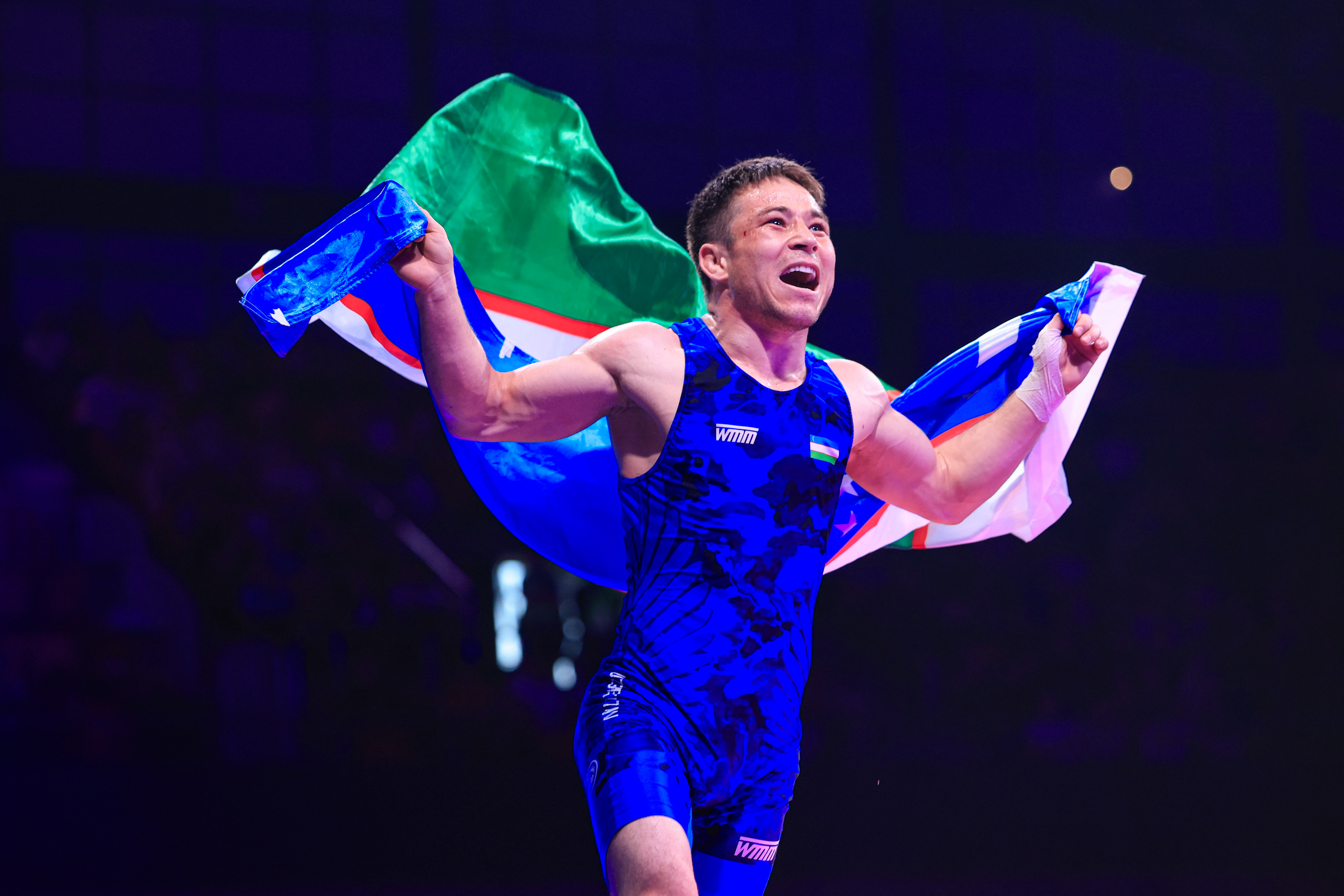 Ikhtiyor BOTIROV (UZB) celebrates after winning his first Asian title. (Photo: United World Wrestling / Amirreza Aliasgari)
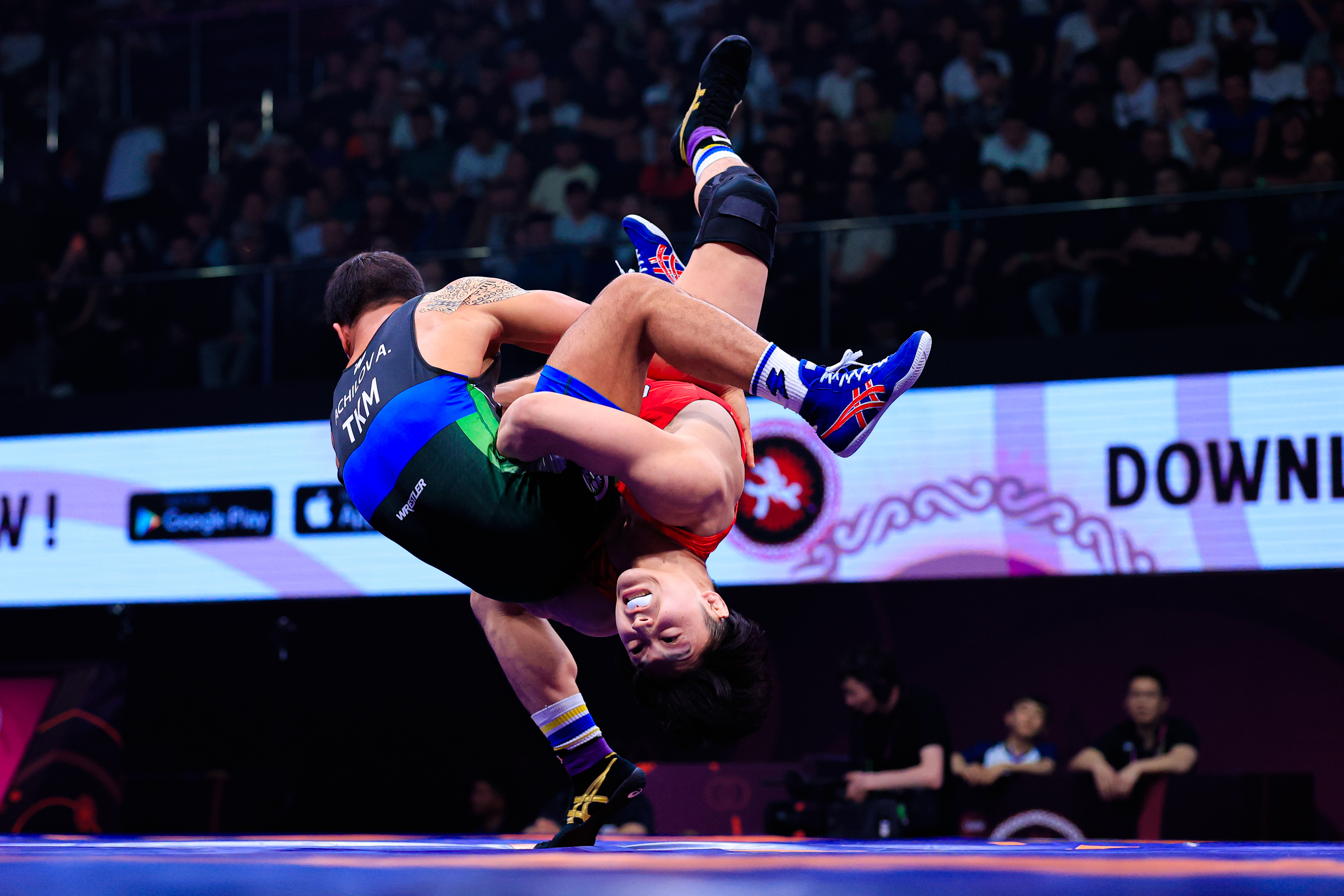 Kaisei TANABE (JPN), Freestyle 65kg Asian champion last year, won a Greco bronze this year. (Photo: United World Wrestling / Kostadin Andonov)
Share your thoughts.
Comments