

#WrestleTokyo

Mijain Lopez: Too Big to Fail

By Tim Foley

CHIBA, Japan (August 1) -- Barrel-chested and arms the width of a subway tunnel, one might gaze up Riza KAYAALP (TUR) and wonder if any wrestler (nay, human) could come in a more menacing and powerful package.

For those eying the Turkish mammoth as he stomped onto the semifinal mat Sunday at the Makhuari Messe it would seem as though he was a man above comparison.

And in the brief moments between Kayaalp taking the center mat and the entrance of his opponent, he was -- the Turk oversaw his domain with a glinty-eyed confidence.

Enter Mijain LOPEZ (CUB). The 6'5" 300 lbs. of Cuban muscle is arranged in a Addonis-adjacent melange of utility, grace, and fearsome size, with proportions that are simply Frankensteinian.

A man should not be that large. He should not move like that.

And yet there he comes, a slight jog up the stairs and arrives on the evening's competition platform. The legend from Cuba. The most feared human to compete in a sport dating back to 5000 BC in a graceful pre-battle canter.

The Cuban grappler falls momentarily still in front of his longtime Turkish rival as the referee takes his position. He's motionless and from below he seems to be blocking the house lights of the Makuhari Messe and casting the now-diminutive Kayaalp in a shade of gray.

Mijain LOPEZ Riza KAYAALPMijain LOPEZ (CUB) defeated Riza KAYAALP (TUR) in the 130kg semifinal at Tokyo Olympics. (Photo: UWW / Kadir Caliskan)

At stake in this match is a trip to the Olympic finals, but for Lopez a win will also mean the opportunity to grasp an achievement beyond belief - a fourth Olympic gold medal in Greco-Roman wrestling.

Aleksander KARELIN (RUS) was the last man to attempt to win a fourth gold medal in Greco-Roman wrestling, stepping onto the finals mat with Rulon GARDNER (USA) in the 125kg finals in Sydney. Equally skilled and as well-proportioned a wrestler that had yet existed, Karelin was tragically fell by the then-unknown American and denied his opportunity at a perfect career and a triumphant fourth gold.

To Lopez, Kayaalp is known and he is well-respected. They've been battling each other for more than a decade.

But as the whistle blew and the two men charged toward each other, it was obvious that this would be the 38-year-old Lopez's evening. A never-waning display of positioning, exertion and conditioning driven from legs with more horsepower than your uncle's Toyota.

Mijain LOPEZ Riza KAYAALPRiza KAYAALP (TUR) during his semifinal against Mijain LOPEZ (CUB) at Tokyo Olympics. (Photo: UWW / Kadir Caliskan)

And when it was over six minutes later, Lopez was the one with his hand raised -- a signal for him to progress to the finals, and history. After a quick gesture to the sky, the Cuban grabbed Kayaalp in an embrace, placed his hands on the Turks cheeks and kissed him on the crown of his head.

Monday Lopez will face a new opponent in the finals, an upstart Georgian who has already outperformed even the best pre-tournament prognostications. And though no win is guaranteed -- and the history of fourth efforts is rotten with failure -- the reign of Mijain Lopez seems destined for a historic finale.
Obituary

Japanese legend and Olympic champ Obara passes away aged 44

By Ken Marantz

TOKYO (July 19) — Legendary Japanese wrestler Hitomi OBARA, the 2012 London Olympic gold medalist at women's 48kg and an eight-time world champion, passed away on Friday, the Japanese media reported on Saturday. She was 44.

The Japan Self-Defense Force Physical Training School, where Obara was a women's coach, said it was withholding the cause of death "out of consideration for the privacy and emotions of the bereaved family," according to The Yomiuri Shimbun.

Obara, the mother of two elementary school-aged children, was a director in the Japan Wrestling Federation, and had just been appointed in June as a coach of the women's national team for the run-up to the 2028 Los Angeles Olympics along with fellow former Olympic champion Kaori ICHO.

Obara, who won six of her world titles at 51kg under her maiden name of SAKAMOTO, became a model case for the ups and downs of high-level sports and the ability to overcome grave disappointment. Her victory at the London Olympics, at age 31, came after being denied spots on Japan's team at both of the two previous Olympics by fellow legend Saori YOSHIDA.

Born in 1981 in the wrestling hotbed of Hachinohe, Aomori Prefecture, in northern Japan, Obara went on to attend Chukyo University (now Shigakkan), which she helped turn into a national powerhouse along with Yoshida and fellow Hachinohe native Icho.

"It's hard, it's hard, I can't keep from crying," former Shigakkan and national team coach Kazuhito SAKAE was quoted as telling the Japanese media. "She was a wrestling prodigy. At the least, she was a hard worker with a strong sense of responsibility. She was wrestling's heaven-sent child. I still can't believe it." 

Obara won back-to-back world 51kg titles in 1999 and 2000. A serious knee injury would keep her from returning to the world championships until 2005, from which she won four in a row.

In between, she attempted to make the Japanese's squad to the 2004 Athens Olympics, but that dream ended with a loss by fall to Yoshida in the 55kg final at the All-Japan Championships in December 2002. She would only compete once in 2003 before returning in earnest in 2004 and beginning her streak of world titles the following year.

But more disappointment came her way in the qualifying process for the 2008 Beijing Olympics. Again it was Yoshida who squashed her dreams, beating her 2-0 (2-0, 4-0) in the 2006 All-Japan final. After the match, Obara sat for hours sobbing in a corner of the warm-up room, a towel draped over her head.

Obara managed to rebound from the defeat to win a playoff for the 51kg spot at the 2007 World Championships, where she won gold No. 5. After adding No. 6 a year later with a run to the gold that included a victory over future Olympic champ Helen MAROULIS (USA), she decided to retire.

But despite all of her success, the lack of a Olympic gold -- or even an appearance, for that matter -- still left a sting that would not abate. That, and the decision of her younger sister Makiko to retire, led her to attempt the difficult path of cutting down to 48kg to make it to London.

Makiko was a world bronze medalist at 48kg in 2005 and 2008, but decided to end her career after placing eighth in 2009. Hitomi had never wanted to displace her sister from the national team, but now the door to 48kg was open.

Her biggest battle may have been with the scale. On the mat, she was as unbeatable as ever, storming to world golds in 2010 and 2011 -- now as Obara after getting married in 2010.

There was one slip-up along the way -- a semifinal loss to So Sim HYANG (PRK) at the 2010 Asian Games that ended her 70-match winning streak in international matches. But she regained her confidence with a decisive win at the All-Japan, and it was with a full head of steam that she headed to the London Olympics, which she had announced would be her swan song.

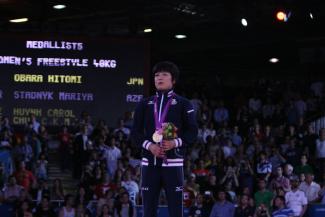
In London, Obara knocked off defending Olympic champion Carol HUYNH (CAN) in the semifinals before coming from behind in the final to defeat Mariya STADNIK (AZE) 2-1 (0-4, 1-0, 2-0) -- a replay of the gold-medal match at the 2011 worlds.

"If you keep doing what you love and never give up, you can achieve your dream," Obara told students at the junior high school she attended during a visit in January last year.

Upon retiring, Obara joined the staff at the Self-Defense Force Physical Training School, where she was also an officer. Among the members she coached were Haruna MURAYAMA OKUNO, Himeka TOKUHARA and Masako FURUICHI, who all made Japan's team to this year's World Championships.

In 2022, Obara was inducted into UWW's Hall of Fame along with Yoshida and Icho.