

Masoumi: Young star's quest for wrestling glory
Wednesday, March 19, 2025 - 15:56 By Vinay Siwach

AMMAN, Jordan (March 18) — Amirreza MASOUMI (IRI) already has his eyes set on next week’s Asian Championships in Amman. His goal is clear: gold. But the path to the podium runs through two opponents he knows all too well — Lkhagvagerel MUNKHTUR (MGL) and BUHEEERDUN (CHN).
Two years ago at the Asian Championships in Astana, the then 18-year-old Masoumi suffered his only international losses to non-Iranian wrestlers. A semifinal defeat to Munkhtur was followed by a bitter loss to Buheeerdun in the bronze-medal bout at 125kg. Now, as a more focused and confident 20-year-old, Masoumi is eager to avenge those setbacks.
Masoumi has grown immensely since then. He is now a six-time world champion in various age groups, with two more titles added in 2024. In those competitions, he didn’t allow a single point to be scored against him. He continued his flawless form at the 2025 Zagreb Open, outscoring his opponents 42-0 in four matches. His elbow, which had once been a source of discomfort, is now fully healed, and Masoumi shows no signs of slowing down.
"I hope to use this experience and return to win the World Championships in Zagreb," he says after claiming gold in the Croatian capital.
Masoumi is on phone with his family, showing them the new sneakers he has bought in Zagreb. Not one but three pairs.
He loves shoes.
"I have a sneaker collection myself, and I really love shoes," he said. "I always carry a lot of them with me. For example, in this tournament alone, I brought five pairs. I mostly try to wear special brands and new collections. I think I have around 100 pairs of shoes."
That's where he spends most his money.
"I don't have to spend money on my face because it's perfect."
That is one way of easing off before the interview. Masoumi settles down with a big bar of chocolate which he finishes by the first two questions into the interview.
Masoumi has just won the Zagreb Open gold medal in a dominating manner and began the new Olympic cycle with a bang.
"The ultimate dream for every athlete is definitely an Olympic gold, and that’s mine as well," he says. "I want to stand on the podium in Los Angeles in four years."
Masoumi is the most exciting heavyweight wrestling on the planet. He isn't your regular teenager of 125kg. Masoumi is a very quick for 125kg who destroys his opponents with a smile. He has six age-group world titles in three years.
He can gut-wrench, switch to the typical Iranian underhook pushouts and even wore down the opponents with his heavy-hands.
Masoumi was 16 when made his international debut at the 2021 U17 World Championships in Budapest at 110kg. He outscored his opponents 35-1 in four bouts and won gold. Then came the U20 World Championships next year. He won gold at 125kg and followed it with a gold medal at the U23 Worlds the same year. He was 17.
His senior debut came in 2022 at the World Cup in Coralville, Iowa, where he won all three of his bouts as Iran finished second to the United States.
The year 2023 wasn’t as fruitful, with Masoumi suffering losses at the Asian Championships and domestically. However, he was given the chance to challenge Zare for a spot in the Iranian team for the Paris Olympics. The match-up took place at the 2024 Zagreb Open, but Masoumi came up short.
Since then, he has bounced back with gold medals at five international tournaments, and now he is aiming for a sixth in Amman.
So, how did a wrestler from Gilan, a province not traditionally known for freestyle wrestling, rise to prominence so quickly?
“There’s no rivalry between us and Mazandaran,” Masoumi says. "It feels good to beat a province known for producing many wrestlers like Mazandaran, but I don’t feel good about defeating a specific city or village. There’s no animosity."
 Amirreza MASOUMI (IRI) with his father Fardin. (Photo courtesy Amirreza Masoumi)
Masoumi was born in Masal village of the Gilan town in northern Iran. His father, Fardin, is a two-time World Championships medalists and the one who pushed him into wrestling.
"When I was three or four years old, when my father wrestled and I went to the competition hall to watch his practice, my childhood was intertwined with wrestling right there," he says. "I was able to get to know the wrestling environment much better in my childhood."
But it was a third-place finish, Masoumi's first medal at a national tournament, which resulted in congratulatory message and reception for Masoumi which he loved.
"I was 12 or 13 years old at the time," he said. "When I came third, I saw everyone come to our house and congratulate me, and I saw what a good feeling it was. So I tried to continue this process until now that I am here."
Standing tall at two metres, Masoumi is lanky for 125kg. More Geno than Zare. But he has to continuously monitor his weight which he does not want to go too high.
"My mother is almost 180cm tall and my father is 186cm," he said. "We're a tall family overall. However, I still control myself a lot to keep my weight down, especially since my mom tries not to feed me too much. I'm right on the edge for the 125 kg weight class, and if I gain any more weight, I'll have to cut it. That's why I'm very careful. My physique is also more similar to my mom and dad's."
Fardin was his first coach and Masoumi would watch his father's bouts against different competitors. While he kept a few techniques of his father, Masoumi was impressed with the others as well. Like the double underhooks he uses to drive his opponents out-of-bounds. Masoumi says he picked that from former world champion Bilyal MAKHOV (RUS).
"I mostly learned this from Makhov and his techniques in the World Championship final -- how he would get under his opponent’s armpit and drive them backward," he said. "I really liked how he was always moving forward. He was physically huge and kept attacking non-stop."
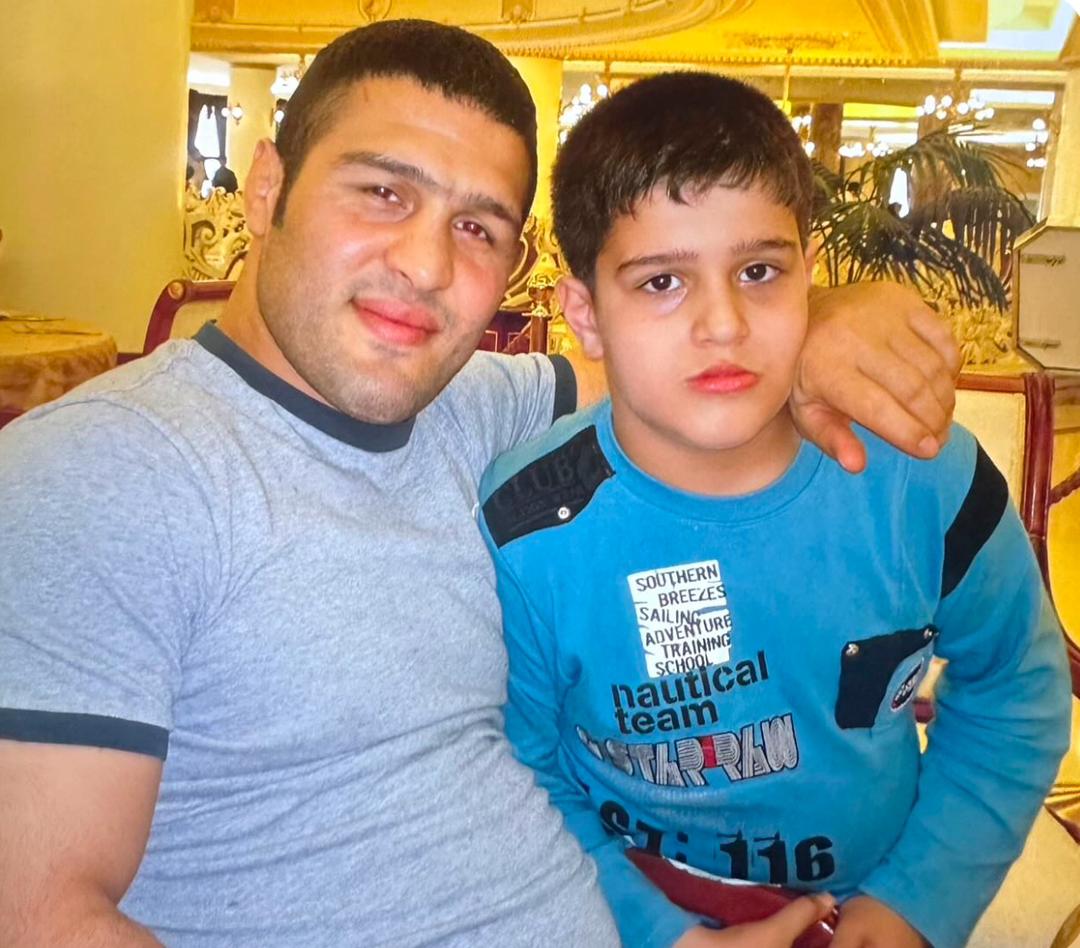 Amirreza MASOUMI (IRI) with former world champion Reza YAZDANI (IRI). (Photo courtesy Amirreza Masoumi)
As he kept putting Gilan on the wrestling map, Masoumi was now being known. People will come to his home, farm and his father's business to congratulate. Being a successful Iran has its share of challenges. Growing up in Gilan and around wrestling, Masoumi wasn't unaware of the pressure it brings. There are fans who become your coach from stands, or even warm-up partners. Iran wrestlers are in the public eye most of their lives.
"I don't know about other countries, but in Iran, it's like that," Masoumi says. "It's the love."
Masoumi's first experience of "stardom" came after he former Asian champion Yadollah MOHEBI (IRI) at the selection trials in Iran.
"When I came out [of the stadium], there was a huge crowd, and a lot of spectators had come for the wrestling," Masoumi recalls ."I noticed many fans were coming up to take pictures with me. That’s when I felt like I was slowly entering an environment with a lot of pressure, and I realized I was growing in this kind of atmosphere."
Masoumi's personality clicks with the fans. He is humble yet celebrates his wins, he acknowledges the fans and doesn't shy away from being cheeky with his opponents after winning the bouts. He also witty.
"I think this comes down to my personality. I’m a bit hyperactive and always try to have my own unique style without being afraid," he says.
He expects them in Amman as well.
For Masoumi, the Asian Championships hold major significance -- not just for this year, but for his entire career. While world champion and Olympic silver medalist Amir Hossein ZARE (IRI) holds the top spot for Iran at 125kg, Masoumi is gunning for that position.
A gold medal in Amman would give Masoumi the chance to challenge Zare for a spot on Iran team for the 2025 World Championships.
"My opponent, Zare, is a tough competitor," Masoumi says. "I’ve been wrestling against him in Iran’s national team trials for three years now. I believe I can secure my spot on the national team this year and win gold at the World Championships."
 Amir Hossein ZARE (IRI) defeated Amirreza MASOUMI (IRI) in the 125kg final at the Zagreb Open in 2024. (Photo: United World Wrestling / Kostadin Andonov)
Zare is also in top form, having won gold at the Muhamet Malo Ranking Series in similar dominant fashion. The world waits for their third meeting, likely at the Takhti Cup, Iran’s premier tournament, at the end of April. The winner of the best-of-three series will secure a spot at the World Championships.
"I need to compete in the Asian Championships," Masoumi says. "Any wrestler who wants to start in Iran should begin with the Takhti Cup and then move on to the 2025 World Championships."
Masoumi believes his unique wrestling style will give Zare trouble.
"I feel that match will be a great one for all wrestling fans. I think my wrestling style in the heavyweight category is quite unique. I don’t think there’s anyone in Iran’s heavyweight division with a six-pack. Naturally, in my mind, I aim to defeat Amirhossein to make up for my two previous losses."
Share your thoughts.
Comments