#wrestlenursultan

Local Hero Zhakansha Uses New Addition to Arsenal to Top Defending Champion, Make Greco 55kg Final

By Ken Marantz

NUR-SULTAN, Kazakhstan (Sept. 14) --- Khorlan ZHAKANSHA (KAZ) figured he needed to add something new to his arsenal. What he came up with worked not only once, but twice against the defending champion, propelling him into the final of the World Championships in his home country.

Zhakansha nailed Eldaniz AZIZLI (AZE) with a pair of 4-point headlock throws to end his reign as the Greco-Roman 55kg champion by scoring an 11-5 victory in the semifinals before a roaring Barys Arena crowd.

“I can’t explain this feeling because I’ve been working so hard for a long time, for many years,” said Zhakansha, a two-time bronze medalist at the Asian Championships.

The medal matches in the four Greco-Roman weight classes that opened the tournament on Saturday will be held Sunday night. 

In the final, Zhakansha will face world U23 champion Nugzari TSURTSUMIA (GEO), who overwhelmed Shota OGAWA (JPN) by 8-0 technical fall in 2:57.

Against Azizli, Zhakansha went ahead 3-0 with a gut wrench off the par terre position, but the Turk scored a takedown to make it 3-2 going into the second period.

Zhakansha then stuck Azizli with his first headlock throw for 4 points. Azizli managed to gain a reversal and a roll to cut the lead to 7-5, but then Zhakansha repeated his awesome throw to clinch the victory.

“I didn’t prepare this, I didn’t think I would do this,” he said of the effective throw. “Before, I would use a back drop, but all of my opponents know that I will do it. So I tried something new.”

Zhakansha credited the partisan crowd for propelling him into the final.

“You can see that so many fans come to support us. It was almost impossible to lose. I felt like I had to win.”
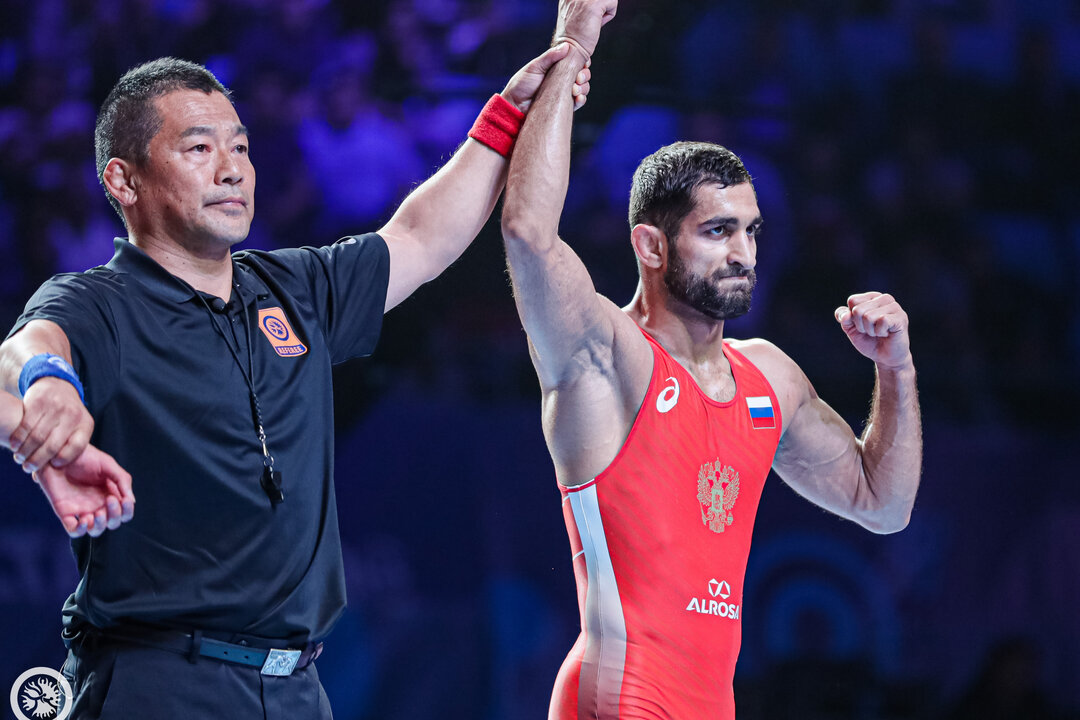
Stepan MARYANYAN (RUS) will look to win back-to-back world title when he takes on Rio Olympic silver medalist Shinobu OTA (JPN)   in the 63kg finals on Sunday night. (Photo: Kadir Caliskan)

Russia, which captured six Greco golds at last year’s World Championships in Budapest, earned a shot at two right off the bat when defending champion Stepan MARYANYAN (RUS) made the final at 63kg and Abulazid MANTSIGOV (RUS) followed suit at 72kg.

Georgia is the only other country with two finalists, with Lasha GOBADZE (GEO) at 82kg joining Tsurtsumia. Kazakhstan, Japan, Uzbekistan and Azerbaijan have one finalist each.

Maryanyan survived a tough test in assuring himself of at least a silver medal, scoring all of his points in the second period to slip past Slavik GALSTYAN (ARM), 4-2.

The lanky Galstyan scored a takedown in the first period. But Maryanyan took advantage of the par terre position to go ahead 3-2 in the second period. 

The remainder of the bout consisted mainly of locking arms, which frustrated Galstyan so much he made a challenge after time ran out, looking for a passivity penalty against Maryanyan. The challenge was denied, giving the Russian his final point.

In the gold-medal match, Maryanyan will face Rio 2016 Olympic silver medalist Shinobu OTA (JPN) in a rematch of the final at the Dan Kolov-Nikola Petrov tournament in February. In that match, Ota took a 3-0 lead in the par terre position, only to see Maryanyan score a reversal, then rip off five straight gut wrenches for a 12-3 technical fall.

Ota said he will be better prepared after denying Almat KEBISPAYEV (KAZ) a place in the final with his third technical fall of the day. 

“If I can defend from the ground position like I did in the semifinal today, I don’t think it will be problem,” Ota said. “I want to go into the final tomorrow with the same feeling that led me to win all of my matches by technical fall.”

In the semifinal, Ota was put in the par terre position in the first period, but fought off Kebispayev’s attempts to turn him, leaving the score 1-0 going into the second period. Ota scored an early takedown, then used a duck under to a bear hug for 4 points. He finished off the match with a similar 4-point move for a 10-1 technical fall in 5:06. 
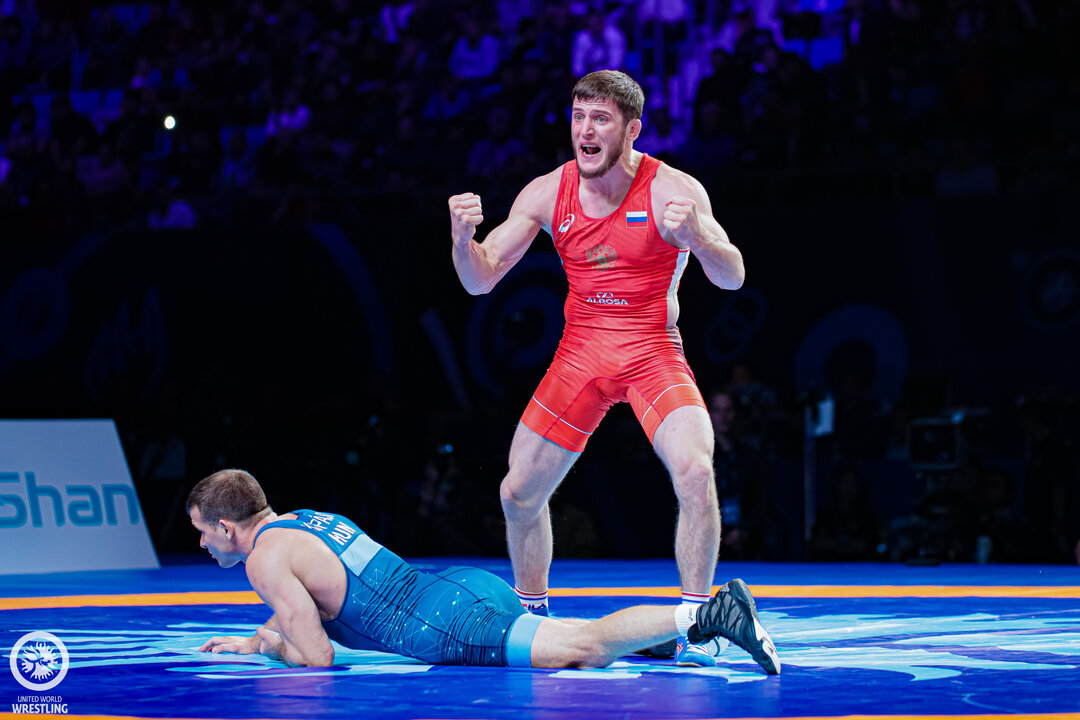
Abulazid MANTSIGOV (RUS) manhandled returning world runner-up Balint KORPASI (HUN) , 8-0 and moved into the 72kg finals.(Photo: Kadir Caliskan)

At 72kg, Mantsigov was similarly dominant in denying veteran Balint KORPASI (HUN) a second straight trip to the final, posting an 8-0 technical fall at 3:32. The big move was a 4-point counter of a back drop late in the first period.

Korpasi, the 2016 world champion and runner-up last year, had beaten Mantsigov in the only previous meeting between the two, in the semifinals at the 2017 European Championships.

Next up for Mantsigov---the only top seed among the four weight classes to make the final---will be Aram VARDANYAN (UZB), who scored a solid 4-1 win over 2019 world bronze medalist Aik MNATSAKANIAN (BUL). 
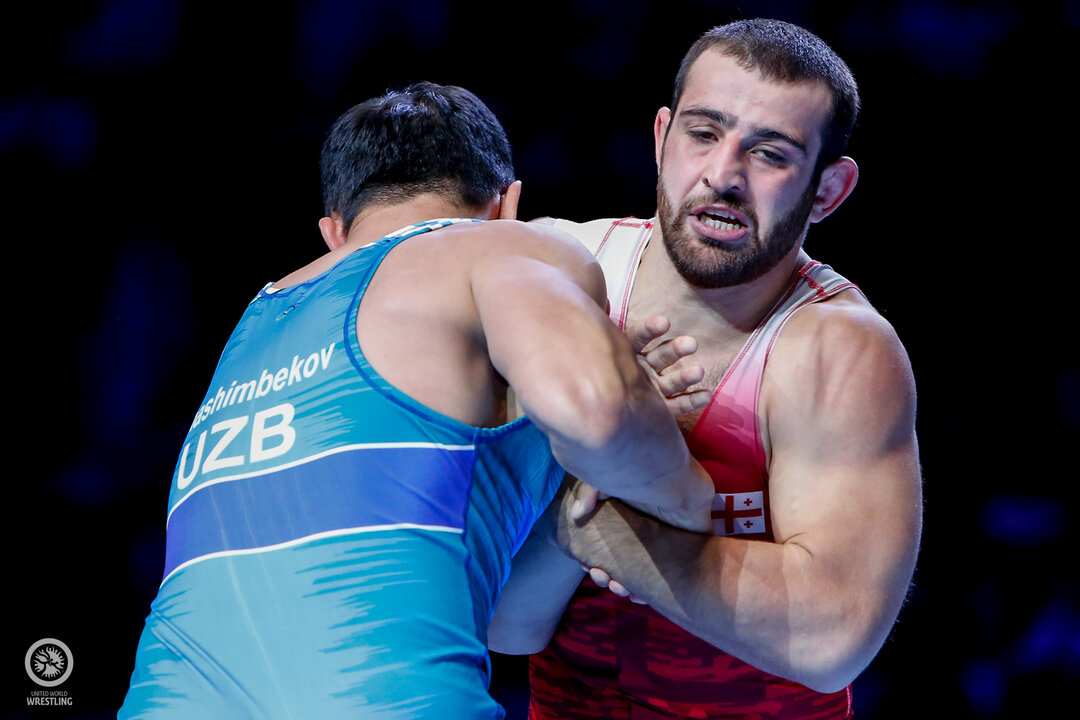
Lasha GOBADZE (GEO) defeated Nurbek KHASHIMBEKOV (UZB), 3-1 in the semifinals and will meet Rafig HUSEYNOV (AZE) in the 82kg gold-medal bout. (Photo: Kadir Caliskan)

The 82kg final will be a showdown between European silver medalist Gobadze and 31-year-old Rafig HUSEYNOV (AZE), who assured himself of a first-ever medal in his eighth trip to the World Championships.

Gobadze scored a roll from the par terre position, then held on when he was put on the bottom to chalk up a 3-1 win over Nurbek KHASHIMBEKOV (UZB). 

Huseynov came out on top of a very physical struggle with Rio 2016 bronze medalist and 2019 Asian champion Saied ABDVALI (IRI), driving his opponent backward for a 4-point move with :28 left to clinch a 8-5 victory. 

The day session on Sunday will see the qualification rounds in the Greco-Roman weight classes of 67kg, 87kg and 97kg. 

Day 1 Results

Greco-Roman - Semifinals

55kg (20 entries)
Khorlan ZHAKANSHA (KAZ) df. Eldaniz AZIZLI (AZE), 11-5 
Nugzari TSURTSUMIA (GEO) df. Shota OGAWA (JPN) by TF, 8-0, 2:57

63kg (18 entries)
Stepan MARYANYAN (RUS) df. Slavik GALSTYAN (ARM), 4-2
Shinobu OTA (JPN) df. Almat KEBISPAYEV (KAZ) by TF, 10-1, 5:06

72kg (25 entries)
Aram VARDANYAN (UZB) df. Aik MNATSAKANIAN (BUL), 4-1
Abulazid MANTSIGOV (RUS) df. Balint KORPASI (HUN) by TF, 8-0, 3:32

82kg (23 entries)
Lasha GOBADZE (GEO) df. Nurbek KHASHIMBEKOV (UZB), 3-1
Rafig HUSEYNOV (AZE) df. Saied ABDVALI (IRI), 8-5


#WrestleZagreb

Ex-Japan champ Shimoyamada trying to put Australia on wrestling map

By Ken Marantz

TOKYO (Sept. 3) -- When Tsuchiku SHIMOYAMADA (AUS) decided to relocate from his native Japan to Australia, he wasn't showered with gifts from a grateful federation looking for an established wrestler to give the country a global boost.

He was more interested in golden beaches than bringing his new homeland gold medals.

"I was in Cairns, and I was feeling like, 'I want to move to Australia,'" Shimoyamada said during a trip back to Japan in July for a tournament. "I like this place. It's good for me. The lifestyle is easy."

Four years after announcing his retirement and three years after making the bold move to Land Down Under, the 31-year-old is back in the game, hoping to put a country more known for its swimmers and rugby players onto the world wrestling map.

While a longshot at best, Shimoyamada, a two-time Japan national champion and two-time Asian medalist, will get a chance to become Australia's first-ever world medalist when he takes the mat at Greco 67kg next week in Zagreb.

It will be the third World Championships of his career and first since 2021, when he nearly knocked off the Olympic champion and symbolically left his shoes on the mat after a repechage-round loss as a sign of his retirement. He finished ninth in his only other appearance in 2018.

Tsuchika SHIMOYAMADA (AUS)Tsuchika SHIMOYAMADA (AUS) had left his shoes on the mat during the 2021 World Championships to mark his retirement. (Photo: United World Wrestling / Martin Gabor)

Success breeds success, and Australian wrestling officials are hoping that Shimoyamada, in addition to helping cultivate a new generation of wrestlers, can produce results that will spark more interest in the sport. Getting through the rounds, even if he falls short of a medal, would have a positive effect, says one official.

"That would be a very good achievement for us," says Aryan Negahdari, president of New South Wales Wrestling Federation, who accompanied him and several wrestlers to Japan. "For many, many years, we haven't a wrestler making it into the semifinals, or even the quarterfinals of the World Championships. Even that itself would be a good achievement."

While Australia has never won a world medal, it may be surprising to learn that the country has actually brought home three Olympic medals -- although it has been nearly eight decades since the most recent one.

Eddie SCARF broke the ice with a bronze medal at freestyle 87kg at the 1932 Los Angeles Olympics. Australia then got two at the 1948 London Games, a silver from Richard GARRARD at freestyle 73kg and a bronze from Joseph ARMSTRONG at freestyle over-87kg. The closest the country has come since then was a fourth place at Freestyle 62kg by Cris BROWN at the 1984 Los Angeles Games.

On the world stage, the highest finishes by Australians were fifth places by Jackie BRYDON at women's 50kg in 1993 at Stavern, Norway, and Macedonian-born Lila RISTEVSKA at women's 47kg at Moscow 1995. There have been three men who have placed sixth, all in freestyle, with the most recent being Uzbekistan-born Talgat ILYASOV at 74kg at New York 2003.

Tsuchika SHIMOYAMA (JPN)Tsuchika SHIMOYAMADA advances to the semifinals at the All-Japan Non-Student Championships in July with a 52-second win over Kokoro GOTO. (Photo: Koji Fuse / wrestling-spirits.jp)

As a Greco wrestler, Shimoyamada will be trying to beat even longer odds. Up to now, Australia has never placed higher than 18th at a World Championships.

Following his graduation from Nippon Sports Science University, which also produced Paris Olympic champions Kenichiro FUMITA and Nao KUSAKA as well as Tokyo bronze medalist Shohei YABIKU, Shimoyamada joined the Tokyo Metropolitan Police Department team. He stayed on the force after ending his wrestling career, but found it wasn't for him.

"When I was back in Japan, I started working for the police," he says. "To be honest, it was stressful. It was not for me."

A trip to Australia opened his eyes to a place where he could start a new life. At first, he planned to only go into coaching, but a practical reason arose that led him to decide to return to the mat -- it helped him get the visa he needed to live in the country.

"I didn't think about wrestling by myself, I thought I could help as a coach," he says. "But for the visa condition, it's better to keep active."

In 2023, he received a residence visa as a "global talent," and in January 2024, United World Wrestling approved his switch of national affiliation to Australia.

Unfortunately, the approval did not come in time for him to try to qualify for the 2024 Paris Olympics. He is still working on gaining citizenship. His need to find a way to make a living proved harder than he expected as he settled in Sydney.

"I'm teaching wrestling, and I'm working as a lifeguard at a swimming pool," he said. "Life is not easy. It's expensive, everything, rent, bills, car."

Shimoyamada's need for gainful employment produced a symbiotic relationship with his hosts, who suddenly found themselves blessed with a world-class competitor to help raise the level of the sport.

"I really think we're super lucky to have him because not only is he a high-level athlete, but he has been helping us a lot as a coach, especially Greco-Roman coach," Negahdari says. "So because of him, we have a lot more athletes doing Greco-Roman, training under Tsuchika."

Shimoyamada's arrival also gave Australia a bonus of sorts -- a connection with an established power in the sport. Through Shimoyamada's ties with his alma mater NSSU, there have been numerous exchanges of wrestlers between the two countries.

Tsuchika SHIMOYAMADA (AUS)Tsuchika SHIMOYAMA faces Keitaro ONO in his opening match at the All-Japan Non-Student Championships in July. (Photo: Koji Fuse / wrestling-spirits.jp)

In the early summer, Paris Olympic silver medalist Daichi TAKATANI and former women's U23 world champion Yu SAKAMOTO went to Australia to put on clinic. In July, Shimoyamada led a contingent of Australian wrestlers who participated in the All-Japan Non-Student Championships (a second-tier national tournament) before training at NSSU.

"He's also been very good for us to build connections with Japan," Nagahdari says. "We've been coming [to Japan] for four years now, like twice a year, training with the Japanese teams. We've had a lot of Japanese athletes coming over to Australia to do seminars for us, to do training with us...It has been very, very beneficial for us in many different ways."

Shimoyamada entered the Non-Student meet at 72kg to give him the high-level competition he needed as preparation for the World Championships, and which is sorely lacking back in Australia. Aside from the low-level Oceania Championships and tournaments in Australia, it was his first outing since the 2021 World Championships.

He held his own, although he lost in the semifinals to Yamato HAGIWARA before winning his bronze-medal match over Rintaro SOGABE, the younger brother of Paris Olympian Kyotaro SOGABE, a fellow NSSU alum who will be Japan's entry at 67kg and a potential opponent of Shimoyamada in Zagreb.

Shimoyamada made his international debut at the 2016 Asian Championships in Bangkok, placing eighth. He won his first All-Japan title in December 2017, earning a return to the continental meet in 2018 in Bishkek, where he took home the silver medal after losing in the final to Almat KEBISPAYEV (KAZ).

Just when it looked like he had lost his edge after losing back-to-back All-Japan finals to Shogo TAKAHASHI in 2018 and 2019, Shimoyamada rebounded to claim his second title in 2020 with a victory over rising NSSU star Katsuaki ENDO. After Shimoyamada left the scene, Endo and Kyotaro Sogabe would battle ruthlessly for supremacy at 67kg.

His final year wrestling for Japan may have been his most productive. At the 2021 Asian Championships in Almaty, he avenged his loss to Kebispayev from three years before to capture the elusive gold. He followed that with a victory at the All-Japan Invitational Championships, known as the Meiji Cup, to clinch his ticket to the World Championships in Oslo.

Tsuchika SHIMOYAMADA (AUS)Tsuchika SHIMOYAMADA (AUS) was dominating Mohammadreza GERAEI (IRI) in their match at the 2021 World Championships before being pinned. (Photo: United World Wrestling / Martin Gabor)

In the second round, Shimoyamada encountered Mohammadreza GERAEI (IRI), one of the few gold medalists from the Tokyo Olympics two months earlier who were entered at the worlds. It would probably be the most impressive loss of his career.

Shimoyamada was dominating the Iranian, scoring with a 4-point arm throw to build up a 6-1 lead. But disaster struck with just over a minute to go. Geraei caught Shimoyamada in a lapse and bear-hugged him backward directly to his back for a shocking victory by fall.

Shimoyamada then lost his repechage match to teenager Hasrat JAFAROV (AZE), and the last we saw of him was him walking off the mat, leaving his shoes behind.

Fast forward four years, and Shimoyamada is now competing for himself and his adopted homeland. While he would like to qualify for the 2028 Los Angeles Olympics, age and opportunity might be too big hurdles to get over.

"I think that's a last challenge, for the Olympics, because I'm not young," Shimoyamada said. "If I can make it for Australia, that's good. Everyone will get interested in wrestling. That's what I should do."

Looking long range, Australian officials are hoping to develop talent to make a good showing when the country hosts the Olympics in Brisbane in 2032. They are hoping that Shimoyamada can spark enough interest and help raise the level in time.

"I think we're in the very early stages, compared to international standards," Nagahdari says. "But I think we can definitely see a very huge improvement, like in the last few years. We have a lot more members now, the number of our wrestlers. For example, compared to only three or four years ago, it has doubled. It's growing slowly, but at a good pace.

"It's a very slow progress, because you know that wrestling is super hard. It takes like a decade to build an athlete to that level. And we're really focusing our efforts toward the Brisbane Olympics in 2032."

Shimoyamada is determined to do whatever he can to make it happen.

"It's hard to get a gold medal at the World Championships and the Olympics, to be honest," he says. "If I make the Olympics, the next generation can become interested in getting to the Olympics or World Championships and they will practice hard."