

Kiyooka hands Susaki first domestic loss in 6 years, Narikuni shines in Freestyle
Thursday, October 2, 2025 - 07:48 By Vinay Siwach
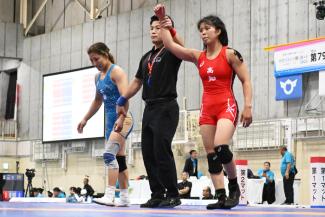
SHIGA, Japan (October 2) -- For six years, Yui SUSAKI (JPN) built a career defined by near perfection. She remained unbeaten in Japan, captured Olympic gold, and added several world titles to her name, moving steadily toward an unprecedented winning streak.
That streak was first broken at the Paris Olympics last year, when Susaki suffered her first international defeat at 50kg, ending a 95-match winning run.
Susaki was dealt with further setback on Tuesday at National Sports Festival in Shiga. As she returned to competition at 53kg, testing herself in a higher weight class after a career largely spent at 50kg, the Tokyo Olympic champion was defeated by world champion Moe KIYOOKA (JPN) in the quarterfinals, marking her first domestic loss since 2019.
The National Sports Festival, held annually in rotating prefectures, features Freestyle and Greco-Roman wrestling in all six Olympic weight classes. Women’s competition includes only two divisions: 53kg and 62kg. Tuesday’s 53kg quarterfinal was Susaki’s first test at the higher weight. After her 2-1 victory over Susaki, Kiyooka went on to claim the gold medal, two months ahead of the Emperor’s Cup in December.
At 62kg, Asian 57kg champion Sara NATAMI (JPN), representing Shiga, gave the local fans a big reason to cheer, as she overcame a deficit to pin world 59kg champion Sakura ONISHI (JPN) in the final, winning the gold despite trailing 8-1 in the second period.
In Freestyle, world 70kg champion Yoshunsuke AOYAGI (JPN) lost a close 3-3 decision in the 74kg quarterfinals to 2022 world 70kg champion Taishi NARIKUNI (JPN), who had transitioned to Greco-Roman after his world title three years ago. Narikuni went on to win the gold after reigning 74kg world champion Kota TAKAHASHI (JPN) withdrew from the semifinals due to injury.
At 65kg, two-time world U20 champion Yuto NISHIUCHI (JPN) captured the gold medal, just three weeks before beginning his pursuit of a world U23 title in Novi Sad, Serbia.
A lot of debate has surrounded Susaki's return to the mat after her Paris loss to Vinesh PHOGAT (IND). She took her time before coming back and, after careful deliberation, decided to enter the National Sports Festival, which offered only 53kg as the option.
After winning her first bout, Susaki faced a tough opponent in Kiyooka, known for some of the toughest defense on the mat. Susaki began the quarterfinal with her usual movements, attempting sweep singles but failed to score. Kiyooka, who won her world gold at 55kg, was put on the 30-second activity clock in the first period and, after failing to score, Susaki led 1-0.
In the second period, Susaki went on the activity clock. After she failed to score, Kiyooka claimed the 1-1 criteria lead with two minutes remaining. With just 30 seconds left, Susaki went for Kiyooka’s left leg following a misdirection to the right.
She was unable to complete the takedown or force a stepout that would have secured victory for her. But Kiyooka prevented Susaki to pass behind and control the takedown. Susaki’s corner challenged for the final pushout but the sequence was well after the clock had expired.
"It’s very frustrating that I couldn’t win such a close match at the end," Susaki told the media. “It shows my lack of skill that I wasn’t able to take advantage, so I’m very disappointed."
The 26-year-old was particularly upset about not finishing the final takedown, which could have handed her the win.
"I made a one-legged tackle and misjudged how to handle it," she said. "I’m very disappointed that I made such a poor decision with so little time left. I wanted to go for it more from the beginning, but it didn’t work out as I wanted."
Susaki hinted that she will compete at the Emperor’s Cup in December but is still undecided about which weight class she will enter.
"There are still two months until the Emperor’s Cup, so I want to prepare well in those two months so I can win,” she said. "I came all the way here aiming to win. It’s really disappointing, but no matter the challenges, my goal remains the same: I’ll definitely win gold.
"Taking into account the situation and this result, I would like to discuss it with the team and decide the weight class. It was my first match in a year, so it was different from practice. I was a little nervous. I want to find the causes of my mistakes and do my best at the Emperor’s Cup."
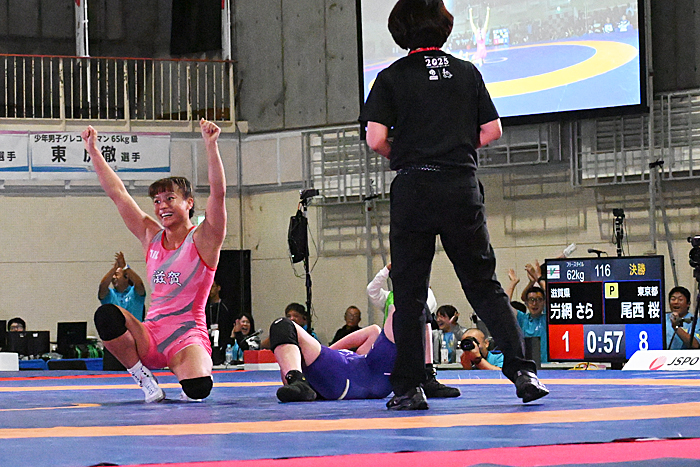 Sara NATAMI (JPN) celebrates after beating Sakura ONISHI (JPN). (Photo: wrestling-spirits.jp)
Natami’s hometown triumph at 62kg left Onishi in tears after Natami pinned her for the fall in the final. Onishi had built an 8-1 lead but was on the defensive in the second period. Both wrestlers launched a few attacks, but when Onishi went for a single-leg, Natami stood firm, unbalancing her opponent. Onishi fell to the mat, and Natami controlled her to secure the victory.
Just two weeks prior, Onishi had won the 59kg gold medal at the World Championships in Zagreb. She moved up to 62kg, an Olympic weight class, in her bid to qualify for the 2028 Los Angeles Olympics.
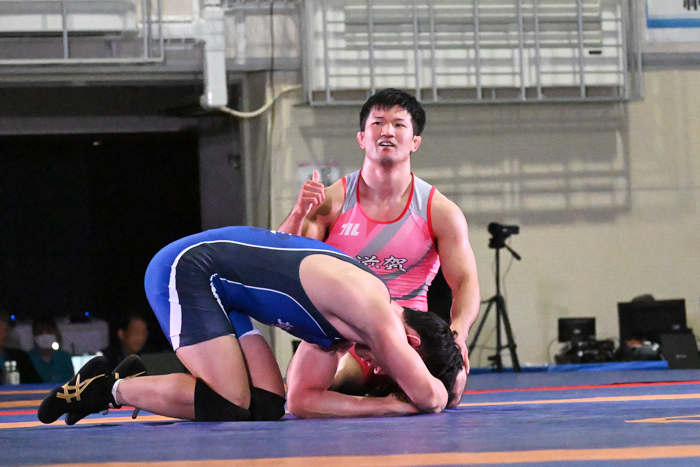 Taishi NARIKUNI (JPN) won the 74kg gold medal. (Photo: wrestling-spirits.jp)
Meanwhile, Narikuni demonstrated he remains a top contender in Freestyle after claiming gold at 74kg. He had recently competed at the Zagreb World Championships in Greco-Roman at 72kg, attempting to add to his Freestyle world title. In Shiga, he returned to Freestyle and faced Aoyagi in the quarterfinals.
During a scramble, both wrestlers went out of bounds and were initially called neutral. Aoyagi challenged, but the review showed it was actually a neutral position. Narikuni was awarded one point for the lost challenge. Aoyagi scored two points by tripping Narikuni, who landed on his back without danger, and added a stepout as he circled inside as Narikuni was trying to force a stepout.
With less than a minute remaining, Narikuni constantly pressured Aoyagi, who dropped to his knees to avoid a stepout. He attempted a counter duckunder, but Narikuni defended and executed a front headlock roll for two points, giving him a 3-3 criteria lead.
After defeating Aoyagi, Narikuni advanced via walkover in the semifinals before decisively beating Masaki SATO (JPN) 8-1 in the final to claim the gold. The victory prompted Paris Olympic 57kg champion and 2022 world champion Rei HIGUCHI (JPN) to post on social media: “Why do you even wrestle Greco?”
RESULTS
Freestyle Winners
57kg: Fuga SASAKI
65kg: Yuto NISHIUCHI
74kg: Taishi NARIKUNI
86kg: Fumiya IGARASHI
97kg: Yudai TAKAHASHI
125kg: Taiki YAMAMOTO
Women's Wrestling Winners
53kg: Moe KIYOOKA
62kg: Sara NATAMI
Greco-Roman Winners
60kg: Koto GOMI
67kg: Chiezo MARUYAMA
77kg: Kodai SAKURABA
87kg: Tatsuya FUJII
97kg: Takahiro TSURUDA
130kg: Sota OKUMURA
Share your thoughts.
Comments