

#Grappling

Kazakhstan dominates Asian Grappling Championships

By Vinay Siwach

ASTANA, Kazakhstan (June 23) -- Host country Kazakhstan dominated the Asian Grappling Championships, securing the majority of the gold medals in the U15 and U17 age categories.

Kazakhstan is currently hosting the Asian Grappling Championships at the Beeline Arena in Astana, which commenced on April 21 and will conclude on April 24.

In the U15 category, the competition featured ten men's Grappling weight classes, with Kazakhstan claiming eight gold medals. Neighboring Kyrgyzstan secured the remaining two gold medals in the 35kg and 53kg divisions. This outstanding performance granted Kazakhstan the team title with 240 points, while Kyrgyzstan finished second with 82 points. India secured the third position with 65 points.

In the same U15 age category, but in Grappling Gi, Kazakhstan exhibited even greater dominance, winning nine gold medals, leaving Kyrgyzstan with only one. Kazakhstan's remarkable performance earned them 245 points, while Kyrgyzstan secured second place with 72 points. India claimed the third position with 60 points.

Moving on to the U17 Grappling competition, Kazakhstan achieved a clean sweep, securing all nine gold medals across all weight classes. Among the five participating countries, Kazakhstan claimed the top spot, with Kyrgyzstan in second place and India in third. The pattern remained consistent in the U17 men's Grappling Gi, with Kazakhstan once again securing all nine gold medals, and the team rankings reflecting the same order as in the Grappling category.

GrapplingGrappling was held in U15, U17 and Veteran categories on the first two days. (Photo: UWW / Assem Shalgumbayeva)

In the women's Grappling Gi competition at the U17 level, bouts were held in six weight classes, with Kazakhstan winning five gold medals. The remaining gold medal went to India.

Similarly, in the women's Grappling competition, India prevented Kazakhstan from achieving a complete sweep by securing one of the six gold medals on offer.

A Veteran's competition also took place and it saw a change in the gold medalists.

In Veteran A men's Grappling Gi category, Kyrgyzstan and Iran won gold medals in three weight classes. While two gold medals went to Kyrgyzstan, Iran won the gold medal at 84kg.

GrapplingGrappling in women's category saw participants from four countries. (Photo: UWW / Assem Shalgumbayeva)

In Veteran A men's Grappling category, Kyrgyzstan won two more gold medals while the third was won by Kazakhstan. In both Grappling and Grappling Gi, Kazakhstan managed only one gold, two silver and a bronze medal.

All the individual bout results and videos of the tournament can be found exclusively on UWW's Asian Grappling Championships page. 
#development

Italy Organizes UWW Level 3 Technical Course for Coaches

By United World Wrestling Press

CESEBATICO, Italy (February 9) -- A United World Wrestling Level 3 Technical Course for coaches was successfully organized in Cesenatico, Italy from January 5 to 9, 2026. The course was organized in collaboration with UWW and the FIJLKAM.

Organised after a international tournament, the course brought together 33 coaches from Italy and other countries, including Germany, Poland, Croatia and Ivory Coast creating a rich environment for technical exchange, professional development and international cooperation.

This tournament provided an important practical framework for the educational programme, allowing coaches to observe real competition situations, analyze match management and technical-tactical aspects, and directly link theoretical learning to high-level competitive practice.

The programme was led by UWW Development Officer Vincent AKA, with practical sessions conducted by Olympic Champion and UWW expert Komeil GHASEMI. The course followed the new UWW education pathway, focusing on advanced coaching competencies for high-performance environments.

Italy

The key topics in the course included coaching philosophy and leadership, advanced planning and periodization, pedagogical situations and match analysis, technical and tactical development, safeguarding, anti-doping and athlete protection and introduction to Beach Wrestling.

Both theoretical and practical evaluations were conducted, allowing participants to apply their knowledge in real coaching situations. At the conclusion of the course, all successful participants were awarded the UWW Level 3 Coaching Certificate.

"I want to thank everyone for this course, for what you did, and for how we got along together," Carmelo RICCARDO, a coach and participant said. "It was a wonderful experience and very interesting course. Thanks to the UWW and FIJLKAM for these important opportunities for growth."

The Italian Wrestling Federation provided high-quality facilities, with classrooms and training venues meeting international standards. All activities were centralized at Villaggio Accademia Cesenatico, ensuring optimal logistical conditions for both learning and training.

The course benefited from the continuous presence of national federation representatives, including the Technical and Sports Directors, as well as the participation of FIJLKAM leadership during the closing ceremony—demonstrating strong institutional commitment to coach education.

After the course, it achieved its educational and development objectives. The combination of high-level technical content, structured evaluations, international expertise, and strong human values.

The course not only strengthened the competencies of participating coaches but also reinforced Italy’s role as a key hub for wrestling education and excellence in Europe, contributing sustainably to the long-term development of the sport.

Sustainability

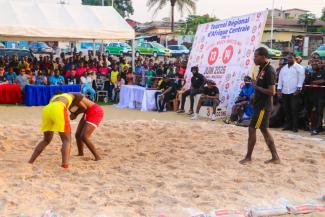
From a sustainability perspective, the use of the covered stadium contributed to the efficient organization of Beach Wrestling activities by optimizing existing infrastructure. By adapting a multi-purpose covered venue for Beach Wrestling sessions, the organizers limited the need for additional temporary installations, reduced logistical and environmental impact, and ensured continuity of activities regardless of weather conditions.

This approach reflects UWW’s commitment to sustainable event organization through the рационal use of facilities and long-term infrastructure legacy.