

Icho, Kaori Icho, Olympic champion, female wrestling

Kaori Icho: Pursuing Her Own Perfection

By Tim Foley

When Kaori Icho won her ninth world championship Thursday night in Tashkent absent were the backflips, tears and group hugs of previous champions. The Japanese wrestler fulfilled her requirement to wave the flag of her home country, but otherwise shooke hands, bowed off the mat and walked off the stage.

Icho’s unaffected reaction to winning a world title might be attributed to her three Olympic gold medals and eight previous world championships. All told, the Japanese great has won a total of 12 world titles, leaving her second all-time in female wrestling behind teammate Saori Yoshida who has 15 world titles on her resume. Those numbers make Icho and Yoshida inarguably the two greatest female wrestlers to ever walk the planet.

Despite the heady assertions and a 172-match winning streak, Icho is not interested in penning history or acquiring titles. She doesn’t want another gold medal for her bedroom or sponsorship money for her bank account.  What Icho wants and why she still wrestles can’t be counted or written down.

It has to be seen.

--

Kaori Icho headed into the 2008 Olympic Games a woman under pressure. She was the defending 2004 champion and hadn’t lost a match since 2003. The media burden in Japan was growing and she felt a growing dissatisfaction with the sport and all its offerings.

Icho’s solution was to discuss retirement. Warm and thoughtful, Icho knew that female wrestling was still in its infancy and she could step off the mat as a two-time Olympic champion at the age of 24. Icho was young enough to conquer something new, maybe a sport, maybe a job.

Her older sister, Chiharu, an eventual two-time Olympic silver medalist, would also be competing in the Beijing Games and had already announced her retirement – a declaration that gave Icho the opening she needed to slough off the stress and unwanted attention of her wrestling career, should she choose to follow her sister.

In addition to her sister, Icho was sharing her Olympic journey with teammate and friend Saori Yoshida, who’d also won an Olympic gold in 2004 and was mentored by her father and national team coach, Eikatsu Yoshida.

“I know that the gold medals mean a lot to Saori,” says Icho. “This is what motivates her and what motivates many wrestlers. I was like this, too, but it wasn’t right for me. Something wasn’t working.”

Icho floated the idea of retirement and, in a country cued into the plans of their most dominant Olympians, the rumors reached the press. “I never made the decision to retire, but I did need a change. I very much needed a change.”

Icho had been training at the same club near Nagoya for much of her life. When she finally took a moment to look up from the mats at age 24 she wanted change.

“I had the same training partners and the same coach,” explains Icho. “ Nothing was wrong with them, I just couldn’t get stronger without something new. If I was going to stay in wrestling I needed to find a new path.”

Of course, Icho would win in Beijing.  And, after her title was announced, she threw her arms in the air and beamed a smile. But that wasn’t from an appreciation of her achievement as much as an alleviation of the stress.

Icho sat out the 2008 World Championships – the model for other world meets for women run concurrently in Olympic years until 2016. Yoshida wrestled, and as she always seems to do, she won.

Icho chose not to retire, but she did decide to leave Japan. She hadn’t left wrestling, but she’d left Japan and moved to Canada.

“I wanted to experience life overseas and see how foreigners trained,” says Icho. “The biggest difference that I saw was how well the athletes and coaches communicated.”

In Japan the athlete-coach relationship is simple: coaches give instructions and wrestlers listen. In Canada, the coaches and the athletes had relationships; they enjoyed each other’s company on a personal level.

“I envied their relationships,” says Icho.

Icho traveled home to Japan, on occasion, but spent the majority of the next eight months training in Canada. She learned English, sat out the 2009 world championships and, in the time away from battling in competition, rediscovered what she loved about the sport -- and it wasn’t winning gold medals.

In addition to envying the close coach-athlete connection she saw in Canada, Icho saw that training methods varied from country to country. Sheltered and cared for in Nagoya, she’d never seen training that didn’t include running (which she dislikes) and was able to use more power lifts in her strength training (which she likes).

When Icho returned to Japan she chose to spend much of her time at the national training center for male wrestlers and looked for college programs and coaches she liked. She spent weeks absorbing new techniques, and also new attitudes – how one school trained varied from another, and from that she cobbled together a loose emotional and physical sketch of what it would take for her to get back on the mats for competition. Icho became more focused on the techniques and chess match of wrestling than on the aggression so often used as a skill. She discovered that passion could always be defeated by pressure or circumstance, but technical acumen was unbeatable, and its acquisition is, in and of itself, fulfilling.

That Icho is uniquely talented cannot be questioned. Her speed and athleticism are evident to even the most casual wrestling observer, but that she’s more spry, more active and more technical runs counterintuitive to the sport’s natural maturation. Thirty-something wrestlers slow down; they are more often injured and often eschew finer movements in favor of fewer movements.

Icho, who turns 30 in June, says that her ongoing improvements are a result of training with men who focus her on better techniques and tougher training regiments. With harder work in tougher scenarios, Icho believes her body will more often retain new techniques.

“Men are more profound in their detail and the moves are more complicated and that makes learning them a serious process.”

Icho refuses to put an expiration date on her career. If she were as poetic in her career path as she is on the mat she might decide to wrestle until the 2020 Olympic Games in Tokyo. Should she win every championship from now until then, she’d end her career with 18 world titles including five Olympic gold medals. But the titles have never mattered, and she won’t start creating storylines for herself.

“I’m not sure when the end will come for me, but I will be wrestling all my life,” says Icho. “I am a wrestler, but I will know when my time as competitor must give way to my time as a coach.”

For now, Icho wrestles one match at a time. Always wondering if she can achieve perfection in her lifetime, knowing that her own expectations become loftier with each technique mastered.

“My goal, my only goal, is to get to closer to the image in my head of what wrestling can be,” says Icho. “Competition is important and it will enrich your life.”

”I’m only now seeing that improvement is what gives me satisfaction and puts a smile on my face."



#wrestlebishkek

Yoshida Repeats as Asian Champ as Japan, India Grab 2 Golds

By Ken Marantz

BISHKEK, Kyrgyzstan (April 11) – Arash YOSHIDA (JPN) brought further glory to a country with little prior success in the upper weights, while also standing out for his Iranian heritage.

And now he has company in that dynamic combination.

Yoshida successfully defended his 97kg title at the Asian Championships on Saturday, one of two golds captured by Japan on the first night of finals in Freestyle – both by wrestlers born and raised in Japan with Iranian fathers.

WATCH ARASH YOSHIDA (JPN) vs AMIRALI AZARPIRA (IRI) FINAL: CLICK HERE

Yoshida outlasted Amirali AZARPIRA (IRI) in a battle of world medalists, notching a second-period takedown for the key score in a 4-0 victory.

“I'm glad I was able to beat an opponent I had been aiming to defeat, and to win the Asian championship,” said Yoshida, who also won the Asian gold at 92kg in 2023.

His victory came a short time after unheralded compatriot Keyvan GHAREHDAGHI (JPN) – who also has an Iranian father and Japanese mother – won the 79kg gold in his first major senior tournament.

It was also a big night for India, which claimed golds from SUJEET (IND) at 65kg and ABHIMANYOU (IND) at 70kg, while Milad VALIZADEH (IRI) won the other title at stake with a somewhat distasteful triumph at 57kg.

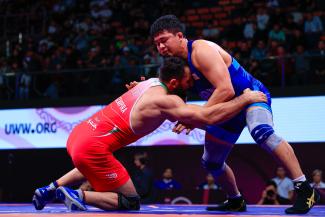
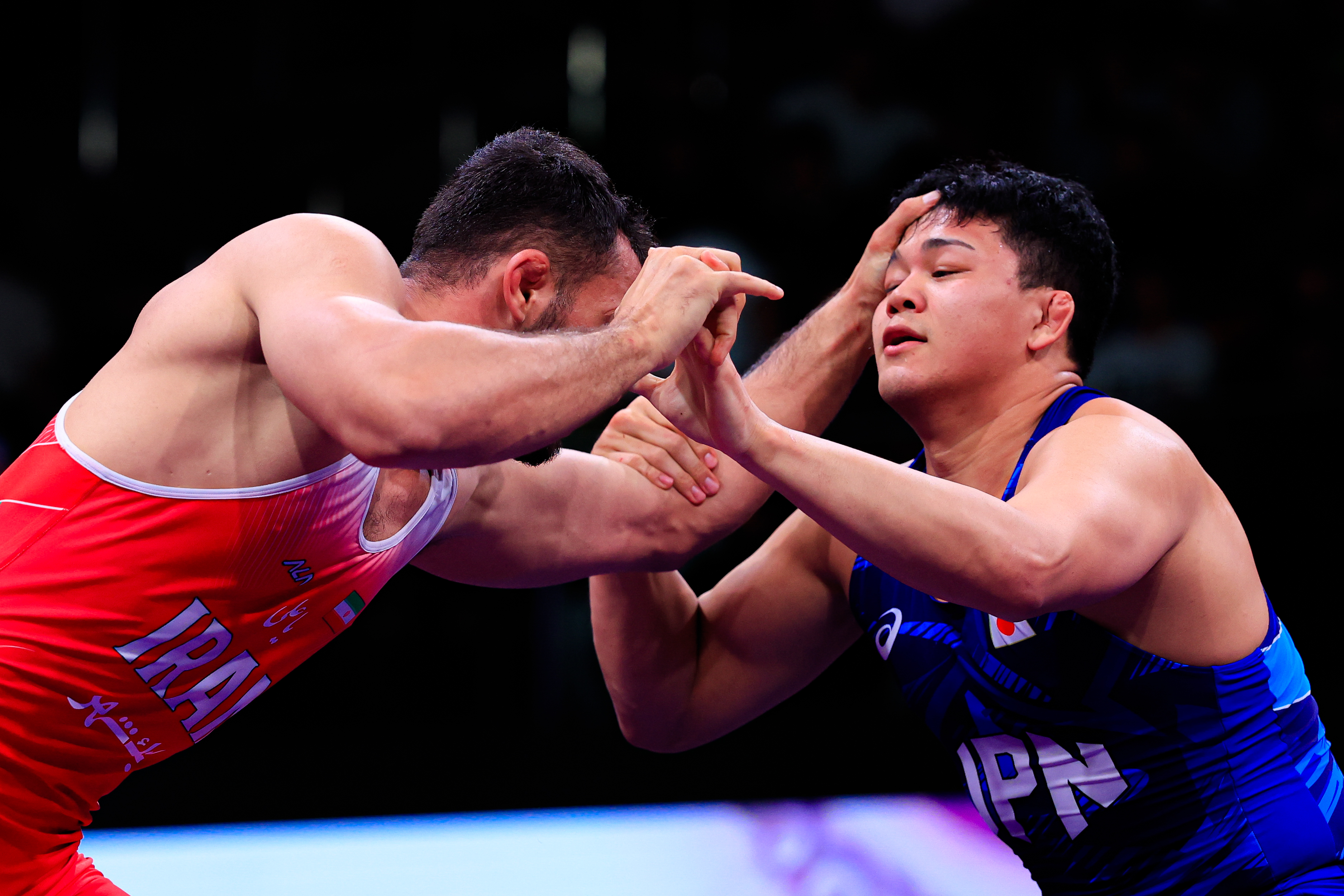
Arash YOSHIDA (JPN)Arash YOSHIDA (JPN), blue, and Amirali AZARPIRA (IRI) battle it out in the 97kg final at the Asian Championships. (Photo: United World Wrestling / Kostadin Andonov)
For Yoshida, his facing – and beating – an Iranian in a major international tournament final had long been the dream of his father, who runs the kids wrestling club outside of Tokyo where Arash and his siblings started the sport.

“It's a bit [special],” Yoshida said of beating Azarpira. “It's not so good that my father is so happy about it, but at the same time, I'm glad. I am my own self, and I came here as a Japanese to represent Japan.”

In the final at Bishkek’s Zhastyk Arena, neither wrestler could make inroads early on as Yoshida received an activity point for the lone score of the first period.

In the second period, Azarpira launched an attack, but Yoshida sprawled and started to work his way behind. When Azarpira tried to get to his feet, Yoshida deftly lunged for an ankle and sent the Iranian to the mat for a takedown and a 3-0 lead. A penalty for hands to the face accounted for Yoshida’s final point.

“I wasn’t able to attack much, so I ended up focusing solely on finding a way to win,” Yoshida said. “The match itself wasn’t very interesting. The Iranian was strong, and I thought it would come down to a battle of power. I thought it was good that I kept the pressure on when we tied up.”

As for achieving a golden repeat, Yoshida said, “That wasn't really an issue for me. It’s more to just do each and everything I needed to do as it comes up. When it comes to repeating, it’s like I’m thankful because it’s something that becomes mine.”

At last year’s World Championships in Zagreb, Yoshida took a bronze medal after losing in the semifinals to Kyle SNYDER (USA), who then beat Paris Olympic bronze medalist Azarpira for the gold.

Yoshida can secure a trip to this year’s World Championships with a victory at next month’s Meiji Cup All-Japan Invitational Championships, or in a playoff in the unlikely event that he loses. The winner will also earn a ticket to the Asian Games that Japan will host in October.

“The top wrestlers will come up with a strategy against me, so I think the world is going to get tougher for me,” Yoshida said. “I will have to put my whole heart into training.”

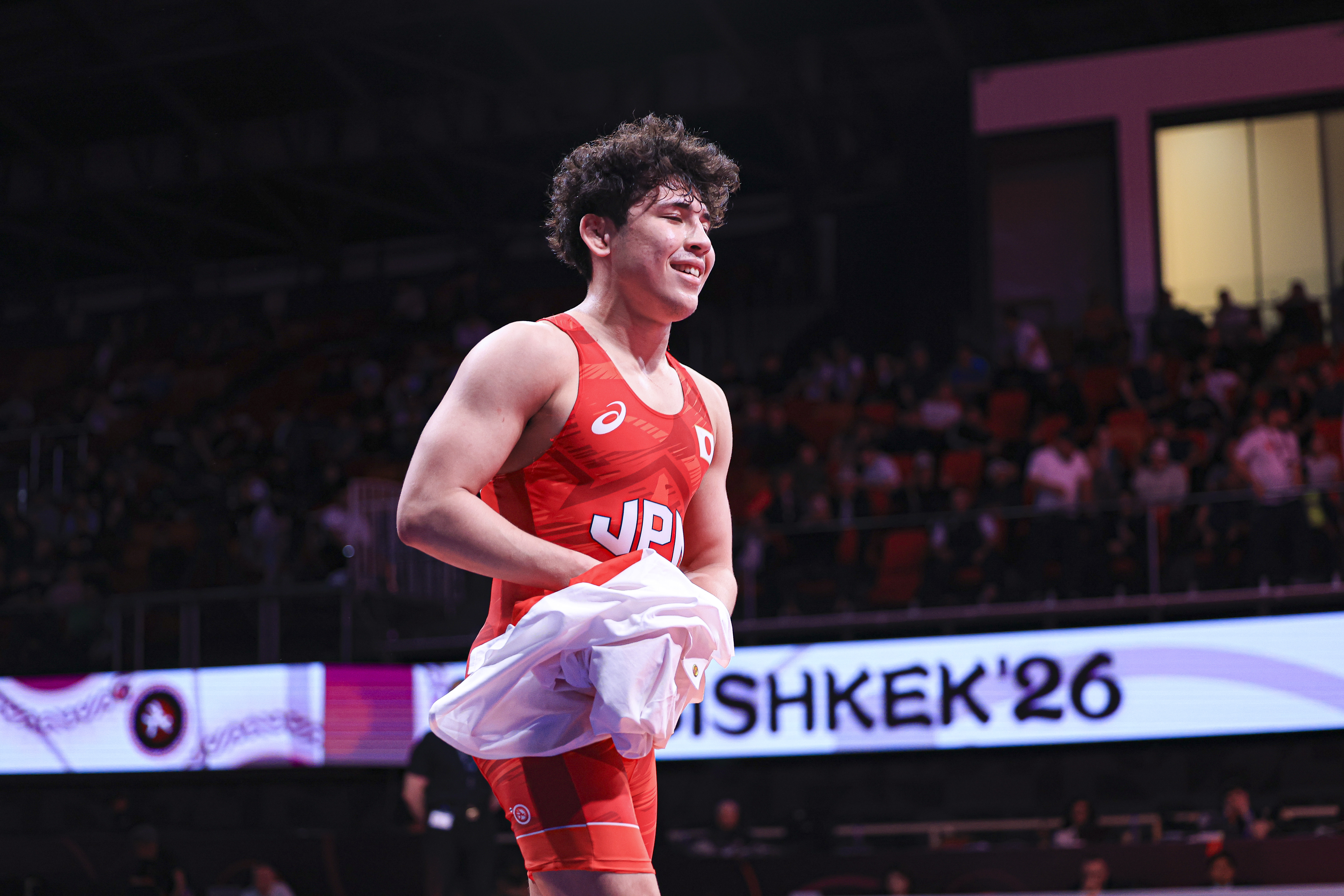
Keyvan GHAREHDAGHI (JPN)Keyvan GHAREHDAGHI (JPN) celebrates after winning the 79kg gold medal at the Asian Championships. (Photo: United World Wrestling / Kadir Caliskan)
As Yoshida continue to establish himself among the world elite, collegian Gharehdaghi took a big first step when he forged out a 2-1 victory over Sandeep MANN (IND) for the 79kg, with activity points accounting for all of the scoring.

Gharehdaghi, a 20-year-old third-year student at Tokyo’s Waseda University, spent the match trying to break through Mann’s defensive shell, while his opponent would not launch a legitimate attack until the final seconds.

It was a far cry from the Gharehdaghi’s action-packed semifinal win over Olympic bronze medalist Razambek JAMALOV (UZB) that suddenly cast him into the spotlight.

“I wanted to be aggressive and do my style of wrestling,” Gharehdaghi said. “But it was a final. The feeling of not wanting to make a mistake comes to the forefront, and there were times I couldn't do the wrestling that I wanted to.

“I''m happy that I won the title, but above that, I wanted it to be more my type of wrestling.”

WATCH: KEYVAN GHREHDAGHI (JPN) BEATS OLYMPIC CHAMPION RAZAMBEK JAMALOV (UZB)

Gharehdaghi’s win ended a run of victories by India in the two previous finals.

“The Indians were really on a roll, starting from 65kg,” Gharehdaghi said. “I wasn't trying to stop the streak. I was just thinking about myself.”

Gharehdaghi said he will eventually move down to 74kg when the Olympic qualifying process begins, and remains unsure at this time what weight class he will enter at the Meiji Cup.

For now, he can bask in the glory of a well-earned triumph without letting it go to his head.

“It gives me confidence, but I am telling myself to not be satisfied with this and to work to get to a higher level,” he said.

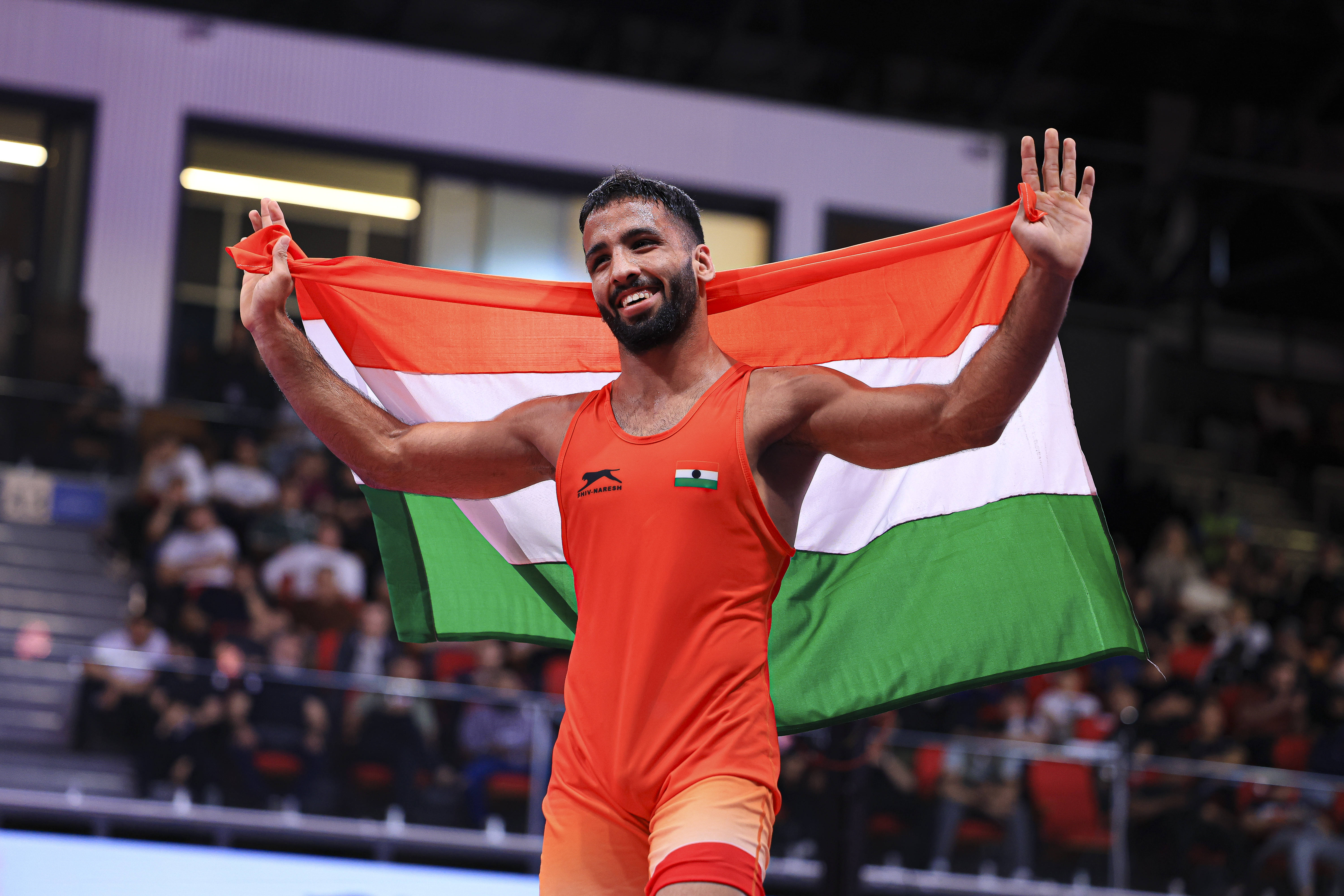
SUJEET (IND)SUJEET (IND) claimed the 65kg gold medal in Bishkek after an 8-1 victory over Umidjon JALOLOV (UZB). (Photo: United World Wrestling / Amirreza Aliasgari)
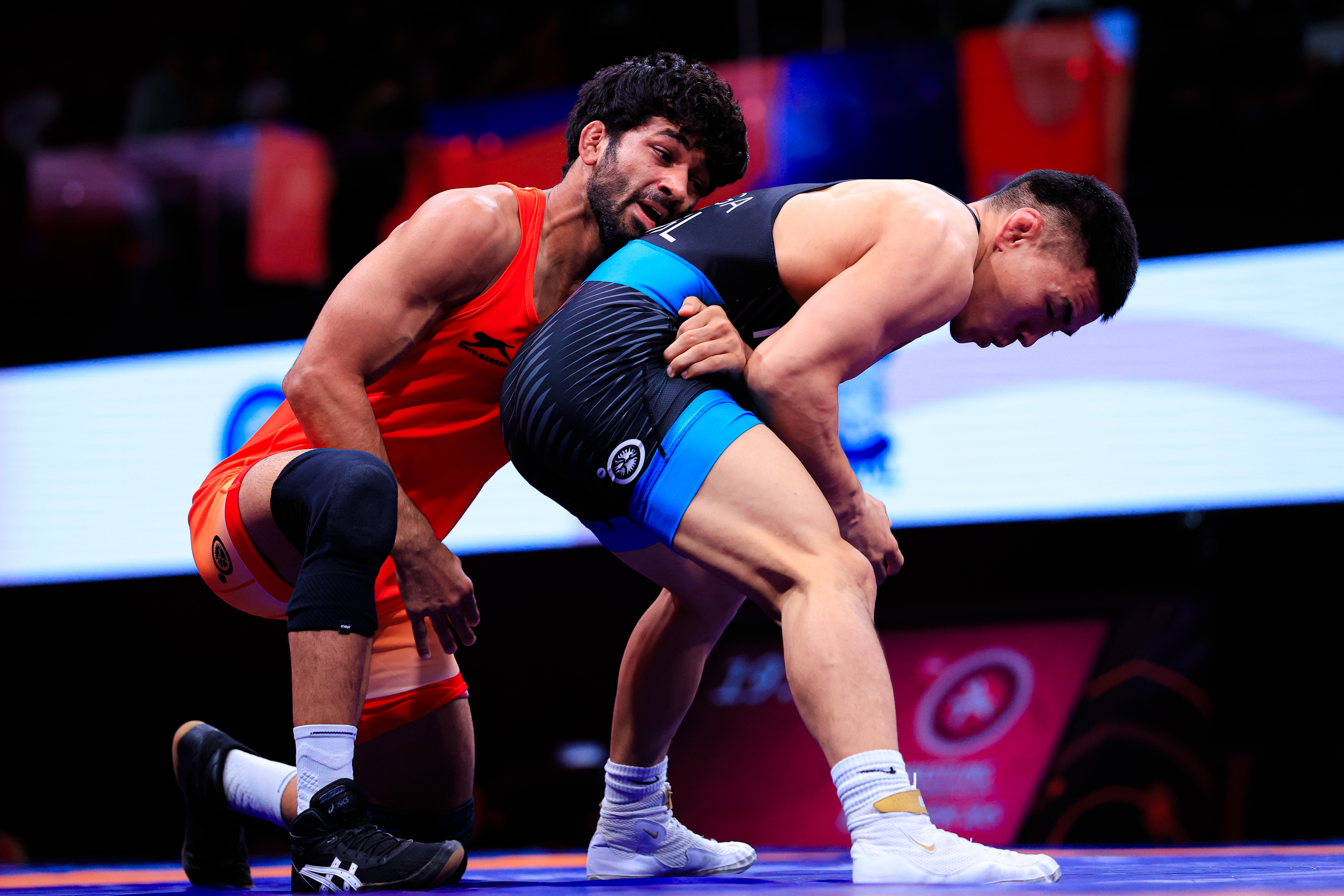
India’s mini gold rush began with Sujeet’s 8-1 win over world bronze medalist Umidjon JALOLOV (UZB) at 65kg, which he secured with three second-period takedowns.

Sujeet, the 2025 world u23 champion and winner of two Ranking Series events this year, gained an activity point and stepout to go ahead in the first period. In the second, the run of takedowns started, disturbed only by a stepout by Jalolov and ending with a nice duck under.

“He is a very good competitor,” Sujeet said of Jalolov, “but I want to give my best. I don’t want to consider any opponent weak or strong.”

It was Sujeet’s fourth win in four meetings with Jalalov, most recently in the final at the last year’s World U23 Championships.

Sujeet still has an axe to grind about his disappointing showing at last year’s senior worlds, where he fell in the quarterfinals, then was eliminated in the repechage to finish out of the medals.

“Last year, there were a lot of shortcomings at the World Championships,” Sujeet said. “I was under a lot of pressure. But this year, I have started to improve. There is a difference between this year and last. I am improving day by day.”

ABHIMANYOU (IND)ABHIMANYOU (IND) scores a takedown on Tulga TUMUR OCHIR (MGL) in the 70kg final. (Photo: United World Wrestling / Kostadin Andonov)
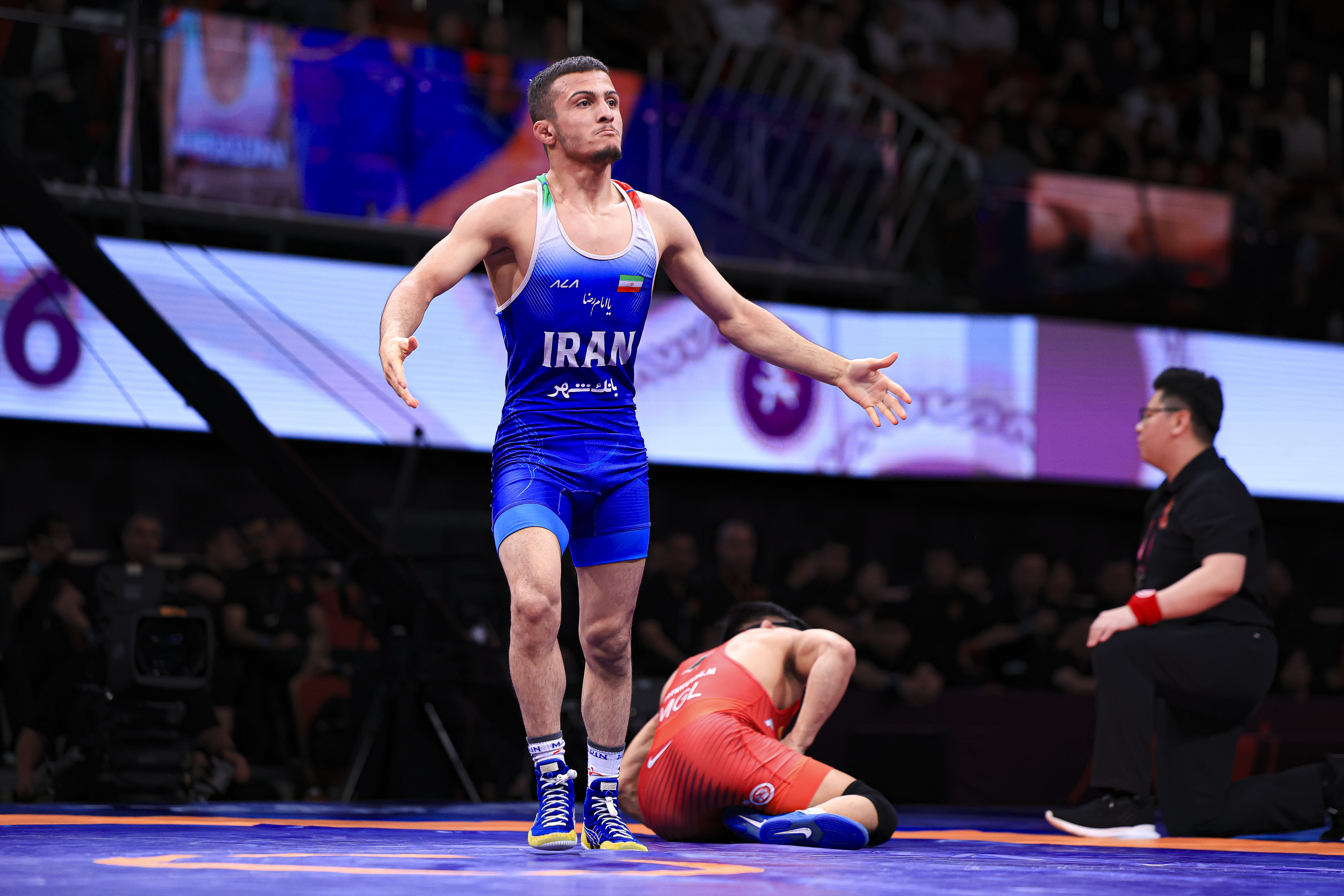
Abhimanyou, a bronze medalist in 2024, followed Sujeet’s victory by rallying for a 5-3 victory in the 70kg final over world silver medalist Tulga TUMUR OCHIR (MGL).

“I just wanted to give 100 percent in the final,” said Abhimanyou, who became the first Indian to win an Asian gold in a weight class above 66kg since 2010.

“I focused on a few things in the final. The Mongolian wrestler has a great underhook on his right side. And my defense on my left side is very good so I could cancel him.”

Tumur Ochir scored first when he spun out of a near takedown for a stepout, then received an activity point to take a 2-0 lead at the break.

Abhimanyou started the second period with a double-leg takedown, with an unsuccessful challenge giving the Indian a 4-2 lead. After limiting Tumur Ochir to a stepout despite getting in deep on a single, Abhimanyou gained a stepout with :54 left to cap the scoring.

“I was not worried even when he scored the first two points,” Abhimanyou said. “I could feel that I will catch him for a takedown whenever I want.”

Milad VALIZADEH (IRI)Milad VALIZADEH (IRI) won the 57kg gold, the only champion for Iran on Saturday. (Photo: United World Wrestling / Amirreza Aliasgari)
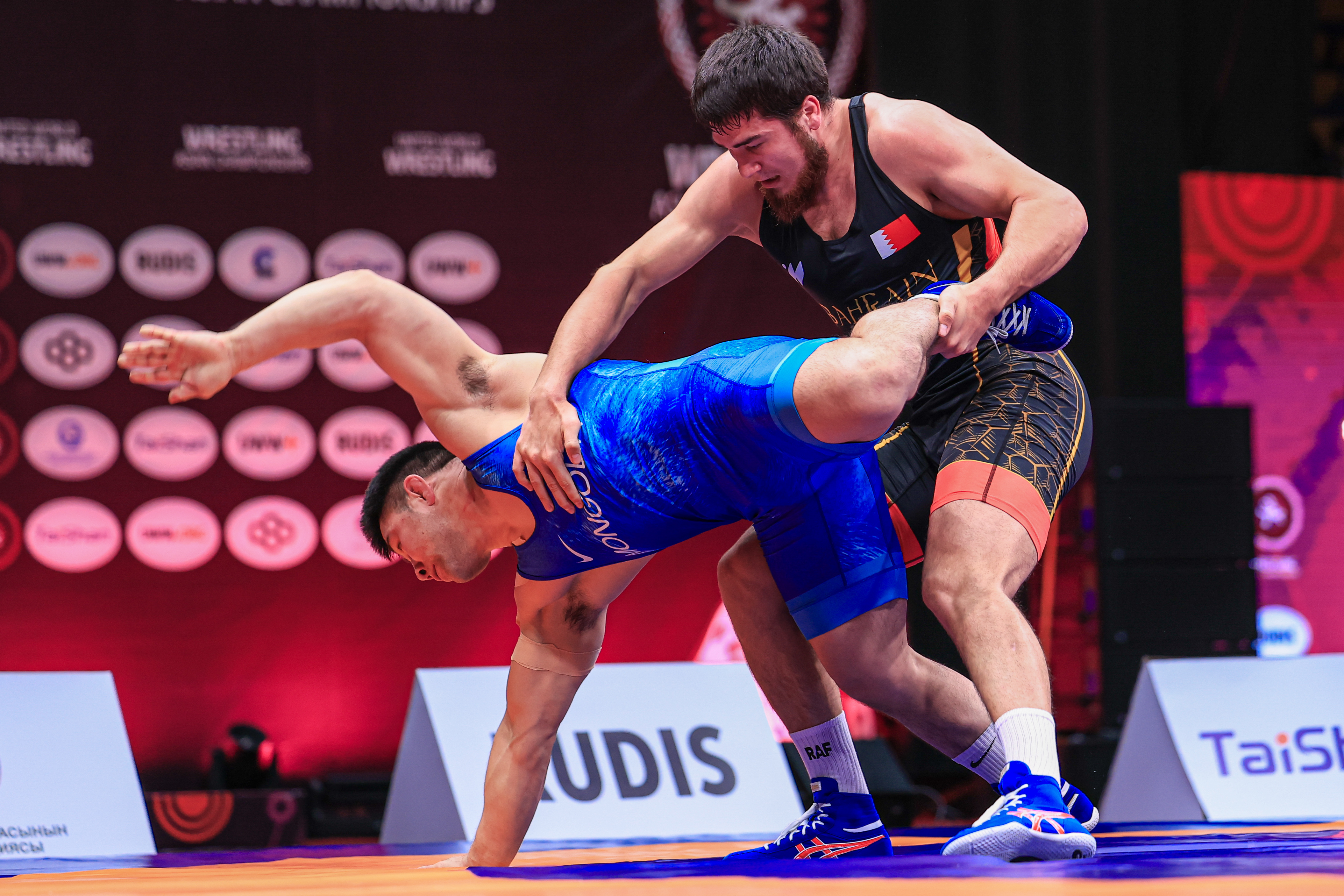
At 57kg, what started as an exciting match between two dynamos ended with returning silver medalist Valizadeh being booed after completing an easy victory over an injured Munkh Erdene BATKHUYAG (MGL).

Batkhuyag suffered an apparent rib injury while scoring a stepout midway through the first period that cut Valizadeh’s lead to 4-3. After the restart, Valizadeh shot in for a takedown, at which time Batkhuyag seemed to have was stopped fighting.

But Valizadeh didn’t, and flip-flopped the lifeless Batkhuyag back and forth until he piled up enough points for a 14-3 victory that ended the match at 1:47.

To be fair, the referee never blew the whistle, and Valizadeh was under no obligation to stop. And after the initial boos, the crowd actually applauded when he celebrated his victory with a gymnastics back flip.

Akhmed TAZHUDINOV (BRN)Akhmed TAZHUDINOV (BRN) returned with a bronze medal at 97kg. (Photo: United World Wrestling / Amirreza Aliasgari)

Tazhudinov takes home 97kg bronze

In the bronze-medal matches, Olympic champion Akhmed TAZHUDINOV (BRN) assured he would not leave Bishkek empty-handed, emphatically beating Bekzat URKIMBAY (KAZ) 14-0 at 97kg.

Tazhudinov, a two-time former gold medalist, jumped out to a 6-0 lead in the first period, then poured it on after tackling Urkimbay, turning him over again and again to end the match in 3:53.

In the other 97kg match, Sherzod POYONOV (UZB) scored a defensive takedown and gut wrench combination in the second period that made the difference in a 7-5 win over VICKY (IND) in a match that was otherwise filled mainly with stepouts.

Poyonov, the world U20 champion at 92kg, added the bronze to the silver he won at 92kg in 2024.

At 70kg, local star Ernazar AKMATALIEV (KGZ) completed his collection of Asian medals with a vintage performance of his counter wrestling as he won one of three bronze medals claimed by the host nation.

Akmataliev, rebounding from a devastating loss in the semifinals when he was unaware of the score, rode his counters to a 14-7 win over Shuang CHEN (CHN).

The three-time world medalist, pulled away in the second period with a pair of takedowns off counters, adding a counter lift for his final points for good measure to add to the gold he won last year and a silver from 2022.

Even when Chen scored four earlier by somersaulting forward with Akmataliev on his back, Akmataliev managed to fenagle a 2-point exposure.

In the other 70kg match, Sina KHALILI (IRI) took home his second straight bronze with a one-sided 11-0 win over Shakhzodbek YARASHEV (UZB) that included a 4-point takedown in the second period.

Zhakshylyk BAITASHOV (KGZ) followed Akmataliev by taking a bronze at 79kg with a 6-0 win over Somonjon IKROMOV (TJK) for his first major medal.

After opening with a stepout and activity point in the first period, Baitashov padded the lead with a takedown in the second period, then scored another blocking a desperate throw attempt by Ikromov.

Suldkhuu OLONBAYAR (MGL) received his second straight Asian bronze and third overall when Jamalov forfeited their match.

At 57kg, Abdymalik KARACHOV (KGZ) also won a bronze without a fight after Sunggwon KIM (KOR) defaulted due to injury. It is the first senior medal for Karachov, the 2024 world U23 silver medalist and Asian U23 champion.

In the other 57kg match, Asian U20 champion ANKUSH (IND) earned his first senior Asian medal when he hit a 4-point hip throw in the second period, leading to an 8-2 victory over Fuga SASAKI (JPN).

Sasaki had gone ahead 2-1 with a takedown to open the second period when Ankush slammed him to the mat. An unsuccessful challenge and a late takedown sewed up the victory for the Indian.

At 65kg, Russian-born Abdulmazhid KUDIEV (TJK) survived a wild battle with Asian U23 bronze medalist Rustamzhan KAKHAROV (KGZ), gaining an early 4-point takedown and getting 4 during a second period scramble to prevail 10-7.

Kudiev, the 2024 world bronze medalist at 70kg, led 5-2 in the second period when Kakharov tried to secure a cradle as he tried to take Kudiev to the mat. In the ensuing chaos, Kakharov got 2, only for Kudiev to reverse for 2 then add a 2-point exposure.

A late 2-point throw and unsuccessful challenge pulled Kakharov to within two points, but Kudiev sewed up the win with a stepout.

In the other 65kg match, Alibeg ALIBEGOV (BRN) was leading 1-1 on criteria when he secured a second-period takedown for a 3-1 victory over Zeneemeder BYAMBASUREN (MGL).

Photo

Day 6 Results

Freestyle

57kg (11 entries)
GOLD: Milad VALIZADEH (IRI) df. Munkh Erdene BATKHUYAG (MGL) by TS, 14-3, 1:47

BRONZE: Abdymalik KARACHOV (KGZ) df. Sunggwon KIM (KOR) by Inj. Def.
BRONZE: ANKUSH (IND) df. Fuga SASAKI (JPN), 8-2

61kg (11 entries)
SF 1: AMAN (IND) df. Ahmad JAVAN (IRI), 11-9
SF 2: Kwang Myong KIM (PRK) df. Gulomjon ABDULLAEV (UZB) by Fall, 2:30 (3-0)

65kg (12 entries)
GOLD: SUJEET (IND) df. Umidjon JALOLOV (UZB), 8-1

BRONZE: Abdulmazhid KUDIEV (TJK) df. Rustamzhan KAKHAROV (KGZ), 10-7
BRONZE: Alibeg ALIBEGOV (BRN) df. Zeneemeder BYAMBASUREN (MGL), 3-1

70kg (10 entries)
GOLD: ABHIMANYOU (IND) df. Tulga TUMUR OCHIR (MGL), 5-3

BRONZE: Ernazar AKMATALIEV (KGZ) df. Shuang CHEN (CHN), 14-7
BRONZE: Sina KHALILI (IRI) df. Shakhzodbek YARASHEV (UZB) by TS, 11-0, 5:06

74kg (14 entries)
SF 1: Magomedrasul ASLUEV (BRN) df. Begijon KULDASHEV (UZB), 4-3
SF 2: Yoshinosuke AOYAGI (JPN) df. Orozobek TOKTOMAMBETOV (KGZ) by TS, 10-0, 3:36

79kg (12 entries)
GOLD: Keyvan GHAREHDAGHI (JPN) df. Sandeep Singh MANN (IND), 2-1

BRONZE: Suldkhuu OLONBAYAR (MGL) df. Razambek JAMALOV (UZB) by Forf.
BRONZE: Zhakshylyk BAITASHOV (KGZ) df. Somonjon IKROMOV (TJK), 6-0

86kg (15 entries)
SF 1: Kamran GHASEMPOUR (IRI) df. Alp Arslan BEGENJOV (TKM) by TS, 11-0, 3:30
SF 2: Mukul DAHIYA (IND) df. Bolat SAKAYEV (KAZ), 12-6

92kg (12 entries)
SF 1: Magomed SHARIPOV (BRN) df. Iakov CHAPLIN (KGZ), 8-0
SF 2: Mobin AZIMI (IRI) df. Azamat DAULETBEKOV (KAZ), 6-0

97kg (13 entries)
GOLD: Arash YOSHIDA (JPN) df. Amirali AZARPIRA (IRI), 4-0

BRONZE: Sherzod POYONOV (UZB) df. VICKY (IND), 7-5
BRONZE: Akhmed TAZHUDINOV (BRN) df. Bekzat URKIMBAY (KAZ) by TS, 12-0, 3:53

125kg (11 entries)

SF 1: Amir Hossein ZARE (IRI) df. BUHEEERDUN (CHN), 5-0
SF 2: Shamil SHARIPOV (BRN) df. DINESH (IND) by Fall, :41 (2-0)