TIRANA, Albania (April 26) -- Zavur UGUEV (UWW) became a two-time European champion in Tirana on Sunday. For a wrestler of Uguev's pedigree, the number looks bleak.
But the 31-year-old, who will turn 32 on May 21, doesn't rue the missed golds but says those were the experiences that helped him win gold later.
"Last year I won my first European gold medal," Uguev said. "My first two or three medals, I was still young and things didn’t work out. There were very experienced athletes competing, and I gained experience from them."
In his two appearances at the European Championships in 2017 and 2018, Uguev suffered losses to Giorgi EDISHERASHVILI (AZE). In the 2018 final, Edisherashvili scored a takedown in the last seven seconds to win.
"[From] losing in the finals in the last 7 seconds in Kaspiysk, I gained great experience," he said. "But last year, I was in great shape and I’m happy that in my career I now have two European Championship gold medals."
His second gold in Tirana may have gone under that radar given the return and dominance of Abdulrashid SADULAEV (UWW), who won his sixth European gold on Saturday and first in six years.
However, if there was an award for the most outstanding wrestler of the tournament, Uguev would handsomely beat all others wrestlers to it.
On Sunday, Uguev defended his 61kg gold medal in Tirana with rather ease after defeating former world champion and home-favorite Zelimkhan ABAKAROV (ALB). The 4-0 win over Abakarov consisted one activity clock, one stepout and a two-point takedown from Uguev.
Even the low-scoring final was a masterclass from Uguev, one of the few who still mixes the art of defense and positioning to win bouts.

At one point, Abakarov would keep trying the two-on-one on Uguev's arm and instead of panicking, Uguev would casually block Abakarov using his head. After the two-minute mark in the match, Abakarov had a similar grip and Uguev was blocking using his head and grip one of Abakarov's wrist.
Abakarov moved to a position from which he could either whizzer or wrist snap Uguev. However, as soon as Abakarov moved sideways, Uguev placed his foot behind Abakarov and let go off his grip, quickly switching to a leg-attack. He scored a stepout to lead 2-0 after one activity period point.
Uguev set up his takedown in the second period when Abakarov took a shot from space and Uguev blocked it using a chest wrap. Instead of scoring exposure from front, Uguev jumped behind and locked Abakarov who tried to break the grip. But Uguev scored a takedown on the edge to lead 4-0, his winning score.
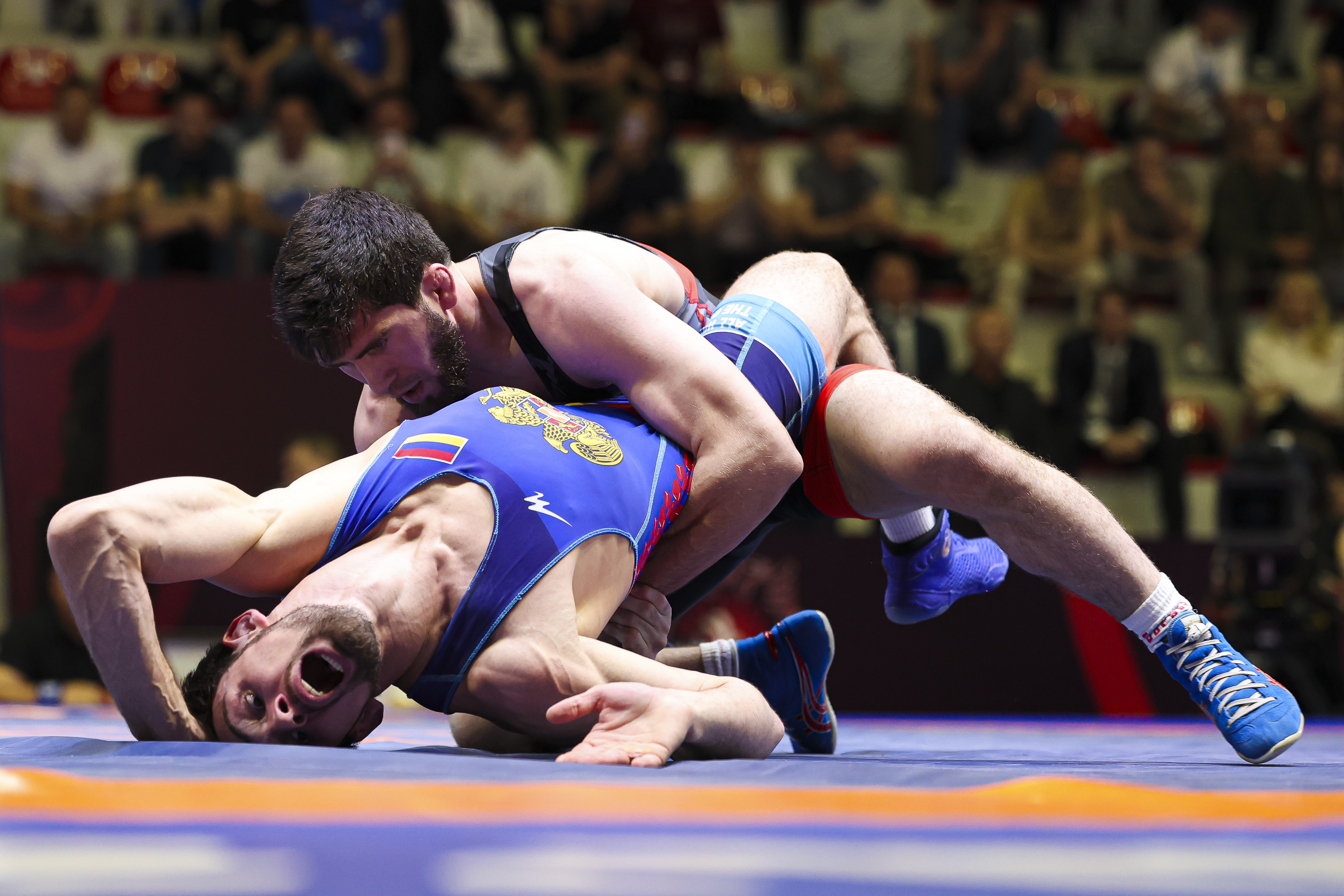 Zavur UGUEV (UWW) pins Arsen HARUTYUNYAN (ARM) in the 61kg semifinals. (Photo: United World Wrestling / Kadir Caliskan)
It was in the semifinals against Arsen HARUTYUNYAN (ARM), Uguev fell behind 3-2 but he brought down Harutyunyan in danger for two points before holding the Armenian in such a grip that he failed to move despite having split hands. Eventually, he gave up to Uguev's pressure who won via fall.
"The final is always a tough contest, both last and this year," Uguev said. "Last year it was Harutyunyan, a four-time European champion, and this year it’s Abakarov, the world champion. It’s a real pleasure to compete against them. I’ve come here solely to compete against them."
Two months ago, Uguev was in Tirana and he put on a wrestling masterclass, winning the 61kg gold medal. However, it was in Tirana that he lost to phenom Masanosuke ONO (JPN) and Vitali ARUJAU (USA) and finished fifth at the World Championships.
"I was here at the start of February for the ranking tournament, and I suppose I had some thoughts about it [losing World Championships in Tirana]," he said. "But I managed to win that tournament, and I came here with the sole intention of winning. The first attempt [2024 World Championships] didn’t go to plan."
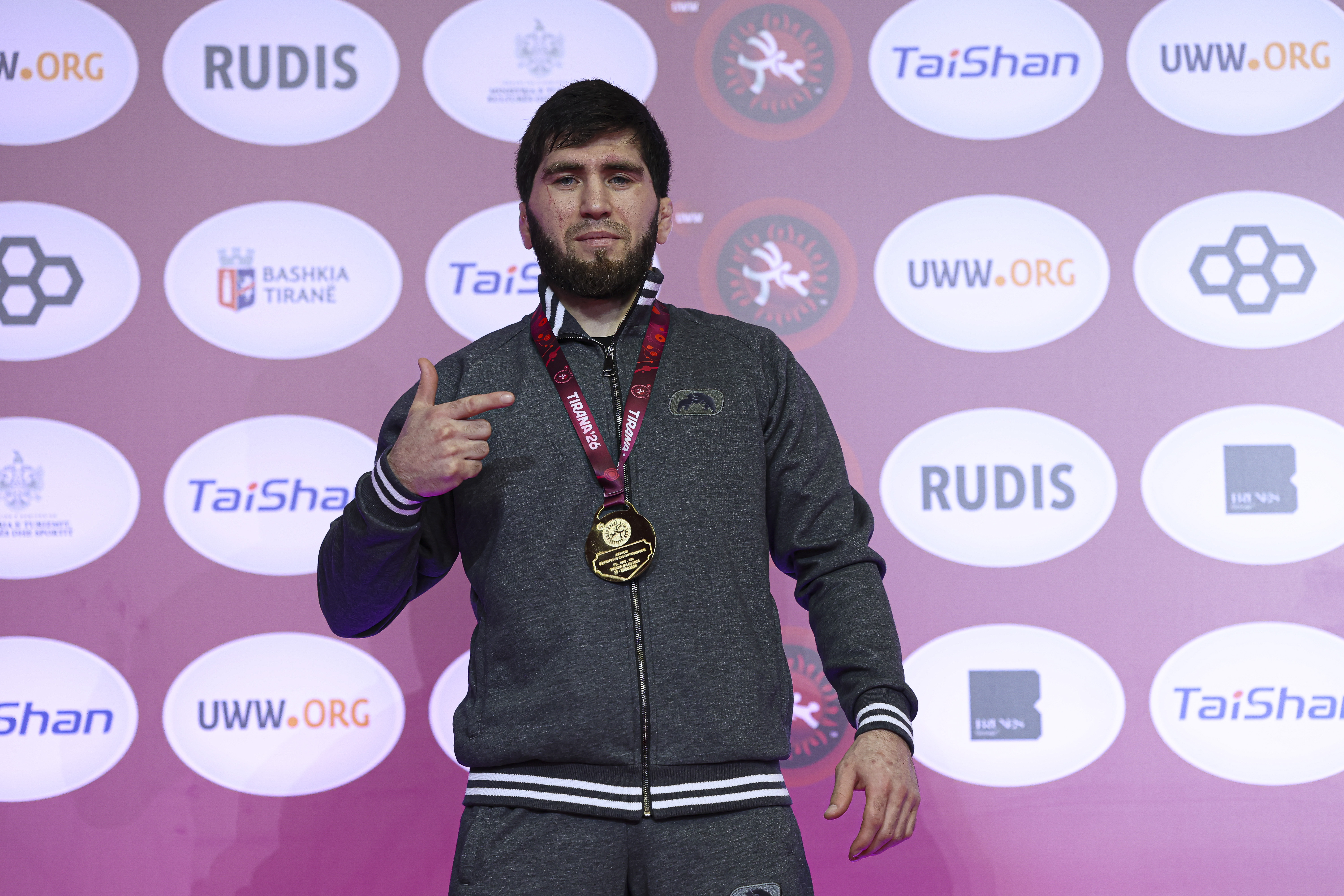 Zavur UGUEV (UWW) after winning the 61kg gold medal in Tirana. (Photo: United World Wrestling / Kadir Caliskan)
The three-time world champion and Tokyo Olympic gold medalist at 57kg has been competing at 61kg for three years now. While he will eventually move to 57kg for a run at the 2028 Los Angeles Olympics, Uguev says he is enjoying wrestling at a higher weight and not dieting during competitions.
"I’ll be wrestling in 65kg soon," he said jokingly. "I’ll probably be dropping down to 57kg. I’ll probably compete for another year or so [at 61kg], and then I’ll keep dropping down. I’m not actually that heavy to begin with, and I reckon anyone competing at 57kg is roughly the same weight as me. For now, I don’t see the point in cutting weight, and I think it’s better to stay as I am for the time being, compete for another year or so. I think that this year, or early next year, we’ll start thinking about which weight class to move to.
"Now that I’ve moved up to 61kg, I’m really enjoying the competition. When I was competing at 57kg, I struggled so much. Now, when I watch the wrestlers like Musa MEKHTIKHANOV (UWW), for example, I’m reminded of my own days on the mat. It’s just that when you’re on a diet, you don’t want to think about anything else. All you can think about is food. Now I feel comfortable. I’m not dieting; I enjoy wrestling and I’m managing to do well at it."
As for European Championships golds, Uguev isn't stopping.
"I'm not going to stop here," he said. "I'm not chasing numbers, I'll keep wrestling as long as I have the strength."




Share your thoughts.
Comments