

Grappling Gi: Prendes doubles up as world champ; Gudanatov stunned
Thursday, October 16, 2025 - 11:45 By Vinay Siwach
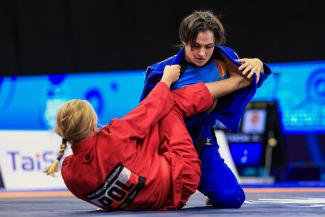
NOVI SAD, Serbia (October 15) - Whether it is Gi or No-Gi, it seems that Carlota PRENDES LARIOS (ESP) is making a habit of winning gold medals.
After winning double-gold at the 2024 World Grappling Championships, Prendes Larios repeated the feat in 2025, winning gold in Gi and No-Gi competition in Novi Sad.
The Spanish grappler won the 53kg gold in No-Gi on Tuesday with a dominant performance and continued the same form in Gi. She won her first two bouts via submission and in the final against Zuzanna KOWALSKA (POL) and won via submission.
She began by top control in the first minute but was called passive, giving one point to Kowalska to lead 2-1. She moved to a back mount and then performed a rear naked choke for submission to claim the gold medal at 53kg.
At 90kg, Tatiana KABANOVA (UWW) made amends and won gold medal after finishing with silver in No-Gi event. She was defeated by Alena VLASOVA (UWW) in that competition but Kabanova managed to remain unbeaten in a three-grappler bracket.
She defeated Vlasova via submission in the first bout and then won 3-1 against Justyna SITKO (POL) to claim the gold medal.
Gudanatov stunned
Defended 130kg world champion Abu GUDANATOV (UWW) was stunned by Bilal KURBABAGAMAEV (UWW) in thrilling final at 130kg. Gudanatov tried to set up a choke but Kurbabagamaev never gave up position and got two points for a controlling Gudanatov on ground.
As the two remained in the same position, Kurbabagamaev was called passive two times in which he failed to score. However, he still led 2-2 on criteria as he had a bigger scoring action than Gudanatov's sequence of one points.
But in the last minute, Gudanatov was called passive and cautioned one point which gave Kurbabagamaev a clear 3-2 lead in the final which he defended to win the gold medal.
In another thrilling final, Shamil MAZHIDKHANOV (UWW) defeated Eldar RAFIGAEV (MDA), 5-3, to win the gold medal at 100kg. Mazdhikhanov scored the first two points for control but he was called passive on top which made the score 2-1. But he managed to move into a side mount for three points and lead 5-1.
With only intention of defending his four-point lead, Mazhidkhanov was docked two more points for passivity but he won 5-3 and captured the gold medal.
At 71kg, making his senior debut, 20-year-old Stefanos VAVILIS (GRE) stunned Sandor LAKATOS (HUN), 2-1, in the final and win his first gold medal.
RESULTS
Men's Grappling Gi
71kg
GOLD: Stefanos VAVILIS (GRE) df. Sandor LAKATOS (HUN), 2-1
BRONZE: Said ZAIPULAEV (UWW) df. Kevin MARTIN TINOCO (ESP), 5-2
BRONZE: Zaur AKHMEDOV (UWW) df. Nico PULVERMUELLER (GER), 2-2
100kg
GOLD: Shamil MAZHIDKHANOV (UWW) df. Eldar RAFIGAEV (MDA), 5-3
BRONZE: Konstantin LI (KGZ) df. Pavel SLANINA ANTON (ESP), 9-3
BRONZE: Khasan ZAPIROV (UWW) df. Ramazan ABDRAKHIMOV (KAZ), 4-1
130kg
GOLD: Bilal KURBABAGAMAEV (UWW) df. Abu GUDANATOV (UWW), 3-2
BRONZE: Alexandr ROMANOV (MDA) df. Abraham COBY MARTINEZ (ESP), via submission (6-2)
BRONZE: John HANSEN (USA) df. Ioannis KARGIOTAKIS (GRE), 8-4
Women's Grappling Gi
53kg
GOLD: Carlota PRENDES LARIOS (ESP) df. Zuzanna KOWALSKA (POL), via submission (6-1)
BRONZE: Anorbi GRISHINA (UWW) df. Giulia ANGIOLINI (ITA), 7-3
BRONZE: Radomira OSTANINA (UWW) df. Evelina FLORIAK (UKR), 9-1
90kg
GOLD: Tatiana KABANOVA (UWW)
SILVER: Justyna SITKO (POL)
BRONZE: Alena VLASOVA (UWW)

Share your thoughts.
Comments