

Fujinami earns shot at world title repeat with 100th straight win
Saturday, June 18, 2022 - 14:47 By Ken Marantz

TOKYO, Japan (June 18) -- Not that she cares about it, but Akari FUJINAMI extended her winning streak dating back to her junior high school days to a nice round 100 in a row on Saturday. Far more important to the super teen was that with the milestone win, she clinched a chance to defend her world 53kg title.
Fujinami hit the century mark in consecutive wins with a 4-0 victory over former world champion Haruna OKUNO in the 53kg final at the Meiji Cup All-Japan Invitational Championships, Japan's second and final domestic qualifier for this year's World Championships.
The 18-year-old, who went into the tournament at Tokyo's Komazawa Gym with 97 straight wins, posted a fall and a technical fall before scoring a takedown in each period to defeat an understandably cautious Okuno for the third time in three career meetings.
"Many in the media talk about it, but for me, the winning streak is all in the past," said Fujinami, to whom a photographer gave a "100"-shaped balloon for a cheesy memorial shot that the Japanese press ate up. "I'm only concerned with myself in the present. From here, there will be more wins, but when I get on the mat, it will have nothing to do with extending the winning streak. I just accept that it's in the past and I only focus on winning.
Fujinami's victory, paired with her title-winning run at the Emperor's Cup All-Japan Championships last December, secured her spot on Japan's team for the World Championships to be held in September in Belgrade, Serbia.
Winners of both national tournaments automatically make the team to Belgrade; in weight classes where the champions are different, a playoff is held at end of the day's action. On Saturday, four playoffs were held, including two involving reigning world champions -- Masako FURUICHI made it, while Ken MATSUI didn't.
Furuichi will get a chance to defend her world title at 72kg after posting two wins over Emperor's Cup champion Sumire NIIKURA, while Matsui, the Greco 55kg gold medalist a year ago in Oslo, lost out in the playoff to two-time Asian champion Yu SHIOTANI after beating him in the Meiji Cup final.
 Akari FUJINAMI controls Haruna OKUNO during the women's 53kg final. (Photo: Takeo Yabuki / Japan Wrestling Federation)
Fujinami has not lost since being beaten in the 44kg final at the national junior high school championships in June 2017 (for trivia buffs, her conqueror was Umi ITO). The 100 wins have come over a span of 24 tournaments, including the last three since she started her freshman year in April at Nippon Sports Science University. She has only given up a total of four points since 2020.
As NSSU, which is locally referred to as Nittaidai, she is under the mentorship of four-time Olympic champion Kaori ICHO as well as her father, who was her coach as a kid and in high school. He took an assistant coaching job at the university in Tokyo, where the two live in an apartment near campus.
"This was my second [national] tournament since entering Nittaidai and many coaches have been teaching me new techniques, and I thought this was a tournament where I could try using them," said Fujinami, who won the gold at the Asian Championships in Ulaanbaatar in April.
"There are some that I tried and others that still have a way to go. I want to reflect on that and
use it my advantage in the next competition."
Asked what she has been addressing, Fujinami said that instead of her former turbo-charged style of tackling, she wants to take it to new level by working on set-ups, tying up and other aspects that will facilitate scoring.
Despite her amazing success at such a young age, Fujinami knows that it also puts a target on her back, with others looking for any weakness. She has to widen her repertoire to keep the opposition off balance.
"It's only natural that [others] will be studying me," Fujinami said. "That's why in college I've been working on tying up and other aspects beyond actual tackling to brush up ways to lead to points. Being studied is par for the course."
In the final, it was clear that Okuno had done her homework after previously losing to Fujinami by fall and 11-2. Okuno maintained a tight guard, but Fujinami broke through with a neat ankle pick in the first period, then shrugged off a headlock counter for a second takedown in the second period.
The only thing missing in Fujinami's latest performance was the antagonist that everyone wants to see her face, Mayu SHIDOCHI (formerly MUKAIDA), the Olympic champion at 53kg who is entered at 55kg in her first tournament since the Tokyo Games.
"I would be lying if I said she's not on my mind," Fujinami said. "She's the Olympic champion in the same weight class. So I'm thinking about her, and I want to beat her."
Their long-awaited clash will likely come at this year's Emperor's Cup in December, which will be the first qualifier for next year's World Championships, which in turn is the first qualifier for the 2024 Paris Olympics. That's what makes it so vitally important.
"Looking ahead, the tournaments leading up to the Paris Olympics are about to get going, but I first want to win a second straight title at the World Championships. This year, I'm sure there will be a higher level of opponents, but I want to repeat as champion and get momentum going for the Paris Olympics."
Okuno, who advanced to the final by beating 2020 world 55kg silver medalist Nanami IRIE 4-1, is one of only two wrestlers on the planet (Furuichi is the other) who have completed the world championship Grand Slam with titles at the U17, U20, U23 and senior levels. But her path back to the world stage has been solidly blocked by the emergence of Fujinami.
Had the 23-year-old Okuno moved up to 55kg, the weight class in which she won the first of her two world titles in 2017 and 2018, it's not a sure thing that she would have been any more successful. Okuno has an 0-8 career record against her former Shigakkan University teammate Shidochi.
 Masako FURUICHI (blue) scores a last-second takedown in the women's 72kg final to defeat Sumire NIIKURA and set up a world team playoff between the two. (Photo: Takeo Yabuki / Japan Wrestling Federation)
Furuichi in, Matsui out
At 72kg, Furuichi needed the playoff to return to the World Championships because she failed to win at the Emperor's Cup after dropping down to 68kg. In her absence, the unheralded Niikura won the 72kg title, which she followed up with a silver medal at the Asian Championships in her first-ever overseas competition.
Furuichi cut it razor-thin in the Meiji Cup final, scrapping to score a decisive takedown in the dying seconds of an 9-6 victory. The playoff was a staid affair, with Furuichi receiving activity points in both periods for a 2-0 win.
In the final, Niikura was leading 6-6 on criteria when Furuichi made a desperate lunge for a takedown. Niikura clamped down from above, but as the seconds ticked off, Furuichi drove ahead and managed to gain control at the buzzer for 2. An unsuccessful challenge added the final point.
"If I didn't win in the final, I wouldn't get into the playoff," said Furuichi, who won her second straight Meiji Cup title and third overall. "I was losing and whether I scored points or not, that was my last chance. I gave it all I had and I was happy to come out with the win and get into the playoff."
 Yu SHIOTANI works to lift Ken MATSUI during their world team playoff at Greco 55kg. (Photo: Takeo Yabuki / Japan Wrestling Federation)
At Greco 55kg, both clashes between Shiotani and Matsui were on a level that could have been the final of a World Championships, with the equally matched collegians each giving their all for the full six minutes in a whirl of action.
Matsui took the opener 6-1 for his second straight Meiji Cup title, but Shiotani came back with a 6-3 win in the playoff. Both are known for the big throws, but both matches hinged on how their actions from the bottom position.
"I really feel like the playoff saved me," Shiotani said. "I should have won in the first place, but I lost. Still I was in the situation where I still had the playoff, and to post a solid victory in that was really good."
Matsui, coming off his gold-medal run in Oslo that made him Japan's youngest-ever Greco world champion, was out for revenge after suffering a humiliating 11-0 loss in the Emperor's Cup final to Shiotani that included two 5-point throws.
And he got it in the Meiji Cup final, reversing Shiotani to his back when he attempted his patented reverse body lift and adding a 2-point exposure for a 6-1 win.
"My opponent came up with a strategy to not fall for the same move," Shiotani said. "I didn't think it would go like last time."
But Matsui wasn't able to repeat that performance in the playoff. Trying to squirm out of the bottom of par terre in the first period, he got hit with 2-point penalty for grabbing below the waist. In the second period with Matsui on top, Shiotani did the reversing to take a 4-1 lead. Matsui cut the gap with a takedown, but gave one back in the final seconds off a desperation
attempt.
"Anyway, I knew it was important to attack from the start in the playoff," Shiotani said. "In the final, I gave up points first. In the end, I didn't get points with my techniques, but to me, it was
worse to give up points first."
Not surprisingly, the win over the reigning world champ gives Shiotani confirms his belief that he can achieve the same feat.
"When I won the Emperor's Cup, I thought there is a chance I could become a world champion," Shiotani said. "At that point, I had only faced Asian opponents, I never faced European opponents. I didn't know how I would do. But Matsui had won thoroughly, so I thought I can win as well."
 Taishi NARIKUNI battles Kota TAKAHASHI in the world team playoff at freestyle 70kg. (Photo: Takeo Yabuki / Japan Wrestling Federation)
In other playoffs for world team spots, Asian champion Taishi NARIKUNI avenged a loss to teenager Kota TAKAHASHI in the Meiji Cup semifinal, beating the NSSU freshman by fall in the wrestle-off to secure the place at freestyle 70kg.
Narikuni, the Emperor's Cup champion, gave up an early takedown to Takahashi, but clamped down on a front headlock, spun to the side and secured a cradle, which he used to turn his opponent over for a fall in 1:22.
Earlier, Takahashi had a 4-point takedown in beating Narikuni 7-1 in the semifinals, then won the title with a 3-1 victory over NSSU teammate Keitaro ONO.
"He's so strong, I can't believe he's only 18," said Narikuni, who likes to hit the weight room himself. "He'll be a world champion some day."
Takahashi came just short of joining older brother Yudai, who won the 79kg title on the opening day, on the team to Belgrade.
Narikuni will get his first shot at the world title he has been chasing his entire life. His mother was a two-time world champion, and also the coach of the kids club where he started the sport.
"I really hate being compared to my mother, I have a complex about it," said Narikuni. "More than the Olympics, my aim is for the World Championships," adding that should he win the gold come September, he will try to win his next one in Greco-Roman.
At freestyle 86kg, Emperor's Cup champion Shota SHIRAI defeated Mao OKUI 2-1 in the playoff after losing to him by the same score in the Meiji Cup final. All points in both matches were scored on the activity clock.
Okui won his first Meiji title since 2019, when he triumphed at 74kg. He finished fifth at the World Championships that year to secure the Olympic 74kg berth for Japan but failed to fill it himself when he lost a playoff to Keisuke OTOGURO.
Meanwhile, Sohsuke TAKATANI continued to establish himself as one of the most dominant wrestlers in Japan history, winning the 92kg title for his seventh career Meiji Cup crown dating back to 2013 and spanning four weight classes.
Takatani, who moved up to 92kg in a successful run at the Emperor's Cup, won all three of his matches by fall or technical fall, capped with a comprehesive 10-0 whitewash in 2:36 in the final over very overmatched collegian Hikaru ABE.
Takatani, the world 74kg silver medalist in 2014, will be heading to Belgrade with his younger brother Daichi, the champion at 74kg. After that, he plans to go back down to 86kg in a bid to make a fourth Olympics.
At 97kg, 2021 Asian bronze medalist Takashi ISHIGURO secured his second trip to the World Championships with a 4-0 victory over Hibiki ITO in a repeat of last year's final.
Ishiguro received an activity point and had a stepout in the first period, then added a 2-point counter lift to top NSSU's Ito, who is a rarity in Japanese wrestling in that he stands a towering 1.95 meters in height.
Ito's athletic ability and size could be linked to his Olympic pedigree. His father Hiromichi competed at Greco 74kg at the 1988 Seoul Olympics, while his mother Keiko was a member of the Japan women's volleyball team that won a bronze medal at the 1984 Los Angeles Olympics. She stands 1.78 meters.
In the other Greco weight class in action, Yuya OKAJIMA scored all of his points in the first period and held on for a 6-4 victory over Masao TANAKA in the 82kg final for his second career title.
Okajima, who also made the world team in 2019, had beaten Tanaka by technical fall in the Emperor's Cup final.
Day 3 Results
Freestyle
70kg (10 entries)
Final - Kota TAKAHASHI df. Keitaro ONO, 3-1
3rd Place - Taishi NARIKUNI df. Hiroki AZEGAMI by TF, 12-2, 3:42
World team playoff - Taishi NARIKUNI df. Kota TAKAHASHI by Fall, 1:22 (4-2)
86kg (7 entries)
Final - Mao OKUI df. Shota SHIRAI, 2-1
3rd Place - Tatsuya SHIRAI df. Taisei MATSUYUKI, 2-2
World team playoff - Shota SHIRAI df. Mao OKUI, 2-1
92kg (8 entries)
Final - Sohsuke TAKATANI df. Hikaru ABE by TF, 10-0, 2:36
3rd Place - Satoshi MIURA df. Ryoichi YAMANAKA, 7-1
97kg (6 entries)
Final - Takashi ISHIGURO df. Hibiki ITO, 4-0
3rd Place - Taira SONODA df. Keisuke ITO by TF, 10-0, :41
Greco-Roman
55kg (10 entries)
Final - Ken MATSUI df. Yu SHIOTANI, 6-1
3rd Place - Yasutaka SHIOZAKI df. Taiga ONISHI by TF, 9-1, 5:06
World team playoff - Yu SHIOTANI df. Ken MATSUI, 6-3
82kg (11 entries)
Final - Yuya OKAJIMA df. Masao TANAKA, 6-4
3rd Place - Tatsuya FUJII df. Renta YAMAGUCHI, 8-1
Women's Wrestling
53kg (9 entries)
Final - Akari FUJINAMI df. Haruna OKUNO, 4-0
3rd Place - Nanami IRIE df. Rino KATAOKA, 3-0
72kg (9 entries)
Final - Masako FURUICHI df. Sumire IIKURA, 9-6
3rd Place - Yuka FUJIKURA df. Kyoka MIZUSHIMA, 3-2
World team playoff - Masako FURUICHI df. Sumire IIKURA, 2-0
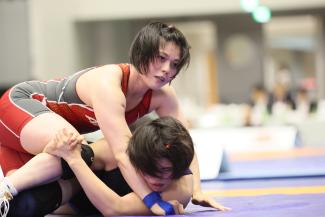
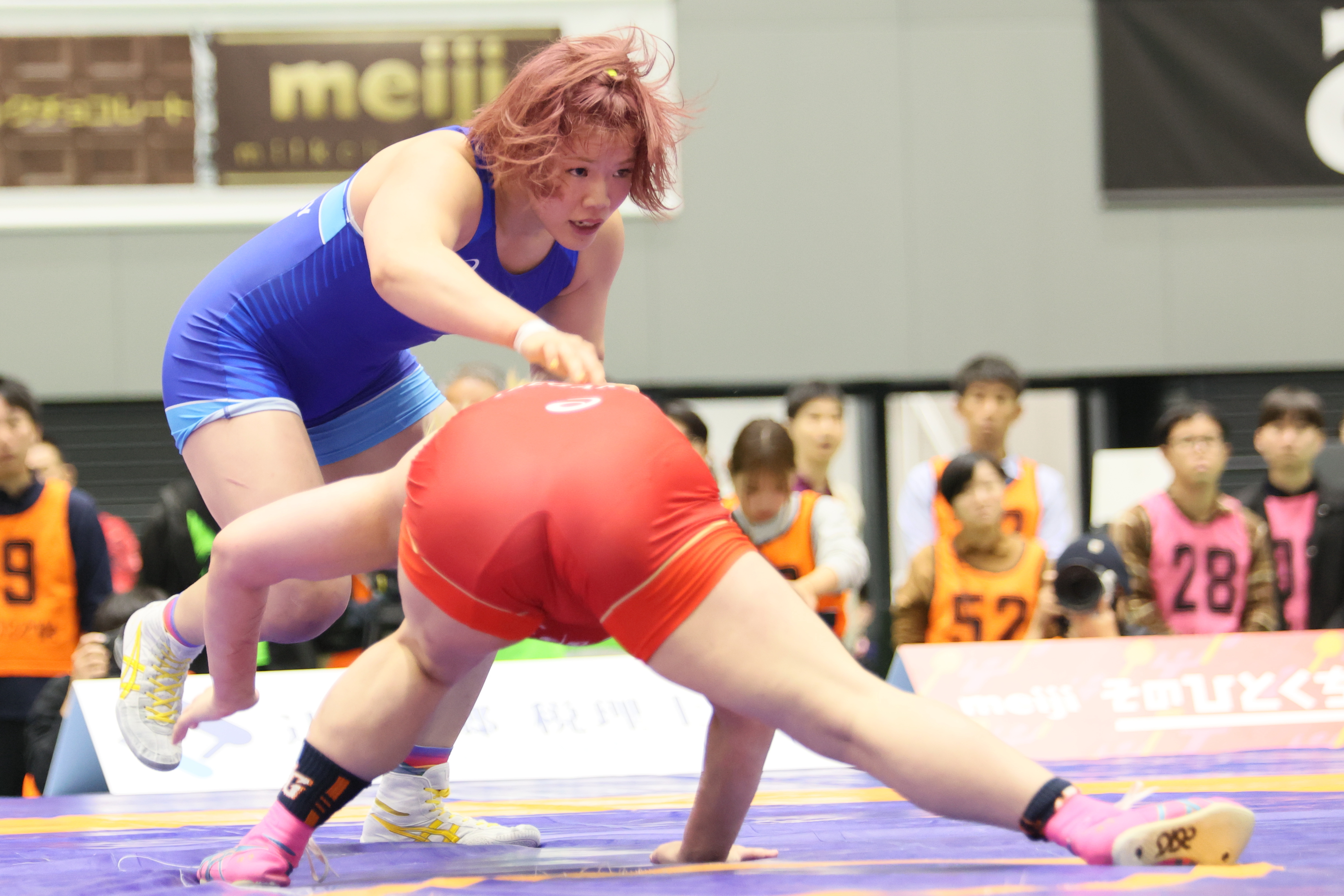 Yuka KAGAMI (JPN) reached the 76kg final at the Meiji Cup. (Photo: wrestling-spirits.jp / Takeo Yabuki)
Share your thoughts.
Comments