

Dosho Earns Shot at Olympic Repeat With Win in Japan Team Playoff
Monday, March 9, 2020 - 13:33 By Ken Marantz

TOKYO (March 8)—Having stuck it out through trying times since her triumph in Rio four years ago, Sara DOSHO (JPN) finally assured that she will be able to defend her Olympic crown at this summer's Tokyo Games.
Dosho edged world junior champion Miwa MORIKAWA (JPN) 3-1 in a special playoff to fill the Olympic spot at 68kg that she herself secured for Japan by placing fifth at last year's World Championships in Nur-Sultan. Morikawa had forced the playoff by winning the All-Japan title last December, where she defeated Dosho 9-2 in the semifinals.
"I had a lot of injuries, but I was able to come back and be here today," Dosho said. "I want to be completely healthy for the Tokyo Olympics and wrestling at a high level. From the time I won in Rio, my aim was to win again in Tokyo. That has not changed. I'll do what I can to make that happen."
Meanwhile, Keisuke OTOGURO (JPN) will join younger brother Takuto on Japan's team at Tokyo 2020 after he chalked up a 5-2 victory over Mao OKUI (JPN) at freestyle 74kg in the other playoff held behind closed doors at the National Training Center in Tokyo. Okui had earned Japan's spot by finishing fifth at Nur-Sultan.
Dosho had been through a lot in recent years, most notably missing almost the entire 2018 season after suffering a shoulder injury at the Women's World Cup that required surgery and kept her from defending the world title she won in 2017.
While less dominant than before, Dosho managed to win the national tournaments that earned her a ticket to Nur-Sultan, but she lost in the quarterfinals to Tamyra MENSAH (USA) and the bronze-medal match to Anna SCHELL (GER).

Sara DOSHO (JPN) defeated Miwa MORIKAWA (JPN) 3-1 and will represent Japan at the Olympic Games at 68kg. (Photo: ©JWF/Sachiko HOTAKA)
According to Japan federation criteria, any Japanese winning a medal in an Olympic weight in Nur-Sultan automatically filled the berth for Tokyo 2020. Fifth-place finishers could secure the spot by winning the ensuing All-Japan Championships, also referred to as the Emperor's Cup. A loss there set up a playoff with the Emperor's Cup champion for the Tokyo 2020 ticket.
Of the three fifth-place finishers, only Takuto Otoguro followed up with a victory at the Emperor's Cup. Dosho and Okui both went down to defeat, setting up the playoffs.
The wrestle-offs were originally scheduled for Feb. 1, but were postponed when both Keisuke Otoguro and Dosho suffered injuries.
Dosho, 25, said she injured her knee in January and did not restart full-fledged practice until mid-February, and she seemed to need every ounce of energy to hold off the 20-year-old Morikawa.
There was little action in the first period, with Dosho scoring the lone point from the activity clock. Dosho padded her lead early in the second, countering a single-leg attempt by Morikawa and working around behind for 2.

Sara DOSHO (JPN) gets coached by fellow Rio Olympic champions Eri TOSAKA (JPN) and Risako KAWAI (JPN) (Photo: ©JWF/Sachiko HOTAKA)
"My main weapon is my tackle, but in my head, I was hesitant to launch attacks," Dosho said. "The way the match went, it turned out to be a good thing. I can't say it went as a I planned because I didn't get any tackles, but I worked in practice on putting pressure on the opponent and using counters, and that went well."
Morikawa, who is coached at Nippon Sports Science University by four-time Olympic champion Kaori ICHO and 2008 Olympic silver medalist Kenichi YUMOTO, kept up the attack, and it nearly paid off. She launched a driving double-leg tackle that forced Dosho backward, but was only able to gain a 1-point stepout for the effort.
"If I moved in the first period like I did in the second, it might have changed the flow of the match," Morikawa said. "At first, I thought I could get her to use up her energy, but she ties up well and she's strong. I kept attacking, but my opponent's defense was stiff, and I couldn't finish it off. It's good to keep attacking, but if you don't get points, you won't do well overseas or in Japan."
Before her surprisingly one-sided loss at the Emperor's Cup, Dosho had faced Morikawa three times—all while Morikawa was still a high schooler—and won all three by technical falls. It was certainly a much-improved and matured version with whom she now had to contend.
"Up until recently, I would beat her by technical falls," Dosho said. "But she really got strong and made it a tough match."
As precautionary measures against the new coronavirus, only Japan federation officials and accompanying team personnel were allowed into the NTC wrestling room where the playoffs were held. Even family members were barred. The media had to watch a livestream of the matches via Twitter or Instagram in the pressroom of the nearby soccer stadium. The wrestlers were later brought in one by one for interviews.
Given the limitations, it was interesting to note that all four women's Olympic champions from Rio were involved in the playoff. In Dosho's corner were 48kg gold medalist Eri TOSAKA (JPN) and 63kg winner Risako KAWAI (JPN), who has qualified for Tokyo 2020 at 57kg by winning the world title. On the opposite side of the mat, Icho, the Rio gold medalist at 58kg, was supporting Morikawa.
Dosho, Tosaka and Kawai all have a connection as products of powerhouse Shigakkan University. Dosho said Tosaka's advice before the match was simple: "Have confidence, and don't let your opponent dictate the pace of the match."
Of the four Rio champions, only Kawai and Dosho will be able to attempt a golden repeat. Tosaka failed to make it to the qualifiers at 50kg, while Icho lost out to Kawai, who set up a clash of Olympic champions by moving down to 57kg.
"I feel I can finally relax," Dosho said. "I lost at the World Championships, then I lost at the Emperor's Cup. This would have been the end. I staked everything on this and came into today looking at it as a challenge."

Keisuke OTOGURO (JPN) celebrates after beating Mao OKUI (JPN), 5-2, in a special 74kg Olympic wrestle-off. (Photo: ©JWF/Sachiko HOTAKA)
Otoguro Makes Tokyo 2020 a Family Affair
Although the older of the two, Keisuke Otoguro has had to yield the spotlight to brother Takuto, who in 2018 became at 19 Japan's youngest-ever world freestyle champion by winning the 65kg title. Keisuke was also at those World Championships in Budapest, but was ousted in the first round at 70kg.
On Sunday, it was Keisuke's turn to shine, and he did it with help from his family—in this case, his father. While dad was not allowed to watch the match in person, he met with Otoguro before it and offered some advice that would pay off.
As with the women's match to follow, the clash between Otoguro and Okui—who are teammates at the Self-Defense Forces Training School—featured little action in the first period as both remained tentative, and the only scoring was an activity clock point awarded to Otoguro.
Okui, who was hampered by a severe knee injury suffered a month ago, went on the attack in the second period. But he was halted on a fireman's carry attempt, and Otoguro was able to spin behind for a takedown.
From the ground position, Otoguro recalled his father's words and, while pinning one of Okui's leg behind him, gained an arm and body lock that allowed him to lever him over for an eventual roll and a 5-0 lead.
"I thought I could turn him," Otoguro said. "Before the match, I met my father, who wasn't allowed into the match, at the entrance. He said to me that I would probably be able to use that move. Even though he just kind of mentioned it off hand, that was in my head as I fought. I got in that position and I was able to turn him.
"I might have used a different move and it might have changed the outcome of the match. I'm glad we had that chat."

Keisuke OTOGURO (JPN) stops a Mao OKUI (JPN) shot in the 74kg special wrestle-off. (Photo: ©JWF/Sachiko HOTAKA)
Okui closed the gap with a single-leg takedown in the final minute, but Otoguro held off later attempts to clinch the win.
The Otoguros will become the first brothers to compete at the same Olympics for Japan since Yumoto and his twin brother Shinichi made the squad for the 2012 London Olympics. Shinichi joined Kenichi as an Olympic medalist at those Games with a bronze at 55kg. Japan will also have a female sibling combination at Tokyo 2020 with Risako and Yukako Kawai.
"Since we were young, we've had a dream of winning the Olympics together," Otoguro said. "At this New Year's, we were reaffirmed our determination to go to the Olympics together, and next, that we will both win gold medals."
Otoguro, who had won national titles at 61kg in 2015 and 70kg in 2017, purposely moved up to 74kg last year in a bid to make the Olympics. It didn't go so well at first. In the second qualifying tournament for the 2019 World Championships, the All-Japan Invitational Championships (Meiji Cup), he lost in the first round. The unheralded Okui won that tournament and earned the ticket to Nur-Sultan, then pulled a surprise by making it to the semifinals and clinching the Olympic spot.
But Otoguro was not discouraged, and came back the following December to win the Emperor's Cup and set up the playoff with Okui.
"A year ago at this time, I didn't get the qualification at the Meiji Cup," Otoguro said. "I stayed calm, and I set my target to meet the standard at the Emperor's Cup. It worked out, and then I could go for the Tokyo Olympics."
Otoguro said it was awkward preparing for the big match in the same wrestling room as his opponent, even though the two had their own training regimens.
"We practice in the same place and our [dormitory] rooms are next to each other, so it made it difficult," Otoguro said. "But we were able to stay separate and keep our focus, as you need to do when everything is on the line. The coaches allowed us to put together a training schedule that best fits us. We prepared separately for this match in our own way."
Okui suffered an anterior cruciate ligament injury that will likely require surgery, but said that was not the cause of his defeat. "I decided that I would wrestle, and I don't want to use that as an excuse," he said. "I thought I had to win however I can, but midway through, I panicked a bit and that led to this result. If I had stayed calmer..."
For his part, he wishes Otoguro well at the Olympics. "I want Keisuke to win the gold medal for us," he said.
Talking about calm, Otoguro said he is not the type to feel pressure and was quite relaxed before the match; Takuto, he said, was "more nervous that me" and was the one who couldn't sleep until 2 a.m.
"I suppose there was a lot of pressure, but I'm the type that doesn't feel it," Keisuke said. "When I woke up this morning, I felt, 'I have a match today, don't I?' After I arrived here, while I was warming up, I felt, 'Yeah, I have a match.' I wasn't feeling nervous."
Otoguro, however, said he started feeling nerves about 10 days ago, mostly because of all the attention he was receiving from those around him. He said it darkened the mood.
"Ten days ago, everyone was saying, 'good luck' and 'we're counting on you,'" Otoguro said. "It subconsciously put pressure on me. At one point, I lost my desire. I was like, who cares about wrestling? But I took some time off, and remembered all I had accomplished since I was little. The hunger came back."
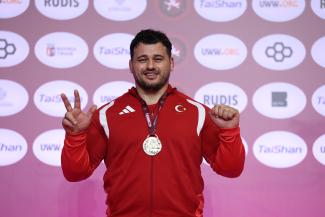
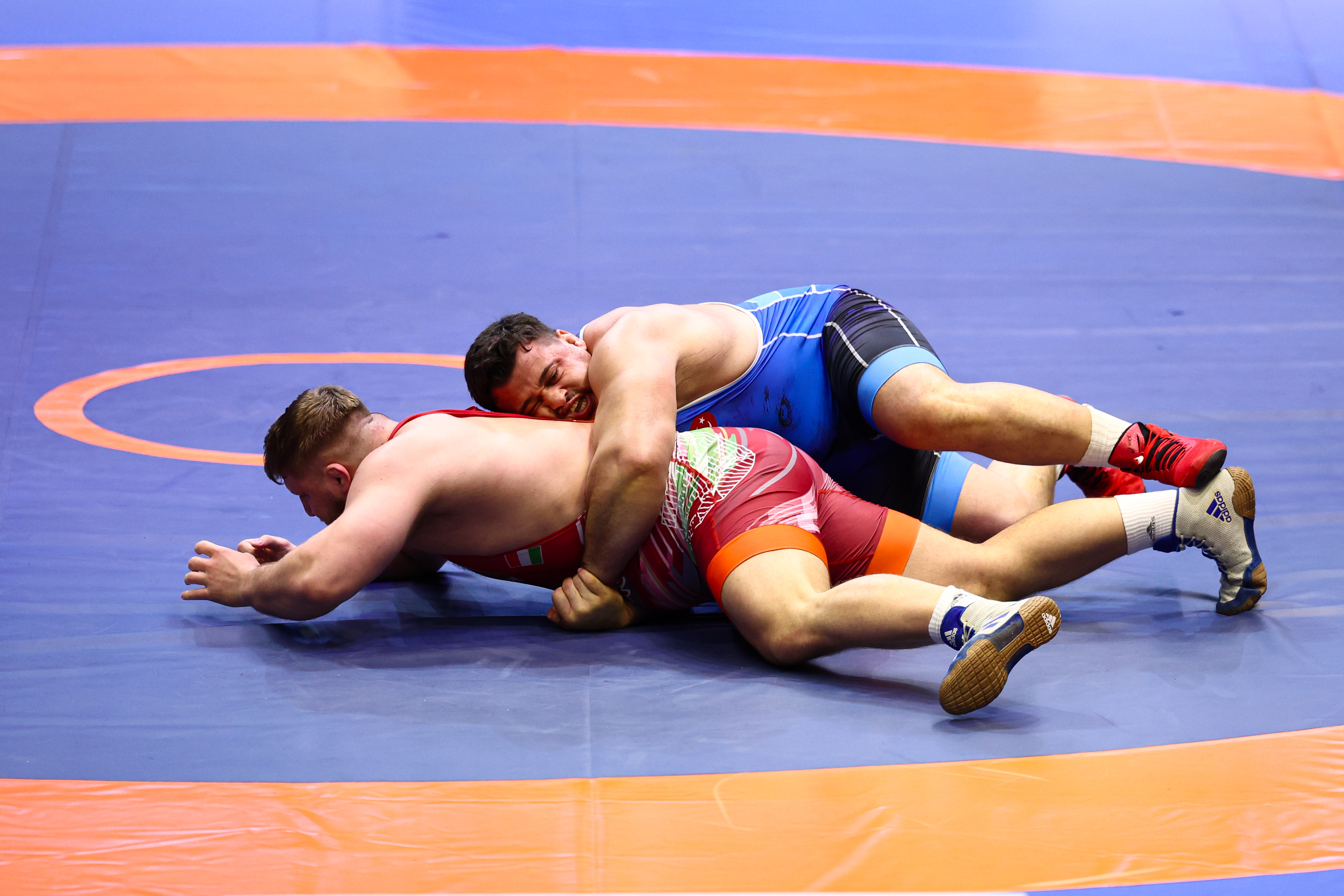 Riza KAYAALP (TUR) turns Darius VITEK (HUN) in the 130kg final. (Photo: United World Wrestling / Kadir Caliskan)
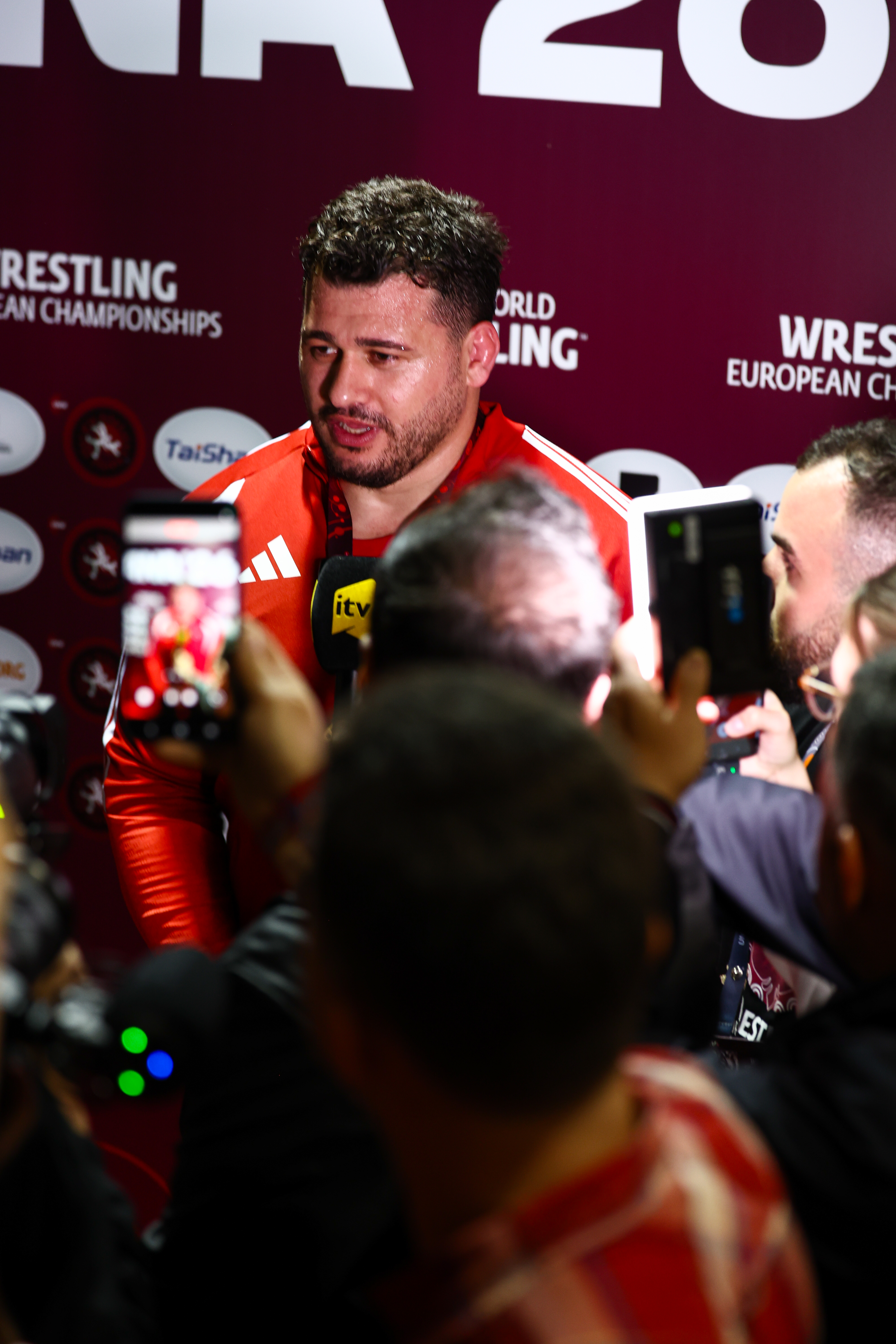 Riza KAYAALP (TUR) speaks to the media after winning the gold medal at the European Championships. (United World Wrestling / Jake Kirkman)
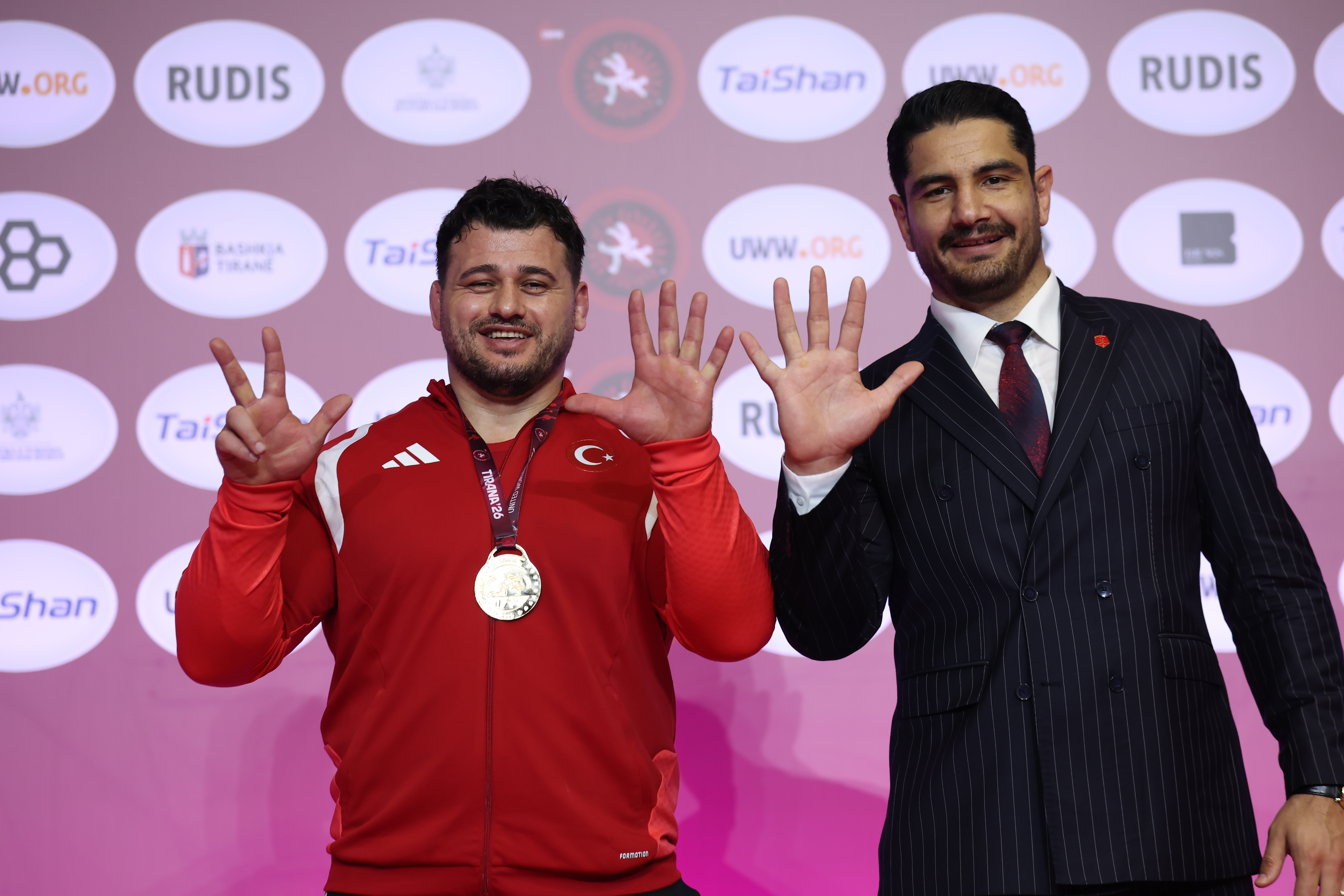 Riza KAYAALP (TUR) with Taha AKGUL (TUR) at the medal ceremony in Tirana. (Photo: United World Wrestling / Kadir Caliskan)
Share your thoughts.
Comments