ATHENS, Greece (July 30) -- Women's Wrestling will kick off at the World U17 Championships with 43kg, 49kg, 57kg, 65kg and 73kg.
WATCH LIVE | LIVE MATCH ORDER | DAY 2 RESULTS
The semifinals will begin at 17:00 hours local time and the medal bouts in Greco-Roman will begin at 18:00 hours local time.
13:30: Fall for Pan-Am champion Ella Jo POALILLO (USA) over Jolina HEALEY (CAN) at 73kg and she also earns a place in the semifinals. She will take on KAJAL (IND) who also pinned Anna GODELASHVILI (GEO).
13:25: Asia champ vs European champ at 73kg as Wenjin QIU (CHN) takes on Eylem ENGIN (TUR). Qiu gets the first exposure and two points. Engin tries to score a takedown but Qiu keeps the par terre as both go out. Turkiye challenge. Engin gets one point for stepout. Qiu with a slide-by a takedown and 4-1 lead at the break. Head outside for Engin but whizzer from Qiu as she gets two points. Two more points and a palce in the semifinals for Qiu as she wins 8-1
13:18: Morgan TURNER (USA) catches Komal VERMA (IND) in a laces and turns her to complete a 10-0 win and enter the 49kg semifinals.
13:15: Feenja HERMANN (GER), European silver medalist, pins Anastasiya KOMANAVA (UWW) at 65kg. Hermann with different techniques to score her points and ultimately gets the fall.
13:11: MONI (IND), the Asian U17 champion at 57kg, needs just 15 seconds to secure a fall over Oana DUMITRU (ROU) and advance to the semifinals. On Mat B, another Asian U17 champion from India, Ashvini VISHNOI (IND) pins Anujin ERKHEMBAATAR (MGL) after a series of takedown to advance to semifinals at 65kg.
13:05: RACHANA (IND) needed some extra effort to see of Mareim ABDELAAL (EGY) 13-2 in their 43kg bout. Rachana is former world U17 silver medalist.
13:03: Asian U17 silver medalist Madkhiya USMANOVA (KAZ) blocks a bodylock throw from Ivanna LUKIANENKO (UKR) and puts her down on the mat for four points and an 11-3 victory at 57kg.
12:58:Madison HEALEY (USA) broke down Sayuki HIBARINO (JPN) and then used the arm-bar to get the fall over Hibarino at 43kg. That is the first loss for Japan in Women's today.
12:55: Ella Jo POALILLO (USA), Pan-Am champion, gets the fall at 73kg over Uranzaya TSERENNYAM (MGL). Excellent offense from Paolillo to get points before securing the fall.
12:50: KAJAL (IND), a world champion from 69kg last year, now moves into the quarterfinals at 73kg with a fall over Claudia MANTOG (ROU) with a double-leg attack. She had a 12-0 before securing the fall.
12:45: A rematch from European U17 Championships final, Eylem ENGIN (TUR) beats Khrystyna DEMCHUK (UKR) again at 73kg. Engin with top position and doesn't allow Demchuk to get behind.
12:40: Former world U17 champion Morgan TURNER (USA) with a crafty fall over Saniya SOLTANGALI (KAZ). Turner had her literally perpendicular to the mat. She advances at 49kg.
12:22: European U17 silver medalist Feenja HERMANN (GER) lets out a scream as she blanks Sophia ANASTASE (ROU) 7-0 in their 65kg bout. Hermann looking for a medal at Worlds after finishing 7th last year.
12:20: Dimitra SKOUVAKI (GRE) wins a small regional rivalry battle against Melike KOPARAN (TUR) 4-2 and the local crowd is ecstatic after the win over their neighbouring country.
12:10: Alexandra MOISEI (MDA) gets the fall over Pan-Am champ Violette LASURE (USA) at 65kg. Great throw from Moisei and she held Lasure on the mat.
12:05: A takedown from Sayuki TANADA (JPN) with 0.20 left on the clock as she beats Emma BACON (USA) 5-3 in their 57kg bout. Tanada was leading 2-2 on criteria but Bacon scored a stepout with 15 seconds left. Tanada with a leg attack and just randomly threw Bacon to get exposure and the win.
11:50: European champion Raniia RAKHMANOVA (UWW) with a hard-working 12-2 technical superiority win over Nurana ASADLI (UWW) at 43kg.
11:42: In a battle between two wrestlers at 57kg who finished fifth at the European U17 Championships, Nini TSITSVIDZE (GEO) scores six points to beat Oona PEKKARINEN (FIN) 6-4
11:30: At 43kg, China, Japan and India wrestlers on the mat and all of them show their higher skills. Xin HUANG (CHN) beats Natalia TERZI (MDA), 10-0, in a minute and 54 seconds, Sayuki HIBARINO (JPN) wins 10-0 in two minutes and 30 seconds against Aiza TAALAIBEKOVA (KGZ) and RACHANA (IND) pins Mariza NASU (CAN).
11:25: World U17 champion at 69kg KAJAL (IND), who won silver at Asian U17 in Vietnam and added an Asian U20 title in Bishkek recently, pins Bianka BARANY ALMASI (HUN) in 25 seconds at 73kg.
11:20: Sayuki TANADA (JPN) with that lethal Japanese leg lace as she beats Albina SALYMBEKOVA (KGZ) 11-0 at 57kg
11:10: European U17 champion Anastasiya KOMANAVA (UWW) is tested by Sofiia ALFOROVA (UKR) in the 65kg bout but Komanava gets activity points along with her technical ones to win 4-0.
11:05: A mismatch at 65kg as two-time Asian U17 champion Ashvini VISHNOI (IND) laces Selsabil ROUABAH (ALG) to win her 65kg bout in just 46 seconds.
10:55: Marta MANKOWSKA (POL) held her own for a few minutes against Asian U17 champion MONI (IND) who ultimately breaks Mankowska with two takedowns and wins the opening bout at 57kg 5-1.
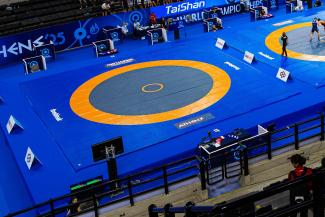
10:30: Welcome to day three of the World U17 Championships and soon after the repechage in Greco-Roman, the Women's Wrestling bout will begin in five weight classes.



Share your thoughts.
Comments