TOKYO (May 21) -- They both were returning to the mat for the first time since winning gold medals at the 2024 Paris Olympics, and both moved up a weight class, for now, with the next Olympic qualifiers still far off.
And each was watched and cheered on for the first time by their most precious fan.
Kenichiro FUMITA and Rei HIGUCHI shook off the rust and emerged unscathed on Thursday to advance to their respective finals at the Meiji Cup All-Japan Invitational Championships at Tokyo's Komazawa Gym.
Fumita, the Paris gold medalist at Greco 60kg, handily won two matches to secure a spot in the 63kg final on Friday, where he will face 2025 world team member Manato NAKAMURA in a bid for his first Meiji Cup title since 2022 and fifth overall.
Higuchi, who struck gold in Paris at freestyle 57kg, needed three wins to set up a showdown in the 61kg final with defending champion and former world bronze medalist Toshihiro HASEGAWA.
Arash YOSHIDA, coming off winning a second straight freestyle 97kg gold at the Asian Championships, also advanced to the finals on the opening day of the four-day Meiji Cup, which is serving as the second of two domestic qualifiers for both this year's World Championships and, in the Olympic weight classes, the Asian Games that will be hosted by Japan.
Winners from the first qualifier, the Emperor's Cup All-Japan Championships held in December, can clinch a spot with a victory at the Meiji Cup; if the two champions are different, a playoff will be held at the end of the day.
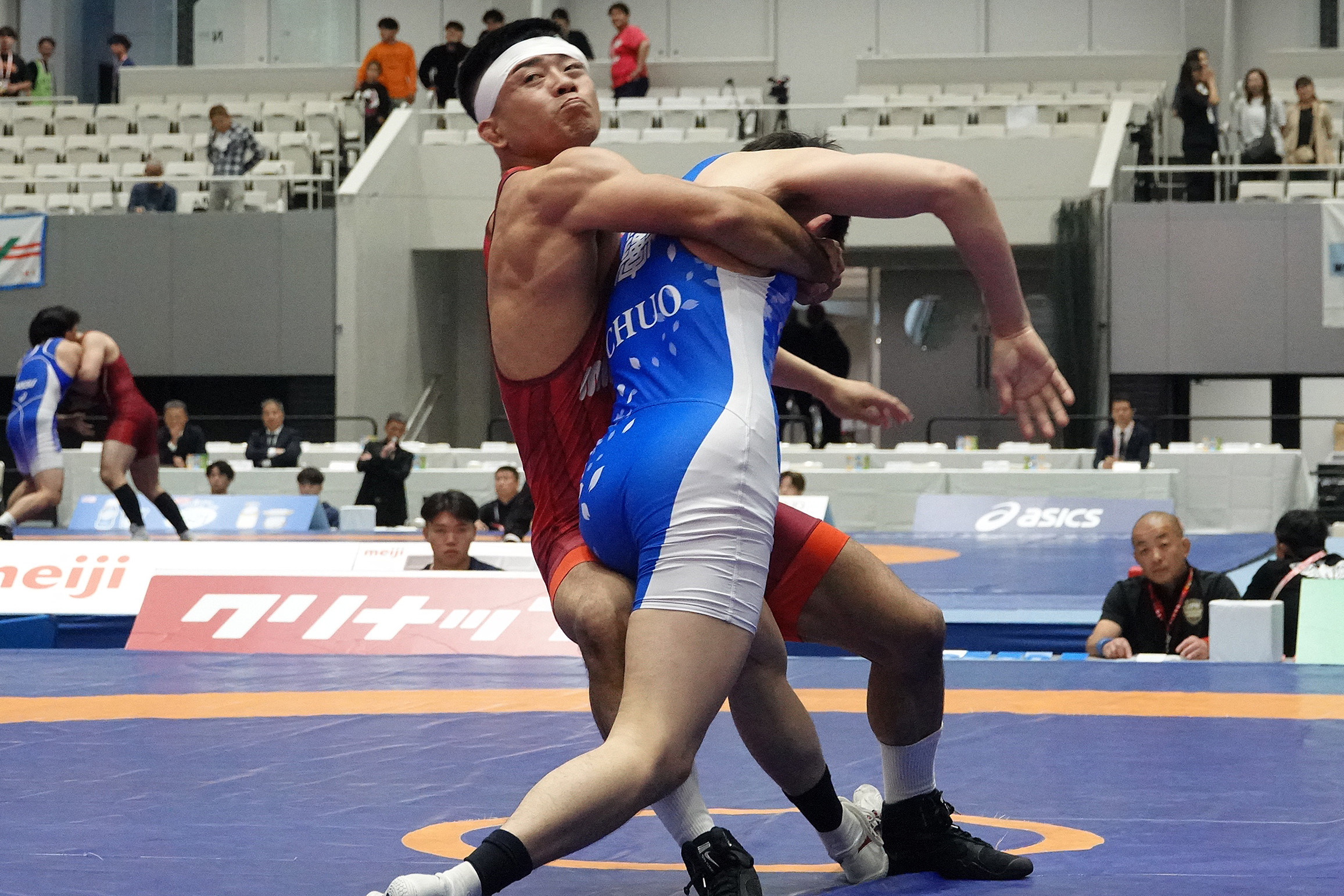 Kenichiro FUMITA (JPN) hits a four-point throw in his round one bout. (Photo: wrestling-spirits.jp / Ikuo Higuchi)
Fumita, the Tokyo Olympic silver medalist and two-time world champion, had planned to return to competition at the Emperor's Cup, but was forced to withdraw due to injury.
As for the move up to 63kg, he said, "Looking at the competitions and my own personal objectives, and my current physical ability, I decided to enter at 63kg. I've really on been on edge up to this point leading up to the competition. It's quite a few years since I've had a match at Komazawa. But I feel great, and was able to enjoy myself."
The return from a long layoff can be as testing mentally as it is physically, and Fumita used the experiences of others to guide him through it.
"I thought I would feel more pressure," said Fumita, who advanced to the final with a 7-1 victory over Kensho NATAMI in the semifinals. "After Paris, I watched [fellow gold medalists] Kotaro [KIYOOKA] and Nao [KUSAKA] up close before their [comeback] matches, and both said they were very nervous.
"Having seen that, it gave me an image of what to expect. I stayed calm and, staying aware of what was going on around me, I felt I was able to control the matches."
Helping calm his nerves was the lilty voice of a child clearly heard amid the sparse crowd on the opening day as she yelled, "Papa, ganbatte (fight hard)!" For the first time, the oldest of his two
daughters, now 3, was old enough to see him compete and understand what he was doing.
Fumita related the emotions he went through seeing fellow Nippon Sport Science University alumnus Shota TANOKURA being inspired by his son loudly yelling that set phrase as he ended his career at the Meiji Cup two years ago.
"I was very moved seeing how he responded," Fumita said. "To continue my career and win with my children with me is really a special feeling. Here, I am wholeheartedly determined to perform for them."
Fumita said there are still aspects of his job about which his daughter is blissfully oblivious.
"Sometimes I take [my daughter] to practice. For her, it is really a fun place. So she thinks I go to a fun place every day and I'm just someone who plays all the time," he said with a laugh.
Fumita already has a memento from his first competition in over two years -- a gash over his left eye that was treated with tape wrapped around his head.
"It happens a lot in practice and in matches," Fumita said. "I have many photos of me in the past with my head taped. It gave me a feeling of going back to my roots, which I thought was great."
Higuchi, who like Fumita is 30, an alumnus of NSSU and is sponsored by children's clothing giant Miki House, was wrestling for the first time in front of his 2-year-old daughter (and like Fumita, he has a second infant daughter).
"She kind of knows what's going on," said Higuchi, who defeated world U23 bronze medalist Akito MUKAIDA 12-1 in the semifinals.
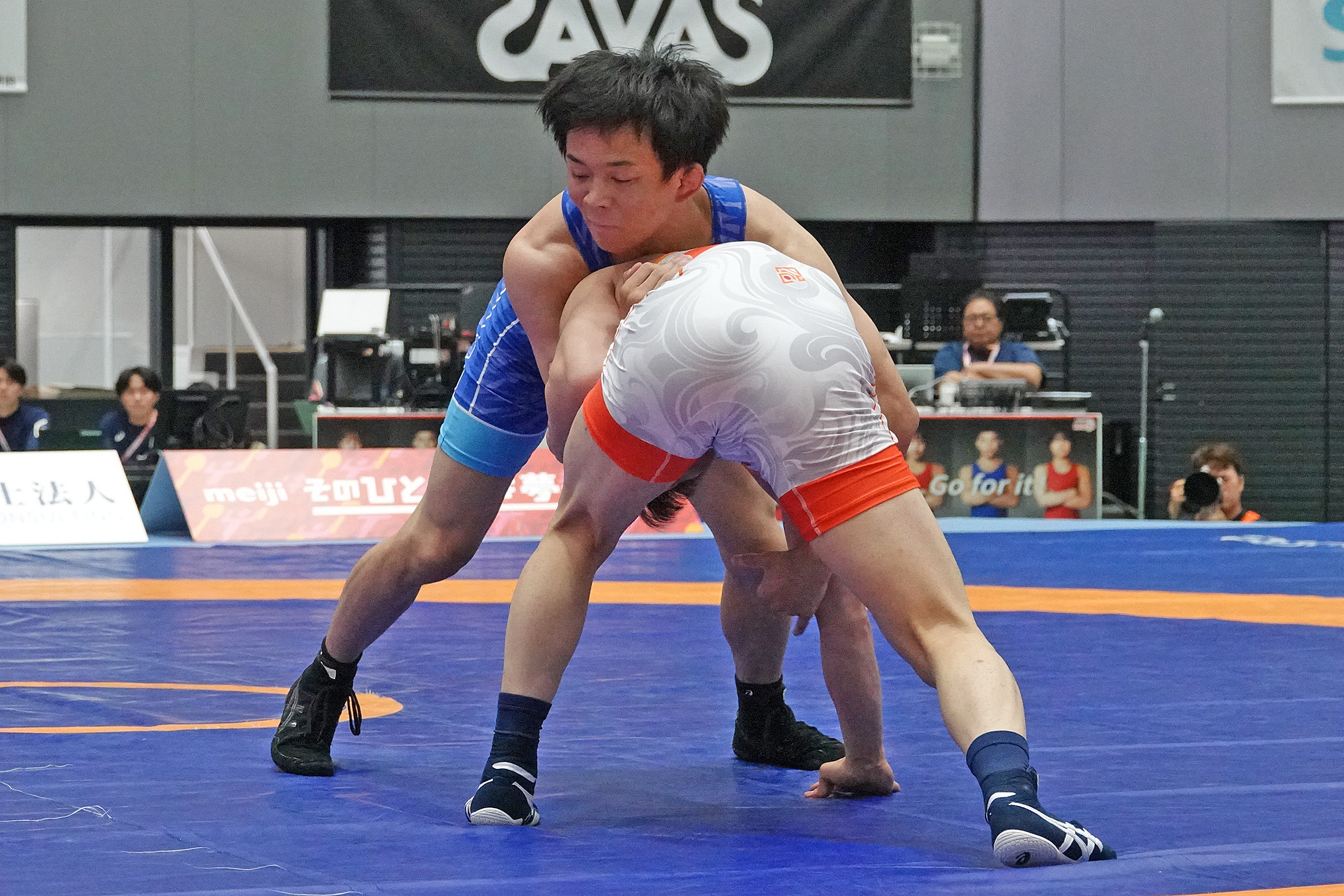 Rei HIGUCHI (JPN) reached the 61kg final at the Meiji Cup. (Photo: wrestling-spirits.jp / Ikuo Higuchi)
For Higuchi, a battle with weight loss proved more daunting than any opponent he faced on the mat on Friday. He normally should have had no trouble making weight at 61kg, but said he didn't manage it correctly.
"It was my first competition in awhile, and my preparation did not go so well," he said. "There are parts that I have to work on. All went well in practice, but I need to do better at conditioning and cutting weight or I won't be able to win out in December [at the Emperor's Cup]."
A notoriously slow starter, Higuchi said he gradually began to find his groove, culminating in his one-sided win over Mukaida.
"My first match, my movement was not very good," he said. "The water loss as a I cut weight didn't go so well either, so the first and second matches were touch and go.
"During the second match, I was able to get in gear. In the third match in the semifinals, my opponent was third at the world U23, which normally should have been a close match. But I was able to put on a fairly good performance, which I give a grade of 80 [out of 100]."
Higuchi is looking forward to mixing it up with another high-level opponent, one he knows quite well. Hasegawa is yet another NSSU alumnus who still trains at the facility.
"From an emotional viewpoint, I was really excited about facing tough opponents," Higuchi said. "Tomorrow, Hasegawa is world-class wrestler. I don't know if I will win or lose, but I'm really happy to be able to have such a showdown on this big stage."
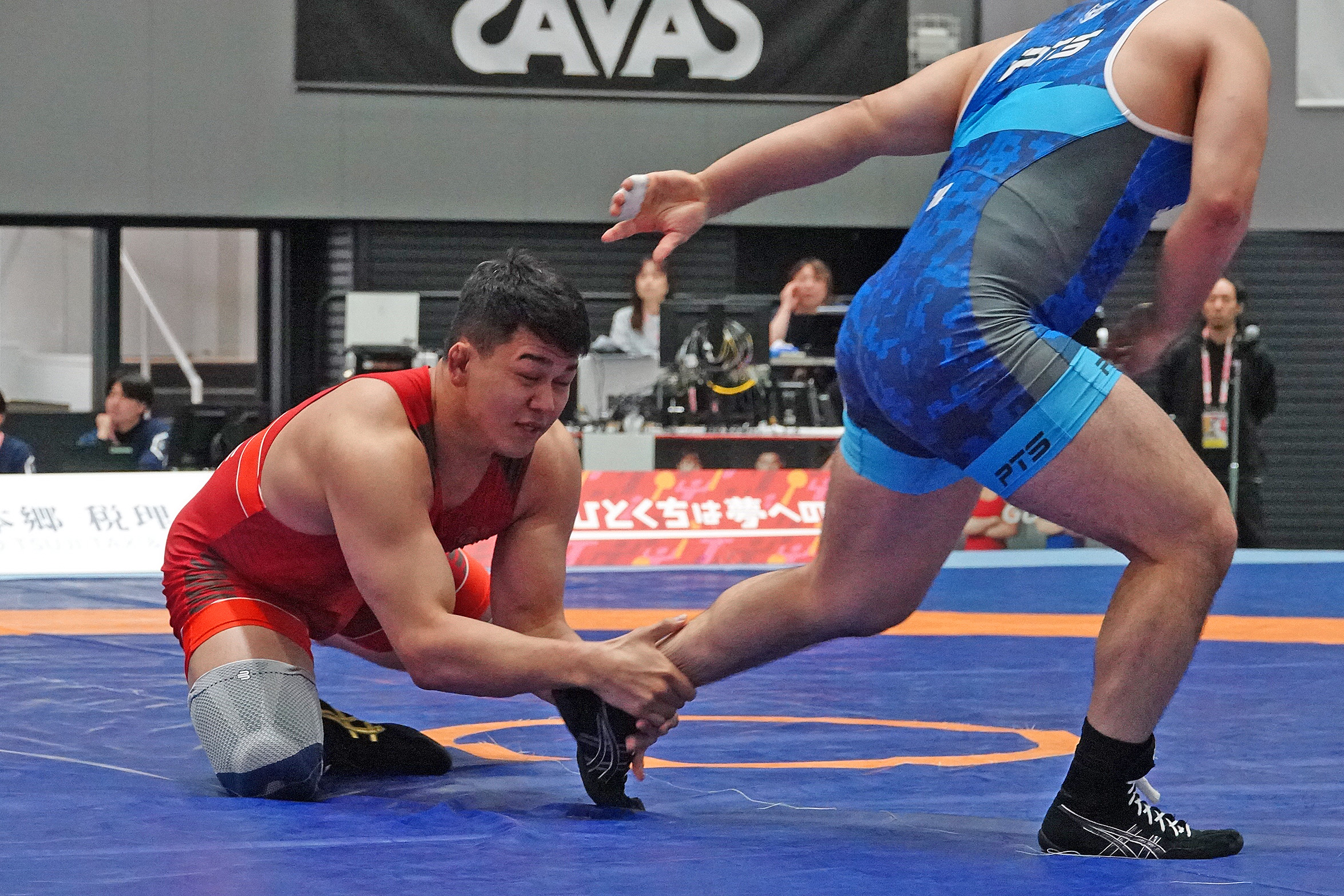 Asian champion Arash YOSHIDA (JPN) returned to the final of Meiji Cup at 97kg. (Photo: wrestling-spirits.jp / Ikuo Higuchi)
At 97kg, defending champion Yoshida stormed to a pair of 10-0 victories, defeating Satoshi MIURA, a 2025 world U23 bronze medalist at 86kg, in the semifinals to advance to the final against teenager Noah LEIBOWITZ.
The final will be a repeat of the gold-medal match at the Emperor's Cup, which Yoshida won 11-0.
Leibowitz is now a freshman at Nihon University, from which Yoshida just graduated in March. Since then, he began living on his own for the first time.
"I have to prepare my own meals," Yoshida said on how his life has changed. "Instead of always being with a group, I am living a life on my own. My father brings over dinner every Friday, but other than that, I prepare it myself. My specialty is pork kimchi; actually that's all I can make."
Meanwhile, Taishi NARIKUNI, who attempted a rare freestyle-Greco double at the Asian Championships in Bishkek, advanced to the freestyle 70kg final, where he will face collegiate champion Yuma TOMIYAMA.
In women's action, world U20 bronze medalist Shirin TAKEMOTO pulled an upset of sorts at 72kg, knocking off Asian silver medalist Mahiro YOSHITAKE 11-6 in the semifinals. She will face Chisato YOSHIDA in the final.
At 65kg, Asian silver medalist Nana IKEHATA scored a takedown and stepout in the final 1:10 to edge Misuzu ENAMOTO 4-3 and set up a gold-medal clash with Hiyori MOTOKI, the younger sister of Paris Olympic champion Sakura MOTOKI.



Share your thoughts.
Comments