

stadiums

China Builds 47 Million Euro Wrestling Stadium in Senegal

By BBC News

DAKAR, Senegal (July 26) -- Senegalese President Macky Sall and his Chinese counterpart, Xi Jinping, inaugurated a national wrestling arena in Dakar this week in a project funded by the Chinese government.

The first arena dedicated to this popular sport in Senegal, located in the city of Pikine, near Dakar, was inaugurated Sunday, the second day of the visit of the Chinese leader in the Senegalese capital.

Xi Jinping, on a state visit to Senegal, symbolically handed Macky Sall the keys of the national arena of Pikine wrestling, during a ceremony marked by a wrestling matches and dancing.

The new arena, built in 28 months by the Chinese, cost 48.7 million euros and was paid for by the Chinese government. The stadium has a capacity of more than 20,000 places.

"The national arena fills a gap for wrestling," Senegalese Sports Minister Matar Ba was quoted by Agence France-Presse as saying.

According to Mr. Bâ the arena can accommodate other sports such as boxing and martial arts, but also socio-educational activities, such as concerts.

The national arena was always a point of concern for Senegalese wrestling professionals, who were forced to organize their competitions in football stadiums.

Lutte Senegalese is the most popular sport in the nations and often broadcast live on television, mobilize thousands of spectators and sponsors, with payment to wrestlers often reaching tens of thousands of euros for a single match.

(This story originally ran in French on the BBC, here)
#development

Road to Dakar 2026 Continues with Successful Central Africa Programme in Brazzaville

By United World Wrestling Press

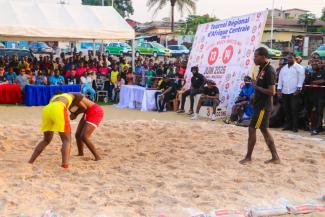
BRAZZAVILLE, Republic of Congo (June 21) -- The second stop of the United World Wrestling (UWW) Africa Regional Educational Development Programme, Road to Dakar 2026, concluded successfully in Brazzaville after a week combining athlete preparation, education, technical development and competition in Olympic and Beach Wrestling.

Held from June 8 to 14 in the Republic of Congo, the Central Africa phase brought together National Olympic Committees and National Federations from across the region under a unified objective: strengthening wrestling ecosystems and creating more accessible pathways toward the Youth Olympic Games Dakar 2026.

As the second of four regional tournaments scheduled within the continental Road to Dakar programme, the event represented another important milestone on the road to the first Olympic event to be hosted on African soil.

Africa REDT

The UWW Africa Regional Educational Development Programme was designed as a comprehensive and sustainable model that extends beyond competition. The initiative combines athlete development camps, coach and referee education, and practical competition opportunities.

By decentralising activities across regions and consolidating training and competition into one structure, the programme aims to reduce financial barriers for national federations and increase opportunities for athletes and technical officials.

Throughout the week, athletes participated in intensive daily training sessions, as coaches attended the UWW Technical Course - Level 2, focused on improving technical knowledge, athlete development methodologies and long-term performance planning.

Africa REDT

Simultaneously, referees took part in dedicated education sessions covering Beach Wrestling and introductory officiating pathways, preparing them for selection to undertake the International Category III referee examination in the future.

The programme concluded with the Regional Tournament, followed by the Beach Wrestling Regional Tournament, giving participants the opportunity to apply lessons learned during the educational phase directly into competition conditions.

The programme specifically prioritised youth development, with participating athletes largely drawn from the U17 age group and encouraging the involvement of emerging coaches across Central Africa. Support mechanisms jointly delivered by UWW and Olympic Solidarity helped facilitate participation through travel, accommodation, training access and tournament organisation.

Africa REDT

More than just a standalone event, Brazzaville demonstrated the long-term vision behind Road to Dakar 2026 by building stronger national structures, expanding participation and creating sustainable development opportunities well before the final qualification stages for the Youth Olympic Games.