ZAGREB, Croatia (September 13) -- With a spectacular display of his old form over two days, Zavur UGUEV (UWW) went from an afterthought back to one of the sport's most dominant wrestlers.
Uguev finessed his way to a third world title and first in six years when he captured the freestyle 61kg gold at the World Championships in Zagreb on Sunday, on the first night of finals in four Freestyle weight classes.
Uguev, the Tokyo Olympic champion at 57kg, rolled to the gold with a comprehensive 11-2 victory in the final over Asian bronze medalist Ahmad JAVAN (IRI), adding to the world titles he won in 2018 and 2019, also at 57kg.
"This is a very joyful event in my life -- I am once again on the top of the podium," Uguev said. "I am very happy and grateful to my team, my coach, my sparring partners, our national team -- thanks to everyone who played a part in my victory."
In other finals, Amir Hossein ZARE (IRI) also became a three-time world champion with his third victory in five years at 125kg, while the two other golds at stake went to first-time winners who had previously made the podium, Yoshinosuke AOYAGI (JPN) at 70kg and Zahid VALENCIA (USA) at 86kg.
Uguev had been the dominant lightweight for the span from his first world title in 2018 to his Olympic triumph in 2021. But then he hit a slump with a fifth-place finish in 2023, a result he repeated in 2024, even after moving up to the non-Olympic weight class of 61kg.
This year, he gave an indication of what might lie ahead when he won his first-ever European title, having previously won a bronze in 2017 and a silver in 2018.
"I didn’t change much," Uguev said. "I just worked on our mistakes, that’s all. We didn’t invent anything new. There were mistakes, we thought them through, corrected them, and this time made only minimal ones."
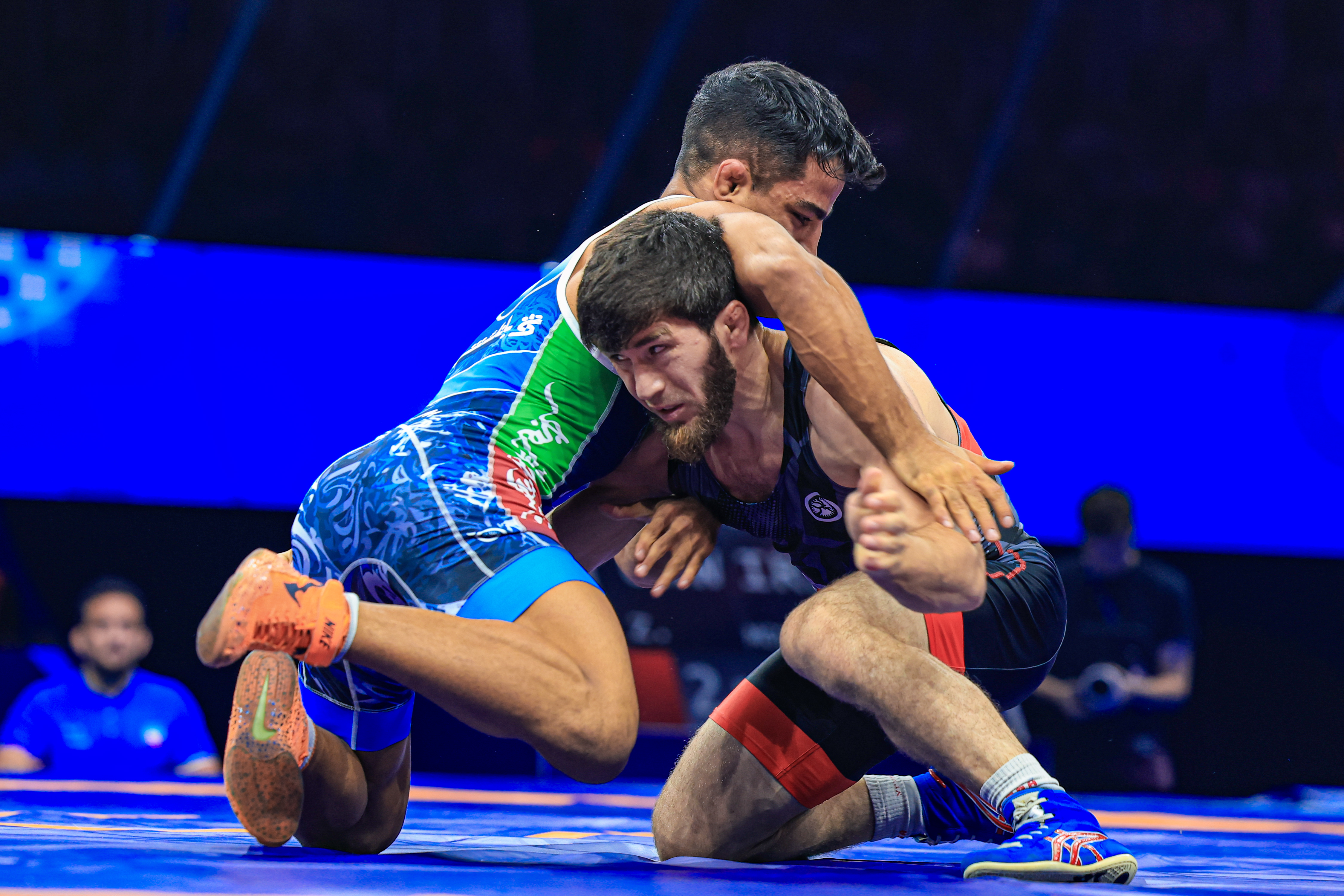 Zavur UGUEV (UWW) tries to score against Ahmad JAVAN (IRI) in the 61kg final. (Photo: United World Wrestling / Amirreza Aliasgari)
Uguev said he welcomes new challengers coming along to try to knock him off the throne again.
"The more new names that appear, the better," he said. "They don’t let us relax. The young wrestlers are improving a lot, and it also makes me want to work harder — to compete with the younger generation."
Regarding a possible return to 57kg, Uguev replied, "I think it’s already clear that I’ve settled into this weight and built up my physique well. I feel comfortable here now, in this weight.
"There’s still time before the [2028] Olympic Games -- we’re not thinking about that yet. For now, there’s a goal for next year. I will work, move only forward. And later we’ll see how things go."
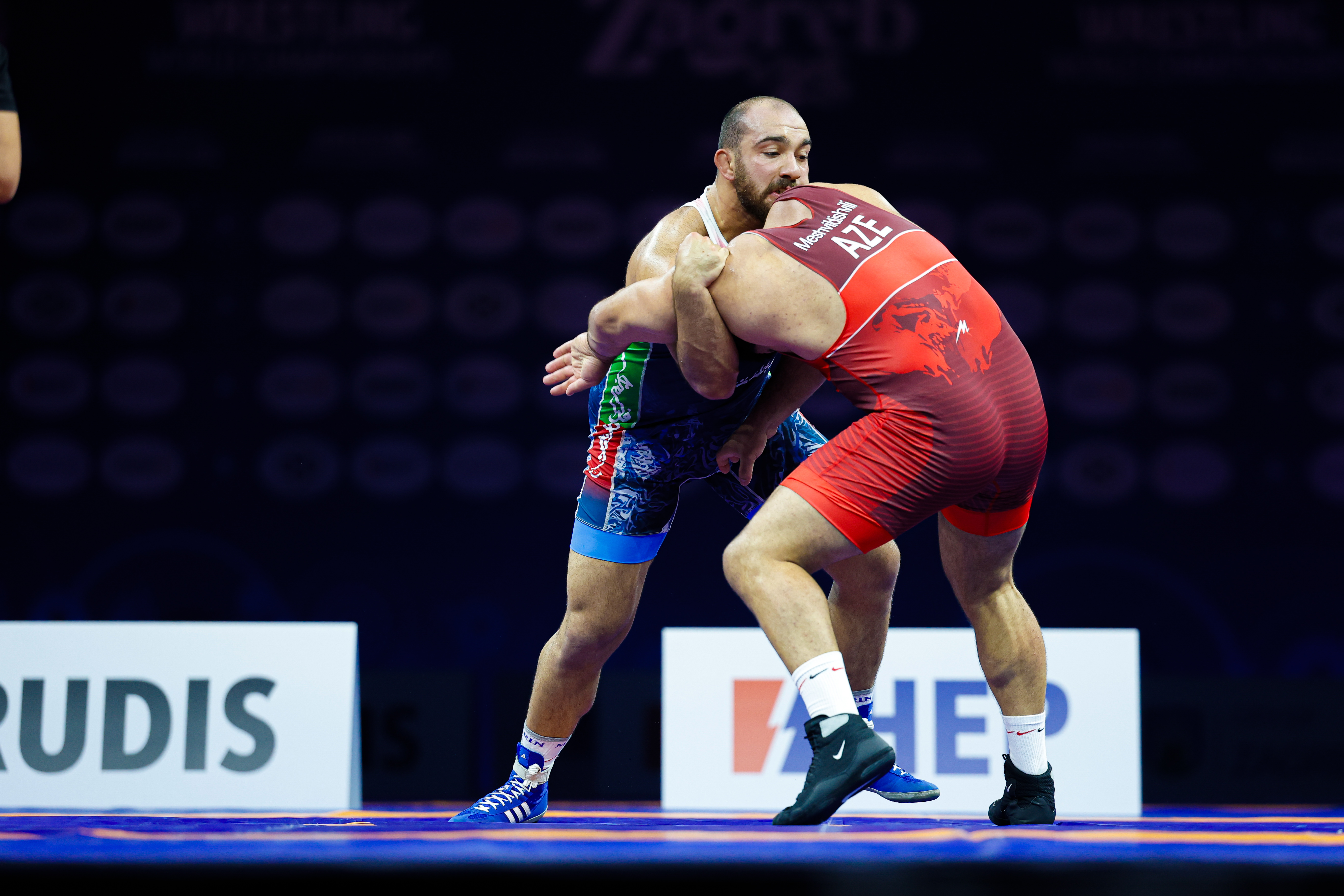 Amir Hossein ZARE (IRI) wrestles Giorgi MESHVILDISHVILI (AZE) in the 125kg final at the World Championships. (Photo: United World Championships / Kostadin Andonov)
At 125kg, Zare reconfirmed himself as the preeminent heavyweight with a 5-0 victory in the final over European champion and Olympic bronze medalist Giorgi MESHVILDISHVILI (AZE), with all of the points coming in the first period.
"I’m thankful that this [winning the title] has happened for the third time now," Zare said. "My hope is that as long as I wrestle, I can keep winning gold medals. This third one feels just as good as the others, and I dedicate it to the people of Iran."
The victory helps alleviate some of the sting of a defeat in the final at the Paris Olympics, where he was dealt a heartbreaking 10-9 loss by Geno PETRASHVILI (GEO).
"That tough experience at the Olympics was really painful, and I’ll never forget it," said Zare, who previously won world titles in 2021 and 2023. "I made mistakes myself. For the last 13 months, I’ve only been focused on training -- so that my next medal would be gold and to make up for those mistakes. I’ll keep grinding, keep pushing, until I get better and finally win that Olympic gold."
Zare also has bronze medals from the 2021 Olympics and 2022 World Championships, as well as a gold from his debut at the Asian Championships last year.
At 70kg, Aoyagi wasn't as dominating as he had been in storming into the final, but he took advantage of the opportunities presented and forged a 5-1 victory over Tulga TUMUR OCHIR (MGL).
"The opponent completely had a strategy to counter my movement, so it made it tough," Aoyagi said. "But I also had a plan for the opponent, so I never thought I would lose."
Aoyagi's victory made up for losing in last year's final, a defeat that caused him to make changes in his approach to training and competition.
"After I lost, I dedicated myself to practice and to expanding my horizons in terms of going different places to train, and going overseas," Aoyagi said.
His overseas ventures resulted in victories at the Ranking Series events in Tirana and Budapest, along with a bronze medal at the Asian Championships, where he lost a close semifinal match to Ernazar AKMATALIEV (KGZ) -- a loss he avenged in spades in his opening match in Zagreb en route to outscoring four opponents 34-1.
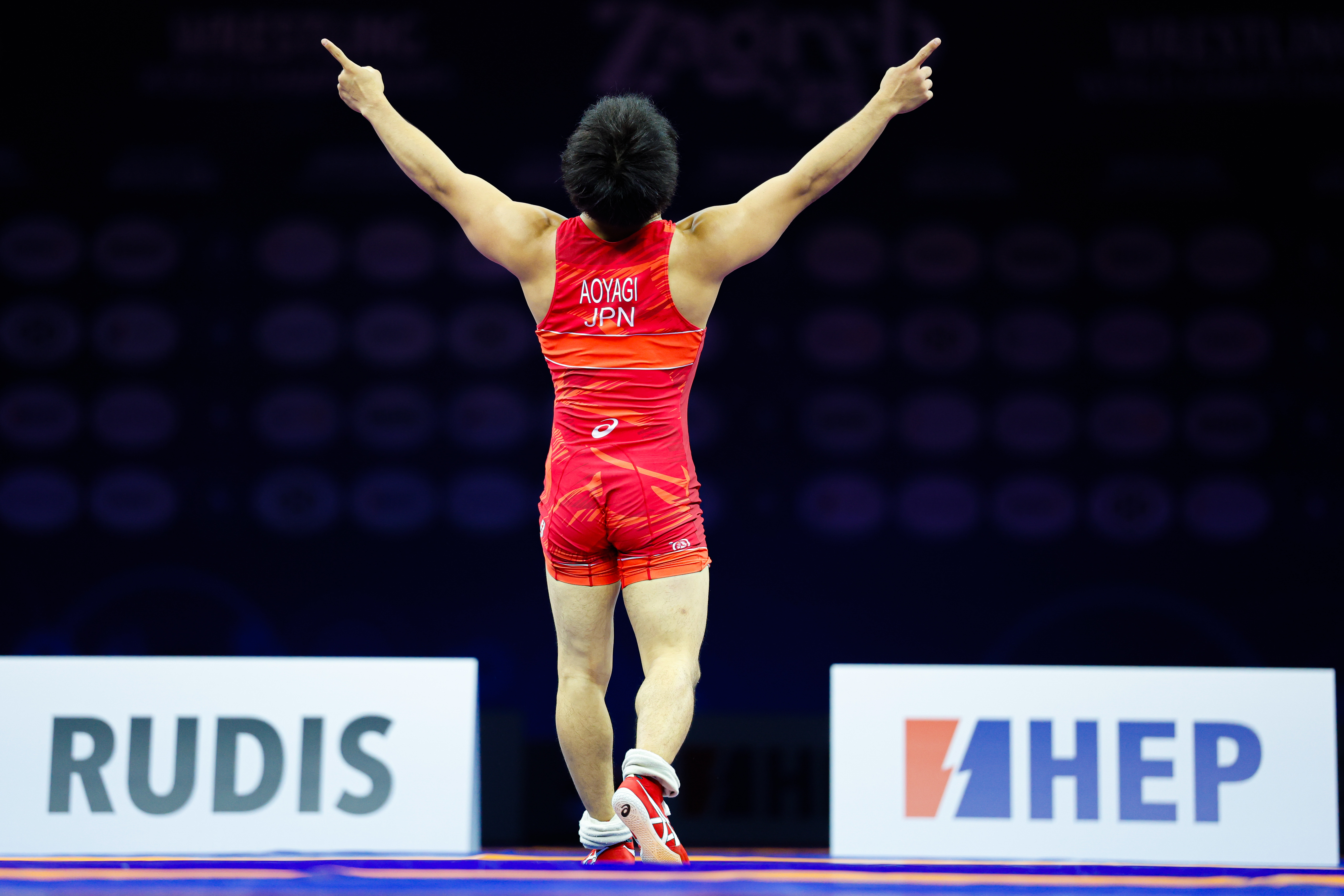 Yoshinosuke AOYAGI (JPN) celebrates after winning the 70kg final. (Photo: United World Wrestling / Kostadin Andonov)
Aoyagi also suffered a setback domestically in June, when he was beaten in the semifinals of the Meiji Cup All-Japan Invitational Championships, the second of two qualifiers for the World Championships. But he came back to earn his ticket to Zagreb by winning a playoff with the eventual champion.
"A little while ago, I lost at a Japan tournament, so right now I'm No. 3 in Japan," he said. "But I never give up in trying to win. I always fight only believing that I can win."
In Sunday's final, Aoyagi gave up an activity point -- the first and only point he surrendered all tournament -- but stuffed a half-hearted arm throw attempt by Tumur Ochir for a 2-point exposure.
In the second period, he was on the verge of giving up a stepout when he suddenly rose up, reversed their positions and gained the stepout himself, which was upheld on challenge to increase his lead to 4-1.
"I knew I had my knee down and it would be no point," said Aoyagi, who would add another stepout in the final seconds. "I was aware of going out, and the opponent pushed me up a bit.
"I didn't want to let the chance get away and I reversed our positions and scored a point. Even if it had been no points, it wouldn't have changed the flow of the match."
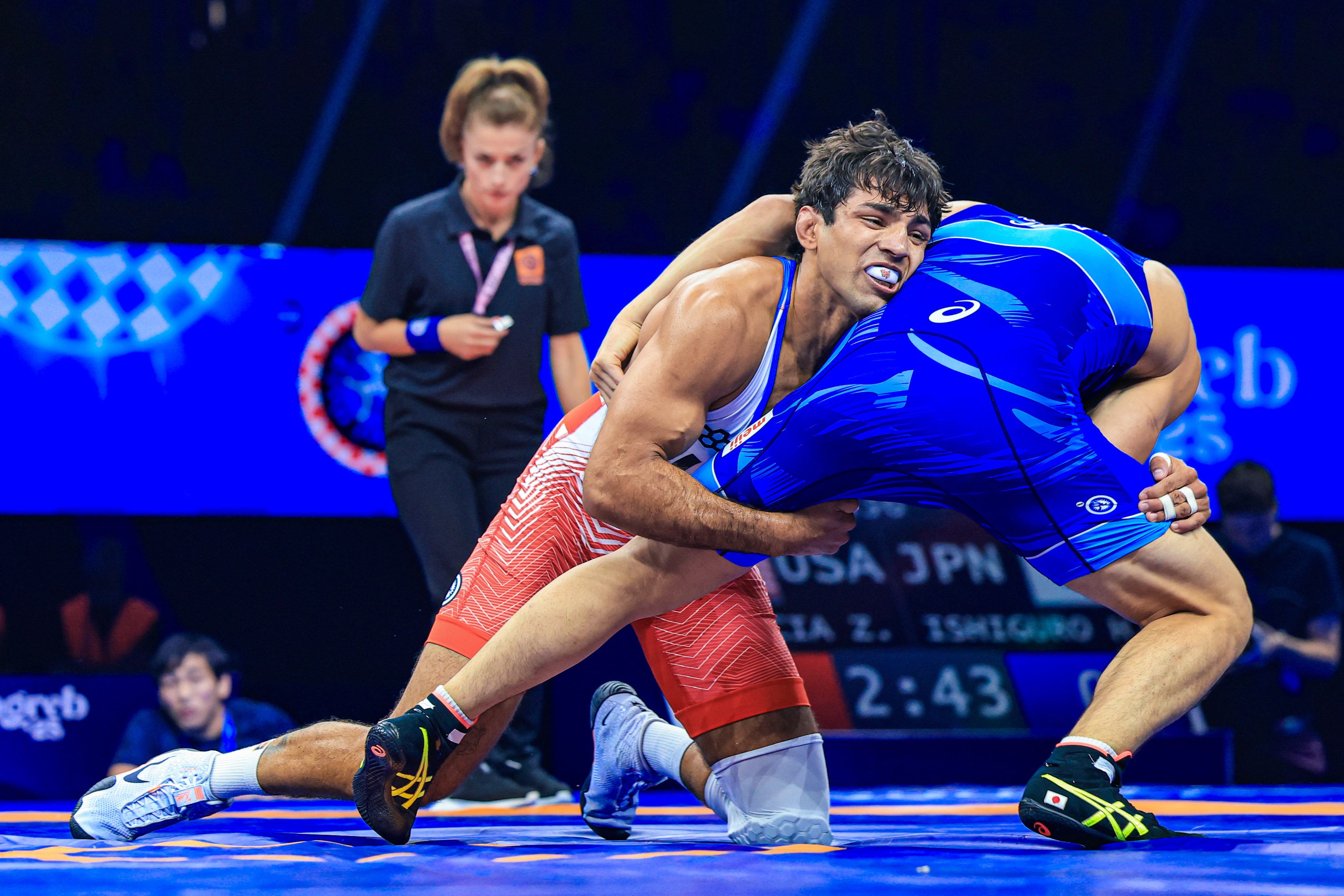 Zahid VALENCIA (USA) scores a takedown against Hayato ISHIGURO (JPN) in the 86kg final. (Photo: United World Wrestling / Amirreza Aliasgari)
At 86kg, Valencia denied Japan a second gold on the night when he overwhelmed 2023 Asian bronze medalist Hayato ISHIGURO (JPN) 12-0 to cap a successful drop from 92kg.
"I felt like I was always the best in the world," Valencia said. "I was confident in myself."
The 28-year-old Valencia, a 2023 world bronze medalist at 92kg, changed his own fortunes when, about a year ago, he decided to train with the Oklahoma State University group under the leadership of former star David TAYLOR (USA) -- a one-time nemesis of his.
"Being able to learn from someone like him, it's been amazing," Valencia said. "That's ultimately why I made the move. He's beat me so many times. I wanted to learn from him and get into his mindset of what it takes to become a world champion. I was able to do it and replicate it and bring home another one for our Team USA."
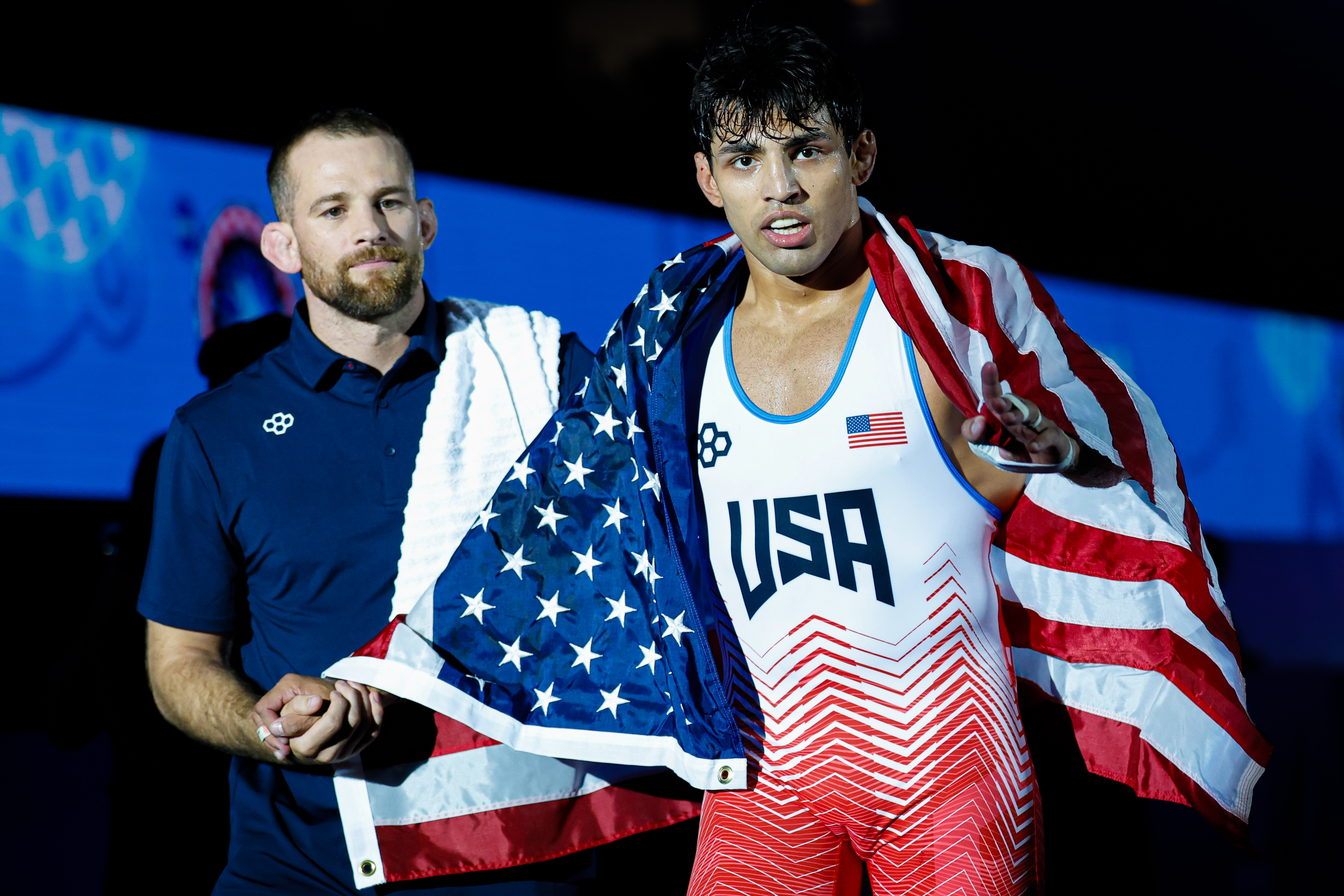 Zahid VALENCIA (USA), right, with coach David TAYLOR, after winning the 86kg final. (Photo: United World Wrestling / Kostadin Andonov)
Just to make Team USA was a challenge in itself. Valencia had to beat four-time world champion Kyle DAKE (USA) twice at the U.S. trials to earn his ticket to Zagreb. That in itself can be quite a confidence booster.
"If you make the team in the U.S., you're prepared to go be a world champ," he said. "So just go out there and let go of your fears and be courageous and let fly, go up there and score points and enjoy every moment and have fun with it."
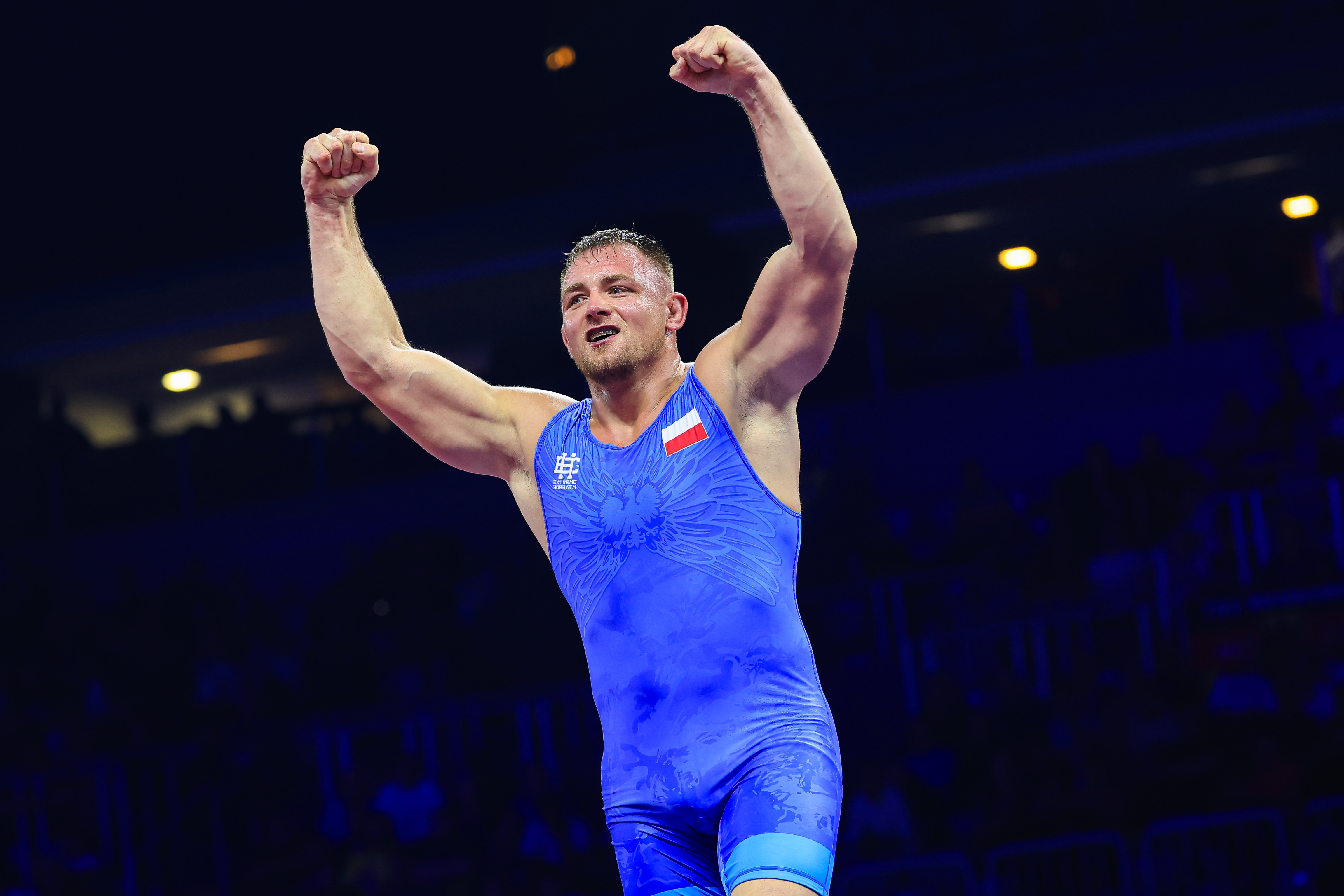 Robert BARAN (POL) celebrates after winning his bronze-medal bout at 125kg. (Photo: United World Wrestling / Kadir Caliskan)
Poland's Baran earns elusive world medal
Making his seventh trip to the World Championships, Robert BARAN (POL) finally made it onto the medal podium at age 34. And he says he wants to get come back for more.
Baran won a bronze at 125kg with a solid 5-0 victory over Vlagyiszlav BAJCAJEV (HUN), ending a run of futility that started in 2017.
"I feel very good, it is my long-awaited first [world] medal," Baran said. "I'm very happy, very pleased, and I hope that it is not the last medal."
Baran's previous best finish was a seventh place in Belgrade in 2023. He came close at last year's Paris Olympics, but lost in the bronze-medal match to Meshvildishvili.
On Sunday, he received an activity point in each period before scoring a stepout in the second to go ahead 3-0. He capped his win with a last-second 2-point exposure.
"During the match, I was feeling great," Baran said. "We worked on a plan with the coaches and I made it work 100 percent."
The other bronze at 125kg went to Shamil SHARIPOV (BRN), who caught Jonovan SMITH (PUR) with a 4-point counter that sent him to his back, then secured a fall in 4:08.
Meanwhile, Assylzhan YESSENGELDI (KAZ), a world medalist on the U23 and U20 levels, picked up his first one as a senior, but it didn't come easy nor without a bit of drama.
Yessengeldi emerged from a wild encounter with high school phenom Jax FORREST (USA) with a 10-8 victory in a bronze-medal match at 61kg that, for an agonizing moment, he had thought he had lost.
Yessengeli came back from a 8-3 deficit to go ahead 9-8 following a scramble that earned him four points. But with the seconds ticking away, he was suddenly flagged for grabbing the singlet, giving Forrest a point -- and the lead on criteria -- with :03 left. But on challenge, his despondence turned to joy when the penalty was overturned.
The other 61kg bronze went to Nuraddin NOVRUZOV (AZE), who put on a master class of counter wrestling to defeat Kum Hyok KIM (PRK) by fall with the last of three scoring moves.
After chalking up a pair of 2-point exposures off Kim's attacks, Novruzov countered him right to his back to secure the fall in 2:19 and gain the bronze medal that evaded him last year.
Akmataliev and Nurkosha KAIPANOV (KAZ) both added to burgeoning world medal collections by taking home the 70kg bronze medals.
Akmataliev went on a six-point run in the second period to finish up an 8-2 victory over Arman ANDREASYAN (ARM) and add to his world silver from 2021 and bronze from 2022.
Kaipanov, who came into Zagreb as the defending champion, also went on a second-period blitz, with his culminating in a 13-2 victory over Vasile DIACON (MDA) in 4:48. Kaipanov also has a silver from 2019.
At 86kg, Kamran GHASEMPOUR (IRI), a two-time world champion at 92kg, bounced back from a disappointing loss to Valencia in the semifinals by manhandling Mukul DAHIYA (IND) with a 10-0 technical fall in 3:33.
Arsenii DZHIOEV (AZE) gave Azerbaijan its second bronze of the night by handily defeating Rakhim MAGAMADOV (FRA) 7-0 in the other 86kg match.
READ THE DAY 2 SEMIFINALS REPORT HERE
RESULTS
Freestyle
57kg (31 entries)
SEMIFINAL: Chongsong HAN (PRK) df. Arsen HARUTYUNYAN (ARM) by Fall, 3:47 (4-1)
SEMIFINAL: Bekzat ALMAZ UULU (KGZ) df. Gulomjon ABDULLAEV (UZB), 8-0
61kg (26 entries)
GOLD: Zavur UGUEV (UWW) df. Ahmad JAVAN (IRI), 11-2
BRONZE: Assylzhan YESSENGELDI (KAZ) df. Jax FORREST (USA), 10-8
BRONZE: Nuraddin NOVRUZOV (AZE) df. Kum Hyok KIM (PRK) by Fall, 2:18 (6-0)
70kg (29 entries)
GOLD: Yoshinosuke AOYAGI (JPN) df. Tulga TUMUR OCHIR (MGL), 5-1
BRONZE: Ernazar AKMATALIEV (KGZ) df. Arman ANDREASYAN (ARM), 8-2
BRONZE: Nurkosha KAIPANOV (KAZ) df. Vasile DIACON (MDA) by TF, 13-2, 4:47
74kg (35 entries)
SEMIFINAL: Chermen VALIEV (ALB) df. Zaurbek SIDAKOV (UWW), 6-4
SEMIFINAL: Kota TAKAHASHI (JPN) df. Taimuraz SALKAZANOV (SVK), 6-4
79kg (27 entries)
SEMIFINAL: Georgios KOUGIOUMTSIDIS (GRE) df. Mohammad NOKHODI (IRI), 8-3
SEMIFINAL: Levi HAINES (USA) df. Suldkhuu OLONBAYAR (MGL), 4-1
86kg (29 entries)
GOLD: Zahid VALENCIA (USA) df. Hayato ISHIGURO (JPN) by TF, 12-0, 4:22
BRONZE: Kamran GHASEMPOUR (IRI) df. Mukul DAHIYA (IND) by TF, 10-0, 3:32
BRONZE: Arsenii DZHIOEV (AZE) df. Rakhim MAGAMADOV (FRA), 7-0
92kg (26 entries)
SEMIFINAL: Trent HIDLAY (USA) df. Osman NURMAGOMEDOV (AZE) by TF, 15-4, 6:00
SEMIFINAL: Amanula GADZHIMAGOMEDOV (UWW) df. Amirhossein FIROUZPOUR (IRI), 11-6
125kg (27 entries)
GOLD: Amir Hossein ZARE (IRI) df. Giorgi MESHVILDISHVILI (AZE), 5-0
BRONZE: Robert BARAN (POL) df. Vlagyiszlav BAJCAJEV (HUN), 5-0
BRONZE: Shamil SHARIPOV (BRN) df. Jonovan SMITH (PUR) by Fall, 4:07 (5-0)



Share your thoughts.
Comments