

Algeria sweeps African Beach Wrestling Championships
Saturday, September 13, 2025 - 12:23 By United World Wrestling Press
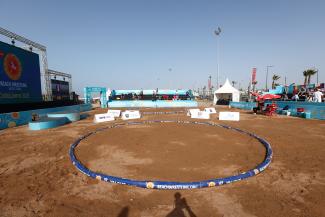
CASABLANCA, Morocco (September 12) -- Rising African heavyweight prodigies, Skander BENMOHAMED (ALG) and Billel BALI (ALG) guided Algeria to the team title of the U17 African Beach Wrestling Championship.
Algeria also bagged the women’s team title, led by a dominating double gold display by Meriem Safiya GRIB (ALG), thus completing a stellar show at the continental competition held in Casablanca, Morocco, on September 4 and 5.
The serene Ain Diab beach, with its gleaming sands and turquoise waters, hosted the best U15, U17, and U20 African talents for the two-day competition. The age-group tournaments were held before the Beach Wrestling World Series event, which was held for the first time in an African city, underlining United World Wrestling’s commitment to increasing the sport’s presence in Africa.
Over the two days of action, wrestling aficionados got a glimpse of some of the best talent from the continent. For many, this was also a build-up to the Dakar Youth Olympic Games, which are less than 500 days away.
From an African point of view, Algeria set an early marker. With two gold medals in the men’s events, in the 80 and 90 kg, and one in the women’s section, the country’s wrestlers dominated the proceedings and finished on top of the overall team rankings in the U17 age group.
Benmohamed, who won the U17 African Championships bronze medals earlier this year in mat wrestling, reigned supreme in the 90kg category.
In his first bout, the 17-year-old edged out Aboubacar Demba CAMARA (GUI) in a close affair before coming into his own and stamping his authority over Ali OUIDAD (MAR) 3-0 and Rihan BRITS (RSA) 3-0 to finish on top of the four-man round-robin draw. With three wins out of three, Benmohamed finished ahead of Ouidad to win the gold medal.
Benmohamed completed a super double by winning the gold medal in the U20 category as well. The Algerian defeated Lahcen AIT ELASRI (MAR) and Mohamed Amine EL MEKKAOUI (MAR) for a double podium finish.
Bali had a chance to follow in the footsteps of his compatriot. In the U17 80kg, Bali blanked Fahd RAZKANE (MAR) for a win by superiority in less than a minute-and-a-half to win the gold medal. However, in the U20 event, he could win just once and finished fourth in the five-man field.
Elbara BENAMMAR (ALG) added a third medal to Algeria's kitty in the men’s U17 category by winning the bronze in the 60kg category. Benammar began strongly by defeating Ernest DIATTA (SEN) and David Kanyimbu Mputu De DEUS (ANG) on technical superiority. However, he lost to Dan KEGODE (KEN) in the third round and then went down once again to Ibrahim DOSSO (CIV) in the semifinals.
Benammar shrugged off the disappointments to finish his campaign with another win by superiority over Hatim RAJAY (MAR) to take home the bronze medal.
With that, Algeria finished with a total of 77 points, ahead of second-placed Morocco (62) and Angola (35), who finished third.
In the women’s U17 category, Grib won both her bouts without conceding a point to reign supreme in the 45kg weight class. Grib defeated Islam BENZBIRIA (MAR) 3-0 in the first round and then got the better of Tahirisoa Tinah ANDRIANAMBININA (MAD) by a similar margin.
Like Benmohamed, Grib too won two titles as she claimed the gold in the U15 category as well, conceding just one point in the three wins.
Algeria came close to a second women’s gold medal in the U17 category but Dounia ZITOUNI was beaten by Hajar KANEB (MAR) 4-2 in the 55kg final. Zitouni won the gold medal in style, after she remained undefeated throughout the competition.
Jemimah Maghumicha WANJALA (KEN) won the 65kg gold medal without conceding a single point. In the final, which lasted less than a minute, Wanjala beat Malak Khaled Fahmy Abdelhamid ABDELGAUL (EGY) on technical superiority, just like her two wins en route to the title clash.
The gold medal in the 75kg category went to Khady Diandy BADJI (SEN), with Dune van ZYL (RSA) taking the silver while Malak SABRY (MAR) won the bronze.
Algeria were close to a gold medal clean sweep in the U20 category. They won gold medals in three out of the four weight categories in the men’s competition to win the team title. But Omar LAMBARRAA (MAR) halted their juggernaut by winning the 80kg title ahead of Bakary SOM (CIV) and Ivan LOUW (RSA).
While Bali could not finish among the medals in U20, his compatriots looked in sublime form.
Watik Aymen TITOUS (ALG) defeated Luvaan LOUW (RSA) 3-1 in the final of the 70kg category to finish on the top of the podium. Titous was largely untested throughout the competition, beating Eugine Osale OMULULE (KEN) and Saad MARIRE (MAR) without conceding a point to storm into the semifinals, where he defeated Nathan Lee STOLTZ (RSA) by technical superiority.
In the +90kg category, Noureddine BOUROUFA (ALG) won two bouts out of two without conceding a point to take home the gold medal ahead of Ruan BRITS (RSA) and Ayoub BELGADI (MAR).
In the women’s event, Kenyan wrestlers were dominant, winning two out of the three gold medals on offer. Ivyone Lusike MASIBO (KEN) reigned supreme in the 60kg class, defeating Fatima Zahra BOUCHIBI (ALG) and Hiba KABIL (MAR) to finish on top in a tough four-wrestler field. At 70kg, Faith Nanjala WAMALWA (KEN) defeated Dyvonter Ashly ODONGO (KEN) in an all-Kenyan affair to win the gold medal.
Yasmine BOUREGBA (ALG) won the title in the +70kg category, defeating Hafsa ECH CHABBI by technical superiority.
Algerian women and men, meanwhile, won two gold medals each as they won the team titles in the U15 sections to extend their dominance on the beach.
Younes MOUSSI (ALG) set the ball rolling by finishing on top in the 50kg category, winning both his bouts in dominating fashion. Later, Houdaifa BARKAT (ALG) defeated Mignane NDONG (SEN) to win the 55kg gold medal.
Senegalese beach wrestlers showed spunk after Mbaye NIANG and Ibrahima SARR picked up the 60kg and 75kg titles, with Michael OOSTHUIZEN (RSA) rallying to the top of the podium in 65kg.
Senegal won two more gold medals in the women’s section. Fatou Bintou COLY (SEN) ensured Algeria did not complete a golden hat-trick as she defeated Soudjoud BOULEBDA (ALG) in a crucial third-round bout to win the gold medal. Both wrestlers had won their opening two matches. In the winner-takes-all Round 3, Coly beat her Algerian rival on superiority for the title. Similarly, Elisabeth DIATTA beat Tasnim CHOUIHI (ALG) to win the 60kg gold medal.
Algerian wrestlers, meanwhile, won the two lightest weight categories. While Grib opened Algeria’s account with the 45kg gold medal, Maram Yamna BOUKHIBAR (ALG) finished ahead of Shalying JOY (KEN) and Ndeye Codou SENGHOR (SEN) to win the 50kg title.
Kenya’s Janet Inwesi OMUMASABA won the 65 kg gold, beating Higidia Januario De Gouveia LEITE (ANG) by technical superiority.
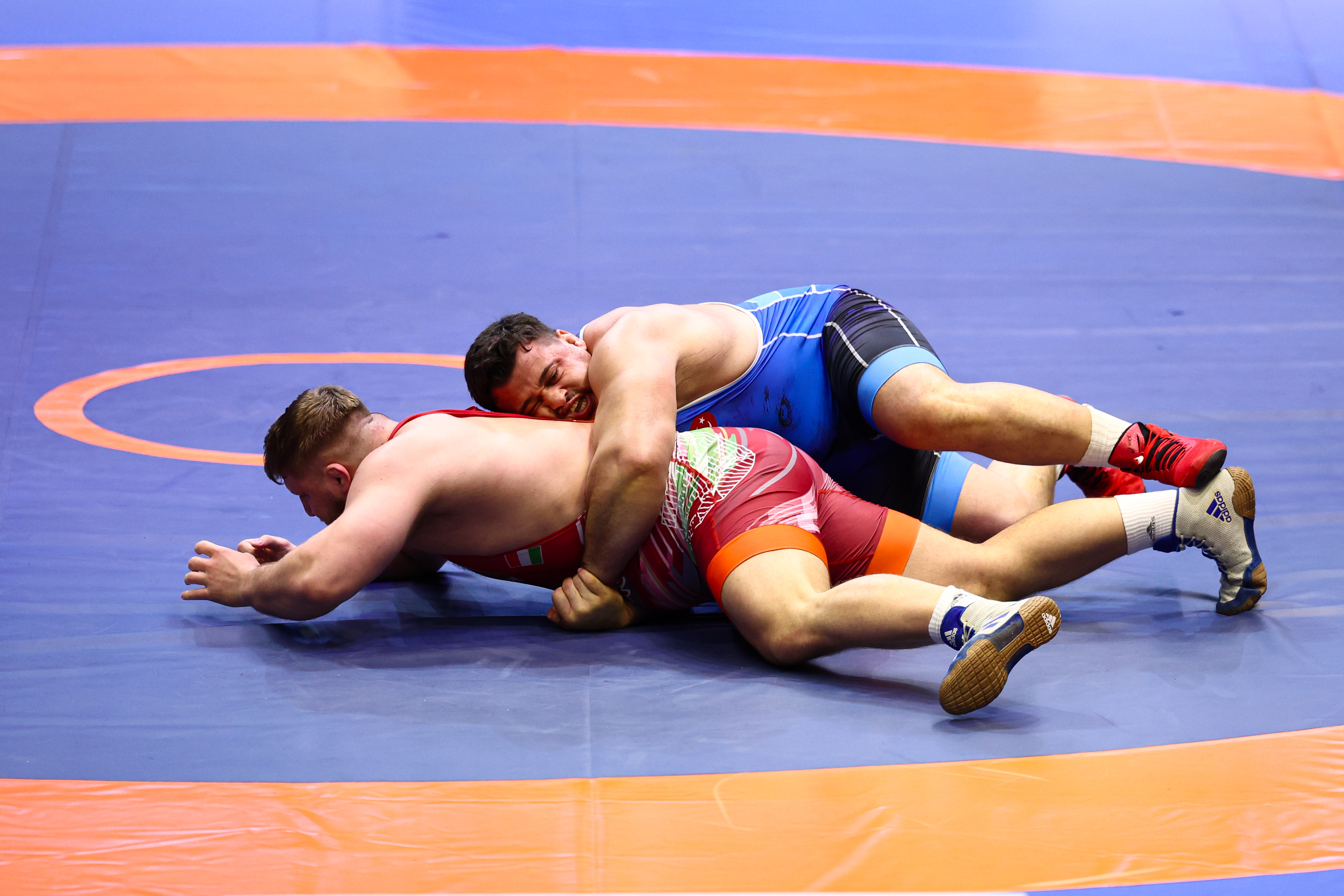 Riza KAYAALP (TUR) turns Darius VITEK (HUN) in the 130kg final. (Photo: United World Wrestling / Kadir Caliskan)
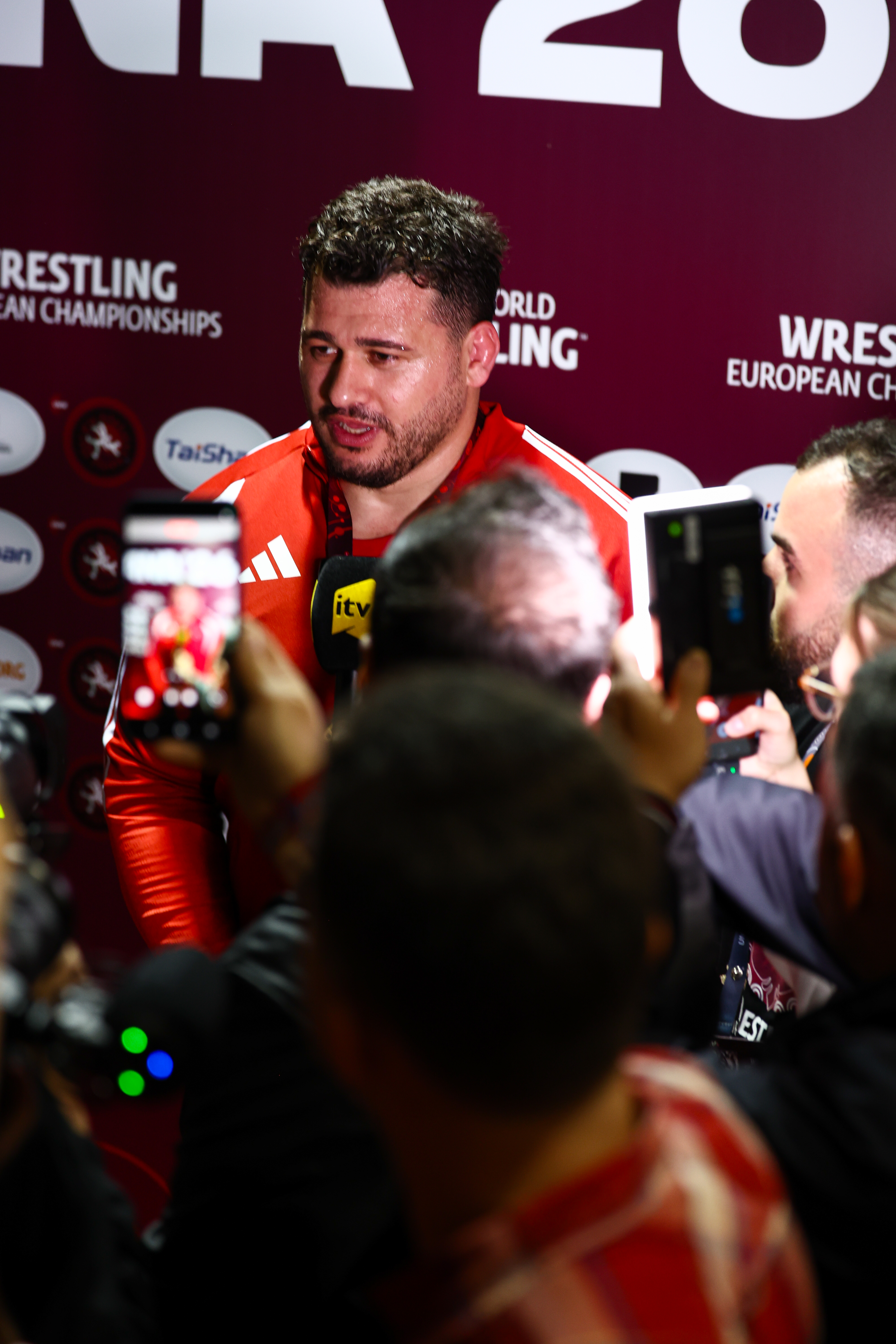 Riza KAYAALP (TUR) speaks to the media after winning the gold medal at the European Championships. (United World Wrestling / Jake Kirkman)
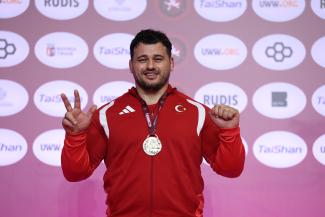
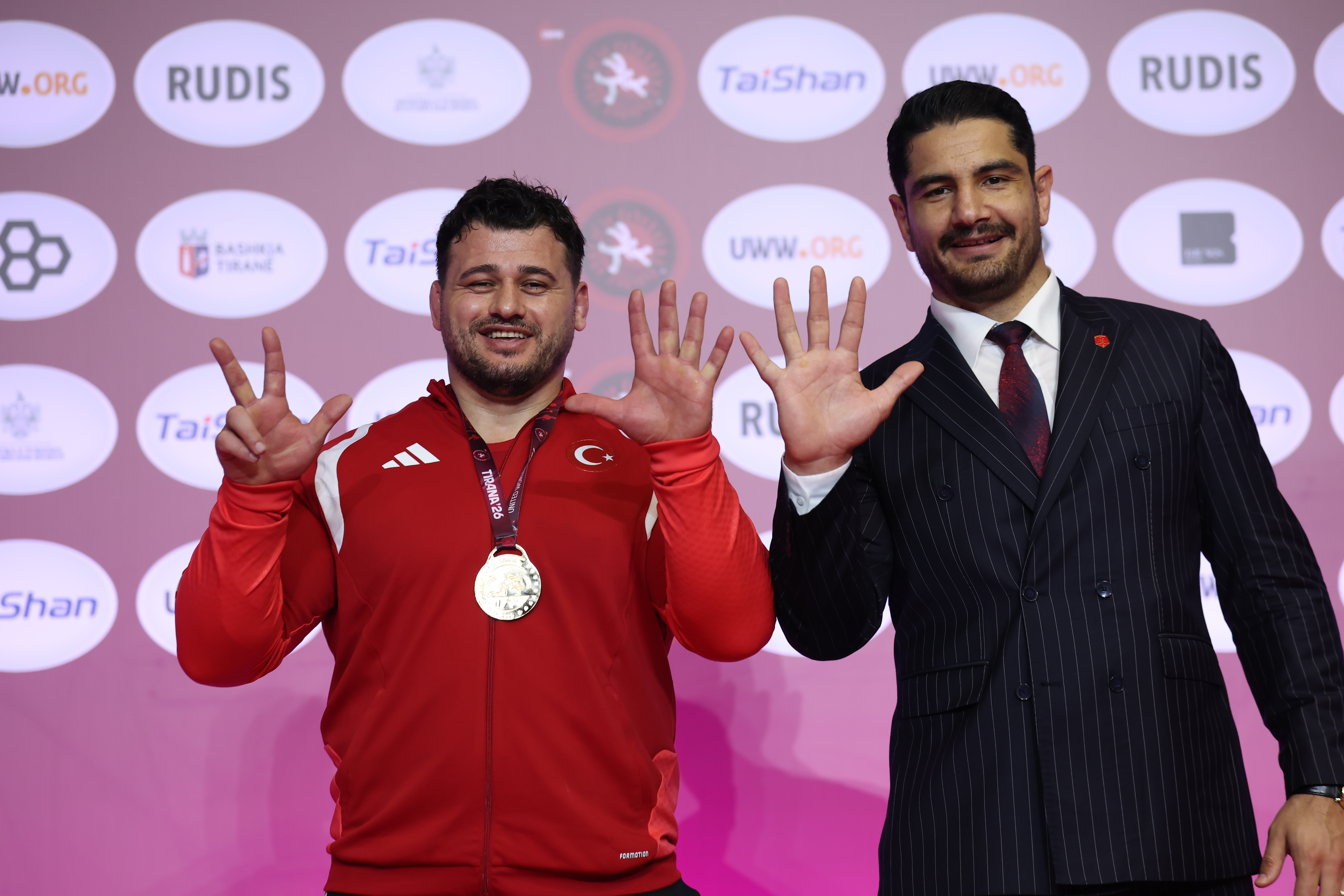 Riza KAYAALP (TUR) with Taha AKGUL (TUR) at the medal ceremony in Tirana. (Photo: United World Wrestling / Kadir Caliskan)
Share your thoughts.
Comments