SAMOKOV, Bulgaria (August 21) -- Two-time World U20 silver medalist Audrey JIMENEZ (USA) earned herself a chance to finally win the gold medal as she reached the final for the third time at 50kg in Samokov on Thursday.
The U.S. wrestler scored three technical superiority wins in three bouts to reach the final in which she will take on 2023 world U17 champion Rinka OGAWA (JPN) also looks in good form.
In the semifinals, Jimenez used her leg-lace to good effect and humbled Diana RYSOVA (UKR), 14-3. Ogawa also used the leg-lace to beat SHRUTI (IND), 10-0.
Jimenez had reached the final in 2022 but lost to Umi ITO (JPN) and then in 2023, she lost to Yanrong LI (CHN) to finish with a silver medal. She also has a silver medal from World U23 Championships after dropping the final against Ito again.
Japan got its second finalist on Thursday when Natsumi MASUDA (JPN) pinned Abigale COOPER (USA) after building a 9-0 lead. She will now wrestle for gold against European U20 champion Anastasiia POLSKA (UKR) who leg-laced SAARIKA (IND) for a 10-0 win.
At 72kg, Asian U20 champion and world U17 silver medalist this year KAJAL (IND) stunned defending champion Jasmine ROBINSON (USA) in a wild semifinal. Robinson got the first takedown and exposure for a 4-0 lead. But Kajal scored a takedown and turned Robinson in the same sequence. The U.S. challenged the second turn but it was given two points as Kajal took a 5-4 lead.
There was no turning back for the Indian from that as she scored two four-point throws and two takedowns in her 13-6 win over Robinson.
Kajal now chance the challenge of returning silver medalist Yuqi LIU (CHN) who dominated her semifinal against Haticenur SARI (TUR) and won 13-2. Liu will look to her upgrade silver from last year to gold.
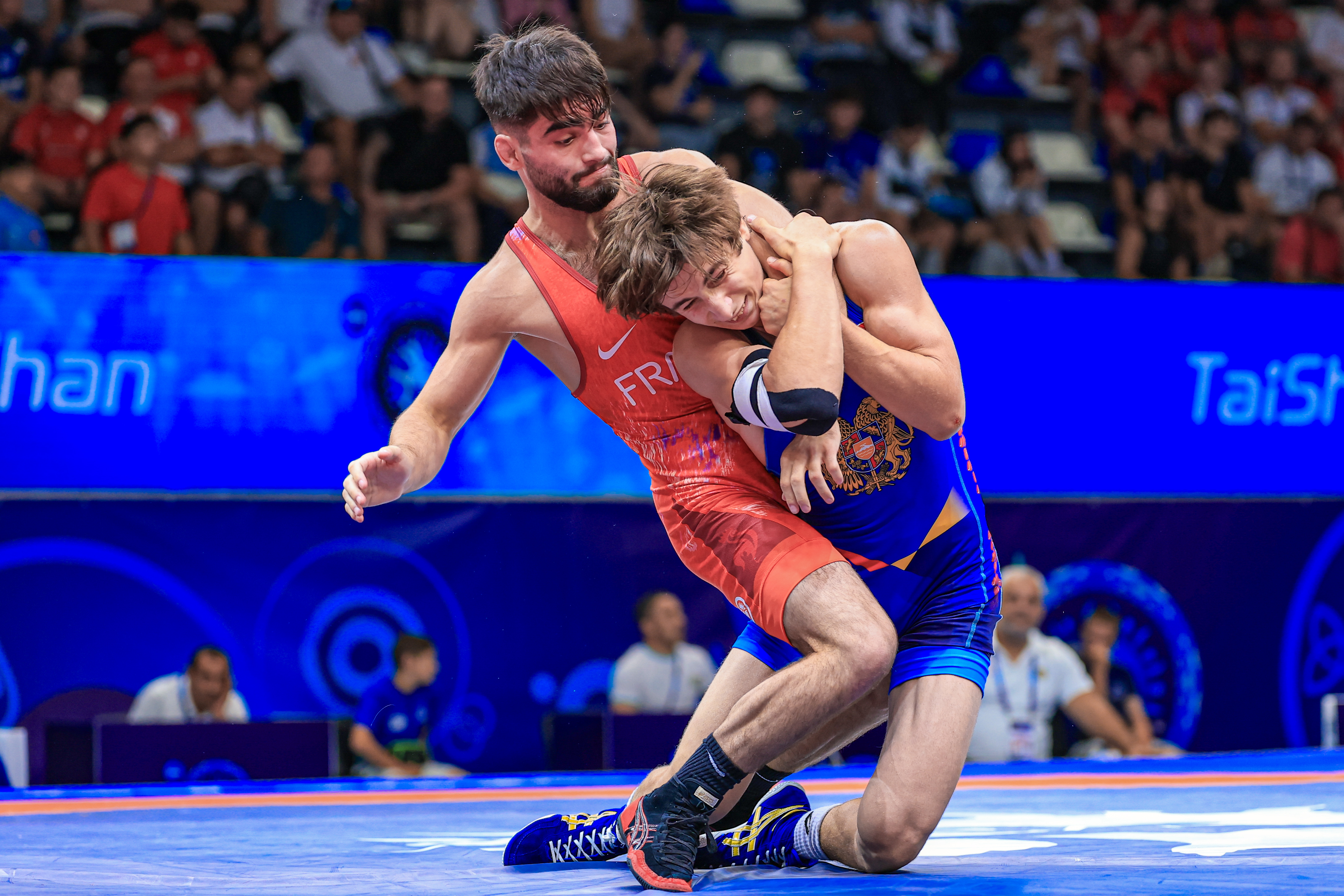 Yurik MKHITARYAN (ARM) reached the 60kg final. (Photo: United World Wrestling / Amirreza Aliasgari)
Greco-Roman action also began at the World U20 Championships Samokov on Thursday with two weight classes -- 60kg and 82kg.
Two 18-year-olds reached the 60kg final in Greco-Roman as European U20 champion Aykhan JAVADOV (AZE) and Yurik MKHITARYAN (ARM) won their respective semifinals in dominant fashion.
Javadov was wrestling senior European bronze medalist Vakhtang LOLUA (GEO) and scored a headlock for four and kept Lolua on the mat for a fall. This was Javadov's third win over Lolua in four encounters.
The 2024 world U17 champion will now face Mkhitaryan who gut-wrenched SURAJ (IND) after a headlock throw for four and win 8-0. India challenged the decision but lost it to add one more point to his score.
At 82kg, a potential rematch from 2023 World U17 Championships final was denied after Taizo YOSHIDA (JPN) lost his semifinal at 82kg to Asian U20 champion Dias SEITKALIYEV (KAZ).
Yoshida, a returning bronze medalist, was put in par terre in the first period and Seitkaliyev hit suplex for four before turning Yoshida twice to win 9-0.
In the other semifinal, European U20 champion Mikhail SHKARIN (UWW) blanked Martik PETROSYAN (ARM), 9-0. Shkarin had lost to Yoshida in Istanbul and finished with a silver medal.
RESULTS
Women's Wrestling
50kg
GOLD: Audrey JIMENEZ (USA) vs. Rinka OGAWA (JPN)
SF 1: Audrey JIMENEZ (USA) df. Diana RYSOVA (UKR), 14-3
SF 2: Rinka OGAWA (JPN) df. SHRUTI (IND), 10-0
53kg
GOLD: Natsumi MASUDA (JPN) vs. Anastasiia POLSKA (UKR)
SF 1: Anastasiia POLSKA (UKR) df. SAARIKA (IND), 10-0
SF 2: Natsumi MASUDA (JPN) df. Abigale COOPER (USA), via fall
72kg
GOLD: Yuqi LIU (CHN) vs. KAJAL (IND)
SF 1: Yuqi LIU (CHN) df. Haticenur SARI (TUR), 13-2
SF 2: KAJAL (IND) df. Jasmine ROBINSON (USA), 13-6
Greco-Roman
60kg
GOLD: Aykhan JAVADOV (AZE) vs. Yurik MKHITARYAN (ARM)
SF 1: Aykhan JAVADOV (AZE) df. Vakhtang LOLUA (GEO), via fall
SF 2: Yurik MKHITARYAN (ARM) df. SURAJ (IND), 9-0
82kg
GOLD: Mikhail SHKARIN (UWW) vs. Dias SEITKALIYEV (KAZ)
SF 1: Dias SEITKALIYEV (KAZ) df. Taizo YOSHIDA (JPN), 9-0
SF 2: Mikhail SHKARIN (UWW) df. Martik PETROSYAN (ARM), 9-0


Share your thoughts.
Comments