

UWW partners with Shigakkan University to expand global wrestling training opportunities
Wednesday, April 16, 2025 - 11:59 By United World Wrestling Press

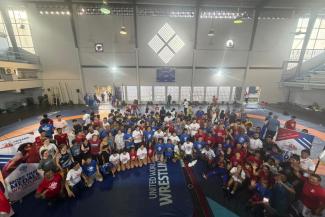
CORSIER-SUR-VEVEY, Switzerland (April 16) – In a significant step towards enhancing training opportunities for athletes, coaches, and the global wrestling community, United World Wrestling has formed a strategic partnership with Shigakkan University, Japan.
Recognized as a pioneering institution in wrestling education, Shigakkan University has been home to many legendary Japanese wrestlers and has played a crucial role in the sport’s development.
The predecessor school of the university was founded in 1905, and its legacy in wrestling education traces back to Chukyo Women’s University Wrestling Club, established in 1989.
Over the years, the institution became highly regarded in the field of physical education, producing numerous Olympic medallists and world-class wrestlers. In 2010, the university was renamed Shigakkan University, opening its door as coeducational institution while continuing their mission of excellence in sports education.
At the heart of Shigakkan University’s philosophy is the principle of “Capacity Building”, which focuses on five key pillars:
- Wellness – Promoting physical and mental well-being
- Intellectual Insight – Encouraging academic excellence and innovation
- Social Ability – Fostering teamwork and communication skills
- Self-Development – Encouraging continuous personal growth
- Effective Citizenship – Cultivating leadership and global engagement
UWW President Nenad LALOVIC expressed his enthusiasm for the partnership, stating: “We are thrilled about this new collaboration with Shigakkan University, a prestigious institution recognized as the school of Japanese wrestling and highly respected within the global wrestling community. We are eager and excited to work with our colleagues at SUJ to contribute to the continued development of women’s wrestling worldwide.”
As part of this partnership, the UWW Development Department and Shigakkan University will work together to implement a range of high-impact initiatives, including:
- Training camps for selected elite wrestlers, providing them with advanced technical, tactical, and physical preparation.
- Education courses for wrestling coaches, aimed at equipping them with the latest coaching methodologies and sports science knowledge.
- Knowledge-sharing activities, such as seminars, educational sessions, and coach exchanges, to promote continuous learning and best practices within the wrestling community.
These initiatives will play a vital role in strengthening world-class athlete preparation systems, supporting referees and coaches, and ensuring experience-sharing, particularly in the advancement of women’s wrestling.
Through this collaboration, UWW and Shigakkan University aim to elevate the sport by fostering international cooperation, enhancing training standards, and nurturing the next generation of wrestling champions.
Share your thoughts.
Comments